
Cell Membrane
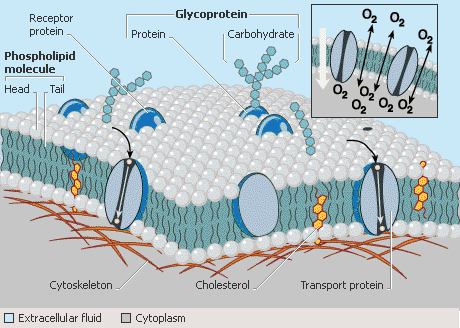
The disorder would always be inherited from the mother because the mother’s mitochondrial gene is the only one that survives when the zygote is formed. The gamete from the mother contains all the information. The head of the father’s sperm is the only part that survives during fertilization. The tail of the sperm containing the male’s mitochondria (an their genes) is lost when the zygote begins development. Thus it is only from the mother that the disorder can be inherited.
Science News: Aug. 5 • Vol. 148, No. 6
| Cell Cycle & Division All Materials © Cmassengale |
 |
Cell Division:
Reasons for Cell Division:
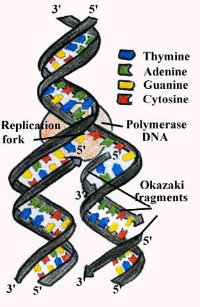
Copying DNA:
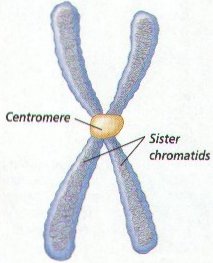
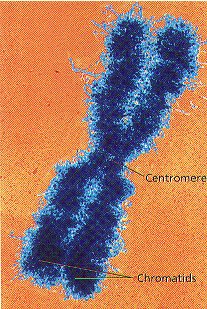
Chromosomes & Their Structure:
Chromosome Numbers:
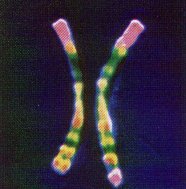
Homologs
| Organism | Chromosome Number (2n) |
| Human | 46 |
| Fruit fly | 8 |
| Lettuce | 14 |
| Goldfish | 94 |

Human Male Karyotype
Genes:
Cell Cycle:

Interphase:
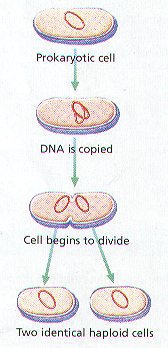
Cell division in Prokaryotes:
Cell Division in Eukaryotes:
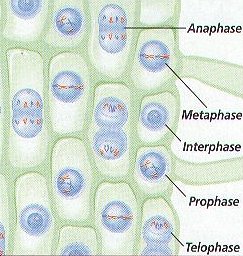
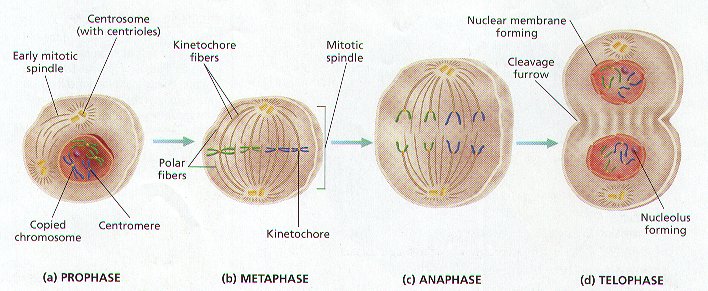
Stages of Mitosis:
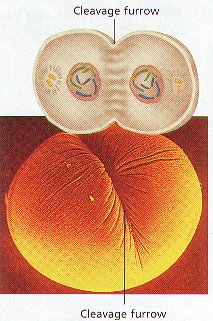
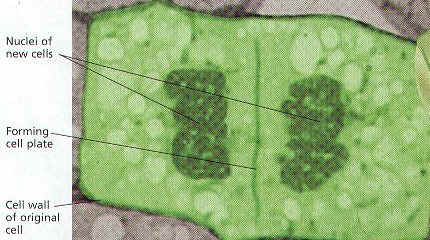
Cytokinesis:
Summary of Mitosis:
 |
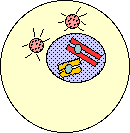 |
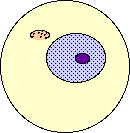
| Interphase
|
Early Prophase
|
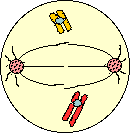 |
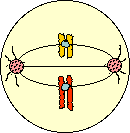 |
Late Prophase
|
Metaphase
|
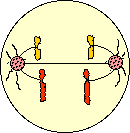 |
 |
Anaphase
|
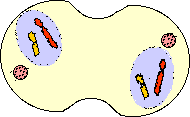
Telophase/Cytokinesis
|
Cancer is Uncontrolled Mitosis:
Meiosis & Sexual Reproduction
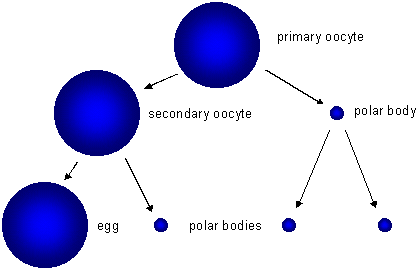
Oogenesis
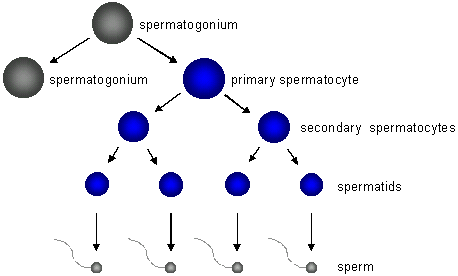
Spermatogenesis
Meiosis I:


Asexual & Sexual reproduction:

Enzyme Rate of Reaction for Catalase |
Introduction:
Life would not be possible without chemical reactions. Chemical reactions are responsible for speeding up the process. A chemical reaction is the process of breaking chemical bonds, forming new bonds or both. The four things that can speed up a chemical reaction is heat, increasing the concentration of reactants, decreasing the concentration of products, and enzymes. Enzyme is a catalase, most the time a protein. Enzymes can control the rate of a reaction, and they also lower activation energy. Enzymes are important in regulating chemical pathways, synthesizing materials needed by cells, releasing energy, and transferring information. Enzymes are involved in digestion, respiration, vision, movement, and thought. There are several things that can affect the function of enzymes like temperature, the pH, and the amount of reactant or product. Simple cells may have as many as 2000 different enzymes, each one catalyzing a different reaction. In this particular lab, your hands act as the enzyme “Catalase”. This enzyme, which is found in your cells, splits hydrogen peroxide, a byproduct made by your cells during cellular respiration, into water and oxygen.
Hypothesis:
If time is increased, then more hydrogen peroxide molecules will be split into water and oxygen
Materials:
The materials used in this lab were pencils, scissors, envelope, 100 paper hydrogen peroxide molecules, and a watch with a second hand so that a person would be able to keep time for the person tearing the strips.
Methods:
Take a paper template and cut out 100 hydrogen peroxide molecules. Place the cut out pieces into an envelope. Then have a person act as a catalase and take one piece of the paper molecules out of the envelope at a time and rip it in two and place the pieces back into the envelope. Have a person hold the envelope person, while another student keeps track of the “tearing” time intervals (10, 20, 30 ,60, and 60 seconds). Count how many molecules are ripped at the end of each time interval and record this number in your data table. When all time intervals and counts are completed, use the formula below to figure the reaction rate for catalase. Record this rate in your data table.
M2 – M1 = reaction rate
T2 – T1
Results:
|
Time in seconds |
Ripped Hydrogen Peroxide Molecules |
Rate of reaction |
|
0-10 |
3 | .3 |
|
10-30 |
10 | .35 |
|
30-60 |
24 | .47 |
|
60-120 |
63 | .65 |
|
120-180 |
124 | 1.02 |
1. What is an enzyme? What are its functions in living things?
Enzymes are proteins in living systems. Enzymes can control the rate of a reaction, and they lower activation energy.
2. Name several things things that can affect the function of an enzyme?
Temperature, the amount of reactant or product and the pH.
3. Write the chemical equation for the breakdown of hydrogen peroxide by the enzyme catalase.
hydrogen peroxide + catalase yields water + oxygen
4. An enzyme’s efficiency increases with greater substrate concentration, but only up to a point. Why?
all of the active sites of the enzymes become filled with hydrogen peroxide molecules
5. If you were allowed to continue this lab and rip hydrogen peroxide molecules for 240 and 300 seconds. What would happen to the rate of reaction and why would this happen?
It would increase.
6. What can you say about the length of time and the rate of the reaction?
The less time, the more the reaction rate is lowered, and the more time, the more the reaction rate is higher.
7. What would happen to the rate of reaction if you remove the water and oxygen molecules as soon as they are produced?
It would be faster.
Error Analysis:
All pieces must be returned to the envelope each time interval to correctly simulate what occurs within a cell.
Discussion and Conclusion:
As the time intervals increased, the reaction rate of catalase increased also. In a living cell, more hydrogen peroxide would be broken down by catalase over a longer period of time.
| Enzyme Rate of Reaction for Catalase |  |
Introduction:
Enzymes are an important part of life that regulate chemical reactions with in the body. Enzymes speed up chemical reactions in four different ways, one way is heat, another is increasing the rate of reactants, the third way is decreasing the amount of products and the fourth way is enzymes, which speed up reaction without themselves being used up. Enzymes are also involved in digestion, respiration, reproduction, vision, movement, thought, and also in the productions of other enzymes. Simple cells may have as many as 2000 enzymes with each one catalyzing a different reaction. An enzyme can speed up a reaction making it 10, 000,000,000 times faster. An enzyme is a catalyst. A catalyst is a chemical that reduces the amount of activation interim needed for a reaction. Without enzymes a reaction would take much longer than if it had and enzyme. Enzymes also the control the rate and direction of the reaction.
Without catalysts chemical reactions would take much longer that the average human life expectancy. So that would mean that in 76 years only a couple chemical reactions would take place. Since our bodies have enzymes though hundreds of chemical reactions a day. If our bodies didn’t have catalysts our bodily cells couldn’t function. Some bacteria, however, possess a defense mechanism which can minimize the harm done by the two compounds. These resistant bacteria use two enzymes to catalyze the conversion of hydrogen peroxide back into diatomic oxygen and water. One of these enzymes is catalase and its presence can be detected by a simple test. The catalase test involves adding hydrogen peroxide to a cultures sample or an agar slant.

Hypothesis:
The reaction rate of catalase splitting hydrogen peroxide into water and oxygen will increase over time.
Materials:
The materials used consisted of 100 paper H2O2 molecules, a data table, paper, pencil, calculator, scissors, watch with a second hand, and an enzyme rate of reaction catalase worksheet.
Methods:
Cut out 100 hydrogen peroxide paper molecules. Double check to make sure there are only 100 paper molecules and place them in an envelope. Then one person will keep track of the time while another person acts as a catalase and tears the paper hydrogen peroxide molecules in half. The torn paper molecules should be returned to the envelope each time. Another person times the person acting as the catalase. The time intervals in which the paper molecules are to be ripped are 10 seconds, 20 seconds, 30 seconds, and two different 60second periods of time. The results should be recorded in a data table. The reaction rate for catalase is figured using the formula:
M2 – M1 = Reaction Rate
T2 – T1
Results:
| Time in Seconds | Ripped H2O2 Molecules | Rate of Reaction |
| 0-10 | 5 | .5 |
| 10-30 | 13 | .4 |
| 30-60 | 31 | .6 |
| 60-120 | 61 | .5 |
| 120-180 | 91 | .5 |
1. What is an enzyme? What are its functions in living things?
chemicals that reduce the amount of activation energy needed for reactions to occur; they are proteins in cells that control metabolic reactions
2. Name several things that can affect the functioning of an enzyme.
temperature, pH, and the amount of reactant or product
3. Write the chemical equation for the breakdown of hydrogen peroxide by the enzyme catalase.
H2O2 + Catalase –> H2O + O2
4. An enzyme’s efficiency increases with greater substrate concentration, but only up to a point. Why?
once all active sites are filled, the enzyme’s reaction rate won’t continue increasing
5. If you were allowed to continue this lab and rip hydrogen peroxide molecules for 240 and 300 seconds, what would happen to the reaction rate and why would this happen?
there would be more molecules ripped because of the increased amount of time
6. What can you say about the length of time and the reaction rate?
The more time available, the faster the reaction will occur.
7. What would happen to the reaction rate if you removed the water and oxygen molecules as soon as they were produced?
The rate of reaction would go even faster
Error Analysis:
The counting of the time may have been off a couple of seconds.
Discussion and Conclusion:
The data shows that the more time there is, the more hydrogen peroxide molecules will be ripped. The catalase in the lab ripped about 6 molecules every 5 seconds. The same thing occurs in a cell as more hydrogen peroxide is produced, catalase speeds up breaking down this waste into water and oxygen.