BIOLOGY SAFETY CONTRACT

BIOLOGY SAFETY CONTRACT

I, ____________________________ have read the safety rules for the biology classroom and lab and agree to follow all of the safety rules set forth in this contract.  I realize that I must obey these rules to ensure my own safety, and that of my fellow students and instructors.  I will cooperate to the fullest extent with my instructor and fellow students to maintain a safe lab environment.  I will also closely follow the oral and written instructions provided by the instructor.  I am aware that any violation of this safety contract that results in unsafe conduct in the laboratory or misbehavior on my part, may result in being removed from the laboratory, detention, receiving a failing grade, and/or dismissal from the course.

 *Failure to have goggles at the beginning of any lab involving heat, chemicals or glassware (except microscopy) will result in removal from the room and a grade of “0” for the lab.  The removal is required by the State of Arkansas.

I do/do not wear contact lenses.

I do/do not have a medical condition that could result in the need for emergency medical attention (explain here if you do).

Signed (student) _________________________________________Date ___________

_______________________________________________________________________________

Dear Parent or Guardian:

We feel that you should be informed regarding the school’s effort to create and maintain a safe science classroom/laboratory environment.  With the cooperation of the instructors, parents, and students, a safety instruction program can eliminate, prevent, and correct possible hazards.

You should be aware of the safety instructions your son/daughter will receive before engaging in any laboratory work.  Please read the list of safety rules above.  No student will be permitted to perform laboratory activities unless this contract is signed by both the student and parent/guardian and is on file with the teacher, a safety test is passed with a 70% or greater, and a classroom map is constructed by the student.

Your signature on this contract indicates that you have read the Student Safety contract, are aware of the measures taken to ensure the safety of your son/daughter in the science laboratory, and will instruct your son/daughter to uphold his/her agreement to follow these rules and procedures in the the laboratory.

Signed (parent) ________________________________Date ___________

Day phone __________________ Convenient hours ___________________

Evening phone _________________Convenient hours __________________

Click here for Notebook Copy

BIOLOGY SAFETY CONTRACT


BIOLOGY SAFETY CONTRACT

I, ____________________________ have read the safety rules for the biology classroom and lab and agree to follow all of the safety rules set forth in this contract.  I realize that I must obey these rules to ensure my own safety, and that of my fellow students and instructors.  I will cooperate to the fullest extent with my instructor and fellow students to maintain a safe lab environment.  I will also closely follow the oral and written instructions provided by the instructor.  I am aware that any violation of this safety contract that results in unsafe conduct in the laboratory or misbehavior on my part, may result in being removed from the laboratory, detention, receiving a failing grade, and/or dismissal from the course. 

I do/do not wear contact lenses.

I do/do not have a medical condition that could result in the need for emergency medical attention (explain here if you do).


Signed (student) ________________________________Date ___________


Dear Parent or Guardian:

We feel that you should be informed regarding the school’s effort to create and maintain a safe science classroom/laboratory environment.  With the cooperation of the instructors, parents, and students, a safety instruction program can eliminate, prevent, and correct possible hazards.

You should be aware of the safety instructions your son/daughter will receive before engaging in any laboratory work.  No student will be permitted to perform laboratory activities unless this contract is signed by both the student and parent/guardian and is on file with the teacher.

Your signature on this contract indicates that you have read the Student Safety contract, are aware of the measures taken to ensure the safety of your son/daughter in the science laboratory, and will instruct your son/daughter to uphold his/her agreement to follow these rules and procedures in the the laboratory.

Signed (parent) ________________________________Date ___________

Day phone ________________________ Convenient hours _______________________

Evening phone _______________________ Convenient hours _____________________


CLICK FOR NOTEBOOK COPY

Biomes of the World Solution

Biomes of the World Solution
T + + + C D A R + R L + T + + + S + + E I E B E + A + U + + + + E S + M T T I + D E N + + + + E R U E A O + O I M D H + + R + S O W R + I + T O R E R T + N + H F C O + B R I A R E + O + S + + N A V + E B C B C C + E + + + + I R I T + + I U + R S A V A N N A N N + + V D F E N I R A M + + R I M + O O G R A S S L A N D + A V O R R S U O U D I C E D G + + O E P + + + + + + + + I + + + + R + + + + + + + + A + + + + + + E + + + + + + T + + + + + + + + (Over,Down,Direction) ABIOTIC(7,1,SE) BIOME(12,7,N) BIOTIC(10,6,NW) CARNIVORE(7,6,SE) CONSUMER(1,8,NE) DECIDUOUS(9,12,W) DESERT(6,1,SW) FRESHWATER(1,10,NE) GRASSLAND(1,11,E) HERBIVORE(14,4,S) INTERTIDAL(11,10,N) MARINE(7,10,W) OMNIVORE(13,11,NW) PRODUCER(15,12,N) RAINFOREST(10,10,NW) SAVANNA(3,9,E) TAIGA(7,15,NE) TUNDRA(13,1,S)


Biotechnology Notes Bi


DNA Technology
All Materials © Cmassengale

Introduction:

  • Biotechnology refers to technology used to manipulate DNA
  • The procedures are often referred to as genetic engineering
  • DNA is the genetic material of all living organisms
  • All organisms use the same genetic code
  • Genes from one kind of organism can be transcribed and translated when put into another kind of organism
  • For example, human and other genes are routinely put into bacteria in order to synthesize products for medical treatment and commercial use
  • Human insulin, human growth hormone, and vaccines are produced by bacteria
  • Recombinant DNA refers to DNA from two different source
  • Individuals that receive genes from other species are transgenic

Viruses & their Structure:

  • Viruses contain genetic material but are not living
  • Host cells are required for their reproduction
  • Viruses are composed of an inner nucleic acid core (genetic material) and an outer protein coat (capsid)
  • Viruses that infect animals have an outer envelope (membrane) that is derived from the cell membrane of the host cell may surround the capsid
  • The genetic material in some viruses is DNA; in others it is RNA


Viral Reproduction:

  • When viral genetic material enters a cell, it is replicated, transcribed (mRNA is produced) and translated (proteins are produced from the mRNA) by the host cell
  • By this process, the host cell uses the genetic instructions in the virus to make more viruses

Viral DNA ® mRNA ® protein

  • If the viral genetic material is RNA, a DNA copy must first be made before transcription and translation can occur
  • The DNA copy of the viral RNA is called cDNA.

viral RNA ® cDNA ® mRNA ® protein

Bacteriophages:

  • Bacteriophages are viruses that infect bacteria
  • Not surrounded by a membrane as the animal-infecting viruses
  • Virus attaches to the bacteria cell, a viral enzyme digests away a part of the wall, and its viral DNA enters the host cell
  • Inside the host cell, the viral DNA is transcribed, translated, and replicated
  • Translation produces protein coats and the enzymes needed in the construction of new virus particles
  • Viral DNA is replicated
  • The protein coats and DNA are assembled into new viral particles
  • The host cell wall to ruptures releasing the newly formed viruses

  • Upon entering the cell, the viral DNA may instead, become integrated into the bacterial DNA
  • It is replicated along with the host DNA when the host reproduces
  • Eventually, it will become transcribed and translated

Retroviruses:

  • Contain RNA & the enzyme reverse transcriptase
  • Reverse transcriptase can make a DNA copy of the viral RNA
  • The new DNA produced from the RNA template is called cDNA
  • DNA synthesis follows the production of cDNA to produce a double-helix
  • cDNA then becomes incorporated into the host DNA (called a prophage)
  • The new viruses escape the host cell by budding
  • The AIDS virus (HIV) is an example of a retrovirus


Vectors

  • Vectors are used to transfer genes into a host cell
  • Plasmids & viruses are the most commonly used vectors
  • A vector must be capable of self-replicating inside a cell
  • Viruses are the vectors of choice for animal cells
  • Marker genes can be used to determine if the gene has been taken up

Plasmids:

  • Small rings of DNA in bacterial cells
  • Used to transfer genes to other organisms
  • Host bacterium takes up the plasmid, which includes the foreign gene
  • When bacteria reproduce, plasmids with the new gene are also reproduced 
  • This clones (copies) the gene each time the bacteria reproduces

Viruses:

  • Can accept larger amounts of DNA than plasmids
  • Once the virus enters the host cell, it also reproduces the foreign gene it carries
  • The copied gene is “cloned”


Restriction enzymes:

  • Restriction enzymes were discovered in bacteria
  • Bacteria use them as a defense mechanism to cut up the DNA of viruses or other bacteria
  • Hundreds of different restriction enzymes have been isolated
  • Each restriction enzyme or RE cuts DNA at a specific base sequence
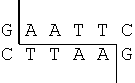
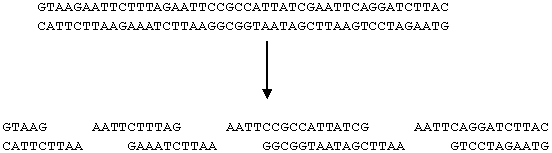
  • For example, EcoRI always cuts DNA at GAATTC as indicated below

  • The sequence GAATTC appears three times in the DNA strand below. As a result, the strand is cut into four pieces

  • Other restriction enzymes cut at different sites, some examples are listed below


Enzyme Cutting Site
Bam HI GGATCC
Hae III GGCC
Pst I CTGCAG
Hind I GANTC


Sticky Ends & Recombinant DNA:

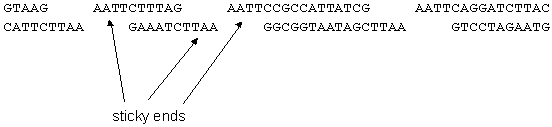
  • Fragments of DNA that has been cut with restriction enzymes have unpaired nucleotides at the ends called sticky ends

  • Sticky ends have complimentary bases, so they could rejoin
  • If the vector and the gene to be cloned are both cut with the same restriction enzyme, they will both have complimentary sticky ends
  • After cutting, the 2 DNA samples are mixed
  • Fragments with complementary sticky ends join together forming recombinant DNA (contains gene from vector & the gene to be cloned)
  • Enzyme DNA ligase seals the fragments together
  • Bacteria such as Escherichia coli are capable of taking up DNA from their environment
  • This process is called transformation
  • CaCl2 and a procedure called heat shock are used to make E. coli cells more permeable so that they take up the modified plasmids more readily

Genomic Libraries:

  • A genome is all of the genes in a particular organism
  • Bacteria or virus vectors can be used to store fragments of the DNA from another species
  • The DNA is cut up into fragments, and the different fragments are inserted into bacteria or viruses
  • The collection of bacteria or viruses is called a genomic library

Polymerase Chain Reaction (PCR):

  • Used to make many copies of small pieces of DNA
  • Procedure requires primers, DNA polymerase, and nucleotides
  • Primers are short chains of about 20 nucleotides that are complimentary to a region in the DNA to be amplified
  • DNA polymerase cannot continue the process unless it has already been started by primers
  • Nucleotides are needed because DNA is composed of nucleotide “building blocks”

  • The DNA is heated to approximately 95o C to separate the two strands of the double helix

  • After the strands are separated, the DNA is cooled to about 50o C, and the primers attach
  • The temperature is raised to approximately 70o C so the polymerase will attach to & copy the strand

  • The DNA replication process repeats itself as the solution is then heated and cooled at regular intervals


DNA Fingerprinting (RFLP Analysis):

  • In RFLP analysis, the DNA of an organism is cut up into fragments using restriction enzymes producing a large number of short fragments of DNA
  • Because no two individuals have identical DNA, no two individuals will have the same length fragments
  • Gel electrophoresis is a technique used to separate the DNA fragments according to their size
  • The fragments are placed in wells on a sheet of gelatin, and an electric current is applied to the sheet
  • DNA is negatively charged and will move in an electric field toward the positive pole

  • The smallest fragments will move the fastest because they are able to move through the pores in the gelatin faster
  • Bands will be produced on the gelatin where the fragments accumulate
  • Shortest fragments will accumulate near one end of the gelatin (furthest from the wells), and the longer, slower-moving ones will remain near the other end
  • DNA bands must be stained to make them visible


Gene Products & Uses of Genetic Engineering:

  • E. coli is used to produce proteins such as insulin by genetic engineering because it is easily grown
  • To recover the product, E. coli must be lysed or the gene must be linked to a gene that produces a naturally secreted protein
  • Yeasts can be genetically engineered and are likely to secrete the gene product continuously
  • Mammalian cells can be engineered to produce proteins such as hormones for medical use
  • Plant cells take up a plasmid from Agrobacterium
  • Plant cells can be engineered and used to produce plants with new properties such as Roundup Ready soybeans
  • Pseudomonas bacteria has been engineered to produce Bacillus thuringiensis or BT
  • BT bacteria make a toxin against insects, thus producing a natural insecticide   (example – B.T. cotton)
  • Animal viruses can be engineered to carry a gene for a pathogen’s surface protein so the virus can be used as a vaccine 
  • Genetic engineering techniques are being used to map the human genome through the Human Genome Project
  • Could provide tools for diagnosis and possible repair of genetic disease
  • Recombinant DNA techniques can be used for genetic fingerprinting
  • Gene therapy can be used to cure genetic diseases by replacing the defective or missing gene
  • Bovine growth hormone (BGH) increases milk production in cows by about 10%

Safety and Ethical Issues:

  • Harmful organisms may be accidentally produced
  • Organisms that are intended to be released in the environment may be engineered with genes that will eventually kill them
  • There is little legislation on the use of genetic screening and information produced by screening
  • The technology is increasing the ability to diagnose genetic diseases pre-natally, adding new complexity to the abortion controversy
  • Ethical questions have been raised over whether we should modify the genes of humans
  • Genetic screening and gene therapy are expensive and may be unavailable to the poor
  • Biological weapons could be created using biotechnology

Build a Cell

Use of our material:
This activity was created by Kelly Riedell for students in Biology class at Brookings High School. We have worked very hard on activities, Powerpoints/games/worksheets, etc to make this a resource for our students. If you are using our materials, please give us credit for our efforts by listing us as a source with links to our site.
Any questions, comments, or corrections can be directed to us at

BUILD -A-CELL GAME
Students review by answering questions AND
by practicing what parts look like and their
location as they build their cell.

AHEAD OF TIME:
1. Make a copy of the question cards. and cut them apart
You will need a set of question cards for each group of 4
I make the sets different colors so the cards don’t get mixed up.

2. Print out the Build a cell game parts sheets.
Copy the blank cell page onto colored paper (1 for each student)
Copy off the cell parts pieces onto clear transparency sheets, cut out,  and place in
paper lunch bags. (1 lunch bag per game group with enough parts in it to make 4 cells.)
Using clear transparencies allows some cell parts to build on top of each other.
(Ex: nucleolus goes inside nucleus, ribosomes sit on top of Rough ER)

PLAY THE GAME:
Students play in groups of 3-4. Each group has a lunch bag with cell parts pieces and a deck of question cards. Each student has his/her own blank cell score sheet. Students play by taking turns answering questions.  If they answer correctly, they get to pick a cell part from the lunch bag and place it on their cell scorecard in the correct place. If they get  it wrong they don’t get a part and the next student gets a turn.

First student to get all 9 cell parts into their cell is the winner.