Chromatography of Plant Pigments 3


Chromatography of Plant Pigments


Introduction:


Can chromatography be used to separate mixtures of chemical substances? The purpose of this experiment is to answer this question. In paper chromatography, a liquid sample flows down a vertical strip of absorbent paper, on which the components of a mixture are deposited in specific directions and locations. Chromatography is a tool used to examine and separate mixtures of chemical substances. Chromatography is essential to the separation of pure substances from complex mixtures. Separation results in a chromatographically pure substance. Chromatography allows you to determine the properties of chemical substances.

The relationship between the chromatography paper, mixture, and the solvent is very important in all chromatographic separations. The solvent has to dissolve the mixture that should be separated. The paper must also absorb the components of the mixtures selectively and reversibly. The substances making up the mixture must be evenly dispersed in the water. Chromatography is a simple and inexpensive tool for separating and identifying chemical mixtures if all these things are done.


Hypothesis:


Paper can be used to separate mixed chemicals.


Materials:


The materials used in this lab are filter paper, test tube, rubber stopper, paper clip, metric ruler, black felt-tip pen, pencil, calculator, and water.


Methods:


First, bend a paper clip so that it’s straight with a hook at one end. Push the straight end of the paper clip into the bottom of a cork stopper. Then, hang a thin strip of filter paper on the hooked end of the paper clip and insert the paper strip into the test tube. The paper should not touch the sides and should almost touch the bottom of the test tube. Next, remove the paper strip from the test tube. Now draw a solid 5-mm-wide band about 25 mm from the bottom of the paper, using a black felt tip pen. After this, use a pencil to draw a line across the paper strip 10 cm above the black band. Then, put the filter paper back into the test tube with the bottom of the paper in the water and the black band above the water. Observe what happens as the liquid travels up the paper and record the changes you see. When the solvent has reached the pencil line, remove the paper from the test tube. Let the paper dry on the desk. Finally, with a metric ruler, measure the distances from the starting point to the top edge of each color. Record the data in a data table and calculate a ratio for each color by dividing the distance, the color traveled by the distance the solvent traveled.


Results:


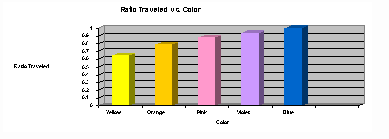
The results of the chromatography experiment are shown in a chart and a graph.


Color of ink (list in order) Distance traveled by each color (mm) Distance solvent traveled (mm) Ratio traveled = distance color moved divided by distance solvent moved
Yellow 70 108 0.65
Orange  

85


108


0.79

Pink 95  

108


0.88

Violet 102  

108


0.94

Blue 108  

108


1.00


Questions:

1. How many colors separated from the black ink? Five colors separated from the ink: yellow, orange, pink, violet, and blue.


2. What served as the solvent for the ink? Water served as the solvent for the ink.


3. As the solvent traveled up the paper, which color of ink appeared first? Dark blue appeared first.


4. List the colors in order from top to bottom that separated from the black ink? The colors separated in the order of: blue, violet, pink, orange, and yellow.


5. In millimeters, how far did the solvent travel? The solvent traveled 108 mm.


6. From your results, what can you conclude is true about black ink? Black ink is a mixture of several different colors.


7. Why did the inks separate? The inks separated because black ink is a mixture of different pigments that are soluble in water, have different molecular characteristics, and travel different distances.


8. Why did some inks move a greater distance? Some inks move a greater distance because molecules in ink have different characteristics, like how readily they are absorbed by paper. This means that the ink least readily absorbed by paper will travel farthest from the starting mark and the ink most readily absorbed by paper will be the closest to the starting mark. All of the different color inks that were separated were different in how readily they are absorbed by paper.

Error Analysis:


There are a few errors that could have changed the results. First, there could be inaccurate measurements of how far every color traveled or how far the water traveled up the filter paper. Another error could occur when calculating the ratio traveled, Rf value. Also, a longer test tube could have been used by different groups which would make the filter strip longer. This means that a group could have detected another color because they had more room on their filter paper. This also could have affected the ratios. Finally, the groups could have put different amounts of black ink on the filter paper.


Conclusion:


The hypothesis that paper can be used to separate mixed chemicals was correct. The different colored inks mixed together give the black its color. The five colors that separated from the black ink were blue, violet, pink, orange, and yellow. Blue appeared first and then was followed by violet, pink, orange, and yellow. The colors separated the way they did because they have different molecular characteristics, like how readily they were absorbed by the paper and their solubility in water. Blue was most readily absorbed by the paper and soluble by water, while yellow was the least.

BACK


Chromatography of Simulated Plant Pigments


Chromatography of Simulated Plant Pigments


Introduction
    This experiment is conducted to investigate the components Plant Pigments separating visibly. There are a couple of different types of components in plant pigments, and they became clearly visible during this lab. The most important and abundant chemical pigment found in plants is chlorophyll. This pigment exists in two forms; chlorophyll a and chlorophyll b. Chlorophyll absorbs two main colors from light quite well. These are blue, and red. The chlorophyll reflects green light very well, however, the two different types of chlorophyll have their maximum absorption at different wavelengths of light. Chlorophyll a, being the main photosynthetic pigment, has a primary purpose to convert light energy to chemical energy used by the plant itself. Chlorophyll b absorbs light in a region of the spectrum apart from the dominant chlorophyll, and transfers the energy it produces to chlorophyll a. Along with chlorophyll b in transferring their energy produced to the dominant chlorophyll, two other pigments that are found in plants are carotenes and xanthophylls, which are orange and yellow respectively. Since chlorophyll is such a dominant pigment in green plants, this domination hides the color of the carotenes and xanthophylls in the leaves. This causes most plant leaves to appear green most of the time. During the autumn, however, the chlorophyll starts to break down, causing the carotenes and xanthophylls to show their bright red, orange and yellow colors.
These brilliant colors can be separated another way. This different technique, known as paper chromatography, separates mixtures in a liquid into individual components. The technique is based on the fact that each substance in a mixture has a specific affinity for a solid surface and a specific solubility in different solvents. By this method, the solid surface is the cellulose fibers in the chromatography paper, and the solvent is the solution that was placed in the bottom of the developing chamber.
This separation takes place through a process of absorption and capillary action. Just a small drop of the mixture, in this case plant pigment to be separated, is placed at the bottom of the strip of chromatography paper. The chromatography paper is then placed in the developing chamber with a solvent, which wicks up the paper, pulling the solvent up the paper by capillary action, and the mixture of pigments is dissolved as the solvent passes over it. The different components of the mixture move upward at different rates. A compound with greater solubility will travel farther than one with less solubility. The pigments then show up as color streaks on the chromatography paper. These substances have formed a pattern called a chromatogram on the chromatography paper.
The Rf values for each pigment is calculated to establish the relative rate of migration for each pigment. This value represents the ratio of the distance a pigment traveled on the chromatogram relative to the distance the solvent front moved.
Scientists use the Rf value of a sample to identify the molecule. Any molecule in a given solvent matrix system has a uniquely consistent Rf value. The formula for this value is as follows:

Rf = Distance each pigment traveled ¸ Distance solvent front traveled


Hypothesis
    Using paper chromatography, the pigments that give a leaf its color can be separated and observed to determine the Rf value of each pigment and their function during photosynthesis.


Materials
For this experiment the following items are used — one chromatography reaction chamber, one paper chromatography strip, one capillary pipette, a pencil and paper, calculator, ruler, 50 ml beaker, colored pencils, approximately 10 ml of solvent depending on the size of the reaction chamber, scissors, and simulated plant pigment.


Procedure
Use scissors to cut the bottom of the chromatography paper to a tapered end. Measure the strip and cut the length to equal slightly longer than the reaction chamber. Draw a faint pencil line at the bottom of the tapered end and use a capillary pipette to add some simulated plant pigment to this line. Add 5-10 ml of solvent to the reaction chamber. Extend the chromatography strip through the slit in the lids of the reaction chamber and carefully lower the strip into the chamber so the tapered end is in the solvent and the pencil line is above the solvent level. Make sure the strip does not touch the walls of the chamber and do not bump the chamber as the pigments begin to separate. After the pigments have completely separated and the solvent front has reached the top of the chamber, remove the strip and mark the solvent front with a pencil line before it evaporates. Measure and record the distance the solvent and each pigment traveled. Use a calculator to determine the Rf values for each pigment.


Data


Table 1

Band # Pigment Color Migration distance (mm) Rf value
1 Carotene Orange 59mm .94
2 Xanthophyll Yellow 56mm .89
3 Chlorophyll a Light green 29mm .46
4 Chlorophyll b Dark green 14mm .22
Solvent 63mm

Questions
1. Describe what happened to the original spot of simulated plant pigments?
  The solvent separated  the original spot by wicking up the solvent while dissolving the various pigments in the spot.
2. List some other uses of chromatography?  Chromatography can be used to separate various mixtures of subtances, liquids and gases.
3. Which of the 4 pigments migrated the furthest and why?  carotene ( orange) because it was the most soluble in the solvent
4. Which type of chlorophyll was the most soluble?  chlorophyll a
5. Explain why leaves change color in the fall?  In Autumn, chlorophyll starts to break down which allows the other brilliant plant pigment colors to show. These pigments include the red, orange, and yellow colors.
6. What is the function of plant pigments in photosynthesis?  Plant pigments trap light energy and convert it into chemical energy that can be used by the plant to make glucose or sugar.

Error Analysis
The chromatography paper touched the sides of the chamber during the waiting time which caused the migration to go slightly to the side instead of straight to the top. Also the strip was bent at the top so there could have been a slight error in measuring the migration of the solvent  front.

Conclusion
Paper chromatography proved to be an accurate method of separating and observing the various colors of plant pigments. The pigments dissolved in the solvent and migrated upward. The colors were observed and their migration distances measured & recorded. The
Rf value of each pigment was determined by dividing its migration by the migration of the solvent.  It was determined that 4 pigments were present in the original spot — carotene, xanthophyll, chlorophyll a, and chlorophyll b. Carotene was the most soluble, while chlorophyll b was the least soluble.

Chemistry Quiz

Name: 

Chemistry Quiz


True/False
Indicate whether the sentence or statement is true or false.
1.
The types of particles that are located in the nucleus of an atom are protons and neutrons, and the types of particles that are located in the energy levels surrounding the nucleus are electrons.
2.
The atomic number of carbon is 6, so it must contain 12 electrons.
3.
Most elements are stable if their outermost energy level contains an even number of electrons.
4.
Atoms in a gas move more rapidly than atoms in a liquid or a solid do.
5.
The products of an endergonic chemical reaction possess more energy than the reactants from which they are produced.
6.
The amount of energy needed to cause a chemical reaction to start is called activation energy.
7.
When an enzyme binds with its substrate, the activation energy needed for the chemical reaction to occur is raised.
8.
Enzymes speed up a chemical reaction by increasing the activation energy of the reaction.
9.
Free hydrogen ions can react with water molecules and form a positively charged ion, the hydronium ion.
10.
Buffers can neutralize acids, but they do not affect bases.
 

Multiple Choice
Identify the letter of the choice that best completes the statement or answers the question.
11.
The smallest particle of matter that can retain the chemical properties of carbon is
a.
a carbon molecule.
c.
a carbon atom.
b.
a carbon macromolecule.
d.
an element.
12.
The bond formed when two atoms share a pair of electrons is called a
a.
hydrogen bond.
c.
covalent bond.
b.
nonpolar bond.
d.
water bond.
13.
Sharing of electrons in the outer energy levels of two atoms
a.
results in ion formation.
b.
occurs in covalent bonds.
c.
only occurs if both are atoms of the same element.
d.
is found only among carbon atoms.
14.
An atom that has gained or lost electrons is called a(n)
a.
molecule.
c.
ion.
b.
nucleon.
d.
element.
15.
Which of the following statements most accurately describes the difference between an ionic bond and a covalent bond?
a.
Atoms held together by ionic bonds separate when placed in water while atoms held together by covalent bonds do not separate in water.
b.
Ionic bonds hold together atoms of two different types, while covalent bonds hold together atoms of the same type.
c.
Electrons are exchanged between atoms held together by an ionic bond, but they are shared between atoms held together by a covalent bond.
d.
Ionic bonds form between atoms that carry opposite charges, while covalent bonds form between uncharged atoms.
16.
A reaction in which the products have less energy than the reactants is
a.
an endergonic reaction.
c.
a filamentous reaction.
b.
an exergonic reaction.
d.
impossible.
      chemistry_quiz_files/i0190000.jpg
17.
Refer to the graph above. Reaction “1” in the graph
a.
is an energy-storing reaction.
b.
requires a greater activation energy than Reaction “2.”
c.
may use the same initial reactant condition needed to form Product “B.”
d.
All of the above
18.
Refer to the graph above. Which of these statements is true regarding the graph?
a.
Reaction “2” occurs faster than Reaction “3” because Reaction “2” requires more energy than Reaction “3.”
b.
The difference in the graphs shown for Reaction “2” and Reaction “3” is due to a difference in the activation energy needed for these reactions.
c.
Reactant “A” contains more energy at the beginning of the reaction than Product “C” has after the reaction.
d.
All of the above
19.
Changing the course or pathway of a chemical reaction so that it requires less activation energy
a.
is a violation of the laws of nature.
b.
requires higher temperatures than those found within cells.
c.
occurs only when reactants are quickly added to the reaction mixture.
d.
is accomplished by the action of catalysts on reactants.
20.
Oxidation-reduction reactions are important in organisms because they
a.
allow the passage of energy from molecule to molecule.
b.
prevent nuclear reactions from occurring.
c.
allow the creation and destruction of energy.
d.
None of the above; oxidation-reduction reactions do not occur in living organisms.


Check Your Work     Reset

Biochemistry Quiz 2

Name: 

Biochemistry 


True/False
Indicate whether the sentence or statement is true or false.
1.
When sugar is dissolved in water, the sugar and water are chemically combined.
2.
Functional groups are side groups of carbon compounds that confer specific properties to these compounds.
 

Multiple Choice
Identify the letter of the choice that best completes the statement or answers the question.
3.
Water molecules are polar, with the
a.
oxygen side being slightly positive and the hydrogen side being slightly negative.
b.
oxygen and hydrogen sides being slightly positive.
c.
oxygen and hydrogen sides being slightly negative.
d.
oxygen side being slightly negative and the hydrogen side being slightly positive.
4.
Which of the following organic compounds is the main source of energy for living things?
a.
carbohydrates
b.
lipids
c.
nucleic acids
d.
proteins
5.
Which of these is a characteristic of enzymes?
a.
they are protein
c.
they are reusable
b.
they are specific
d.
all of these
6.
Which element is found in proteins but not in carbohydrates and fats?
a.
nitrogen
c.
hydrogen
b.
carbon
d.
oxygen
7.
Which organic molecule below is most closely related to lipids?
a.
amino acids
c.
nucleotides
b.
CH2 chains
d.
sugars
chp3_online_tutoria_files/i0100000.jpgchp3_online_tutoria_files/i0100001.jpg
             Molecule A        Molecule B
8.
Refer to the illustration above. Molecules like Molecule “B” are found in
a.
carbohydrates.
c.
nucleic acids.
b.
lipids.
d.
proteins.
9.
Which of the following is composed of fatty acids and glycerol?
a.
carbohydrate
c.
protein
b.
lipid
d.
nucleic acid
10.
This group of organic compounds includes monosaccharides:
a.
carbohydrates
c.
protein
b.
lipids
d.
nucleic acids
11.
Carbon is different from most other elements in that
a.
it has four electrons in its outermost energy level.
b.
it readily bonds with other carbon atoms.
c.
it can form single, double, or triple bonds with other atoms.
d.
it shares two electrons with another atom when it forms a covalent bond.
12.
Which of the following characteristics of water is not a result of hydrogen bonding?
a.
adhesive strength
b.
capillarity
c.
cohesive strength
d.
All of the above are a result of hydrogen bonding.
13.
Polysaccharides are
a.
carbohydrates.
c.
proteins.
b.
lipids.
d.
unsaturated fats.
14.
Enzymes involved in a chemical reaction:
a.
are used up during the reaction
b.
are decomposed during the reaction
c.
react more rapidly as the reaction progresses
d.
are not used up during the reaction
15.
Which organic compound is involved in heredity?
a.
carbohydrate
c.
proteins
b.
lipid
d.
nucleic acids
16.
Water molecules break up other polar substances,
a.
such as sugars.
b.
because of the uneven charge distribution that exists in water molecules.
c.
thus freeing ions in these substances for use by the body.
d.
All of the above
17.
When a glass is filled to the brim with water, the water appears to bulge from the sides of the glass due to
a.
capillarity
c.
adhesion
b.
thermal energy
d.
cohesion
18.
Lipids are soluble in
a.
water.
c.
oil.
b.
salt water.
d.
All of the above
19.
Which organic molecule below is classified as a carbohydrate?
a.
amino acid
c.
nucleotide
b.
CH2 chain
d.
sugar
20.
Which of the following is not an organic macromolecule?
a.
carbohydrate
c.
lipid
b.
ice
d.
nucleic acid
21.
Long chains of amino acids are found in
a.
carbohydrates.
c.
proteins.
b.
lipids.
d.
sugars.
22.
Amino acids are the building blocks of larger molecules called:
a.
cellulose
c.
fats
b.
proteins
d.
glycogen
23.
Which of the following is an organic compound?
a.
CaO
c.
C5H12
b.
H2O
d.
H2SO4
24.
All of the following are examples of carbohydrates except
a.
sugar.
c.
steroids.
b.
cellulose.
d.
glycogen.


Check Your Work     Reset

Chordates

Chordates
All Materials © Cmassengale  

Characteristics of Chordates

  • All chordates have a notochord, dorsal nerve cord, pharyngeal pouches, & postanal tail at some time in their life
  • Notochord is a firm, flexible rod of tissue located on the dorsal side of the body that becomes part of the endoskeleton in vertebrates
  • Dorsal nerve cord is a hollow tube lying dorsal to the notochord that becomes the brain & spinal cord in vertebrates
  • Pharyngeal pouches are small outpockets of the anterior part of the digestive tract that become gills in aquatic chordates & jaws, inner ear, & tonsils in terrestrial chordates
  • Postanal tail consists of muscle tissue & lies behind the posterior opening of the digestive tract

Subphyla of Chordates

  • The Phylum Chordata  includes all of the vertebrates, as well as two groups of marine animals that lack backbones and are called invertebrate chordates
  • The phylum is divided into three subphyla, determined by the development of the notochord
  • Subphylum Cephalochordata contains about 24 species of blade-shaped animals known as lancelates that retain the notochord, dorsal nerve chord, pharyngeal pouches, and postanal tail throughout their life
  • Subphylum Urochordata  contains 2,000 species commonly called tunicates because their bodies are covered by a tough covering, or tunic
    * Called sea squirts because they shoot out a stream of water when touched
    *Sessile, barrel-shaped, filter feeding animals that live on the sea bottom
    *Adults have a pouch-like pharynx with slits
    *Adults do not have a notochord, dorsal nerve cord, or postanal tail
  • Subphylum Vertebrata is the largest subphylum in which the notochord is replaced with vertebrae
    *  Skeletons consist of bone &/or cartilage
    * Brain is protected by a cranium
    * Well developed 4 chambered heart with a closed circulatory system
    * Includes fish, amphibians, reptiles, birds, & mammals

Fish, Amphibians, Reptiles, Birds, and Mammals
BACK