AP Genetics Problems


Genetics Problems

1. A rooster with gray feathers is mated with a hen of the same phenotype. Among their offspring, 15 chicks are gray, 6 are black, and 8 are white.

  • What is the simplest explanation for the inheritance of these colors in chickens?
  • What offspring would you predict from the mating of a gray rooster and a black hen?

2. In some plants, a true-breeding, red-flowered strain gives all pink flowers when crossed with a white-flowered strain: RR (red) x rr (white) —> Rr (pink). If flower position (axial or terminal) is inherited as it is in peas what will be the ratios of genotypes and phenotypes of the generation resulting from the following cross: axial-red (true-breeding) x terminal-white? What will be the ratios in the F2 generation?

3. Flower position, stem length, and seed shape were three characters that Mendel studied. Each is controlled by an independently assorting gene and has dominant and recessive expression as follows:


Character Dominant Recessive
Flower position Axial (A ) Terminal (a )
Stem length Tall (T ) Dwarf (t )
Seed shape Round (R ) Wrinkled (r)


If a plant that is heterozygous for all three characters were allowed to self-fertilize, what proportion of the offspring would be expected to be as follows: (Note – use the rules of probability (and show your work) instead of huge Punnett squares)

  1. homozygous for the three dominant traits
  2. homozygous for the three recessive traits
  3. heterozygous
  4. homozygous for axial and tall, heterozygous for seed shape

4. A black guinea pig crossed with an albino guinea pig produced 12 black offspring. When the albino was crossed with a second one, 7 blacks and 5 albinos were obtained.

  • What is the best explanation for this genetic situation?
  • Write genotypes for the parents, gametes, and offspring.

5. In sesame plants, the one-pod condition (P ) is dominant to the three-pod condition (p ), and normal leaf (L ) is dominant to wrinkled leaf (l) . Pod type and leaf type are inherited independently. Determine the genotypes for the two parents for all possible matings producing the following offspring:

  1. 318 one-pod normal, 98 one-pod wrinkled
  2. 323 three-pod normal, 106 three-pod wrinkled
  3. 401 one-pod normal
  4. 150 one-pod normal, 147 one-pod wrinkled, 51 three-pod normal, 48 three-pod wrinkled
  5. 223 one-pod normal, 72 one-pod wrinkled, 76 three-pod normal, 27 three-pod wrinkled

6. A man with group A blood marries a woman with group B blood. Their child has group O blood.

  • What are the genotypes of these individuals?
  • What other genotypes and in what frequencies, would you expect in offspring from this marriage?

7. Color pattern in a species of duck is determined by one gene with three alleles. Alleles H and I are codominant, and allele i is recessive to both. How many phenotypes are possible in a flock of ducks that contains all the possible combinations of these three alleles?

8. Phenylketonuria (PKU) is an inherited disease caused by a recessive allele. If a woman and her husband are both carriers, what is the probability of each of the following?

  1. all three of their children will be of normal phenotype
  2. one or more of the three children will have the disease
  3. all three children will have the disease
  4. at least one child out of three will be phenotypically normal

(Note: Remember that the probabilities of all possible outcomes always add up to 1)

9. The genotype of F1 individuals in a tetrahybrid cross is AaBbCcDd. Assuming independent assortment of these four genes, what are the probabilities that F2 offspring would have the following genotypes?

  1. aabbccdd
  2. AaBbCcDd
  3. AABBCCDD
  4. AaBBccDd
  5. AaBBCCdd

10. In 1981, a stray black cat with unusual rounded curled-back ears was adopted by a family in California. Hundreds of descendants of the cat have since been born, and cat fanciers hope to develop the “curl” cat into a show breed. Suppose you owned the first curl cat and wanted to develop a true breeding variety.

  • How would you determine whether the curl allele is dominant or recessive?
  • How would you select for true-breeding cats?
  • How would you know they are true-breeding?

11. What is the probability that each of the following pairs of parents will produce the indicated offspring (assume independent assortment of all gene pairs?

  1. AABbCc x aabbcc —-> AaBbCc
  2. AABbCc x AaBbCc —–> AAbbCC
  3. AaBbCc x AaBbCc —–> AaBbCc
  4. aaBbCC x AABbcc —-> AaBbCc

12. Karen and Steve each have a sibling with sickle-cell disease. Neither Karen, Steve, nor any of their parents has the disease, and none of them has been tested to reveal sickle-cell trait. Based on this incomplete information, calculate the probability that if this couple should have another child, the child will have sickle-cell anemia.

13. Imagine that a newly discovered, recessively inherited disease is expressed only in individuals with type O blood, although the disease and blood group are independently inherited. A normal man with type A blood and a normal woman with type B blood have already had one child with the disease. The woman is now pregnant for a second time. What is the probability that the second child will also have the disease? Assume both parents are heterozygous for the “disease” gene.

14. In tigers, a recessive allele causes an absence of fur pigmentation (a “white tiger”) and a cross-eyed condition. If two phenotypically normal tigers that are heterozygous at this locus are mated, what percentage of their offspring will be cross-eyed? What percentage will be white?

15. In corn plants, a dominant allele I inhibits kernel color, while the recessive allele i permits color when homozygous. At a different locus, the dominant gene P causes purple kernel color, while the homozygous recessive genotype pp causes red kernels. If plants heterozygous at both loci are crossed, what will be the phenotypic ratio of the F1 generation?

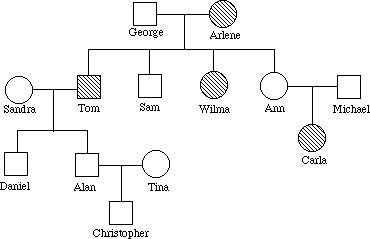
16. The pedigree below traces the inheritance of alkaptonuria, a biochemical disorder. Affected individuals, indicated here by the filled-in circles and squares, are unable to break down a substance called alkapton, which colors the urine and stains body tissues. Does alkaptonuria appear to be caused by a dominant or recessive allele? Fill in the genotypes of the individuals whose genotypes you know. What genotypes are possible for each of the other individuals?
 
17. A man has six fingers on each hand and six toes on each foot. His wife and their daughter have the normal number of digits (5). Extra digits is a dominant trait. What fraction of this couple’s children would be expected to have extra digits?

18. Imagine you are a genetic counselor, and a couple planning to start a family came to you for information. Charles was married once before, and he and his first wife had a child who has cystic fibrosis. The brother of his current wife Elaine died of cystic fibrosis. What is the probability that Charles and Elaine will have a baby with cystic fibrosis? (Neither Charles nor Elaine has the disease)

19. In mice, black color (B ) is dominant to white (b ). At a different locus, a dominant allele (A ) produces a band of yellow just below the tip of each hair in mice with black fur. This gives a frosted appearance known as agouti. Expression of the recessive allele (a ) results in a solid coat color. If mice that are heterozygous at both loci are crossed, what will be the expected phenotypic ratio of their offspring?

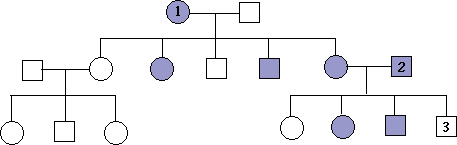
20. The pedigree below traces the inheritance of a vary rare biochemical disorder in humans. Affected individuals are indicated by filled-in circles and squares. Is the allele for this disorder dominant or recessive? What genotypes are possible for the individuals marked 1, 2, and 3.


Solutions

AP Lecture Guide 04 – Carbon & the Molecular Diversity of Life

AP Biology: CHAPTER 4


CARBON & THE MOLECULAR DIVERSITY OF LIFE


1. Define organic chemistry.

___________________________________________________________________________

___________________________________________________________________________

___________________________________________________________________________

2. What are the major groups of organic compounds studied in biology?

___________________________________________________________________________

___________________________________________________________________________

3. Describe some of the shapes of carbon skeletons.

___________________________________________________________________________

___________________________________________________________________________

___________________________________________________________________________

4. Define the following:

a. Isotopes ________________________________________________________________

___________________________________________________________________________

b. Geometric isotopes ________________________________________________________

___________________________________________________________________________

c. Enantiomers _____________________________________________________________

__________________________________________________________________________

5. Why are enantiomers of biological interest?

___________________________________________________________________________

___________________________________________________________________________

___________________________________________________________________________

6. What is the significance of functional groups?

___________________________________________________________________________

___________________________________________________________________________

7. For each of the functional groups, complete the chart:

Group Formula Properties
Hydroxyl .. .
Carbonyl .. aldehyde
Carbonyl . ketone
Carboxyl . .
Amino . .
Sulfhydryl . .
Phosphate . .


Algal & Fungal Protist


Algal & Fungal-like Protists
Kingdom Protista
All Materials © Cmassengale

Copyright © by Holt, Rinehart and Winston


Algal-Like Protists

Characteristics of Algae:

  • Plantlike members of the kingdom Protista
  • Eukaryotes
  • Most unicellular, but some multicellular
  • Autotrophic – contain chlorophyll & make food by photosynthesis
  • Plankton = communities of organisms, mostly microscopic, that drift passively or swim weakly near the surface of oceans, ponds, and lakes
  • Produce oxygen that is returned to the atmosphere
  • Range in size from microscopic to seaweeds hundreds of feet in length
  • Do not have true roots, stems, nor leaves
  • Form gametes (eggs & sperm) in single-celled gametangia (chambers) instead of     multicellular gametangia like true plants
  • Found in freshwater, marine, and moist soil habitats
  • Most have flagella at some time in life cycle
  • Algae cells contain organelles called pyrenoids organelles that make & store starch

Structure of Algal Cells:

  • The body of algae is called the thallus  (1n)
  • Algae may  be unicellular, colonial, filamentous, or multicellular
  • Unicellular algae are single-celled & make up phytoplankton (a population of photosynthetic organisms that begins many aquatic food chains)
  • Phytoplankton make much world’s carbohydrates & are the major producers of oxygen


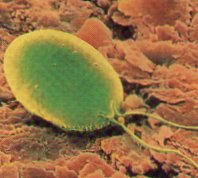
Chlamydomonas
Copyright © by Holt, Rinehart and Winston

  • Colonial algae consist of groups of cells working together
  • Some colonial algal cells may specialize for movement, feeding, or reproduction showing for division of labor 


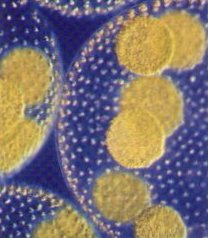
Volvox
Copyright © by Holt, Rinehart and Winston

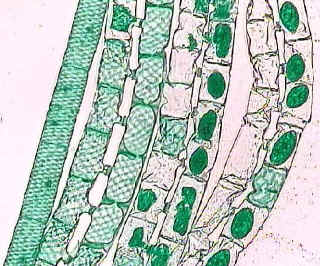
  • Filamentous algae have slender, rod-shaped thallus arranged in rows joined end-to-end
  • Holdfasts are specialized structures in some filamentous algae that attaches the algae so it can grow toward sunlight at the surface


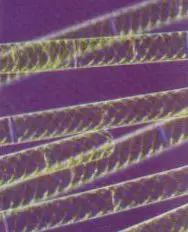
Spirogyra
Copyright © by Holt, Rinehart and Winston

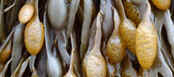
  • Multicellular algae often have a large, complex leaf-like thallus & may have stem-like sections and air bladders
  •  Macrocystis is among the largest multicellular algae


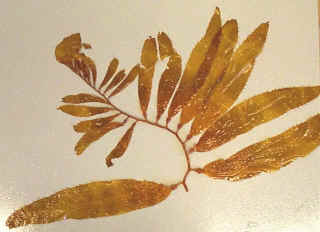
Macrocystis
Copyright © by Holt, Rinehart and Winston

Reproduction in Unicellular Algae:

Asexual Phase

  • Algae absorbs its flagellum
  • Haploid algal cell then divides mitotically from 2 to 3 times
  • From 4 – 8  haploid flagellated cells called zoospores develop in this parent cell
  • Zoospores break out of the parent cell & eventually grow to full size

Sexual Phase

  • Haploid cells dividing mitotically to produce either “plus” or “minus” gametes
  • A plus gamete and a minus gamete come into contact with one another, shed their cell walls, and fuse to form a diploid zygote
  • This resting stage of a zygote is called a zygospore & an withstand bad environmental conditions
  • When conditions are bad, the thick wall opens and the living zoospore emerges


Life Cycle of Chlamydomonas
Copyright © by Holt, Rinehart and Winston

Reproduction in Multicellular Algae:

  • Oedogonium is a multicellular, filamentous green algae with specialized cells called gametangia that form gametes
  • The male gametangia or antheridium makes sperm, & the female gametangia or oogonium makes eggs
  • Sperm are released into the water & swim to the egg to fertilize them
  • The fertilized egg or zygote is released from the oogonium & forms thick-walled zoospores
  • Zoospores undergo meiosis so one cell attaches to the bottom & develops a holdfast while the other zoospores divide & form a filament


Oedogonium Life Cycle
Copyright © by Holt, Rinehart and Winston

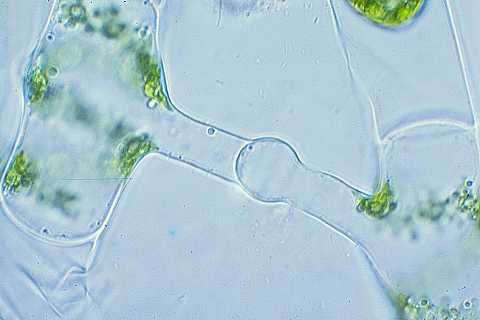
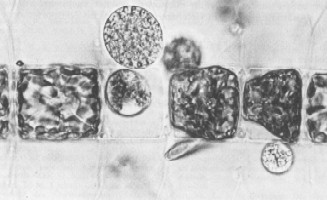
  • Spirogyra, another filamentous green algae, reproduces by conjugation

spirogyra conjugating.jpg (91550 bytes)

  • Two filaments align side by side, their adjacent cell walls dissolve, & a conjugation tube forms between them
  • Fertilization occurs when a + gamete cell moves through the tube & fuses to the – gamete cell 
  • Zygote forms a thick walled spore (sporangium) that breaks away from the parent & forms a new filament

Spirogyra: conjugation begining.
Conjugation Tube between Spirogyra

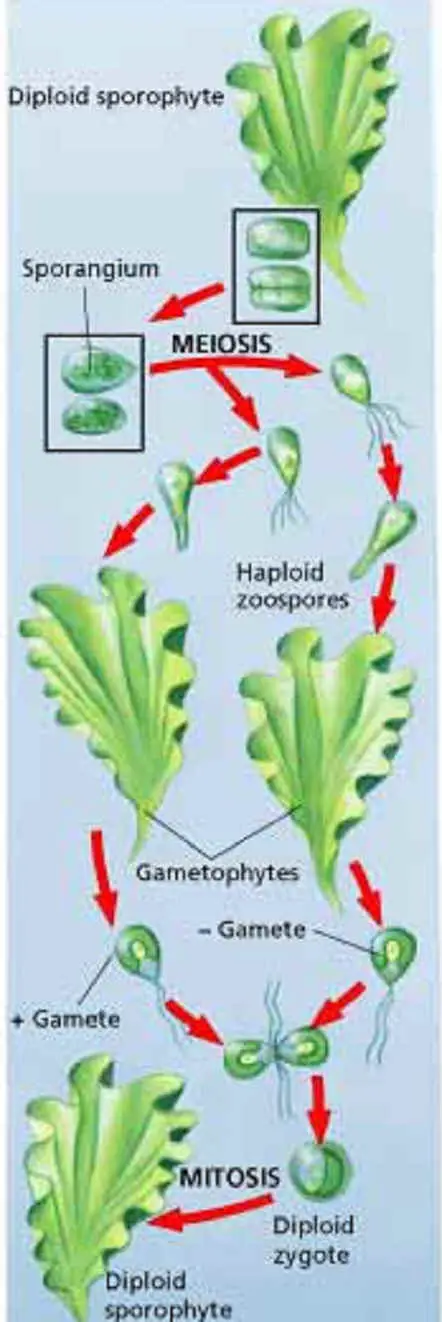
  • The leaflike algae Ulva has a sexual reproductive cycle characterized by a pattern called alternation of generations
  •  Alternation of generations has two distinct multicellular phases- a haploid, gamete-producing phase called a gametophyte and a diploid, spore-producing phase called a sporophyte
  • Alternation of Generation also occurs in more complex land plants, but the gametophyte & sporophyte do not resemble each other


Ulva Life cycle
Copyright © by Holt, Rinehart and Winston

Classification: 

  • Algae are classified into 7 phyla, based on color, type of chlorophyll, form of food-storage substance, and cell wall composition
  • All phyla contain chlorophyll a
  • All algae live in water or moist areas (ponds, seas, moist soil, ice…)
  • Act as producers making food & oxygen
  • Many species of algae reproduce sexually and asexually
  • Sexual reproduction in algae is often triggered by environmental stress


SEVEN PHYLA OF ALGAE

Phylum Structure of Thallus Pigments Food Storage  Cell Wall composition
Chlorophyta
(Green Algae)
Unicellular
Colonial
Filamentous
Multicellular
Chlorophyll a & b Carotenoids Starch Mainly Cellulose
Phaeophyta
(Brown Algae)
Multicellular Chlorophyll a & c Carotenoids Fucoxanthin
Peridinin
Laminarin  Cellulose
Algin
Rhodophyta
(Red Algae)
Multicellular Chlorophyll a Phycobilins Carotenoid Starch Cellulose
CaCO3
Bacillariophyta
(Diatoms)
 Unicellular Some Colonial Chlorophyll a & c Carotenoids Xanthophyll Starch
Pectin
SiO2
Dinoflagellata
(Dinoflagellates)
Unicellular Chlorophyll a & c Carotenoids Starch Cellulose
Chrysophyta
(Golden Algae)
 Unicellular Some Colonial Chlorophyll a & c
Xanthophyll Carotenoids
Laminarin Cellulose
Euglenophyta
(Euglenoids)
Unicellular Chlorophyll a & b
Carotenoids Xanthophyll
Paramylon
No Cell Wall  Pellicle


 Chlorophyta (green Algae):7000 species

  • May be unicellular, multicellular, or colonial
  • Include Spirogyra, Ulva, & Chlamydomonas
  • Contain chlorophyll a & chlorophyll b and carotenoids (orange & yellow pigments) as accessory pigments
  • Store food as starch
  • Cell walls mainly cellulose, but some marine forms add CaCO3
  • Habitat may be freshwater, moist surfaces, or marine environments
  • Some have whip-like flagella for movement
  • May live symbiotically as lichens
  • Thought to have given rise to terrestrial plants

Phaeophyta (brown algae):1500 species

  • Contain chlorophyll a & chlorophyll c and fucoxanthin (brown pigment) as accessory pigments
  • Most are multicellular growing in cooler marine habitats
  • Include kelps & seaweeds
  • Largest protists
  • Specialized rootlike holdfasts anchor thallus to rocks
  • Specialized air bladders keep leaflike blades afloat near surface to get light for photosynthesis
  • Stemlike structures are called the stipe and support the blades
  • Store food as a carbohydrate called laminarin
  • Include Laminaria & Fucus


Laminaria Fucus


  • Macrocystis or giant kelp contains algin in its cell walls which is used in cosmetics, some drugs, ice cream, etc.

Rhodophyta (red algae):4000 species

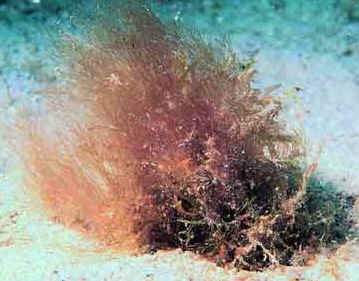
  • Multicellular algae that mainly grow deep in warm marine waters
  • Some freshwater species exist
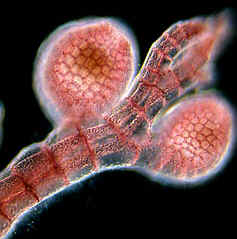
  • Highly branched thallus
  • Contain chlorophyll a & phycobilins (red pigments) to trap sunlight for photosynthesis


Polysiphonia (red algae)

  • Store food as starch
  • Cell walls contain cellulose and agar (used as a base in culture dishes to grow microbes)
  • Some species contain carageenan in their cell walls used for gelatin capsules & in some cheeses

Bacillariophyta (diatoms):11,500 species

  • Abundant in marine & freshwater habitats
  • Called phytoplankton & start many aquatic food chains
  • Contain chlorophyll a & c, carotenoids (orange pigments), & xanthophyll (yellow pigments)
  • Store food as starch & contain mainly cellulose in their cell walls
  • Lack cilia & flagella
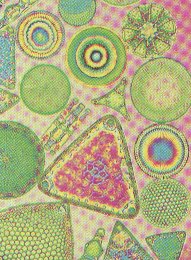
  • Have glass like shells or valves containing SiO2 that fit together in 2 parts


Diatoms
Copyright © by Holt, Rinehart and Winston

  • Centric diatoms are marine & have circular or triangular shells
  • Pennate diatoms are found in freshwater & have rectangular shells
  • When diatoms die, they form a layer called diatomaceous earth that is abrasive and used in detergents, toothpaste, fertilizers, etc.

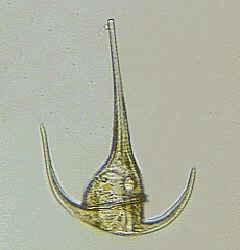
Dinoflagellata or Pyrrophyta (dinoflagellates):1100 species

  • Major producers in marine habitats
  • Small, unicellular organisms making up plankton
  • Many are photosynthetic, but some are colorless heterotrophs
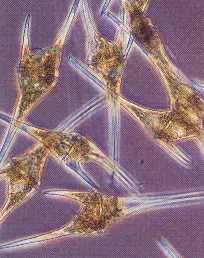
  • Photosynthetic dinoflagellates are yellow to brown in color due to chlorophyll a & c and carotenoids


Copyright © by Holt, Rinehart and Winston

  • Have 2 flagella that spin and move the dinoflagellate through water

  • Store food as starch
  • Some dinoflagellates are covered with armor like plates & spines made of cellulose
  • Often undergo algal blooms where their numbers greatly increase
  • Produce a toxic substance and cause poisonous red tides (water appears red due to red pigments in the dinoflagellates)


Red Tide

  • Some such as Noctiluca can produce light by bioluminescence


Photograph by Robert Brons

Chrysophyta (golden algae)850 Species:

  • Most are live in freshwater habitats, but some are marine
  • Unicellular algae containing chlorophyll a & c and the brown pigment fucoxanthin and carotenoids
  • Many have flagella for movement
  • May be naked or have cellulose cell walls or silica scales or shells
  • May form highly resistant cysts to survive beneath frozen lake surfaces in winter

Euglenophyta1000 Species:

  • Unicellular algae that lack cell walls
  • Have a flexible protein covering called the pellicle
  • Called euglenoids
  • Possess chlorophyll a & b and carotenoids
  • Store food as paramylon (polysaccharide)
  • Most live in freshwater, but some live in moist soil & the digestive tracts of certain animals


Copyright © by Holt, Rinehart and Winston

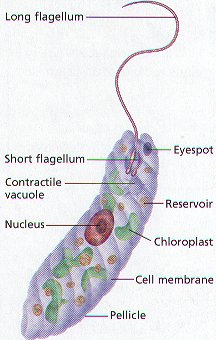
  • Euglena is a common euglenoid found in freshwater
    a. Elastic, transparent pellicle below cell membrane
    b. Contractile vacuole to pump out excess water
    c. Chloroplasts to make food by photosynthesis
    d. Can be heterotrophic in the absence of light 

Fungal-Like Protists

Characteristics of Fungal Protists:

  • Includes cellular slime molds,  plasmodial slime molds, & water molds
  • Unique life cycles with two phases
  • Multicellular, heterotrophic organisms
  • Little tissue specialization
  • Usually small & live in moist or watery habitats
  • Act as decomposers breaking down dead organic matter

Slime molds:

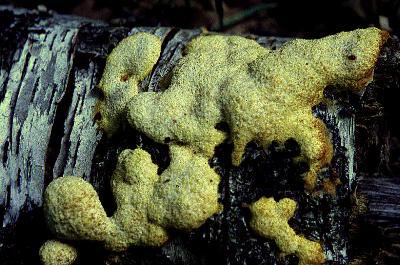
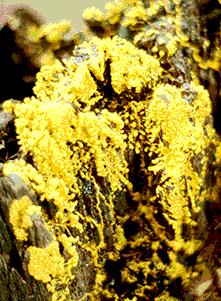
  • Shiny, wet appearance
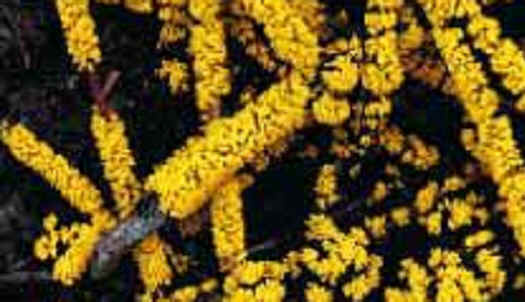
  • Often brightly colored (yellow or orange) 
  • Have unique life cycles with 2 phases — a mobile feeding stage & a nonmotile reproductive stage


Feeding Stage of Slime Mold
Copyright © by Holt, Rinehart and Winston

  • Fungal-like in nutrition (absorptive heterotrophs that break down dead organic matter)
  • May be saprophytes or parasites


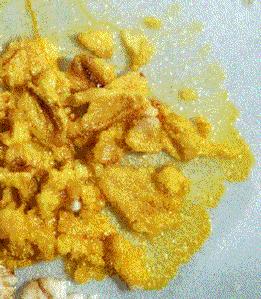
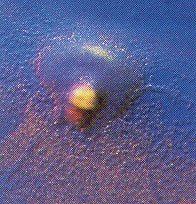
Saprophytic Slime Mold

  • Multinucleate body mass
  • May have a mobile, ameba-like feeding stage
  • Make a reproductive structure or fruiting body that produces spores
  • Often found on decaying wood or leaves

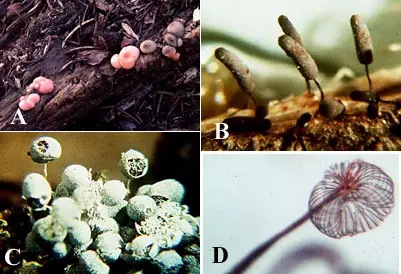
some slime mold fruiting bodies
A is Lycogala epidendrum, B is Comatricha typhoides, C is Badhamia utricularia, D is Dictydium

  • Two groups of slime molds exist — Cellular slime molds & Plasmodial slime molds
  • Cellular Slime Molds (Phylum Acrasiomycota)
  • Plasmodial Slime Molds (Phylum Myxomycota)

       
 Copyright © by Holt, Rinehart and Winston

Acrasiomycota (Cellular Slime Molds):

  • Alternate in their life cycle between amoeboid feeding stage & spore-producing fruiting body

  • Live in freshwater, moist soil
  • Clump together into masses called pseudoplasmodium whenever little food is available


  • Cells in the pseudoplasmodium are independent but move together “slug-like”
  • Pseudoplasmodium settles & forms fruiting body with spores 
  • Spores spread by wind to new location & form individual amoeboid feeding stage

Myxomycota (Plasmodial Slime Molds):

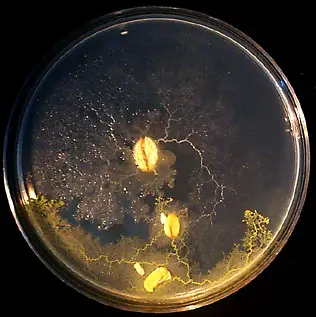
  • Exist as a plasmodium ( a mass of cytoplasm with many nuclei)
  • Plasmodium creeps along over decaying material 

  • Decomposes & absorbs plant material as food
  • When food is scarce, the plasmodium forms stalked fruiting bodies with spores that are resistant to bad environmental conditions
  • When conditions turn favorable, spores form a new plasmodium

Oomycota (Water Molds):

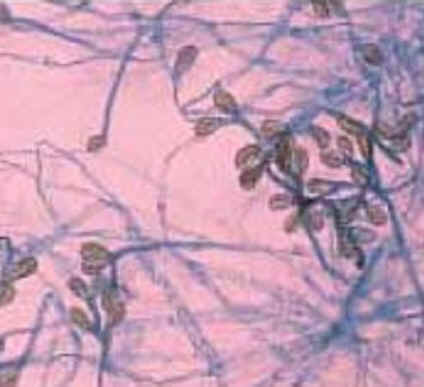
  • Fungal-like organism made of branching filaments with cell walls of cellulose


Branching Filaments of Water Mold

  • Aquatic water molds are parasites on fish forming furry growths on their gills
  • May act as decomposers in water of dead plants & animals
  • May be pathogenic to plants
    e.g. Phytophthora infestans caused blight in potatoes (Irish Potato Famine in 19th century)
  • Blight in plants decays & discolors stems & leaves 

  
Blight on Leaves & Potatoes

  • Water molds reproduce sexually & asexually
  • Motile zoospores are asexually produced from reproductive structures called sporangium
  • In sexual reproduction, cells with eggs form tubes to cells with sperm to fertilize & form new branching filaments

Chytridiomycota (Chytrids):

  • Aquatic protists that form gametes & zoospores
  • Most are unicellular or filamentous

  • May be saprophytes (decomposers) or parasites on algae, plants, or insects
  • May be a link between protists & fungi
BACK


Virus Worksheet


  Viruses Worksheet   

Structure of Viruses

1. Are viruses living or nonliving?

2. How can viruses be useful?


3. What odes a virologist do for a living?


4. Construct a Venn diagram comparing viruses and cells.


5. Explain how viruses were discovered and by whom.


6. Compare the size of viruses, bacteria, and eukaryotic cells.


7. What must be true for viruses to be able to replicate?


8. Name the two main parts of all viruses.


9. Discuss the hereditary material of viruses.


10. Compare & contrast capsids and envelopes of viruses.


11. Name 2 enveloped viruses that cause sexually transmitted disease.

12. What type of virus causes flu?

13. Where are glycoproteins found & what is there purpose?


14. What characteristics are used to group viruses?


15. How are these viruses grouped — retrovirus, adenovirus, and herpes virus?


16. Compare & contrast helical & icosahedral viral shapes & diseases.


17. Explain how RNA viruses replicate.


18. Do viruses contain enzymes? Explain.


19. Compare 7 contrast viroids & prions by constructing a Venn diagram.


Viral Replication

20. Why are viruses considered to be obligate intracellular parasites?


21. What is the best known bacteriophage, and what virus does it attack?


22. Sketch & label a bacteriophage and tell the function of each labeled part.


23. Name the steps of the lytic cycle & tell what happens to the host cell & virus at each stage.


24. What are temperate phages and how do they affect a cell?


25. Name the steps of the lysogenic cycle & tell what happens to the host cell & virus at each stage.


26. How does a prophage form?


27.Name a sexually transmitted virus that uses the lysogenic cycle to attack host cells.

28. Why is the influenza virus so hard to combat?


Viruses & Human Disease

29. Name some of the most common viral disease that attack humans.


30. How are shingles & chickenpox alike? How are they different?


31.What two methods are used to control viral diseases?


32. What is the CDC and what is its job?


33.What eradication program did the World Health Organization undertake in 1967, and what were the results?


34. What virus do we vaccinate our pets against each year?

35. How does AZT work?


36. What drugs prevent viruses from making capsids?

37. Why is rain forest clearing dangerous to humans?


38. Some lysogenic viruses can trigger certain types of _________________.


BACK