

Category: Curriculum Map
Amphibian
| Amphibians All Materials © Cmassengale |  |
Amphibian Evolution:
| Arose from lobe-fined ancestor called Crossopterygians | |
| Land plants & insects provided new food source | |
| Had primitive lungs & short, limb like fins for short periods on land | |
| Appeared during late Devonian | |
| Icthyostega early amphibian with 4 limbs, lungs, & a tail for swimming |
Adaptations:
| Four limbs with claws on digits (toes) | |
| Lungs instead of gills | |
| Both internal & external nares (nostrils) | |
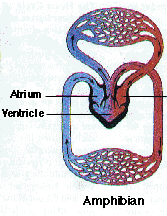
| Three chambered heart (two atria & one ventricle) | |
| Double loop blood circulation to lungs & rest of body cells |
| Skin with keratin (protein) to prevent water loss | |
| Necks to more easily see & feed | |
| Most with smooth, moist skin to take in dissolved oxygen | |
| Some with oral glands to moisten food they eat | |
| Webbed toes without claws | |
| Ectothermic – body temperature changes with environment | |
| Show dormancy or torpor (state of inactivity during unfavorable environmental conditions) | |
| Hibernate in winter and aestivate in summer | |
| Aquatic larva called tadpole goes through metamorphosis to adult | |
| Metamorphosis controlled by hormone called thyroxine |
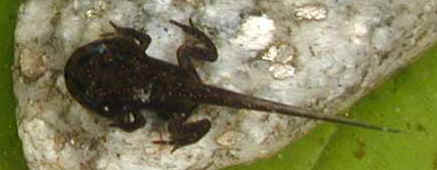
Tadpole
| External fertilization with amplexus (male clasps back of female as sperm & eggs deposited into water) | |
| Eggs coated with sticky, jelly like material so they attach to objects in water & do not float away | |
| Eggs hatch into tadpoles in about 12 days |

- Males with vocal sacs to croak
- Digested system adapted to swallow prey whole
- Well developed muscular system
Classification:
- Anura – frogs & toads
- Urodela – salamanders & newts
- Apoda – caecilians
- Trachystoma – sirens or mud eels
Anuran Characteristics:
- Both terrestrial & freshwater species
- Tadpole with tail, gills, & two-chambered heart
- Adults without a tail, four limbs, & lungs
- Frog skin smooth & moist for cutaneous respiration, while toads is rough & warty (poison glands)
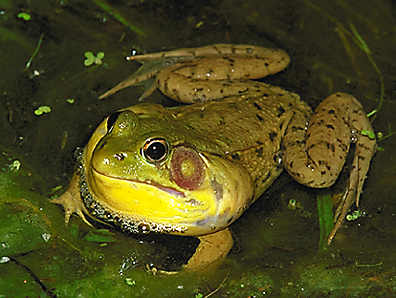 Frog |
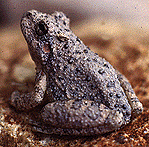 Toad |
- Long hind limbs for jumping
- Long, forked tongue hinged at front of mouth
Urodela Characteristics:
- Includes salamanders & newts
- Have elongated bodies with a tail & four limbs
- Smooth, moist skin for cutaneous respiration
- Less able to stay on dry land than anurans
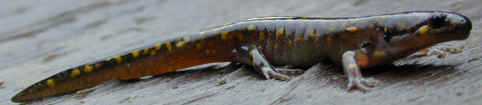
Spotted Salamander
- Size from a few centimeters long to 1.5 meters
- Nocturnal when live in drier areas
- Newts are aquatic species
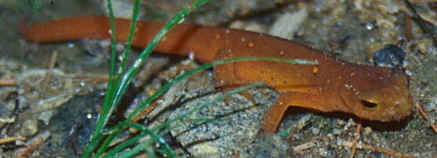
Red Spotted Newt
- Lay eggs in water or damp soil
- Some bear live young
- May or may not go through tadpole stage (some hatch & look like small adult)
Apodan Characteristics:
- Includes caecilians
- Tropical, burrowing, worm like amphibians
- Legless
- Small eyes & often blind
- Eat worms & other invertebrates
- Average length 30 centimeters, but can grow up to 1.3 meters
- internal fertilization
- Female bear live young
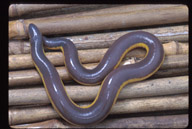
Caecilian
Trachystoma Characteristics:
- Includes mud eels or sirens
- Known as “rough mouth” amphibians
- Found in eastern U.S. & southern Europe
- Have minute forelimbs & no hindlimbs
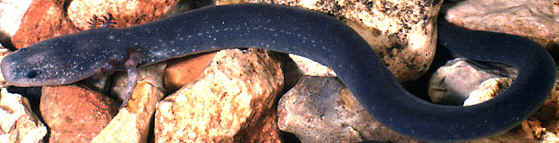
Mud Eel or Siren
External Frog Anatomy:
- Live double life on land & water
- Powerful hind legs for jumping & swimming fold under body when at rest
- Bulging eyes to stay submerged but still see predators
- Blinking eyelids protect eyes from dust & dehydration
- Nictitating membranes clear to moisten eye & see underwater
- Internal nostrils or nares allow frog to breathe underwater
- Tympanic membranes or eardrums behind each eye transmit sound through bone called columella to inner ear
- Eustachian tubes connect mouth & middle ear to equalize pressure

- Males croak or make sound to attract females & ward off other males
- Have protective coloration from cells called chromatophores
- Granular glands secrete foul tasting or poisonous substance
- Mucus glands lubricate skin for oxygen to be dissolved & absorbed
Internal Frog Anatomy:
Skeletal System
- Nine spinal vertebrae (1 cervical in neck, 7 trunk, & 1 sacral supporting hind legs)
- Urostyle long, slim bone connecting sacral vertebrae & trunk
- No rib cage, but pectoral girdle forms shoulders & connects front legs
- Pelvic girdle connects to hind legs
Digestive System
- Tongue sticky, forked, & hinged at front of mouth so can be extended out to catch insects
- Can pull eyes inward to help swallow food
- Two, sharp, backward-pointing vomerine teeth in roof of mouth help prevent prey from escaping
- Maxillary teeth line the edge of the upper jaw
- Alimentary canal (mouth, esophagus, stomach, small & large intestines, and cloaca) is where food is digested, absorbed & wastes eliminated
- Stomach makes gastric juices to break down food
- Pyloric sphincter muscle controls movement of food from stomach into first part of small intestine called duodenum
- Liver makes bile to digest fats; stored in gall bladder
- Pancreas makes pancreatic juice to digest food in small intestine
- Ileum is coiled mid portion of small intestine
- Mesentery is a fanlike membrane holding the intestine in place
- Wastes collect in large intestine & then move into cloaca along with eggs, sperm, & urine until they leave body through the anus
 |
Circulatory System
- Need more oxygen to burn increased amount of food needed to live on land
- 3 chambered heart (right atrium receives deoxygenated blood from body, left atrium receives oxygenated blood from lungs, & ventricle pumps blood to lungs & rest of the body)
- Double loop blood circulation (pulmonary from heart to lungs & systemic from heart to rest of body)
- Conus arteriosus carries blood from ventricle to body cells
Respiratory System
- Tadpoles use gills to breathe
- Adult frogs breathe through lungs & moist skin (cutaneous respiration)
- Glottis is the opening into throat & lungs
Excretory System
- Carbon dioxide excreted through skin & lungs
- Kidneys filter blood & store urine in urinary bladder until leaves cloaca
Nervous System
- Olfactory lobes at base of brain detect smells
- Cerebrum behind olfactory lobes controls muscles
- Optic lobes detect sight
- Cerebellum controls balance & coordination
- Medulla oblongata controls heart rate & breathing
- Cranial nerves connect brain & spinal cord, while spinal nerves branch off the spinal cord to muscles & sensory receptors
Antibiotic Resistant Lab
Antibiotic resistance of bacteria
Procedure Using a sterile loop, pick an isolated colony from you bacterial plate. Try to find one that grew well but is all by itself. Move the colony (don’t scoop up the agar) to a new plate.  Using a moist, sterile, cotton swab, spread the bacteria around on the plate.
The goal is to get an complete, even, coverage of bacterial growth on the plate (called a “lawn”). Remember to open the plate only minimally, using the lid as an “umbrella” to prevent contamination (see image below). Label each plate on the bottom (agar contaning side) and store it for examination during next week’s lab.Each new prepared plate will receive four paper discs containing antibiotics. We will be using several different types of Antibiotics and/or antimicrobials.
(please fill in which antibiotics you used below)
- 1
- 2
- 3
- 4
The antibiotic discs come in a little tube-like dispenser. To remove the discs take a sterile toothpick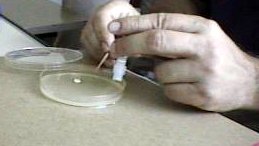 and push out a disc into your plate. Use the toothpick to gently press the disc onto the agar. Once you have added the five antibiotic discs to your plates, make sure the plates are labelled and store them in the back of the lab until next week.
If the bacteria are susceptible to the antibiotic a zone of inhibited growth will be evident next week. Measuring the size of this zone is a relative indication of the effect of the antibiotic on the particular bacteria.
Bacteria possess several characteristics that enable them to become resistant to antimicrobial drugs:
- Asexual reproduction
- Short generation times
- High mutation rates
Some Information on Antibiotics
Questions –
1. Name two ways (1. and 2. ) that common human practices towards antimicrobials aids bacteria in becoming resistant.
2. Name two reasons your Physician will perform cultures such as the ones you have done in this lab.
4. How are materials are collected for cultures?
5. Why is neccesary to use sterile technique when obtaining cultures?
Animal Symmetry and Phyla

Amphibian Study Guide BI
Amphibian Study Guide

| Describe what happens to a tadpole during its metamorphosis. |
| Explain why amphibians must return to the water to reproduce. |
| What characteristics of the frog’s skeleton make it adapted for jumping. |
| What is a series of body changes during an amphibian’s life cycle called? |
| Does a frog’s heart pump oxygenated or deoxygenated blood? Explain. |
| Are adult frogs omnivores, herbivores, or carnivores? tadpoles? |
| Tell some unusual ways some frogs undergo their metamorphosis. |
| Where must frogs lay their eggs? |
| Give the order for amphibians without tails. |
| Where do toads lay their eggs? |
| What does the word “amphibian” mean? |
| What is the earliest known amphibian fossil? |
| Where does fertilization take place in most amphibians? |
| Describe the skin of amphibians. How does this compare to reptiles? |
| Describe caecilians. |
| What is the purpose of the cloaca in amphibians? |
| Amphibians with slender bodies and no limbs are _____________. |
| Why do amphibians need thin, moist skin? |
| Name the 2 ways gases are exchanged in amphibian adults. |
| Give the order for newts & salamanders. |