Amino Acids

Listed below are the common names and structural formulas of the twenty amino acids found in proteins. They are arranged alphabetically.

Structure of alanine. [str5ala.jpg]
alanine
Structure of arginine. [str5arg.jpg]
arginine
Structure of asparagine. [str5asn.jpg]
asparagine
Structure of aspartic acid. [str5asp.jpg]
aspartic acid
Structure of cysteine. [str5cys.jpg]
cysteine
Structure of glutamic acid. [str5glu.jpg]
glutamic acid
Structure of glutamine. [str5gln.jpg]
glutamine
Structure of glycine. [str5gly.jpg]
glycine
Structure of histidine. [str5his.jpg]
histidine
Structure of isoleucine. [str5ile.jpg]
isoleucine
Structure of leucine. [str5leu.jpg]
leucine
Structure of lysine. [str5lys.jpg]
lysine
Structure of methionine. [str5met.jpg]
methionine
Structure of phenylalanine. [str5phe.jpg]
phenylalanine
Structure of proline. [str5pro.jpg]
proline
Structure of serine. [str5ser.jpg]
serine
Structure of threonine. [str5thr.jpg]
threonine
Structure of tryptophan. [str5trp.jpg]
tryptophan
Structure of tyrosine. [str5tyr.jpg]
tyrosine
Structure of valine. [str5val.jpg]
valine

Alien Invasion


Alien Invasion

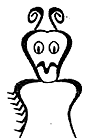
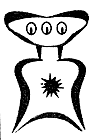
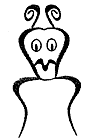
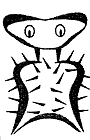
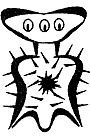
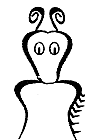
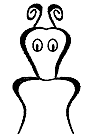
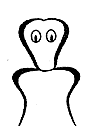
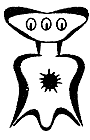
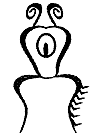
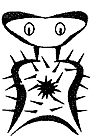
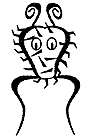
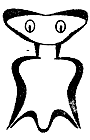
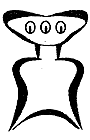
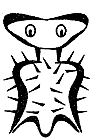
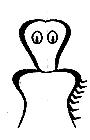
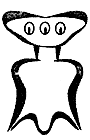
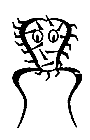
Help! Aliens have landed on Earth from another planet. Before scientists can release the aliens, they want to identify and classify them. Use the dichotomous key on the next page to identify these creatures.


1.
2.
3.
4.
5.
6.
7.
8.
9.
10.
11.
12.
13.
14.
15.
16.
17.
18.
19.
20.


   A Key to Alien Creatures:


1. a. The creature has a large wide head…………………………………….go to 2
b. The creature has a small narrow head……………………………….go to 11
2. a. It has 3 eyes ……………………………………………………………………………..go to 3
b. It has 2 eyes …………………………………………………………………………….go to 7
3. a. There is a star in the middle of its chest………………………….go to 4
b. There is no star in the middle of its chest ………………………go to 6
4. a. The creature has hair spikes ………………………………………..Broadus hairus
b. The creature has no hair spikes…………………………………………..go to 5
5. a. The bottom of the creature is arch-shaped ……………Broadus archus
b. The bottom of the creature is M-shaped ……………….Broadus emmus
6. a. The creature has an arch-shaped bottom ……………….Broadus plainus
b. The creature has an M-shaped bottom……………………Broadus tritops
7. a. The creature has hairy spikes ……………………………………………go to 8
b. The creature has no spikes…………………………………………………go to 10
8. a. There is a star in the middle of its body ………………..Broadus hairystarus
b. The is no star in the middle of its body ………………………..go to 9
9. a. The creature has an arch shaped bottom ……………….Broadus hairyemmus
b. The creature has an M shaped bottom ……………………Broadus kiferus
10. a. The body is symmetrical ………………………………………………Broadus walter
b. The body is not symmetrical……………………………………….Broadus anderson
11. a. The creature has no antennae ……………………………………….go to 12
b. The creature has antennae …………………………………………….go to 14
12. a. There are spikes on the face ………………………………….Narrowus wolfus
b. There are no spikes on the face ………………………………….go to 13
13. a. The creature has no spike anywhere ……………………Narrowus blankus
b. There are spikes on the right leg ………………………..Narrowus starboardus
14. a. The creature has 2 eyes…………………………………………………go to 15
b. The creature has 1 eye……………………………………………Narrowus cyclops
15. a. The creature has a mouth……………………………………………..go to 16
b. The creature has no mouth…………………………………………..go to 17
16. a. There are spikes on the left leg ………………………..Narrowus portus
b. There are no spikes at all ………………………………….Narrowus plainus
17. a. The creature has spikes ………………………………………………go to 18
b. The creature has no spikes ……………………………..Narrowus georginia
18. a. There are spikes on the head …………………………………..go to 19
b. There are spikes on the right leg……………………..Narrowus montanian
19. a. There are spikes covering the face ……………….Narrowus beardus
b. There are spikes only on the outside edge of head ……Narrowus fuzzus


Return to Earth

Annelid

Annelids
Segmented Worms
All Materials © Cmassengale
 

Phylum Annelida
Characteristics

  • Includes duster worms, earthworms, & leeches
  • Abundant in all habitats
  • Have a true coelom fully lined with mesoderm
  • Body divided into external segments called metameres (metamerism)

  • Metameres correspond to internal segments
  • Have a one-way digestive system with a mouth & anus
  • Well developed brain & sensory organs
  • Fluid-filled coelom provides hydrostatic skeleton
  • Most have external bristles or setae that aid movement
  • Setae may be modified into flashy appendages called parapodia


PARAPODIA

  • Includes 3 classes based on number of setae & presence or absence of parapodia
  • Classes of segmented worms — Oligochaeta, Polychaeta, & Hirudenia

Class Oligochaeta
Characteristics

  • Have no parapodia & few setae
  • Includes earthworms


EARTHWORM

  •  Bodies may have over 100 metameres
  • Internal partitions called septa
  • Distinct anterior & posterior ends
  • Cephalization (head with sense organs) shows specialization for burrowing
  • Have both circular & longitudinal muscles for movement
  • Have external, saddle-shaped structure called clitellum that forms a cocoon containing eggs & sperm
  • Prostomium or lip digs through soil as earthworm feeds on organic matter
  • Pharynx is a muscular organ behind the mouth to help suck in food
  • Food temporarily stored in crop, ground in gizzard, and digested & absorbed in intestine
  • Wastes called castings pass out through anus
  • Closed circulatory system with 5 pairs of aortic arches or hearts
  • Dorsal blood vessel carries blood posteriorly to cells & ventral blood vessel returns blood anteriorly

  • Secrete mucus to keep skin moist so oxygen will dissolve & diffuse into body
  • Long tubules called nephridia filter wastes from blood & excrete it through pores
  • Simple brain, no eyes, & dorsal and ventral nerve cords
  • Sensitive to light, touch, moisture, chemicals, temperature, & vibrations
  • Hermaphrodites exchange sperm & cross-fertilize
  • Sperm sacs store the worm’s own sperm & seminal receptacles store exchanged sperm

Class Hirudenia
Characteristics

  • No setae or parapodia
  • Includes leeches
  • Have anterior & posterior suckers for attachment


LEECH

  • Some suck blood from hosts, while others are scavengers or predators
  • Mouth’s of blood-sucking leeches with chitinous teeth & secrete anticoagulant
  • Found in freshwater
  • Flattened dorso-ventrally
  • Hermaphrodites that cross-fertilize

Class Polychaeta
Characteristics

  • Marine
  • Includes sandworms & clamworms
  • Have paddle-like parapodia to move
  • Take in oxygen through parapodia
  • Some are free-swimming predators with strong jaws to feed on small animals
  • Many live commensally with sponges, mollusks, & echinoderms
  • Well-developed head with antenna & specialized mouthparts


SANDWORM

BACK


Amylase on Starch Lab


Enzyme Amylase Action on Starch

INTRODUCTION:

In this experiment you will observe the action of the enzyme amylase on starch. Amylase changes starch into a simpler form: the sugar maltose, which is soluble in water. Amylase is present in our saliva, and begins to act on the starch in our food while still in the mouth.
Exposure to heat or extreme pH (acid or base) will denature proteins. Enzymes, including amylase, are proteins. If denatured, an enzyme can no longer act as a catalyst for the reaction.
Benedict’s solution is a test reagent that reacts positively with simple reducing sugars like maltose, but will not react with starch. A positive test is observed as the formation of a brownish-red cuprous oxide precipitate. A weaker positive test will be yellow to orange.

MATERIALS:

Cornstarch
Distilled water
Saliva
Vinegar
Benedict’s qualitative solution
3 graduated cylinders (10mL)
250-ml beaker
Stirring rod
3 test tubes (16 x 125mm)
Test tube rack
Wax pencil
Water Bath

PRE-LAB:

Add 1g of cornstarch to a beaker containing 100ml of cold distilled water. While stirring frequently, heat the mixture just until it begins to boil. Allow to cool.

PROCEDURE:

1. Fill the 250-mL beaker about 3/4 full of water and place on the hot plate for a boiling water bath. Keep the water JUST AT BOILING.

2. Mark 3 test tubes A, B and C. “Spit” between 1 and 2 mL of saliva into each test tube.

3. Into tube A, add 2 mL of vinegar. Into tubes B and C, add 2 mL of distilled water. Thump the tubes to mix.

4. Place tube B into the boiling water bath for 5 minutes. After the five minutes, remove from the bath, and place back into the test tube rack.

5. Add 5 mL of the starch solution to each tube and thump to mix. Allow the tubes to sit for 10 minutes, occasionally thumping the tubes to mix.

6. Add 5 mL of Benedict’s solution to each tube and thump to mix. Place the tubes in the hot water bath. The reaction takes several minutes to begin.

OBSERVATIONS:

Tube A: Starch + saliva treated with vinegar (acid)

    • Was the test positive or negative? _______________________

What does this indicate?__________________________________________________

____________________________________________________________________

____________________________________________________________________

Tube B: Starch + saliva and water, treated in a boiling water bath

    • Was the test positive or negative? _______________________

What does this indicate?__________________________________________________

____________________________________________________________________

____________________________________________________________________

Tube C: Starch + saliva

    • Was the test positive or negative? _______________________

What does this indicate?__________________________________________________

____________________________________________________________________

____________________________________________________________________

QUESTIONS:

1. What is the function of an enzyme?


2. Where does a substrate attach to an enzyme?

3. If an enzyme is present in a reaction, less ________________ _________________ will be needed to get the reaction started.

4. What is a common suffix found at the end of most biological enzymes?

5. Most enzymes are macromolecules called ________________.

6. Define denaturation of proteins.


7. Name 3 things that can denature or unfold an enzyme.


8. In this lab, what weak acid denatured the protein?

9. What was the purpose of placing one test tube in a hot water bath?


10. What happens to enzymes in your body whenever you run fever?


Alien Taxonomy Project


Alien Taxonomy


In the year 2525:

Humans, after hundreds of years of constant effort, have successfully polluted all bodies of water on Earth. As a result, almost all previously known species of plants, animals, and other life forms have become extinct. Through natural selection, genetic engineering, and selective breeding programs, a portion of the Earth has been successfully repopulated. The following organisms are all that remain:

  1. Photosynthetic humanoids with green chlorophyll-containing hair (autotrophs)
  2. Chemosynthetic dolphin-like organisms who derive their energy for food production from the contaminants in the water (autotrophs)
  3. Aquatic humanoids who work on the dolphin’s aquaculture farms (heterotrophic)
  4. Aqua wheat, a heterotrophic crop grown by the dolphins that feeds on bacteria
  5. Legless, photosynthetic humanoid space travelers with arm-like tentacles that visit the Earth every 6 weeks
  6. Anaerobic humanoids designed for space living, but when on Earth for space training, they must wear deoxygenated space suits (heterotrophs)
  7. Cockroach-like organisms that feed on humanoid and dolphin excrement (Decomposers)
  8. Heterotrophic giant squids that feed on humanoids & dolphins
  9. Green-skinned, photosynthetic rats
  10. Parasitic mosquitoes that feed on humanoids

Your Assignment:

As an alien taxonomist, it is your responsibility to classify these existing organisms.

  1. Create Latin-sounding Genus and species names for each organism. Remember that the species name should reflect a characteristic of the organism.
  2. Create a taxonomic scheme for each organism including a kingdom, phylum, and the genus and species name you created. Use only two kingdoms that you create. Be sure to also include the number of the organism with the scheme
  3. Illustrate your interpretation of each organism’s appearance including all the characteristics given to you.  All illustrations should be numbered and colored on a single sheet of unlined paper.
  4. Prepare a dichotomous key using the scientific names for these organisms so that your fellow aliens can also identify them when they come to Earth for summer vacations. 
  5. Make a cover sheet with your name, date, and period and paper clip your sheets together.


CLICK HERE FOR PRINTABLE COPY OF ACTIVITY & WORKSHEET

BACK