Vertebrate Worksheet


Vertebrate Worksheet


1. In what phylum & kingdom are the vertebrates found?

2. List the classes of vertebrates.


3. Discuss the characteristics of chordates & vertebrates.


4. What were the 1st vertebrates & describe them?


5. Sketch a lamprey & describe the characteristics of this fish. Where are they found?


6.  Describe a hagfish.


7. In what group are lampreys & hagfish found & why?


8. Do agnathans have paired fins?


9. What were the 1st jawed fish & describe them.


10. What are the 2 classes of jawed fish?

11. What is in the class Chondrichthyes & what traits do they have in common.


12. Sketch & describe sharks.


13. Sketch a ray or skate & describe them.


14. Name the class for bony fish.


15. Name the 2 groups of bony fish.


16. Give several examples of ray-finned fish & describe them.


17. Name 2 lobe-finned fish & describe both of them.


18. What was the 1st group of vertebrates to move onto land? What is in this group?


19. Describe characteristics of amphibians.


20. Amphibians are ectotherms. What does this mean?


21. How are amphibians still linked to water?


22. What is in the class Reptilia?


23. Reptiles do not need water for reproduction. Explain why this is true.


24. Describe the amniote egg of reptiles. Include a labeled sketch of the egg.


25. What reptile group is thought to be the ancestors of mammals?


26. What were pterosaurs?


27. What 3 groups of retiles are still alive today?


28. Describe characteristics of the reptiles.


29. How can snakes swallow such large prey?


30. What is the purpose of the Jacobson’s organ in snakes?


31. What takes the place of teeth in turtles?


32. Describe crocodiles & alligators & tell some of their habits.


33. What class contains birds?

34. From what did birds probably evolve?

35. What are the distinguishing features of birds?


36. Sketch & label the parts of a feature.


37. Birds are endotherms. What does this mean?


38. Name some flightless birds.


39. Name some swimming birds.


40. What are the 3 main characteristics of all mammals?


41. What in female mammals produces milk?

42. What is mammalian hair made of & give its 4 functions.


43. What bones are modified in mammals to help them hear sounds?

44. Name a flying mammal.

45. Give examples of mammals that are herbivores.

46. Give examples of mammals that are carnivores.

47. What mammal is a thinker & toolmaker?

48.Name 7 adaptations of mammals.


49.Give examples of monotremes & tell their characteristics. Tell where they are found.


50. Give examples of marsupials & tell their characteristics. Tell where most of them are found.


51. Most mammals are placentals. What does this mean?


52. What is gestation? Do all mammals have the same gestation period?


53. What is the purpose of the chorion?


54.Name the 12 orders of placental mammals & give an example of an animal in each order.


Virus


Viruses
All Materials © Cmassengale

Discovery of Viruses

  • Beijerinck (1897) coined the Latin name “virus”  meaning poison for  the substance infecting tobacco plants
  • Wendell Stanley (1935) crystallized sap from tobacco leaves infected with Tobacco Mosaic Virus (TMV) & found virus was made of nucleic acid & protein


Wendell Stanley Tobacco Leaf with Virus


  • Edward Jenner developed smallpox vaccine using milder cowpox viruses
  • Virology – study of viruses
  • Deadly viruses are said to be virulent
  • Viruses couldn’t be seen until electron microscope invented

Viral Characteristics

  • Not living organisms
  • Noncellular
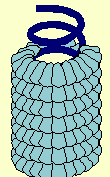
  • Consist of a nucleic acid core (DNA or RNA) and a protein coat called the capsid
  • Capsid made of protein subunits called capsomeres
  • Cannot grow or replicate on their own (inactive particles)


  • Can only reproduce inside of a living host cell using its raw materials & enzymes
  • Lack ribosomes & enzymes needed for protein synthesis or metabolism
  • Are extremely small particles ranging from 20 – 400 nanometers on average
  • Largest virus is 1000 nanometers in dimension
  • Some can cause disease (smallpox, measles, mononucleosis, influenza, colds, AIDS, Ebola

Ebola Picture
Ebola Virus

  • Some may also cause cancers such as leukemias
  • Virus free cells are rare
  • Highly host specific (only infect certain cells)
  • Referred to as phages
  • Viruses are classified into 2 main groups by their nucleic acid — DNA or RNA Viruses
  •  DNA & RNA viruses are subdivided by capsid shape & whether they do or don’t have an envelope

Viral Structure

  • DNA or RNA core surrounded by protein sheath called capsid
  • Nucleocapsid  includes the viral nucleic acid & its capsid
  • Some form lipid rich covering around capsid called the envelope
  • Envelope usually formed from host cell membrane
  • Envelope may have spikes to help chemically recognize & attach to the host cell
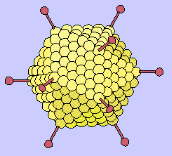
  • Shaped determined by the arrangement of proteins making up the capsid
  • TMV is rod shaped

  • Adenovirus & polio viruses are icosohedral (20 sided)

Virus Structure

  • Measles & rabies viruses are helical
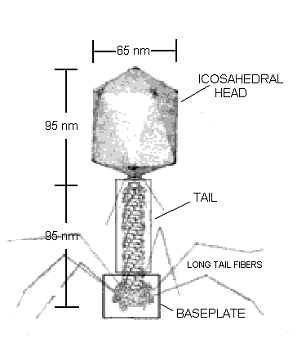
  • T -phages have a head & tail

Bacteriophage Structure

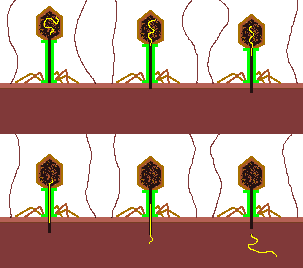
Bacteriophages or T-Phages

  • Among the most complex viruses
  • Attack bacterial cells
  • Composed of a icosohedral head, tail, base plate, & tail fibers
  • Long DNA molecule is inside the head 
  • Tail helps inject the viral DNA into host cell
  • Tail fibers used to attach to host

Retroviruses

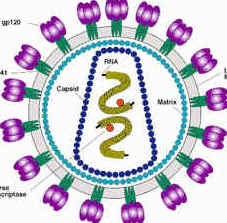
  • Contain RNA
  • Have an enzyme called reverse transcriptase which helps use the RNA to make DNA
  • Use the host cell’s ribosomes & raw materials to make viral proteins
  • Cause some cancers & AIDS


HIV Virus

Viroids

  • Smallest particle able to replicate
  • Made of a short, single strand of RNA with no capsid
  • Cause disease in plants


Viroid Attack on Potatoes

Prions

  • No nucleic acid or capsids
  • Made of protein particles that have folded incorrectly
  • Attacks the central nervous system
  • Cause animal diseases in cows (Mad Cow disease), sheep, & humans

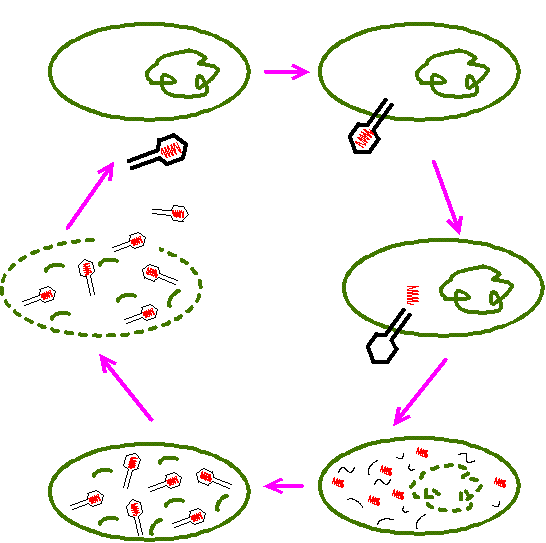
Lytic Cycle

  • Viral replication that rapidly kills the host cell causing it to lyse or burst
  • Involves 5 steps —– Adsorption, Injection, Replication, Assembly, & Lysis
  • Adsorption — phage attaches to cell membrane of host
  • Injection — nucleic acid (DNA) of virus injected into host cell
  • Replication — viral DNA inactivates host cell’s DNA & uses host’s raw materials & ribosomes to make viral DNA, capsids, tails, etc.
  • Assembly — new viral parts are combined to make new phages
  • Lysis — enzymes weaken & destroy the cell membrane causing it to lyse releasing new viruses that infect other cells


Phases of the Lytic Cycle of a Virulent Virus:

  • Absorption:
    1. Virus attaches itself to the cell.
  • Entry:
    1. Enzymes weaken the cell wall and nucleic acid is injected into the cell, leaving the empty caspid outside the cell. Many viruses actually enter the host cell intact.
  • Replication:
    1. Viral DNA takes control of cell activity.
  • Assembly:
    1. All metabolic activity of the cell is directed to assemble new viruses.
  • Release:
    1. Enzymes disintegrate the cell in a process called

lysis

    , releasing the new


Source: http://science.howstuffworks.com/virus-human.htm

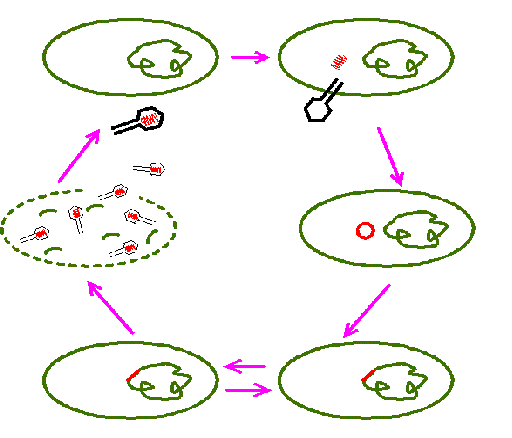
Lysogenic Cycle

  • Replication in which the virus stays inactive inside of the host cell & doesn’t immediately kill it
  • Viruses are called temperate phages
  • Lysogenic steps include adsorption, injection, recombination, cell reproduction, activation, replication, assembly, & lysis
  • Recombination —Viral DNA joins with host cell DNA forming an inactive prophage
  • Host cell reproduces  normally until activated by an external stimuli 
  • External stimuli unknown, but could be ultraviolet radiation, carcinogens, etc.
  • Once activated, prophage forms new viruses & destroys host cell
  • HIV is an example of a temperate phage


The Lysogenic Cycle of a Temperate Virus:

  • The virus attaches itself and injects its DNA into the cell.
  • The viral DNA attaches itself to the host DNA, becoming a new set of cell genes called a prophage.
  • When the host cell divides, this new gene is replicated and passed to new cells. This causes no harm to the cell, but may alter its traits.
  • Now there are two possibilities:
    • The prophage survives as a permanent part of the DNA of the host organism.
    • Some external stimuli can cause the prophage to become active, using the cell to produce new viruses.


Source: http://science.howstuffworks.com/virus-human.htm

Viral Control

  • Interferon are proteins made by cells to fight viruses
  • Two types of viral vaccines exist — inactivated & attenuated
  • Inactivated virus vaccines don’t replicate in the host’s system
  • Attenuated viral vaccines have been genetically altered so they can’t cause disease
  • Antiviral drugs (AZT, acyclovir, & azidothymidine) interfere with viral DNA synthesis
  • Protease Inhibitors interfere with viral capsid production
  • New viruses emerge as rain forests are cleared (Ebola virus)
Back

Who Ate the Cheese


Who Ate the Cheese?!

Introduction:

DNA isolation from blood, hair, skin cells, or other genetic evidence left at the scene of a crime can be compared with the DNA of a criminal suspect to determine guilt or innocence. This is due to the fact that every person has a different sequence. Scientists use a small number of sequences of DNA that are known to vary among individuals, and analyze those to get a possibility of a match.  DNA is isolated, cut using restriction enzymes and sorted by size by gel electrophoresis. DNA is placed in a gel and an electrical charge is applied to the gel. The positive charge is at the top and the negative charge is at the bottom. Because DNA has a slightly negative charge, the pieces of DNA will be attracted to the bottom. The smaller pieces move more quickly towards the bottom than the larger pieces. The DNA can then be analyzed.

Objectives:

In this simulation you will examine crime scene evidence to determine who is responsible for eating the Queen’s special imported Lindbergher Cheese (yes, the stinky cheese). You will model the process of electrophoresis and DNA fingerprinting.

ROYAL GUARD INCIDENT REPORT

Incident Data

Incident Type: Theft Complaint Status Pending DNA results
Processed by: Chief Wiggam Other Officers: Officer Li Gase

Property

Property Code: Rare cheese Owner’s Name Queen Elizabeth
Name: Lindbergher Value: $12,000

Burglary Data

Method of Entry: Unknown, no evidence of force on doors or windows.

Narrative: The cheese was allegedly stolen from the Queen’s sitting room the night before the grand ball. The cheese was listed as a gift from the Manchurian diplomat. Officer Li Gase dusted for fingerprints and found none on the table or doors, the maid claimed that they had been wiped clean earlier. The wheel of cheese was on a platform in the sitting room, and half of it had been eaten. We took pictures of the half eaten cheese and sent it to the lab for further tests. Edna N. Zime, the lab technician said that saliva samples could be taken from the teeth imprints of the cheese that was left behind.

Suspect Data

Suspect Number: 1
Name: Princess Dubbah Elix
Description of Suspicion: The princess was seen entering the sitting room earlier in the evening. She is well known for her love of cheese.

Suspect Number 2
Name: Electra Foresis
Description of Suspicion: Electra was recently involved in a relationship with the Manchurian diplomat that sources say ended badly. Her motive may have been to sabotage the diplomat’s gift to the Queen.

Suspect Number 3
Name: Ada Nine
Description of Suspicion: Ada was the maid in charge of cleaning the sitting room. She had access to the cheese.

Suspect Number 4
Name: Gene Tics
Description of Suspicion: Gene is the leader of the local Cheese-Makers Guild, he may not have wished for Queen Elizabeth to have cheese from anywhere but his own guild.

Crime Lab Data

Crime Lab Investigator R. Renee Lab Technician Edna N. Zime
List of Evidence Received Plastic bag with cheese crumbs List of Procedures Used DNA extraction
Polymerase Chain Reaction
DNA restriction Analysis

Narrative: After receiving the package with the plastic bag marked Crime Scene, the DNA was extracted. Because the sample was so mall, the DNA was amplified using the polymerase chain reaction. We isolated the DNA from the four suspects and compared them to the crime scene DNA using DNA restriction analysis.

Results: See attached DNA Results

DNA Evidence Evaluation:

1. Turn your paper strips (DNA sequences) so that the side with the bases is facing you. The restriction enzyme cuts at every point it finds C C G G, always cutting between the C and the G. Label the back of the slips with the suspect number so that you don’t get them confused after cutting. Use scissors to cut the DNA sequence at the C C G G points.

2. Count the number of base pairs (bp) in each piece of DNA that you created. Record the base pair number on the back side of the DNA fragment.

3. Make an enlarged chart like the one shown. Your teacher will give you paper for this. Use a ruler to ensure that the lengths are uniform.

4. Tape your DNA fragments to the chart, using the base pair numbers as a guideline for fragment placement.

5. Compare the crime scene DNA to the suspects and indicate on your chart, which suspect is guilty of eating the cheese.


ANALYSIS:

1. On your chart, label the positive (+) and the negative (-) ends. Circle the suspect’s DNA who matches the DNA at the crime scene and write the name of the suspect.

2. For each of the following tasks performed in the activity, describe what they are actually simulating.

Cutting the DNA into fragments:


Taping the DNA onto the large paper:


3. For each word below, describe how it relates to DNA Fingerprinting:

Polymerase Chain Reaction:


Gel Electrophoresis:


Restriction Enzyme:


BACK

What is Ecology PPT Questions


What is Ecology?
By Susan Lundy


1.  Definition:

2.      It ________________ how living organism affect each other and the world they live in.
3.      ____________________ is the place a plant or animal lives in.
4.      ____________________ is an organism’s total way of life (its job)
5.      ____________________ factors are the nonliving parts of an organism’s environment.
6.      4 Examples of abiotic factors are:


7.      _____________________ factors are all the living organisms that inhabit an environment.

8.      Some things that organism’s rely on each other are _________________, ______________________, __________________ or _________________

9.      What are the levels of simple organization from simplest to most complex?

10.      _________________________ have organized the interactions an organism takes part in to different levels according to ________________

11.     Level 1 Organism:

12.     Level 2 Population:

13.     Level 3 Biological Community:

14.     Level 4 Ecosystem:

15.     Level 5 Biosphere:

16.      Where can you find life?


Unsegmented Worm

Unsegmented Worms

All Materials © Cmassengale

Phylum Platyhelminthes
Characteristics

  • Called flatworms because bodies are flattened dorso-ventrally

  • Acoelomate – solid bodies without a lined body cavity
  • Have 3 body layers — outer ectoderm, middle mesoderm, & inner endoderm
  • Bilaterally symmetrical
  • Show cephalization (concentration of sensory organs at anterior or head end)
  • Body cells exchange oxygen & carbon dioxide directly with environment by diffusion
  • Single opening into gastrovascular cavity; two-way digestive tract
  • Some are parasites & others are free-living
  • Parasitic worms have thick cell layer called tegument covered with a nonliving cuticle covering their bodies as protection inside hosts
  • Includes 3 classes — Turbellaria (planarians), Trematoda (parasitic flukes), & Cestoda (parasitic tapeworms

Class Turbellaria

  • Most are marine but includes freshwater planarian (Dugesia)

Planarians

  • Spade-shaped at the anterior end & have two, light-sensitive eyespots
  • Can sense light, touch, taste, & small
  • Have 2 clusters of nerve cells or ganglia to form a simple brain
  • Nervous system composed of a nerve net
  • Capable of simple learning
  • Move by tiny hairs or cilia over a mucus layer that they secrete
  • Feed by scavenging or protozoans
  • Have a single opening or mouth located at the end of a muscular tube called the pharynx which can be extended when feeding
  • Flame cells help remove wastes to excretory pores

  • Hermaphrodites that cross-fertilize eggs that are then deposited into a capsule until hatching in 2-3 weeks
  • Reproduce asexually by fragmentation

Class Trematoda

  • Includes parasitic flukes
  • About 1 cm long & oval shaped

  • Require a host to live
  • Have both oral & ventral suckers to cling to host & suck blood, cells, & body fluids
  • Oral sucker around mouth at anterior end sucks blood
  • May be endoparasites (live inside a host) or ectoparasites (live on the outside of host
  • Covered in tough, unciliated tegument
  • Nervous & excretory systems like turbellarians
  • Hermaphrodites
  • Have a long, coiled uterus that stores & releases 10,000+ eggs
  • Eggs released through genital pore & develop into larva
  • Show complex life cycles
  • Life cycle of sheep liver fluke:
    * Adult liver flukes live in sheep liver & gall bladder where they mate & form eggs
    * Eggs enter intestines, pass out with feces, & hatch in water
    * Larva enter snails, asexually multiply, then leave snail & form cysts
    * Cysts (dormant larva with hard, protective covering) clings to grass
    * Sheep ingest cysts when they eat grass
    * Cysts hatch in digestive tract & bore through intestines into bloodstream
    * Mature & reproduce in the liver

  • Schistosomiasis (disease caused by parasitic blood flukes) infects people in Asia, Africa, & South America causing intestinal bleeding & tissue decay that can result in death

Class Cestoda

  • Includes tapeworms
  • Adapted for parasitic life
  • Tough outer tegument prevents being digested by host
  • Anterior end called scolex contains hooks & suckers for attachment to intestine of host

  • Long, ribbon-like bodies up to 12 m in length
  • Nervous system extends length of body but lacks sense organs
  • Lacks mouth & digestive tract but absorbs digested nutrients from host
  • Grows by making body segments called proglottids
  • Each proglottid produces eggs & sperm that cross-fertilize with other segments & also self-fertilize (hermaphrodites)
  • Oldest, mature proglottids containing eggs at posterior end break off & pass out with feces
  • Life cycle of beef tapeworm:
    * Cattle eat grass with proglottids containing fertilized eggs
    * Eggs hatch into larva & bore through cow’s intestine into bloodstream
    * Larva burrow into cow’s muscle & form cysts
    * Humans eat beef (muscle) & cysts travels to intestines
    * Cyst breaks open & adult beef tapeworm forms


BEEF TAPEWORM LIFE CYCLE

Phylum Nematoda
Characteristics

  • Called roundworms
  • Includes Ascaris, hookworms, Trichinella, & pinworms
  • Pseudocoelomates have fluid-filled body cavity partially lined with mesoderm
  • Pseudocoelom contains the body organs & provides hydrostatic skeletal support for muscles
  • Have long slender bodies that taper at both ends

  • Covered with flexible cuticle
  • Digestive tract with anterior mouth & posterior anus; called one-way digestive tract
  • Separate sexes in most species
  • Most are free living
  • Some are parasites on plants & animals
  • Ascaris is a parasitic roundworm living in the intestines of pigs, horses, & humans
  • Ascaris life cycle:
    * Enter body in contaminated food or water & hatch in intestines
    * Larva bore into bloodstream & carried to lungs & throat
    * Larva coughed up, swallowed, & return to intestines to mature & mate
    * Block the intestine causing death

  • Hookworm eggs hatch in moist soil & larva bore through bare feet of new host 
  • Trichinella are human parasites caused by eating undercooked pork containing the cysts
    * Cause disease called trichinosis
    * Cysts cause muscle pain & stiffness


 CYSTS IN CONTAMINATED PORK

Phylum Rotifera
Characteristics

  • Known as rotifers or wheel animals
  • Transparent, free-swimming microscopic animal
  • Freshwater & marine
  • Have a ring of cilia around mouth that rotates like a wheel to bring in food
  • Feed on unicellular algae, bacteria, & protozoa
  • Have a muscular organ called the mastax behind the pharynx to chop food
  • Nervous system composed of anterior ganglia & 2 long nerve cords
  • Show cephalization (head end)
  • Have 2 anterior, light-sensitive eyespots

Back