Taxonomy

Taxonomy
All Materials © Cmassengale


Carolus Linnaeus

Taxonomy – study of classifying organisms

  • Taxonomists are scientists who study classifying
  • Taxon ( taxa-plural) is a category into which related organisms are placed

Reasons to Classify:

  • Shows evolutionary relationships
  • Accurately & uniformly names organisms
  • Prevents misnomers such as starfish & jellyfish that aren’t really fish
  • Uses same language (Latin) for all names
  • Prevents duplicated names because all names must be approved by International Naming Congresses (International Zoological Congress)
  • Naming rules are followed called the International Code for Binomial Nomenclature

Early Taxonomy:

  • Aristotle was the first taxonomist dividing organisms into land, sea, & air dwellers
  • John Ray was the first to use Latin for naming
  • Linnaeus developed the modern system of naming known as binomial nomenclature, a two-word name (Genus & species)
  • Scientific names should be italicized in print or underlined when writing
  • Always capitalize the genus name, but write the species in lower case
  • The scientific name for man is Homo sapiens
  • The genus name may be abbreviated, but not the species (H. sapiens)

Taxonomic categories:

  • Linnaeus placed organisms into related groups called taxa (taxon-singular) based on their morphology (similar structure & function)
  • The broadest taxon is called the kingdom
  • Linnaeus put all organisms into one of two kingdoms — Plantae or Animalia
  • The other six taxa from broadest to most specific are — Phylum, Class, Order, Family, Genus, & species
  • A sentence to help remember these taxa is — “King Phillip Came Over For Gooseberry Soup.”
  • Each taxa is a proper noun &should be capitalized except species
  • Each level or taxon groups together organisms that share more characteristics than the level above

  • Botanists use the term division instead of phylum for classifying plants
  • Plant species are subdivided into varieties, while bacteria are subdivided into strains

Basis for Modern taxonomy:

  • Modern taxonomists classify organisms based on their evolutionary relationships
  • Homologous structures have the same structure, but different functions & show common ancestry
  • The bones in a bat’s wing, human’s arm, penguin’s flipper are the same (homologous), but the function is different

  • Analogous structures have the same function, but different structures & do not show a close relationship (insect wing & bird’s wing)
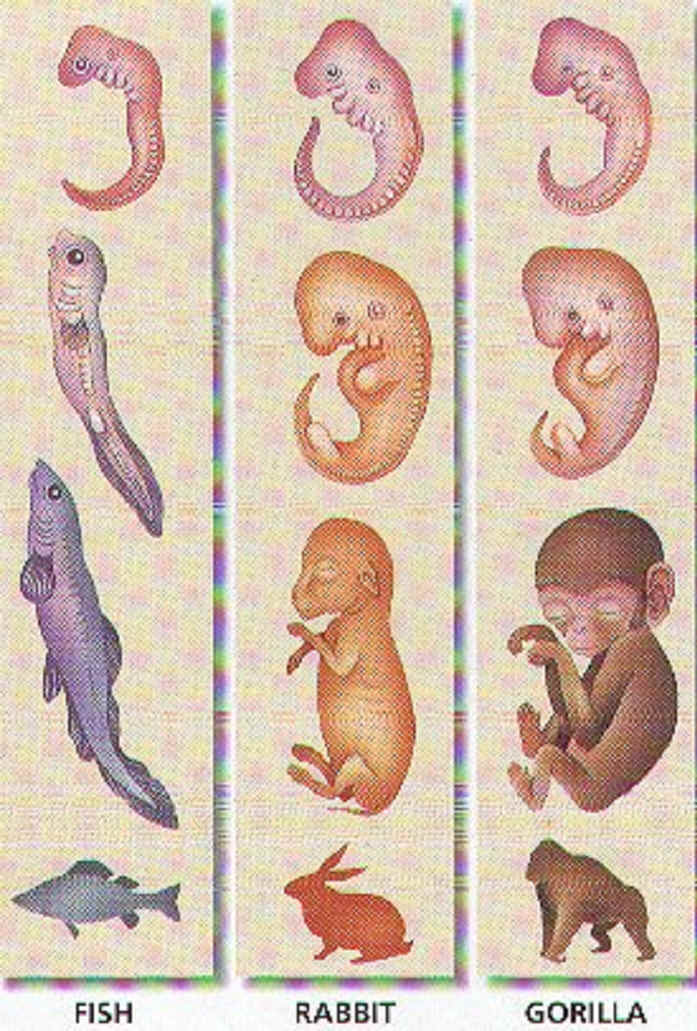
  • Similarity in embryo development shows a close relationship (vertebrate embryos all have tail & gill slits)

  • Similarity in DNA & amino acid sequences of proteins show related organisms

Modern Taxonomic System:

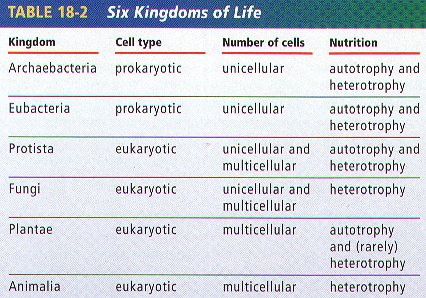
  • Modern taxonomy uses six kingdoms — Archaebacteria, Eubacteria, Protista, Fungi, Plantae, & Animalia
  • Archaebacteria & Eubacteria are unicellular prokaryotes lacking a nucleus, while Protista, Fungi, Plantae, & Animalia are all eukaryotes with a nucleus & membrane-bound organelles
  • All members of Plantae & Animalia are multicellular organisms
  • Fungi & Animalia are heterotrophs, while Plantae are all autotrophs capable of making their own food
  • Archaebacteria live in harsh environments like very salty lakes; intestines of mammals; and hot, sulfur springs & may be autotrophs or heterotrophs
  • Eubacteria are true bacteria some of which cause disease
  • Protista are mainly unicellular with a few multicellular organisms and may be autotrophic (Euglena) or heterotrophic (Ameba)
  • Fungi include multicellular mushrooms, mold, unicellular yeast, etc. & are absorptive heterotrophs (digest food & then absorb it)
  • Animalia are ingestive heterotrophs that take in food & then digest it inside their multicellular bodies.
  • Plantae includes all plants & are the only all multicellular, autotrophic kingdom

Phylogeny (evolutionary history):

  • Phylogenetic trees are branching diagrams showing how organisms are related
  • Also called family trees
  • Fossil records help establish relationships on a phylogenetic tree
  • Organizes living things based on their evolution (systematics)
  • Common ancestor is shown at the base of the tree
  • Most modern organisms shown at tips of branches
  • Each time a branch divides into a smaller branch, a new species evolves

  • Cladograms shows how organisms are related based on shared, derived characteristics such as feathers, hair, scales, etc.

Three Domain System:

  • Based on comparing sequences of ribosomal RNA in different organisms to determine ancestry
  • All organisms placed into three broad groups called domains
  • Domain Archaea (kingdom Archaebacteria) contains chemosynthetic bacteria living in harsh environments
  • Domain Bacteria (kingdom Eubacteria) contains all other bacteria including those causing disease
  • Domain Eukarya (kingdoms Protista, Fungi, Plantae, & Animalia) contains all eukaryotic organisms

BACK


Teddy Graham Natural Selection Lab

Natural Selection in Teddy Grahams

Introduction

You are a bear-eating monster. There are two kinds of bears that you like to eat: happy bears and sad bears. You can tell the difference between them by the way they hold their hands. Happy bears hold their hands high in the air, and sad bears hold their hands down low. Happy bears taste sweet and are easy to catch. Sad bears taste bitter, are devious and hard to catch. Because of this you only eat happy bears. The happy trait in bears is caused by the expression of a recessive allele. The homozygous recessive condition is being happy. The sad trait is caused by a dominant allele. New bears are born every year (when they are hibernating in their den, the cardboard box), and the birth rate is one new bear for every old bear left from last year.

Materials:

Teddy Bear Grahams, lab worksheet, pencil

Procedure:

1. Obtain a population of 10 bears and record he number of happy and sad bears and the total population number. Using the equation for Hardy-Weinberg equilibrium, calculate the frequencies of both the dominant and recessive alleles and the genotypes that are represented in the population. Example: If 5 of the 10 bears are happy, then 10 out of 20 alleles would be happy alleles. Therefore the q2 number would be 0.5. You must then determine the q number by taking the square of 0.5.

2. Now, go hunting! Eat 3 happy bears. (If you do not have 3 happy bears then eat the difference in sad bears.)

3. Once you have consumed the bears obtain a new generation from your den (the box). You should only remove seven additional bears from the den for a total of 14 bears.

4. Repeat the procedures again. Be sure to record the number of each type of bear and the total population.

Table:


Generations P2 (sad) 2pq (sad) q2 (happy) P q
1. Initial
2.
3.
4.


Questions:

1. Describe what is happening to the genotype and allele frequencies in the population of Teddy Grahams?


2. What would you expect to happen if you continued the selection process for additional generations?


3. How would the frequencies change if you were to now select for the sad bears?


4. Why doesn’t the recessive allele disappear from the population? How is it protected?


Taxonomy PPT Questions

Taxonomy
ppt Questions

Classification

1. How many known species are there?

2. What percent of all organisms that have ever lived is this?

3. Are all organisms on Earth today identified?

4. Define classification.


5. What is another term for classification?

6. What do you call scientists that study classification?

7. Classifying organisms makes naming organisms more _____________ and _____________.

8. Classifying prevents ____________ or inaccurate naming.

9. Give two examples of misnomers and explain why they aren’t correct.


10. What language is used for scientific naming?

11. Sometimes, scientific names may be ___________ instead of Latin.

12. Why don’t scientists around the world just use more simple, common names for organisms?


13.What language is universally used by scientists for naming?

14. Who was the first taxonomist and what two groups did he place organism in?


15. How did Aristotle subdivide his two groups?


16. Who was first to use Latin for scientific naming?

17. What was the problem with Ray’s names?

18. What 18th century taxonomist developed the naming system still used today?

19. How did Linnaeus group his organisms?

20. Who is the “father of taxonomy”?

Binomial Nomenclature

21. What is Linnaeus’s naming system called?

22. Explain binomial nomenclature.


23. Besides Latin, what other language is sometimes used for scientific names?

24. How do scientific names appear in print?

25. What must be done to a scientific name when you are writing it?

26. Give an example of a common and scientific name for an animal.


27. Where can you find the rules for naming organisms?

28. All scientific names must be approved by ________________ ___________ ______________.

29. Why do naming congresses have to approve names?


Taxonomic Groups

30. What is a taxon?


31. What is plural for taxon?

32.There is a ______________ of groups that goes from the broadest grouping to the most _____________ grouping.

33. Name the 8 taxon in order from broadest to most specific.


34. What is the NEWEST and BROADEST taxon?

35. Instead of the taxon phylum, what other taxon is used for plants at this level?

36. What is the most specific taxon?

37. Write the sentence used to help remember the 8 most important taxonomic levels.


38. Complete the following taxonomic table:


Classification for Humans
Taxonomic Level Taxon
Domain
Kingdom
Phylum
Class
Order
Family
Genus
Species


Domains of Organisms

39. How many domains are there?

40. Name the 3 Domains.


41. What are the main characteristics of Archaea and Eubacteria?


42. What are the main characteristics of the Domain Eukarya?


43. What Domain of organisms probably evolved first?

44. Where do Archaea live? Give some examples.


45.Name an Archaean.

46. Where are eubacteria found?


47. Some bacteria cause ______________ but many act as decomposers & are important to the ______________.

48. Some members of eubacteria live in the __________ of animals.

Kingdoms

49. The Domain Eukarya is divided into how many kingdoms?

50. List the 4 kingdoms of Eukarya and tell what organisms are in each group.


51. Which 2 kingdoms contain all multicellular members?

52. List the main characteristics of the Kingdom Protista.


53. Microscopic organisms found in pond water are most likely in the kingdom _______________.

54. All members of the Kingdom Fungi are _____________ except for unicellular ____________.

55. What type of heterotrophic organism are fungi?

56. Explain what it means to be an absorptive heterotrophic.


57. The cell walls of fungi are made of ______________.

58. Members of the kingdom Plantae are all ________________ and _____________.

59. What do plants use as their energy to make food?

60. Name the food making process of plants.

61. Plant cell walls are made of _______________.

62. Members of the Kingdom Animalia contain all of the multicellular _____________ on Earth.

63. Animals are ______________ heterotrophs that feed on __________ or other __________.

64. Define ingestive heterotroph.


65. Complete the following table for characteristics of each kingdom:

Kingdom Organization Type of Nutrition Examples
Protista
Fungi
Plantae
Animalia

66. A Genera may contain a number of different ___________.

67. What Genera is an exception to this?

68. Which Kingdom has the largest number of different kinds of organisms?

69. What two groups are in the plant kingdom?


Basis for Modern Taxonomy

70. List three examples of things used as a basis for modern taxonomy.

     a.

     b.

     c.

71. What are homologous structures?


72. What is an embryo?

73. At the molecular level, similarities in ___________, __________, or the __________ __________ sequence of proteins can be a basis for grouping organisms together.

74. Give an example of homologous structures show similarities among organisms in the same taxon.


75. Name 5 organisms that have similar embryonic development. To what taxon do these organisms belong?


76. What is a cladogram?


77. Using the following cladogram, name the organisms that share 4 of the 5 characteristics.

78. What characteristic(s) do the grouper and lamprey share?


79. What characteristic is found in all the animals EXCEPT the lancelet?

80. What is a dichotomous key?


81. When using a dichotomous key, you should make sure you ___________ both characteristics and either ____________ the organism OR go to ____________ set of characteristics.


82. Use the following dichotomous key to identify the picture of each organism.


1a Tentacles present – Go to 2
1b Tentacles absent – Go to 6
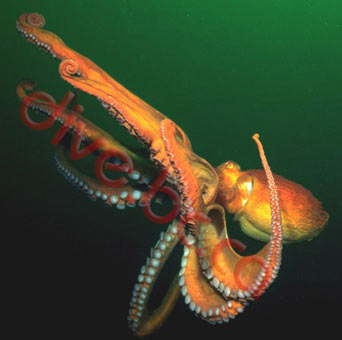
2a Eight Tentacles – Octopus
2b More than 8 tentacles – 3
3a Tentacles hang down – go to 4
3b Tentacles upright–Sea Anemone
4a Balloon-shaped body–Jellyfish
4b Body NOT balloon-shaped – 5


Study of Biology pptQ


Study of Biology
ppt Questions

What is Biology?

1. Define biology.


2. What are organisms?

3. Name 5 groups of organisms.


4. Living things share common _______________.

5. What is the basic unit of life that makes up all organisms?

6. To survive, populations of organisms must be able to _____________ offspring.

7. All organisms have a _________ code carried in  a molecule called _______.

8. Organisms require ____________ such as food and need __________ for their activities.

9. Living things _________ to their environment.

10. Organisms must maintain what type of internal environments ?

11. What does evolve mean?


12. Do groups or individuals evolve?

Characteristics

13. All ____________ are made of cells.

14. Most cells are so __________, they can’t be seen without a microscope.

15. What is cytoplasm?


16. What surrounds all cells?

17. What is the function of the cell membrane?


18. Cells are complex and highly ___________.

19. What are organelles and give an example?


20. The simplest type of cells are known as ______________.

21. Describe prokaryotic cells.


22. Name one of the most common prokaryotes.

23. More complex cells are called ______________.

24. Eukaryotes have a true _________ and _________________ organelles.

25. Name 3 types of eukaryotic cells.

26. Organisms can be grouped by their __________ of cells.

27. Define unicellular organisms.

28. What are multicellular organisms?


Reproduction

29. When organisms reproduce they pass what on to their offspring?

30. Name 2 types of reproduction.

31. What type of reproduction involves 2 parents?

32. A fertilized egg is called a ___________.

33. Are sexually reproduce organisms genetically identical to their parents?

34. asexual reproduction involves a _____________ parent or _________.

35. In asexual reproduction, a single cell __________ to form two new cells.

36. How do asexually reproduced organisms genetically compare  to their parents?

Genetic Code

37. What carries the genetic code for all organisms?

38.DNA stands for ____________________ ___________.

39. Do all organisms have DNA?

40. What does DNA code for in a cell?

41. Why are proteins so important to cells?


Growth and Development 

42. Name the stages of development in the life of a frog.


43. Name two ways that organisms grow.

44. When organisms change into adults they ___________ and may change.

Requiring Food and Energy

45. What organisms can make their own food?

46. What is a photoautotroph and give an example.


47. What food making process is used by photoautotrophs?

48. What do chemoautotrophs use to get energy?

49. ___________ cannot make their own food.

50. How do heterotrophs meet their food requirements?

51. Name 3 groups of heterotrophs.

52. Explain the difference among herbivores, carnivores, and omnivores.


53. Define metabolism.


54. All metabolic processes require ____________.

55. What is the ultimate energy for all life on earth?

56. What metabolic process uses sunlight for energy?

57. Write the balanced overall equation for the photosynthesis process and label the reactants & products.


58. What metabolic process releases the chemical energy stored in food?

59. Write the balanced overall equation for cellular respiration .


60. Name several environmental factors that organisms respond to.


61. Give an example of an organism responding to their environment to promote survival.


62. Define homeostasis.


63. Give 3 examples of internal conditions in which organisms must maintain stability.


64. Why do populations evolve?


65. What record do we have that populations evolve?

Organization Levels

66. Name 3 nonliving levels into which life is organized.

67. At what level of organization does life begin?

68. Cells organize into ____________.

69. What makes up organs?

70. Organs working together become a ____________, and these working together make the entire _____________.

71. From simplest to most complex, list the levels of life above organism.

72. What is the most inclusive level of life?


BACK

Sponges & Cnidarian

Sponges, Cnidarians, & Ctenophores

Phylum Porifera
Characteristics

  • Includes marine & freshwater sponges
  • Found in the kingdom Animalia & subkingdom Parazoa
  • Sessile as adults
  • Simplest of all animals

  • Contain specialized cells, but no tissue
  • Asymmetrical
  • Bodies filled with holes or pores for water circulation
  • Marine sponges are larger & more colorful than freshwater sponges
  • Range in size from 2 centimeters to 2 meters
  • Osculum is single, large body opening at the top for water & wastes to leave
  • Spongocoel is the body cavity of sponges
  • Have only 2 cell layers (ectoderm & endoderm) separated by jellylike material
  • Flagellated cells called choanocytes or collar cells line their internal body cavity
  • Flagella of choanocytes beat & pull in water containing food which the collar traps


  • Spongin is a network of flexible, protein fibers making up the sponge’s skeleton
  • Spicules are tiny, hard particles shaped like spikes or stars in the  skeleton of some sponges
  • Spicules are made of calcium carbonate or silica

Feeding

  • Sponges are filter feeders that remove plankton (food) from the water that is brought in through pores lined with collar cells
  •  Flagella pull in bacteria, protozoans, & algae that sticks to collar of choanocytes where it is digested
  • Amebocytes are specialized cells in sponges that can roam to pick up food from choanocytes & distribute it to all other parts of the sponge
  • Amebocytes also transport carbon dioxide & wastes away from sponge cells
  • Excess water & food leaves through the excurrent osculum

Reproduction

  • Sponges can reproduce asexually by external buds that break off & form new sponges or stay attached to form sponge colonies
  • Gemmules are specialized, internal buds formed by sponges during cold or dry weather that can survive harsh conditions
  • Gemmules consist of a food-filled ball of amebocytes surrounded by a protective coat with spicules & released when adult sponge dies
  • Gemmules break open when conditions improve & the cells form new sponges

  • Sponge can also asexually regenerate missing parts or a new sponge from a small piece of sponge
  • Sponges are hermaphrodites (produce both eggs & sperm), but they exchange sperm & cross-fertilize eggs during sexual reproduction
  • Planula is the flagellated, free-swimming larva that forms from the zygote
  • Planula larva eventually settles to the bottom & attaches to develop into an adult, sessile sponge

Classes of Sponges

  • Calcarea are chalky sponges with calcium carbonate spicules
  • Hexactinella includes glass sponges & the Venus flower basket with silica spicules
  • Demospongiae include horny & bath sponges with only spongin or spongin & silica spicules
  • Sclerospongiae are coral sponges & have spongin & silica and calcium carbonate spicules

Phylum Cnidaria
Characteristics

  • Includes marine organisms such as jelllyfish, Portuguese man-of-war, coral, sea anemone, & sea fans
  • Hydra is a freshwater cnidarian

  • All carnivorous
  • Have 2 cell layers (epidermis -outer & gastrodermis-inner) with a hollow body called gastrovascular cavity
  • Contain a jelly-like layer between epidermis 7 gastrodermis  called mesoglea
  • Single opening (mouth/anus) to gastrovascular cavity where food & water enter & wastes leave; called two-way digestive system
  • Have tentacles around mouth to pull in water & capture food

  • Have a simple nerve net with to help with movement & senses
  • Sessile members include corals, sea anemones, & sea fans
  • Have radial symmetry as adults

  • Contain stinging cells called cnidocytes in their tentacles that contain coiled stingers called nematocysts that can shoot out & paralyze prey 

Body Forms

  • Have 2 basic body forms —polyp & medusa


MEDUSA

POLYP


  • Polyp forms are usually sessile with upright tentacles arranged around the mouth at the top and with a thin layer of mesoglea
  • Polyps are the asexual stage
  • Corals, hydra, & sea anemones exist in the polyp form as adults 


CORAL POLYPS

  • Medusa forms are usually free-swimming, bell-shaped animals with tentacles that hang down around the mouth and with a thick layer of mesoglea for support
  • Medusa are the sexual stage
  • Jellyfish & Portuguese man-of-war are medusa form as adults
  • Some cnidarians are dimorphic or go through both polyp & medusa stages in their life cycle

Life cycle of a jellyfish
JELLYFISH LIFE CYCLE

  • Some are solitary (Hydra) others are colonial (corals)
  • Three classes include Hydrozoa (hydra), Scyphozoa (jellyfish), & Anthozoa (sea anemones & corals)

Hydrozoa

  • Includes freshwater, sessile hydra (exists only as polyps) 
  • Portuguese man-of-war (exists as colony of polyps & medusa)
  • Group of cells called basal disk produces sticky secretion for attachment & can secrete gas bubbles to unattach & let hydra float
  • Hydra also move by somersaulting (tentacles bend over to bottom as basal disk pulls free)
  • Tentacles pull food into gastrovascular cavity where enzymes digest it
  • Reproduce asexually by budding during warm weather & sexually in the fall
  • Hermaphrodites that release sperm into water to fertilize eggs of another hydra


HYDRA

Scyphozoa

  • Includes bell-shaped jellyfish
  • Medusa stage is dominant in the life cycle
  • Tentacles may be meters in length & carry poisons that cause severe pain or death
  • Have both asexual polyps & sexual medusa stages in their life cycles
  • Adult medusa stage releases eggs & sperm into water
  • Fertilization produces ciliated planula larva that settles to the bottom, attaches, & forms tentacles 
  • New medusa bud off of reproductive polyps & form adult jellyfish

jellyfish life cycle photo
JELLYFISH

Anthozoa

  • Include corals in a limestone case & sea anemones
  • Called “flower animals”
  • All marine
  • Sea anemone is a sessile, polyp-form that uses its tentacles to paralyze fish
  • Some anemones in the Pacific Ocean live symbiotically with the clownfish sharing food & protecting each other

#22A

  • Corals are small, colonial polyps living in limestone cases
  • Coral reefs form as polyps die & provide a home and protection for other marine animals
  • Reefs form in warm, shallow water & only the top layer has living polyps
  • Algae may live symbiotically with coral supplying them with oxygen

Phylum Ctenophora

Characteristics

  • All marine
  • Includes comb jellies

  • Have eight rows of fused cilia called “comb rows”
  • Largest animal to move by cilia
  • Move by beating cilia
  • Lack cnidocytes but have cells sticky cells called colloblasts that bind to prey
  • Colloblasts located on two ribbon-like tentacles
  • Have sensory structure called apical organ to detect direction in the water
  • Most are hermaphrodites (make eggs & sperm)
  • Produce light by bioluminescence
BACK