Starfish Dissection


Starfish Dissection

Introduction:

Echinoderms are radially symmetrical animals that are only found in the sea (there are none on land or in fresh water). Echinoderms mean “spiny skin” in Greek. Many, but not all, echinoderms have spiny skin. There are over 6,000 species. Echinoderms usually have five appendages (arms or rays), but there are some exceptions.

Radial symmetry means that the body is a hub, like a bicycle wheel, and tentacles are spokes coming out of it (think of a starfish). As larvae, echinoderms are bilaterally symmetrical. As they mature, they become radially symmetrical.

Most adult echinoderms live on the bottom of the ocean floor. Many echinoderms have suckers on the ends of their feet that are used to capture and hold prey, and to hold onto rocks in a swift current.

Sea Stars
Sea StarSea stars (group name Stelleroidea) are sometimes called starfish, though they are not real fish (they lack both vertebrae and fins). There are two sub-types of sea stars:

  • Asteroideas are the true sea stars and sun stars.
  • Ophiuroideas are brittle stars and basket stars.

The differences between the two sub-types lies in how the arms connect to the central disk. Ophiuroids have arms that do not connect with each other. There is a distinct boundary between arm and central disk. Asteroids have arms that are connected to each other. Also, it is harder to tell with asteroids where the central disk ends and the arms begin.

The sea star’s top surface (or skin) looks spiny if you examine it. If you look very closely you will notice that there are different types of growths on the surface. Some bumps are used to absorb oxygen, they are called dermal branchiae. Pedicellaria are pincher-like organs used to clean the surface of the skin. Barnacle larvae could land on a sea star and start growing if it were not for these organs.

How Do Sea Stars Move?
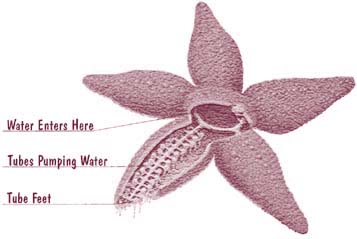
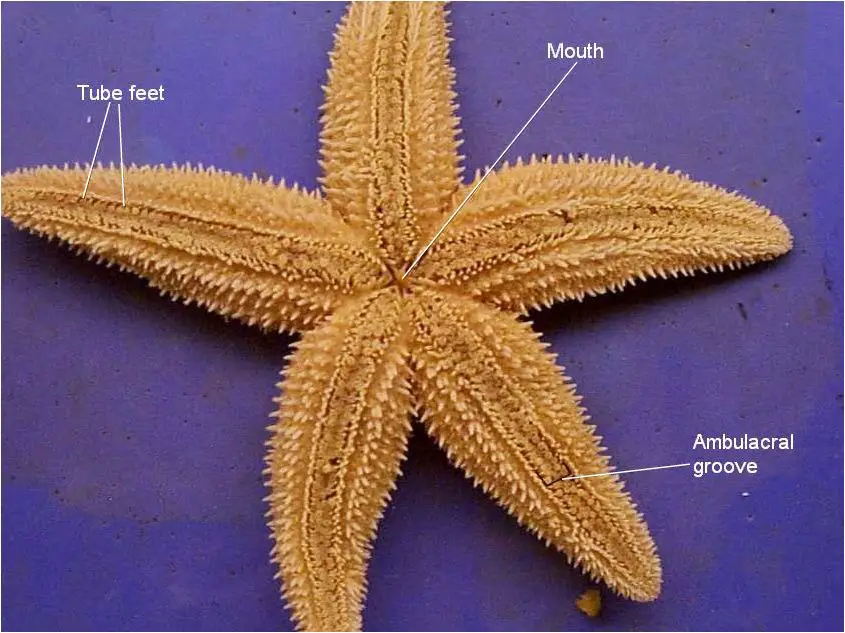
Underside of a Sea StarEach sea star had hundreds of tiny feet on the bottom of each ray. These are tube feet, or podia. These tiny feet can be filled with sea water. The vascular system of the sea star is also filled with sea water. By moving water from the vascular system into the tiny feet, the sea star can make a foot move by expanding it. This is how sea stars move around. Muscles within the feet are used to retract them.

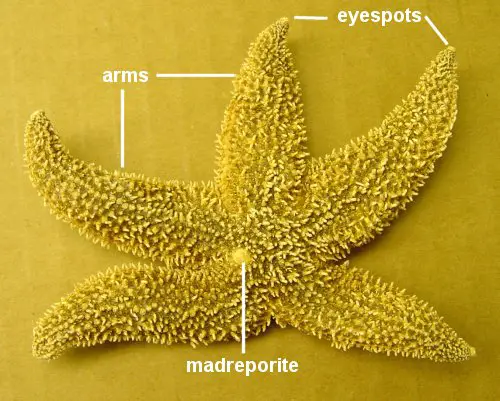
Each ray of a sea star has a light sensitive organ called an eyespot. Though it can not see nearly as well as we do, sea stars can detect light and its general direction. They have some idea of where they are going.

Sea Star Anatomy

Can Sea Stars Grow New Arms?
Given enough time, sea stars can grow back arms that have been damaged or removed. For a few species, the severed arm can grow back into a complete sea star! For most sea stars, however, a severed limb dies.

What Do Sea Stars Eat?
Sea stars eat many things. A sea star’s diet can include: barnacles, snails, sea urchins, clams, and mussels. A few species, such as the spiny star of the North Atlantic, eat other sea stars! Many sea stars eat mussels and clams in an interesting way. They surround the shell and use the suckers on their feet to pull the two shells (or valves) apart. The sea star has enough force in its arms to actually bend the shell! This creates an opening between the two shells that is only .01 inches wide. Using this tiny gap, the sea star puts its stomach into the clam’s shell and eats its insides. When it is done, nothing is left but an empty shell.

Materials:

Preserved starfish, dissecting pan, scissors, scalpel, forceps, T-pins, pencil, lab apron, safety glasses

Procedure:


Dorsal view of starfish showing external anatomy

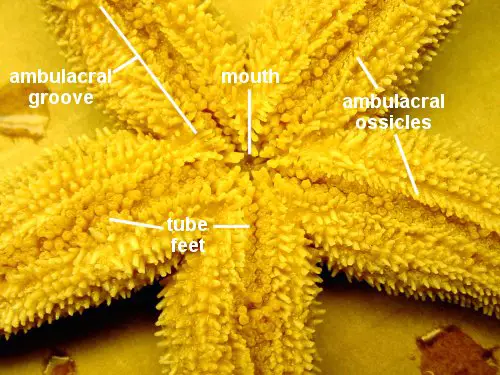
Ventral view of starfish showing external anatomy

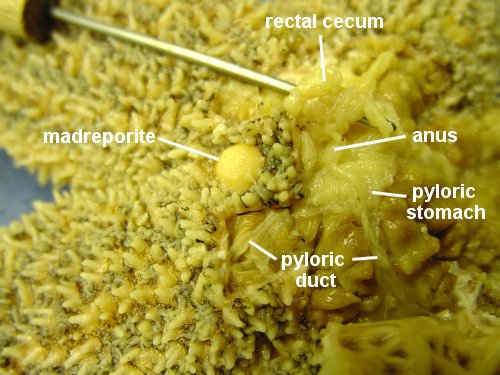
Dorsal view of a dissected starfish showing rectal cecum, anus, madreporite, pyloric stomach, pyloric duct

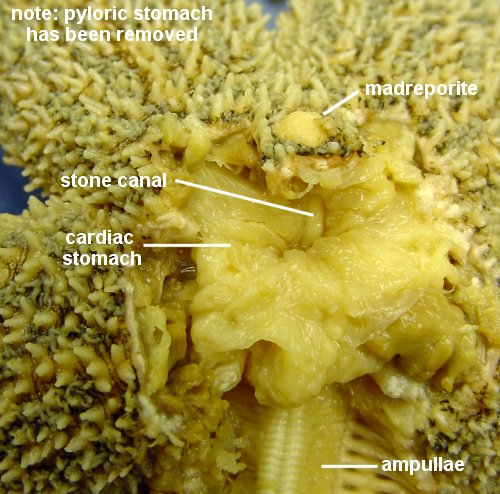
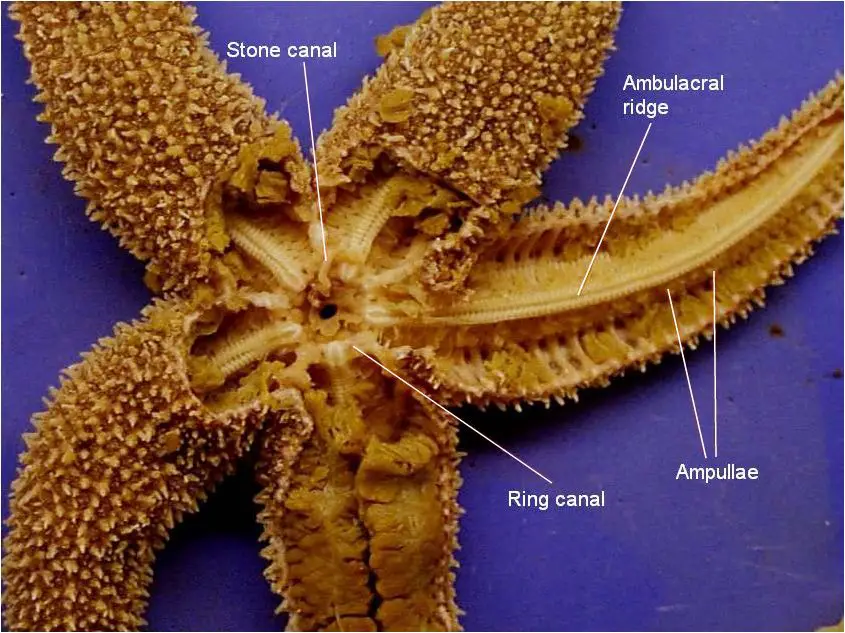
Dorsal view of a dissected starfish showing madreporite, stone canal, cardiac stomach, and ampullae

Dissection showing where cardiac stomach opens into the mouth
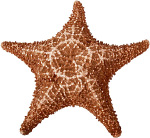
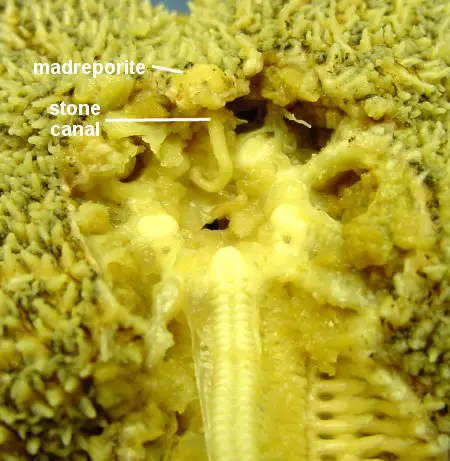
Close up of madreporite and stone canal

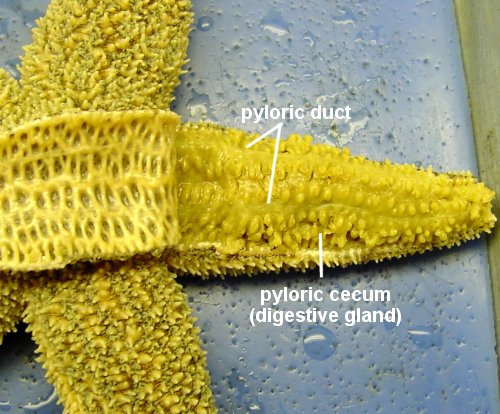
Dorsal view of a dissected starfish showing pyloric caecum and pyloric ducts

Dorsal view of a dissected starfish showing gonads and ampullae

Ventral view of starfish showing external anatomy

Starfish Prelab


Starfish Prelab

1. In what phylum are starfish found?

2. What is the habitat for starfish?

3. On what do starfish feed?

4. What system in their body helps them catch & hold their food?

5. What does echinoderm mean in Greek? Why is this a good name for this group?


6. Name 2 classes of echinoderms & a member of each class.


7. Where does water enter a starfish? Where does it leave?


Spongebob Safety Rules

 Sponge Bob Safety Rules
T. Trimpe 2003

The Bikini Bottom gang has been learning safety rules during science class. Read the paragraphs below to find the broken safety rules and number and underline each one. How many can you find? On the back of your sheet, write the number and the CORRECT safety procedure that should have been used.

SpongeBob, Patrick, and Gary were thrilled when Mr. Krabbs gave their teacher a chemistry set! Mr. Krabbs warned them to be careful and reminded them to follow the safety rules they had learned in science class. The teacher passed out the materials and provided each person with an experiment book. SpongeBob and Gary flipped through the book and decided to test the properties of a mystery substance. Since the teacher did not tell them to wear the safety goggles, they left them on the table.
SpongeBob lit the Bunsen burner, then reached across the flame to get a test tube from Gary . In the process, he knocked over a bottle of the mystery substance and a little bit splashed on Gary . SpongeBob poured some of the substance into a test tube and began to heat it. When it started to bubble he looked into the test tube to see what was happening and pointed it towards Gary so he could see. Gary thought it smelled weird so he took a deep whiff of it. He didn’t think it smelled poisonous and tasted a little bit of the substance.
They were worried about running out of time, so they left the test tube and materials on the table and moved to a different station to try another experiment. Patrick didn’t want to waste any time reading the directions, so he put on some safety goggles and picked a couple different substances. He tested them with vinegar (a weak acid) to see what would happen even though he didn’t have permission to experiment on his own. He noticed that one of the substances did not do anything, but the other one fizzed. He also mixed two substances together to see what would happen, but didn’t notice anything. He saw SpongeBob and Gary heating something in a test tube and decided to do that test. He ran over to that station and knocked over a couple bottles that SpongeBob had left open. After cleaning up the spills, he read the directions and found the materials he needed. The only test tube he could find had a small crack in it, but he decided to use it anyway. He lit the Bunsen burner and used tongs to hold the test tube over the flame. He forgot to move his notebook away from the flame and almost caught it on fire.

Before they could do another experiment, the bell rang and they rushed to put everything away. Since they didn’t have much time, Patrick didn’t clean out his test tube before putting it in the cabinet. SpongeBob noticed  that he had a small cut on his finger, but decided he didn’t have time to tell the teacher about it. Since they were late, they skipped washing their hands and hurried to the next class.

CLICK HERE FOR NOTEBOOK COPY

Semester Test Study Guide 2004 BI

Study Guide Semester Test 2004
Taxonomy, Plants, Invertebrates, & Vertebrates 

1.     Fruits of cereal plants are called __________________.

2.     Viral DNA becomes integrated into the host cell’s DNA during the ________________ cycle.

3.     Viruses only reproduce in ___________________.

4.      ____________________ use reverse transcriptase to transcribe DNA from RNA.

5.     Prions are composed only of __________________.

6.      RNA or DNA covered by a protein coat makes up a _______________.

7.     Classifying living things is called ______________________.

8.     From the kingdom to the species level organisms become more ___________________ in appearance.

9.     The system of classifying organisms by assigning genus & species names was developed by _________________.

10.    Which word in a scientific name is the genus?

11.   Noncellular structures that can’t make proteins or use energy, but can reproduce inside living cells would be ____________________.

12.  Scientists all over the world use the _______________, scientific name for an organism.

13.  Scientific names are written in ________________, a dead language.

14. The taxonomic hierarchy is kingdom, phylum, _________________, order, ______________, genus and _______________.

15. A waxy ________________ on the outside of plants prevents evaporation of fluids from the plant.

16. An internal system of connected tubes and vessels in some plants is called ______________________ tissue.

17.   __________________ tissue in plants transports water and minerals.

18. All seed plants have a seed containing an _________________, a ________________ supply, and a protective __________________.

19. Pines, cedars, spruce, and fir are examples of ____________________.

20. Monocot leaves have __________________ venation.

21. Plants grow in regions of active cell division called ________________.

22. Leaves connect to stems at areas called __________________.

23. ____________________ is the loss of water by the leaves & stem of a plant.

24. ____________________ tissue in plants transports sugars.

25. Multicellular heterotrophic organisms without cell walls would be in the kingdom _______________________.

26. Most animals have a head at the _________________ end and a tail located at the _______________ end.

27. Name a freshwater cnidarian closely related to the jellyfish.

28. The concentration of sensory organs on the anterior end of an animal is known as ________________________.

29. The sea anemone has ______________________ symmetry.

30.  The head of a fish would be located on the _______________ end.

31.   _________________ are animals whose cells are specialized but aren’t organized into tissues.

32.  The absence of a vertebral column or backbone is characteristic of all ______________________.

33. ________________ cells help draw water into a sponge.

34. Hard needle-like structures in the wall of a sponge are called __________________.

35. Sponges obtain food by _________________ feeding.

36. _________________ in sponges are cells that move throughout the sponge’s body wall to deliver food to the organism’s cells.

37. _____________________ organisms can produce both eggs and sperm.

38.  A sea anemone captures its prey using ___________________ in its tentacles.

39.  _________________ and _________________ are the two distinct life stages of cnidarians.

40. Name 3 cnidarians.

41. Sea anemones exist as _____________ in the adult stage.

42.                         Housed in chambers on each side of the head are the ______________ of bony fish.

43.                         __________________ mammals keep their offspring inside the mother until their development ids complete.

44. The ____________________ of fish helps them be buoyant in the water.

45. Amphibians breathe through lungs and their _______________.

46. The skin of reptiles is dry and ___________________.

47. Bird’s bones are _________________ and ________________.

48. Amphibian skin is thin and ______________ for __________ exchange.

49. The _______________ is a sheet of muscle below the rib cage in mammals to help them breathe.

50.  The _______________ egg allowed reptiles to adapt to life on land.

Sponges & Cnidarian

Sponges, Cnidarians, & Ctenophores

Phylum Porifera
Characteristics

  • Includes marine & freshwater sponges
  • Found in the kingdom Animalia & subkingdom Parazoa
  • Sessile as adults
  • Simplest of all animals

  • Contain specialized cells, but no tissue
  • Asymmetrical
  • Bodies filled with holes or pores for water circulation
  • Marine sponges are larger & more colorful than freshwater sponges
  • Range in size from 2 centimeters to 2 meters
  • Osculum is single, large body opening at the top for water & wastes to leave
  • Spongocoel is the body cavity of sponges
  • Have only 2 cell layers (ectoderm & endoderm) separated by jellylike material
  • Flagellated cells called choanocytes or collar cells line their internal body cavity
  • Flagella of choanocytes beat & pull in water containing food which the collar traps


  • Spongin is a network of flexible, protein fibers making up the sponge’s skeleton
  • Spicules are tiny, hard particles shaped like spikes or stars in the  skeleton of some sponges
  • Spicules are made of calcium carbonate or silica

Feeding

  • Sponges are filter feeders that remove plankton (food) from the water that is brought in through pores lined with collar cells
  •  Flagella pull in bacteria, protozoans, & algae that sticks to collar of choanocytes where it is digested
  • Amebocytes are specialized cells in sponges that can roam to pick up food from choanocytes & distribute it to all other parts of the sponge
  • Amebocytes also transport carbon dioxide & wastes away from sponge cells
  • Excess water & food leaves through the excurrent osculum

Reproduction

  • Sponges can reproduce asexually by external buds that break off & form new sponges or stay attached to form sponge colonies
  • Gemmules are specialized, internal buds formed by sponges during cold or dry weather that can survive harsh conditions
  • Gemmules consist of a food-filled ball of amebocytes surrounded by a protective coat with spicules & released when adult sponge dies
  • Gemmules break open when conditions improve & the cells form new sponges

  • Sponge can also asexually regenerate missing parts or a new sponge from a small piece of sponge
  • Sponges are hermaphrodites (produce both eggs & sperm), but they exchange sperm & cross-fertilize eggs during sexual reproduction
  • Planula is the flagellated, free-swimming larva that forms from the zygote
  • Planula larva eventually settles to the bottom & attaches to develop into an adult, sessile sponge

Classes of Sponges

  • Calcarea are chalky sponges with calcium carbonate spicules
  • Hexactinella includes glass sponges & the Venus flower basket with silica spicules
  • Demospongiae include horny & bath sponges with only spongin or spongin & silica spicules
  • Sclerospongiae are coral sponges & have spongin & silica and calcium carbonate spicules

Phylum Cnidaria
Characteristics

  • Includes marine organisms such as jelllyfish, Portuguese man-of-war, coral, sea anemone, & sea fans
  • Hydra is a freshwater cnidarian

  • All carnivorous
  • Have 2 cell layers (epidermis -outer & gastrodermis-inner) with a hollow body called gastrovascular cavity
  • Contain a jelly-like layer between epidermis 7 gastrodermis  called mesoglea
  • Single opening (mouth/anus) to gastrovascular cavity where food & water enter & wastes leave; called two-way digestive system
  • Have tentacles around mouth to pull in water & capture food

  • Have a simple nerve net with to help with movement & senses
  • Sessile members include corals, sea anemones, & sea fans
  • Have radial symmetry as adults

  • Contain stinging cells called cnidocytes in their tentacles that contain coiled stingers called nematocysts that can shoot out & paralyze prey 

Body Forms

  • Have 2 basic body forms —polyp & medusa


MEDUSA

POLYP


  • Polyp forms are usually sessile with upright tentacles arranged around the mouth at the top and with a thin layer of mesoglea
  • Polyps are the asexual stage
  • Corals, hydra, & sea anemones exist in the polyp form as adults 


CORAL POLYPS

  • Medusa forms are usually free-swimming, bell-shaped animals with tentacles that hang down around the mouth and with a thick layer of mesoglea for support
  • Medusa are the sexual stage
  • Jellyfish & Portuguese man-of-war are medusa form as adults
  • Some cnidarians are dimorphic or go through both polyp & medusa stages in their life cycle

Life cycle of a jellyfish
JELLYFISH LIFE CYCLE

  • Some are solitary (Hydra) others are colonial (corals)
  • Three classes include Hydrozoa (hydra), Scyphozoa (jellyfish), & Anthozoa (sea anemones & corals)

Hydrozoa

  • Includes freshwater, sessile hydra (exists only as polyps) 
  • Portuguese man-of-war (exists as colony of polyps & medusa)
  • Group of cells called basal disk produces sticky secretion for attachment & can secrete gas bubbles to unattach & let hydra float
  • Hydra also move by somersaulting (tentacles bend over to bottom as basal disk pulls free)
  • Tentacles pull food into gastrovascular cavity where enzymes digest it
  • Reproduce asexually by budding during warm weather & sexually in the fall
  • Hermaphrodites that release sperm into water to fertilize eggs of another hydra


HYDRA

Scyphozoa

  • Includes bell-shaped jellyfish
  • Medusa stage is dominant in the life cycle
  • Tentacles may be meters in length & carry poisons that cause severe pain or death
  • Have both asexual polyps & sexual medusa stages in their life cycles
  • Adult medusa stage releases eggs & sperm into water
  • Fertilization produces ciliated planula larva that settles to the bottom, attaches, & forms tentacles 
  • New medusa bud off of reproductive polyps & form adult jellyfish

jellyfish life cycle photo
JELLYFISH

Anthozoa

  • Include corals in a limestone case & sea anemones
  • Called “flower animals”
  • All marine
  • Sea anemone is a sessile, polyp-form that uses its tentacles to paralyze fish
  • Some anemones in the Pacific Ocean live symbiotically with the clownfish sharing food & protecting each other

#22A

  • Corals are small, colonial polyps living in limestone cases
  • Coral reefs form as polyps die & provide a home and protection for other marine animals
  • Reefs form in warm, shallow water & only the top layer has living polyps
  • Algae may live symbiotically with coral supplying them with oxygen

Phylum Ctenophora

Characteristics

  • All marine
  • Includes comb jellies

  • Have eight rows of fused cilia called “comb rows”
  • Largest animal to move by cilia
  • Move by beating cilia
  • Lack cnidocytes but have cells sticky cells called colloblasts that bind to prey
  • Colloblasts located on two ribbon-like tentacles
  • Have sensory structure called apical organ to detect direction in the water
  • Most are hermaphrodites (make eggs & sperm)
  • Produce light by bioluminescence
BACK