Plant Analytical Questions

Plant Analytical Questions

Plant Structures and Function

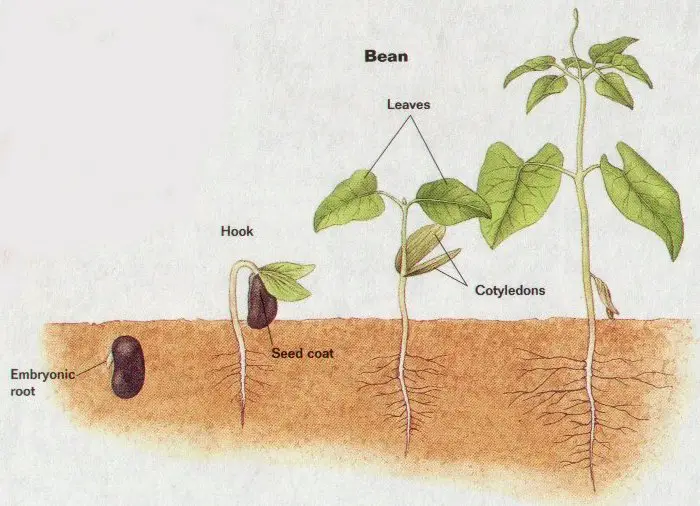
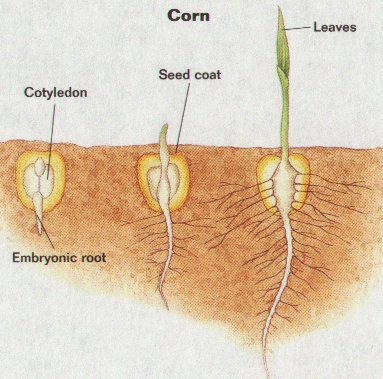
Part 1: Use the following diagram of a seedling to answer these questions.

  1. What tropisms are being exhibited by the various parts of this seedling?


  1. What hormones are involved in these responses?


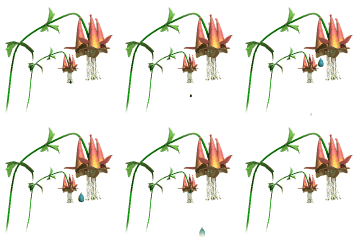
Part 2: Use the diagram below to complete lines a – f.

The diagrams represent three conditions of day & night length. A short-day plant, with a critical night length of 14 hours, and a long-day plant, with a critical night length of 8 hours, are grown under each condition. On lines a – f, indicate whether each plant will flower under each condition.


Plant Pigments and Photosynthesis


Plant Pigments and Photosynthesis


Introduction:
In this laboratory you will separate plant pigments using chromatography. You will also measure the rate of photosynthesis in isolated chloroplasts. The measurement technique involves the reduction of the dye DPIP. The transfer of electrons during the light-dependent reactions of photosynthesis reduces DPIP, changing it from blue to colorless.

Exercise 4A: Plant Pigment Chromatography:
Paper chromatography is a useful technique for separating and identifying pigment and other molecules from cell extracts that contain a complex mixture of molecules. The solvent moves up the paper by capillary action, which occurs as a result of the attraction of solvent molecules to the paper and the attraction of the solvent molecules to one another. As the solvent moves up the paper, it carries along any substances dissolved in it. The pigments are carried along at different rates because they are not equally soluble in the solvent and because they are attracted, to different degrees, to the fibers of the paper through the formation of intermolecular bonds, such as hydrogen bonds.

Beta carotene, the most abundant carotene in plants, is carried along near the solvent front because it is very soluble in the solvent being used and because it forms no hydrogen bonds with cellulose. Another pigment , Xanthophyll differs from carotene in that it contains oxygen. Xanthophyll is found further from the solvent font because it is less soluble in the solvent and has been slowed down by hydrogen bonding to the cellulose. Chlorophyll’s contain oxygen and nitrogen and are bound more tightly to the paper than the other pigments. Chlorophyll a is the primary photosynthetic pigment in plants. A molecule of chlorophyll a is located at the reaction center of the photo systems. The pigments collect light energy and send it to the reaction center. Carotenoids also protect the photosynthetic systems from damaging effects of ultraviolet light.

Procedure:
1. Obtain a 250 mL beaker which has about 2 cm of solvent at the bottom. Cover the beaker with aluminum foil to prevent the vapors from spreading. It is also suggested this work be done under a fume hood.

2. Cut a piece of filter paper which will be long enough to reach the solvent. Draw a line about 1.0 cm from the bottom of the paper. See Figure 4.1 below.

Figure 4.1

3. Use a quarter to extract the pigments from spinach leaf cells. Place a small section of leaf on the top of the pencil line. Use the ribbed edge of the coin to to crush the leaf cells. Be sure the pigment line is on top of the pencil line. Use a back and forth movement exerting firm pressure through out.

4. Place the chromatography paper in the cylinder. See Figure 4.2 below. Do not allow the pigment to touch the solvent.

Figure 4.2


5. Cover the beaker. When the solvent is about 1 cm from the top of the paper, remove the paper and immediately mark the location of the solvent front before it evaporates.

6. Mark the bottom of each pigment band. Measure the distance each pigment migrated from the bottom of the pigment origin to the bottom of the separated pigment band. Record the distance that each front, including the solvent front, moved in Table 4.1 Depending on the species of plant used, you may be able to observe 4 or 5 pigment bands.

Table 4.1

Distance moved by Pigment Band (millimeters)

Band Number Distance (mm) Band Color
1
2
3
4
5

Distance Solvent Front Moved _________________

Analysis of Results:
The relationship of the distance moved by a pigment to the distance moved by the solvent is a constant called Rf . It can be calculated for each of the four pigments using the formula:
 

Rf = distance pigment migrated (mm)_____
distance solvent front migrated (mm)

Record your Rf values in Table 4.2

Table 4.2

___________________________ = Rf for carotene (yellow to yellow -orange)
___________________________ = Rf for xanthophyll (yellow)
___________________________ = Rf for Chlorophyll a (bright green to blue green)
___________________________ = Rf for Chlorophyll b (yellow green to olive green)

Topics for Discussion:
1. What factors are involved in the separation of the pigments?

_______________________________________________________________________________

_______________________________________________________________________________

_______________________________________________________________________________

_______________________________________________________________________________

_______________________________________________________________________________

2. Would you expect the Rf value of a pigment to be the same if a different solvent were used? Explain.

_______________________________________________________________________________

_______________________________________________________________________________

_______________________________________________________________________________

_______________________________________________________________________________

_______________________________________________________________________________

3. What type of chlorophyll does the reaction center contain? What are the roles of the other pigments?

_______________________________________________________________________________

_______________________________________________________________________________

_______________________________________________________________________________

_______________________________________________________________________________

_______________________________________________________________________________

Exercise 4B: Photosynthesis / The Light Reaction:
Light is a part of a continuum of radiation or energy waves. Shorter wavelengths of energy have a greater amounts of energy. For example, high-energy ultraviolet rays can harm living things. Wavelengths of light within the visible spectrum of light power photosynthesis. when light is absorbed by leaf pigments, electrons within each photosystem are boosted to a higher energy level and this energy level is used to produce ATP and to reduce NADP to NADPH. ATP and NADPH are then used to incorporate CO2 into organic molecules, a process called carbon fixation.

Design of the Exercise:
Photosynthesis may be studied in a number of ways. For this experiment, a dye-reduction technique will be used. The dye-reduction experiment tests the hypothesis that light and chloroplasts are required for the light reactions to occur. In place of the electron accepter, NADP, the compound DPIP ( 2.6-dichlorophenol-indophenol), will be substituted. When light strikes the chloroplasts, electrons boosted to high energy levels will reduce DPIP. It will change from blue to colorless.

In this experiment, chloroplasts are extracted from spinach leaves and incubated with DPIP in the presence of light. As the DPIP is reduced and becomes colorless, the resultant increase in light transmittance is measured over a period of time using a spectrophotometer. The experimental design matrix is presented in Table 4.3.

Table 4.3: Photosynthesis Setup

Cuvettes

1

Blank


2

Unboiled Chloroplasts Dark

3

Unboiled Chloroplasts Light

4

Boiled Chloroplasts Light

5

No
Chloroplasts

Phosphate Buffer 1 ml. 1 ml. 1 ml. 1 ml. 1 ml.
Distilled Water 4 ml. 3 ml. 3 ml. 3 ml. 3 ml + 3 drops
DPIP —- 1 ml. 1 ml. 1 ml. 1 ml.
Unboiled Chloroplasts 3 drops 3 drops 3 drops —- —-
Boiled Chloroplasts —- —- —- 3 drops —-

Procedure:
1. Turn on the spectrophotometer to warm up the instrument and set the wavelength to 605 nm by adjusting the wavelength control knob.

2. While the spectrophotometer is warming up, your teacher may demonstrate how to prepare a chloroplast suspension from spinach leaves.

3. Set up an incubation area that includes a light, water flask, and test tube rack. The water in the flask acts as a heat sink by absorbing most of the light’s infrared radiation while having little effect on the light’s visible radiation.

Figure 4.2: Incubation Setup

Flood Light ——-Water Heat Sink——-Cuvettes


4. Your teacher will provide you with two beakers, one containing unboiled chloroplasts. Be sure to keep these on ice at all times.

5. At the top rim, label the cuvettes 1,2,3,4, and 5, respectively. Using lens tissue, wipe the outside walls of each cuvette ( Remember: handle cuvettes only near the top). Using foil paper, cover the walls and bottom of cuvette 2. Light should not be permitted inside cuvette 2 because it is a control for this experiment.

6. Refer to Table 4.3 to prepare each cuvette. Do not add unboiled or boiled chloroplasts yet. To each cuvette, add 1 ml of phosphate buffer.

7. Bring the spectrophotometer to zero by adjusting the amplifier control knob until the meter reads 0% transmittance. Cover the top of cuvette 1 with Parafilm@ and invert to mix. Insert cuvette 1 into the sample holder and adjust the instrument to 100% transmittance by adjusting the light -control knob. Cuvette 1 is the blank to be used to recalibrate the instrument between readings. For each reading, make sure that the cuvettes are inserted into the sample holder so that they face the same way as in the previous reading.

8. Obtain the unboiled chloroplast suspension, stir to mix, and transfer three drops to cuvette 2. Immediately cover and mix cuvette 2. Then remove it from the foil sleeve and insert it into the spectrophotometer’s sample holder, read the % transmittance, and record it as the time 0 reading in Table 4.4 . Replace cuvette 2 into the foil sleeve, and place it into the incubation test tube rack. Turn on the flood light. Take and record additional readings at 5,10,and 15 minutes. Mix the cuvette’s contents just prior to each readings. Remember to use cuvette 1 occasionally to check and adjust the spectrophotometer to 100% transmittance.

9. Obtain the unboiled chloroplast suspension, mix, and transfer three drops to cuvette 3. Immediately cover and mix cuvette 3. Insert it into the spectrophotometer’s sample holder, read the % transmittance, and record it in Table 4.4 . Replace cuvette 3 into the incubation test tube rack. Take and record additional readings at 5,10,and 15 minutes. Mix the cuvette’s contents just prior to each readings. Remember to use cuvette 1 occasionally to check and adjust the spectrophotometer to 100% transmittance.

10. Obtain the boiled chloroplast suspension, mix, and transfer three drops to cuvette 4. Immediately cover and mix cuvette 4. Insert it into the spectrophotometer’s sample holder, read the % transmittance, and record it in Table 4.4 . Replace cuvette 4 into the incubation test tube rack. Take and record additional readings at 5,10,and 15 minutes. Mix the cuvette’s contents just prior to each readings. Remember to use cuvette 1 occasionally to check and adjust the spectrophotometer to 100% transmittance.

11. Cover and mix the contents of cuvette 5. Insert it into the spectrophotometer’s sample holder, read the % transmittance, and record it in Table 4.4 . Replace cuvette 5 into the incubation test tube rack. Take and record additional readings at 5,10,and 15 minutes. Mix the cuvette’s contents just prior to each readings. Remember to use cuvette 1 occasionally to check and adjust the spectrophotometer to 100% transmittance.

Table 4.4: Transmittance (%)

Time (minutes)

Cuvette 0 5 10 15
2 Unboiled /Dark
3 Unboiled/ Light
4 Boiled / Light
5 No Chloroplasts

Analysis of Results:
Plot the percent transmittance from the four cuvettes on the graph below
.

a. What is the dependent variable? ____________________________________________

b. What is the independent variable? __________________________________________

Graph Title: __________________________________________________________________

Graph 4.1

Topics for Discussion:
1. What is the purpose of DPIP in this experiment?

___________________________________________________________________________

___________________________________________________________________________

___________________________________________________________________________

2. What molecule found in chloroplasts does DPIP “replace” in this experiment? _________________

3. What is the source of the electrons that will reduce DPIP? _________________________________

4. What was measured with the spectrophotometer in this experiment? ____________________________________________________________________________

____________________________________________________________________________

____________________________________________________________________________

____________________________________________________________________________

5. What is the effect of darkness on the reduction of DPIP? Explain.

____________________________________________________________________________

____________________________________________________________________________

____________________________________________________________________________

____________________________________________________________________________

6. What is the effect of boiling the chloroplasts on the subsequent reduction of DPIP? Explain.

____________________________________________________________________________

____________________________________________________________________________

____________________________________________________________________________

____________________________________________________________________________

7. What reasons can you give for the difference in the percent transmittance between the live chloroplasts that were incubated in the light and those that were kept in the dark?

_____________________________________________________________________________

_____________________________________________________________________________

_____________________________________________________________________________

_____________________________________________________________________________


Pedigree Lab

Constructing a Pedigree

Introduction

A pedigree is a special chart or family tree that uses a particular set of standardized symbols. Pedigrees are used to show the history of inherited traits through a family. In a pedigree, males are represented by squares and females by circles . An individual who exhibits the trait in question, for example, someone who suffers from hemophilia, is represented by a filled symbol or . A horizontal line between two symbols represents a mating . The offspring are connected to each other by a horizontal line above the symbols and to the parents by vertical lines. Roman numerals (I, II, III, etc.) symbolize generations. Arabic numerals (1,2,3, etc.) symbolize birth order within each generation. In this way, any individual within the pedigree can be identified by the combination of two numbers (i.e., individual II3).

Objective

Inherited traits can be traced through a family’s history by constructing a pedigree chart.

Materials

Large sheet of paper or poster board
Markers
Ruler
Protractor

Procedure
Part 1

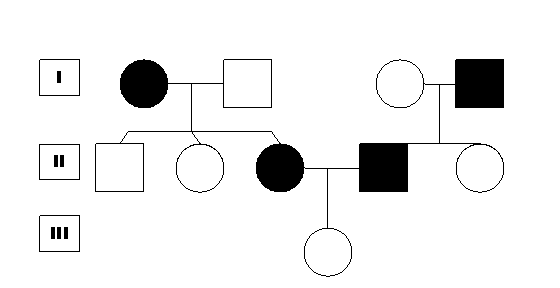
1.      Examine Figure 1 that traces the ability to roll your tongue through three generations in a family. Remember: Blackened circles show the trait and circles are females and squares are male.

2.    Determine which parents and which offspring would be able to roll their tongue.  

FIGURE 1


Part 2

3.    Read the Passage 1 about the Smith family and their inherited trait of dimples.

4.    After reading the passage, construct a pedigree showing all family members in each generation that does and does NOT have dimples.

5.    Once the pedigree is constructed, write the correct genotype by each person in the family.


Passage 1

Grandfather and Grandmother Smith smiled a lot and showed off their dimples each time. They had a son named John, who had dimples, and daughter named Julie, who did not. Julie died at an early age, but her brother John Smith met and married Mary Jones because she had the most beautiful dimples when she smiled. They had 5 children, 2 boys and 3 girls. Only one of their sons, Tom, had dimples, but both girls, Judy and Kay, had dimpled smiles. Their sister June lacked dimples. After college, Tom met and married Jane Kennedy who also had dimples. They had 3 children, all girls, who shared their parent’s dimpled smile. Tom’s sister Kay married a lawyer named James who seldom smiled and didn’t have dimples. Their only son Matthew was like his mother when he smiled. Judy never married. Tom’s sister, June, married a doctor and had 5 children. Three of the children were boys, Jay, Fred, and Mike. Mike and Fred had dimples like dad, but Jay’s smile was like his mom’s lacking dimples. One sister, Susan, had dimples, but the other, Katherine, didn’t.


Questions

1.      What type of information does a pedigree contain?

2.    How do you show the presence of a trait in a pedigree?

3.    How do you denote males & females in a pedigree?

4.    From your pedigree, is the presence of dimples a dominant or recessive trait?

5.     How could examining a family pedigree be helpful to a couple wanting to have children?


Photosynthesis Worksheet Ch6 BI


Photosynthesis


Section 6-1 Capturing Light Energy

1. All organisms require ___________________ to carry out their life functions.

2. ___________________ is the ultimate energy for all life on earth.

3. During photosynthesis, the energy from the sun is stored within _____________________

compounds, mainly the sugar _______________________.

4. What organisms can carry on photosynthesis?

5. Name several autotrophic organisms.

6. What is a biochemical pathway and give an example?

7. What gas is used by autotrophs & what gas is produced?

8. What organisms release stored energy from organic compounds through cellular respiration?

9. Draw the diagram showing energy storage & transfer between autotrophs & heterotrophs. (Figure 6.1)

10. What are the light reactions of plants and in what organelle do they occur?

11. Draw & label the parts of a chloroplast. Tell the function of each labeled part.

12. Flattened sacs in chloroplasts are known as ____________________ and are

_______________________ to each other.

13. Thylakoid sacs in chloroplasts are called _____________________________.

14. What gel-like solution surrounds the thylakoids inside the chloroplast?

15. What is the visible spectrum?

16. Name the 7 colors that make up the visible spectrum.

17. What 3 things can happen to light that strikes an object?

18. What are pigments & what is their function in plants?

19. Is red light reflected or absorbed by an object if the object appears red to your eyes?

20. Name the most important chloroplast pigment & tell the 2 most important types of this pigment.

21. Only ________________________ is directly in capturing light energy.

22. Chlorophyll b is an example of an ______________________ pigment in plants.

23.Name another accessory pigment & tell what colors it includes. When could you see these colors?

24. Chlorophyll is most abundant in the _____________________ of a plant, while accessory
pigments appear more in the _________________________ and fruits.

25. The _________________________ and ________________________ pigments are grouped
into clusters in the thylakoid membrane.

26. What is a photosystem?

27. Name the 2 types of photosystems.

28. The light reactions start when __________________ pigments absorb ______________.

29. Absorbed light is passed to a pair of ________________________ pigment molecules in
photosystem ________.

30. When light energy is absorbed by chlorophyll a molecules, what happens to its electrons?

31. Once these electrons become “excited”, they have enough energy to do what?

32. What are the chemicals called that pick up these freed electrons & where are they located?

33. These electrons lose _________________ as they are passed through a series of molecules
called the ______________________________________ chain.

34. Photosystem I chlorophyll molecules also absorb ________________, and its electrons
eventually combine with ______________________ to form NADPH.

35. What would happen if the electrons lost from photosystem II weren’t replaced?

36. ________________________ provides the replacement electrons for photosystem II when
water is __________________________.

37. Write the equation for the splitting of a water molecule.

38. What important gas is released when water is split?

39. ______________ or energy for a cell is synthesized during the light reactions in a process
called ________________________________.

Section 6-2 Calvin Cycle

40. The _________________ cycle is the second set of photosynthetic reactions that uses energy
stored in ________________ and _____________________ to make __________________
compounds.

41. Carbon atoms from ______________ are “fixed” into organic compounds in the Calvin
cycle in a process called carbon _________________________.

42. In what part of the chloroplast does the Calvin cycle occur?

43. Carbon dioxide combines with _______________ to make two molecules of
_____________________________.

44. PGA is converted into ________________, ADP, _________________, and
phosphate.

45. Carbohydrates made from PGAL in the Calvin cycle include the monosaccharides
______________________ and ______________________, the disaccharide
_______________________, and polysaccharides such as _____________________,
________________________, and _______________________.

46. Write the balanced equation for photosynthesis. (See bottom of page 118.)

47. Plants that fix carbon through the Calvin cycle are called what type of plants?

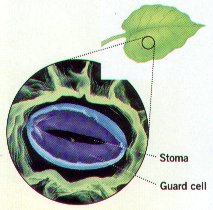
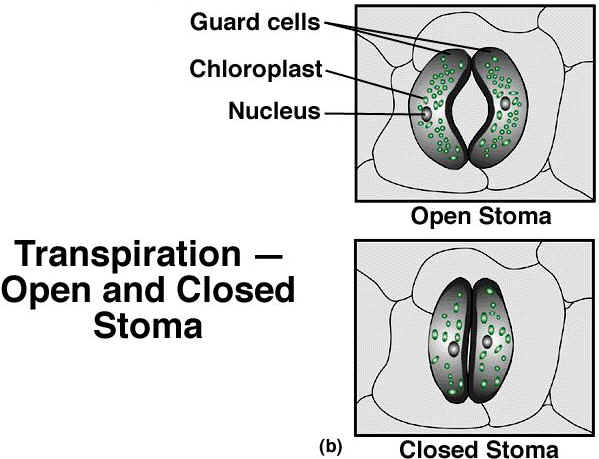
48. What are stomata & where are they located?

49. When would plant cells need to close or partially close their stomata?

50. Name 2 alternate carbon-fixing pathways used by plants in hot climates.

51. Plants that close their stomata during the hottest part of the day thus fixing carbon into four
carbon compounds are called ______________________. Name three.

52. CAM plants open stomata at ______________ and close during the _________________.

53. Name 3 environmental factors that affect the rate of photosynthesis.

BACK


Photosynthesis Cellular and Respiration Study Guide


Photosynthesis & Cellular Respiration Study Guide

* Name 3 life processes that require energy.

* What is the ultimate source of energy on earth?

* The process of plants capturing sunlight & making complex molecules is called?

* Where in chloroplasts are grana found?

* What are biochemical pathways?

* Name 3 things that happens to light that strikes an object.

* Why does chlorophyll look green to your eyes?

* What happens to chlorophyll’s electrons when they absorb energy?

* What pigments are found in flower petals?

* What chain do electrons enter when they are raised to a higher energy level after absorbing energy?

* What replaces the electrons lost by photosystem I?

* What is the source of oxygen during photosynthesis?

* Complex carbohydrates are made during what part of photosynthesis?

* Where is energy temporarily stored when food molecules are broken down?

* What gas made during photosynthesis is used in cellular respiration?

* What is the process of breaking down food molecules to release stored energy called?

* Name 3 things that occur during glycolysis.

* Breaking down organic molecules without oxygen is known as what?

* What acid builds up in muscles during heavy exercise without enough oxygen?

* Name the 2 stages of cellular respiration.