Isopod Behavior


Isopods in Training  


Introduction:

Terrestrial isopods are land dwelling crustaceans, commonly known as sowbugs or pillbugs (or rollypollys). They are related to lobsters, crabs, and shrimp and terrestrial isopods breath with gills. While they look similar, sow bugs are different from pill bugs. Pill bugs will curl into a ball when threatened whereas sow bugs will attempt to flee.

Ethology is the study of animal behavior. Many behaviors involve movement of the animal within its environment. In this exercise, you will investigate some innate (instincts) behaviors of isopods. Orientation is a process by which animals position themselves with respect to spatial features of their environments. Taxis involves the turning of an animal’s body relative to a stimulus – either toward or away. Kinesis is a random turning or movement of an animal in relation to a stimulus.

Materials:

isopods, behavior chamber, paper towels, water

Procedure – Orientation of Isopods in Response to Moisture

  1. Cut paper towels to fit into the bottom of BOTH sides of your behavior chamber.
  2. Moisten one side with tap water while keeping the other side dry.
  3. Transfer 5 isopods to each side of the chamber (total of 10).
  4. Count and record the number of animals on each side of the chamber every 30 seconds for ten minutes.
  5. Record your data in the data table.

Data:


Time # in Wet # in Dry
0:00
0:30
1:00
1:30
2:00
2:30
3:00
3:30
4:00
4:30
5:00
5:30
6:00
6:30
7:00
7:30
8:00
8:30
9:00
9:30
10:00


Analysis:

1. Based on your observations, do isopods prefer a moist or dry environment.

2. Would this movement be taxis or kinesis? Explain your answer.


3. Suggest a reason why this behavior might be advantageous to an isopod


4. Select one of the following factors and design an experiment to test for your hypothesis.


Factor Materials (suggested)
Temperature cold pack, warm pack
Light lamps, flashlights, dark construction paper, aluminum foil
pH low pH (HCl), high pH (NaOH)
Substrate (surface) soil, sand, sandpaper, bark, paper, cedar chips, gravel
Odor ammonia
Food apple, potato, fish food, lunchmeat
Other Organisms mealworms, crickets, earthworms


No Slide Title

This page uses frames, but your browser doesn’t support them.

Karyotype Lab


Karyotype lab


Introduction:

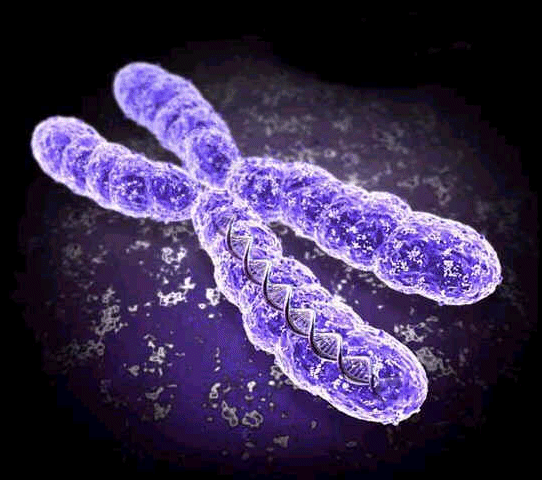
We can learn a lot by looking at chromosomes! They can tell us everything from the likelihood that an unborn baby will have a genetic disorder to whether a person will be male or female. Scientists often analyze chromosomes in prenatal testing and in diagnosing specific diseases. Fetal cells from an unborn child are contained in the amniotic fluid and can be tested for hereditary disorders such as Tay-Sachs or Phenylketonuria. Chromosomes are compact spools of DNA. If you were to stretch out all the DNA from one of your cells, it would be over 3 feet (1 meter) long from end to end! You can think of chromosomes as “DNA packages” that enable all this DNA to fit in the nucleus of each cell. Normally, we have 46 of these packages in each cell; we received 23 from our mother and 23 from our father. A karyotype is an organized profile of a person’s chromosomes. In a karyotype, chromosomes are arranged and numbered by size, from largest to smallest. This arrangement helps scientists quickly identify chromosomal alterations that may result in a genetic disorder.

To make a karyotype, scientists take a picture of someone’s chromosomes, cut them out and match them up using size, banding pattern and centromere position as guides. Homologous pairs are arranged by size in descending order (largest to smallest) with the sex chromosomes (XX for female or XY for male) as the last or 23 pair. Homologous chromosomes have genes for the same trait at the same location.

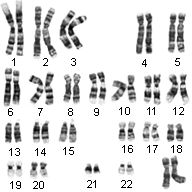
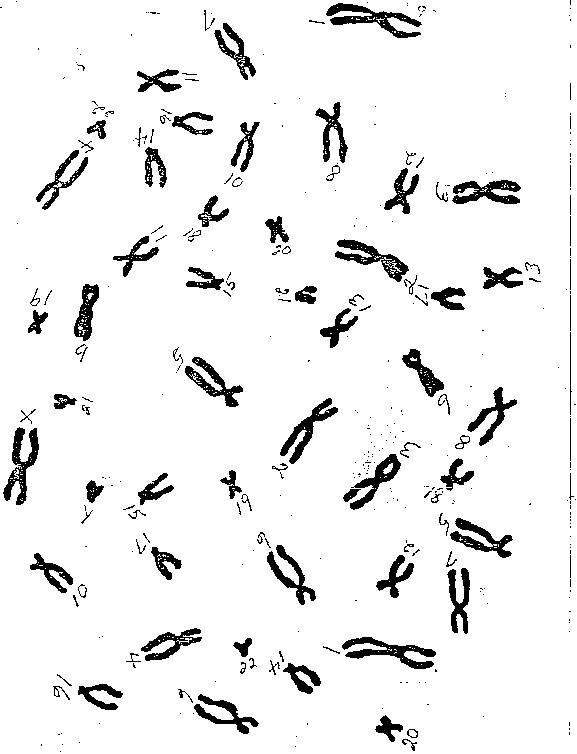
Since humans have 46 chromosomes in their somatic or body cells, they have 23 pairs of chromosomes in their karyotype. If chromosomes fail to separate in meiosis, a condition called nondisjunction, a person may have more or less than the normal 46 chromosomes on their karyotype. A disorder called Down Syndrome would be a example of this. A person with Down Syndrome will have 3 chromosomes in their 21st pair. The image below shows chromosomes as they are seen on the slide (left panel) and after arrangement (right panel).

Materials:

karyotype background (run on colored paper), 1-3 sheets of numbered chromosomes, stick glue, scissors, envelope, black ink pen or fine-point marker

Procedure:

  1. Use your assigned sex and chromosome condition to determine how many of each chromosome you will need for your karyotype. (Assigned conditions include Normal male, Normal female, Female with Turner Syndrome, Male with Klinefelter’s Syndrome, Female with Down Syndrome, Male with Down Syndrome, Female with three X chromosomes, Male with no X chromosome, female with Cri-du-chat, Male with Cri-du-chat)
  2. Cut out this number of chromosomes keeping the homologous pairs together. (Do not cut off the chromosome numbers until you are ready to glue the chromosomes to your karyotype sheet.)
  3. Start arranging the chromosome pairs on the construction paper karyotype sheet in descending order by their size. Do not glue the chromosomes until  all of them are arranged correctly.
  4. Evenly space out 4 rows of chromosomes on your karyotype sheet. Row 1 should contain pairs 1-6, row 2 has pairs 7-12, row 3 has pairs 13-18, and row 4 pairs 19 through the sex chromosomes.
  5. If any additional chromosomes are needed to complete your karyotype, cut these out from additional chromosome sheets.
  6. Make sure ALL PAIRS are in the same direction with their SHORTER END TOWARDS THE TOP OF THE CONSTRUCTION PAPER. 
  7. Cut off the numbers from one homologous pair of chromosomes at a time and glue that pair to your construction paper karyotype sheet.
  8. With your ink pen or marker, neatly number each pair 1-23 below the glued pair.
  9. In the lower left corner of your karyotype, write the sex of your individual and their genetic condition (normal, Cri-du-chat, Down’s…).
  10. In the lower right corner, write the total number of chromosomes for this person.

Karyotype Template: (Click here for additional templates)

Questions & Observations:

  1. What is a karyotype? 


2. How can a karyotype be useful to a couple wanting to have children?


3. What makes up chromosomes?

4. How is a karyotype of an unborn infant obtained?


5. What was the sex of the individual you were assigned?

6. What is this person’s GENOTYPE for sex?

7. What is a mutation?


8. What mutation, if any, occurred in this person’s karyotype?

9. How many chromosomes are in a somatic or body cell of this individual?

10. How many chromosomes are in a gamete or sex cell of this individual?

11. How many chromosomes are in a normal person’s somatic cells?

12. How many chromosomes are in a normal person’s gametes?

13. How many UNPAIRED chromosomes are their in this organism’s somatic cells?

14. What is the sex of an individual with 23 MATCHED pairs of chromosomes?

15. What is the diploid number for this organism?

16. Explain nondisjunction.


17. Name and explain 3 disorders due to nondisjunction of chromosomes.


Invertebrate Worksheet


Invertebrate Lecture Worksheet
All Materials © Cmassengale

1. Approximately what percentage of animals are invertebrates?

2. What are invertebrates?


3. Name the phyla of invertebrates and members of each phyla.


Sponges

4. __________ are in the phylum Porifera.  There are about _____ different species & most of  these are _________ organisms found in oceans & seas.  A few sponges are found in  __________, but these are small and not brightly colored.

5. Sponges are _____________ that trap __________ from water as it flows through them.

6. Sponges have no basic body arrangement and are said to be ________________.

7. Sponges live attached to one spot as adults so they are __________.

8. The skeleton of sponges is made of a flexible protein called ___________ and hard fibers  called __________ which are composed of calcium carbonate or silicon dioxide.

9. Sponges are full of holes called __________ through which water flows into their __________  bodies.

10. Sponges are the simplest animals and lack the __________ level of specialization like all other animals. Sponges do have some specialized _________ in their bodies.

11. Special cells called choanocytes line the pores and have __________ that spin to pull in water.

12. __________cells at the base of choanocytes capture plankton from the water & start digesting it.

13. _______________ are special cells that carry this food to all other parts of the sponge.

14. Wastes and excess water leave a sponge through a large opening at the top called the   __________.

15. Sponges reproduce asexually by internal or external __________ and by _______________ whenever a piece of a sponge breaks off.  This last method helps sponges form   _____________.

16. Sponges reproduce sexually also and are _______________ producing both eggs and sperm.  Sponges __________ sperm with each other and do not fertilize their own eggs.

17. Internal buds or ____________ form if the freshwater supply evaporates and are release  when the sponge __________ and become ___________ when freshwater returns.

 Cnidarians

 17. The phylum Cnidaria includes what organisms?


18. All cnidarians are _______________ organisms except for the __________ which is found in freshwater.

19. Cnidarians all have _______________ symmetry and _____________ or arms that have stinging cells called _______________.  These stinging cells shoot out like a   _______________ and contain a __________ that can kill or paralyze their prey.

20. Cnidarians have _____ body layers; an inner _______________ and an outer ____________.

21. Cnidarians have _______ opening into their hollow bodies called the __________ so food enters and wastes leave through this same opening.  This is called a ________________ digestive system.

22. The hollow cavity the mouth opens into is called the ____________________ cavity.

23. Cnidarians have 2 body forms. ___________ forms have the mouth & tentacles located at the  top like Hydra, corals, and sea anemones. _____________forms like the jellyfish have their  tentacles and mouth located at the bottom.

24. Some cnidarians like the _______________ go through both polyp and medusa forms in their life cycle.

25. Cnidarians have a simple nerve _________ and can reproduce both _____________ and  _____________.

26. Corals build _____________ cases that make underwater ___________.

Flatworms

27. Flatworms are in the phylum _______________ and are flattened ______________ with  __________ symmetry.

28. Flatworms are said to be _________________ because of their solid body.

29. ___________and ____________ are parasitic flatworms having only _______ body opening called the _____________.

30. Specialized _____________ cells remove wastes.

31. The ______________ is the most common free living flatworm.  It is found in __________ or _____________ places.

32. Planarians produce both eggs and sperm and are said to be ________________; however, they _____________ sperm with other planarians.  Planarians also reproduce asexually by  _________________.

33. Flukes and tapeworms usually live in their host’s ______________ tract resistant to digestive  _______________ allowing the __________ to digest their food.

34. Tapeworms are divided into sections called _________________ with complete  _________________ structures.  The head is called the _______________ and has both  _________________ and ______________ to attach to the host.

35. Tapeworms are ___________________ and ______________ their own eggs which pass out of the host’s body in ripe ____________________ along with feces.

36. Humans get tapeworms from eating _______________________, while children pick up tapeworm eggs from ________________ boxes.

 Nematodes

37. _______________ are in the phylum Nematoda and are _________________ in shape and  ________________ at both ends.

38. Roundworms are ____________________ because their body cavity or       ________________is not fully lined. The body cavity is filled with fluid giving them a   ____________________ skeleton against which _______________can contract.

39. Roundworms have a complete gut with both a ______________ and an _____________  giving them a ________________ digestive tract.

40. Roundworms have no ____________ and no ___________ but can digest food.

41. Most roundworms are _________________ with ________________ symmetry and no   _____________________.  They are found in _______________________.

42. A protective __________________covers them and must be _____________.

43. Roundworms reproduce _________________.

44. The roundworm called Trichinella causes the disease _______________ and is picked up when someone eats ________________________.  This disease affects the ______________ and _______________.

45. The roundworm Ascaris parasitizes human _____________________.   __________________  and _________________ are common parasites of humans, and the Filaria worm attacks the _________________ system causing great swelling.

 Rotifers

46. Rotifers are ___________________ worms found in terrestrial & aquatic habitats.

47. Rotifers have a crown of ______________ surrounding their mouth for ________________ and ______________________.  Their bodies are covered with ________________.

48. Rotifers have separate _____________, but some species reproduce by       _______________________.

49. Describe parthenogenesis.


 Mollusks

50. Name several organisms in the phylum Mollusca.


51.Mollusks have a durable shell made of ________________ and are found      ________________.

52. List several economic importance’s of this group.


53. Name the 2 largest invertebrates.


54. Mollusks have ________________ symmetry and a ___________________ containing their body organs.  Mollusks also have a muscular ____________ for movement which can be modified into arms or _________________.

55. Mollusks breathe through ________________ or________________ located below a protective layer called the _______________.  This layer can also form an external  _____________.

56. The ______________ is a rough tongue for scraping food.

57. Mollusks have a ___________________ heart and an ______________________circulatory system.

58. Mollusks reproduce ___________________ and go through a free swimming larval stage called the _______________________.

59. ____________________ mollusks have a muscular foot on their belly and include the shelled  _______________ and the unshelled ________________.

60. ___________________ mollusks have a 2 part hinged shell that is opened and closed by  _________________ muscles.  They move by ___________________ or by extending their muscular _______________, and they respire through __________________.

61. Name some bivalve mollusks.

62. _____________________ are head-foot mollusks that have a _______________ and  ________________, arms or ___________________, and ____________________ to move by jet propulsion.

63. Name some cephalopod mollusks.


64. What is the only shelled cephalopod?

65. Cephalopods breathe through _______________ .

66. Cephalopods are the most ________________________ mollusks.

67. The _____________________ & ________________ can secrete an inky substance into the water to escape predators and have an __________________ shell.

 Annelids

68. Annelids are ____________________ worms found in _________________.

69. External segments correspond to internal segments called _______________.

70. Give two ways that segmentation is an advantage for an organism.


71. Annelids have a tube within a tube body plan called the ___________________ where the body _______________ are located. This tube runs from the _________________ to the _______________ and is fully _______________.

72. Annelids show ______________________ by having bilateral symmetry with an anterior head where most sense organs are found.

73. Coelomic fluid gives annelids a ______________________ skeleton.

74. The best known member of this group is the ____________________ which moves by external bristles called _________________ on each body segment.  These bristles are made of _________________.  Earthworms respire through their ________________________ and have a ___________________ circulatory system and _____________ pairs of hearts or  aortic arches.

75. Describe how an earthworm feeds and tell how this helps the environment.


76. What are castings and where can they be found?


77. ______________ are annelids with _____________ at both the anterior and posterior end.  Anterior suckers are used to __________________________ , while posterior suckers help to  ____________________________.

78. Most leeches are _______________________ or ____________________, but blood sucking leeches are collected for ___________________________.

79. Both leeches and earthworms produce eggs and sperm and are called        _______________________; however, leeches lack ________________ and are flattened  _________________________.

80. ___________________ are marine annelids whose setae are modified into paddle like ____________________ for movement and more area for _______________________.

81. Polychaetes live commensally with what other organisms?


Arthropods

82. Arthropod means _________________ appendages.

83. Give 5 characteristics of all arthropods.


84. What is ecdysis and why is it necessary?


85. What is the exoskeleton of arthropods composed of?

86. What is meant by an open circulatory system?


87. Arthropods are divided on the type of _____________________ they have.       ______________________ have chelicerae or fangs and no_________________,  _______________________ have pincers called ___________________, and      _______________________ have mandibles or jaws.

88. ___________________ are extinct, marine arthropods with a_____________ and segmented _____________________ with a pair of legs on each section.

89. ________________________ arthropods like insects, centipedes, & millipedes breathe through hollow air tubes called _____________________;  aquatic chelicerates like the ____________________ crab have ___________________ to breathe; spiders, ticks, and  scorpions use _____________________ to get air; and crustaceans breathe through  ______________________.

90. Terrestrial mandibulates are ____________________ with one-branched appendages; while aquatic crustaceans are _______________________ with two-branched appendages.

91. Arthropods have a nervous system with an anterior ___________________ and sensory organs that include compound eyes or simple eyes called _______________;  ______________________ membranes for hearing; and ___________________ for smelling, feeling, or tasting.

92. ______________________ tubules filter wastes in arthropods.

93. The subphylum Chelicerarta contains the class ______________________ with the horseshoe Crab and the class ____________________ with spiders, ticks, scorpions, & mites.  Both classes have ___________ body regions, the ___________________ and abdomen, no ___________________, ____________________ legs, and ___________________ or fangs.

94. Appendages on the head of chelicerates called _____________________ are used for sensing the environment and getting food into the mouth.

95. Spiders have posterior glands called ________________ that help make their silken webs to get prey.  Spiders detect movement whenever their prey gets caught in their  ________________ and by sensory ________________ on their body.  Spiders produce  _______________ to kill their prey & are beneficial because they feed mainly on  ____________________.

96. Spiders are unlike insects in that they have _____________ not ___________ legs, only ___________________ eyes and not compound, and _________ body regions and not _____________.

97. Name the body regions of insects and spiders.


98. The ____________________ and ____________________ are two poisonous spiders in our  area.

99. The class Crustacea is in the subphylum _______________________ and includes  _________________, ________________, ________________, _________________,  _________________, and the terrestrial __________________ & ___________________.

100. Crustaceans have a pair of sensory __________________ and a pair of shorter ___________________ for balance.  The head also contains three types of mouthparts –  _____________________, _____________________, and _______________________.  They also have pincers called __________________ to help catch and eat food.

101. Aquatic crustaceans have an external shell or __________________ that must be molted, and they are used by man for ___________________.

102. The class _____________________ contains predators called centipedes with  ________________, _________________ glands,  posterior_______________, &  ________________ pairs of legs per body segment.

103. The class ____________________ contains millipedes which are ____________________ with _______________ pairs of legs per body segment.

104. The largest and most successful group of arthropods are the __________________.

105. Insects have _______ body regions, _________ legs, a pair of sensory ________________, and a pair of ________________ for flight. ___________________ & ___________________ are wingless insects, while flies have their second pair of wings modified into balancing organs called ____________________.

106. Insects have 4 mouthparts which include the jaw or ________________, the   _______________, the lower lip or _________________, and the upper lip or      __________________.

107. Insect mouthparts are modified according to their ___________________.  Butterflies have  ___________________ mouthparts, flies have _________________ mouthparts, mosquitoes have ________________ mouthparts, and grasshoppers have   ___________________ mouthparts.

108.  Wings and legs are both attached to the _________________ on insects, and some female insects have an egg laying tube or ____________________ on the end of their abdomen.

109. Name 2 ways insects communicate.


110. Insects detect sound by _________________ membranes on the abdomen and sensory  _______________ that cover their body.

111. _________________ along the abdomen of insects open into their breathing tubes or ___________________.

112. Insects with _________________ metamorphosis go through egg, larva, pupa, & adult stages; while those with incomplete metamorphosis go through ________________,  ___________________, and _________________ stages.

113. Give examples of insects with complete and incomplete metamorphosis.


114. __________________ control metamorphosis.

Echinoderms

115. Give some examples of echinoderms.


116. What does echinoderm mean?


117. Why are echinoderms considered to be the most advanced invertebrates?


118. All invertebrates, except echinoderms, are considered to be________________ because their blastopore becomes their _________________.

119. Echinoderms have an __________________ made of movable or fixed calcium plates called ___________________, ___________________ symmetry with a ______________ part body plan, no __________________ or _________________ as adults, and extendable ________________________ for movement.

120. Echinoderms have a ___________________________ system composed of canals.  Water enters a pore called the ______________________ and goes through a short  _________________ canal to the _______________ canal. __________________ canals  connect to the ring canal & determine the 5 part body plan.

121. How do starfish use their water vascular system when feeding?


122. _____________________ are used for respiration and________________.

123. Echinoderms reproduce asexually by _____________________ or sexually with _________________ fertilization.

124. Starfish are in the class ____________________ and are active marine _______________ With _______________ arms attached to a _______________________.  Their mouth is located on the underside or _________________ surface. ___________________ mollusks are favorite food of starfish. They can eject their _________________ into the clam and digest it.

125. ___________________ and ____________________ are in the class Echinoidea and they lack distinct __________________.  They do have five rows of protruding _____________________ which they use along with external __________________ for movement.  Triangular ________________ around the mouth help them scrap or crush their food. They graze on __________________,

____________________, & dead fish.

126. The class Crinoidea contains ______________________ & ______________________.

127. Crinoids have upright, highly branching ________________ around their mouth which they use for _________________________.  Sea lilies are attached by a _________________, while feather stars are able to ________________ and move about.

128. Brittle stars are in the class ________________ and have slender _______________ that easily break off to escape predators.

129. Holothuroidea contains ___________________ that are soft, sluglike marine creatures with ___________________ outer skin.  They usually lie ________________________ and can eject part of their _____________________ to scare away predators.  They move with         _________________ or by ____________________________.  Some of these are _________________________ which is unusual for echinoderms.


BACK

AP Lab 2 Report 2001


Enzyme Catalysis


Introduction
Enzymes are proteins produced by living cells that act as catalysts, which affect the rate of a biochemical reaction. They allow these complex biochemical reactions to occur at a relatively low temperature and with less energy usage.

In enzyme-catalyzed reactions, a substrate, the substance to be acted upon, binds to the active site on an enzyme to form the desired product. Each active site on the enzyme is unique to the substrate it will bind with causing each to have an individual three-dimensional structure. This reaction is reversible and is shown as following:

E + S—-ES—- E + P

Enzymes are recyclable and unchanged during the reaction. The active site is the only part of the enzyme that reacts with the substrate. However, its unique protein structure under certain circumstances can easily be denatured. Some of the factors that affect enzyme reactions are salt concentration, pH, temperature, substrate and product concentration, and activators and inhibitors.

Enzymes require a very specific environment to be affective. Salt concentration must be in an intermediate concentration. If the salt concentration is too low, the enzyme side chains will attract each other and form an inactive precipitate. Likewise, if the salt concentration is too high, the enzyme reaction is blocked by the salt ions. The optimum pH for an enzyme-catalyzed reaction is neutral (7 on the pH scale). If the pH rises and becomes basic, the enzyme begins losing its H+ ions, and if it becomes too acidic, the enzyme gains H+ ions. Both of these conditions denature the enzyme and cause its active site to change shape.

Enzymes also have a temperature optimum, which is obtained when the enzyme is working at its fastest, and if raised any further, the enzyme would denature. For substrate and product concentrations, enzymes follow the law of mass action, which says that the direction of a reaction is directly dependent on the concentration. Activators make active sites better fit a substrate causing the reaction rate to increase. Inhibitors bind with the enzymes’ active site and block the substrate from bonding causing the reaction to subside.

The enzyme in this lab is catalase, which produced by living organisms to prevent the accumulation of toxic hydrogen peroxide. Hydrogen peroxide decomposes to form water and oxygen as in the following equation:

2H2O2 ® 2H2O + O2

This reaction occurs spontaneously without catalase, but the enzyme speeds the reaction considerably. This lab’s purpose is to prove that catalase does speed the decomposition of hydrogen peroxide and to determine the rate of this reaction.


Hypothesis
The enzyme catalase, under optimum conditions, effectively speeds the decomposition of hydrogen peroxide.


Materials
Exercise 2A: Test of Catalase Activity

In Part 1, the materials used were 10mL of 1.5% H2O2, 50-mL glass beaker, 1 mL catalase, and 2 10-mL pipettes and pipette pumps. In Part 2, the materials used were 5 mL of catalase, a boiling water bath, 1 test tube, a test tube rack, 10 mL of 1.5% H2O2, 50-mL beaker, and 2 10-mL pipettes and pipette pumps. In Part 3, the materials used were 10 mL of 1.5% H2O2, 50-mL beaker, liver, and a syringe.

Exercise 2B: The Baseline Assay

This part of the lab required 10 mL of 1.5% H2O2, 1 mL distilled H2O, 10 mL of H2SO4, 2 50-mL beakers, a sheet of white paper, 5 mL KMnO4, 2 5-mL syringes, and 2 10-mL pipettes and pumps.

Exercise 2C: The Uncatalyzed Rate of H2O2 Decomposition

The materials used for this section were 15 mL of 1.5% H2O2, 1 mL distilled H2O, 10 mL H2SO4, 2 50-mL beakers, a sheet of white paper, 5 mL KMnO4, 2 5-mL syringes, and 2 10-mL pipettes and pumps.

Exercise 2D: An Enzyme-Catalyzed Rate of H2O2 Decomposition

The materials required for Exercise 2D were 70 mL of 1.5% H2O2, 70 mL of H2SO4, 6 mL of catalase solution, 13 plastic, labeled cups, 3 100-mL beakers, 1 50-mL beaker, 1 10-mL syringe, 1 5-mL syringe, 1 60-mL syringe, a sheet of white paper, a timer, and 30 mL of KMnO4.


Method
Exercise 2A: Test of Catalase Activity

In Part 1, 10 mL of 1.5% H2O2 were transferred into a 50-mL beaker. Then, 1 mL of fresh catalase solution was added and the reaction was observed and recorded. In Part 2, 5 mL of catalase was placed in a test tube and put in a boiling water bath for five minutes. 10 mL of 1.5% H2O2 were transferred to a 50-mL beaker and 1 mL of the boiled catalase was added. The reaction was observed and recorded. In Part 3, 10mL of 1.5% H2O2 were transferred to a 50 mL beaker. 1 cm3 of liver was added to the beaker and the reaction was observed and recorded.

Exercise 2B: The Baseline Assay

10 mL of 1.5% H2O2 were transferred to a 50-mL beaker. 1 mL of H2O was added instead of catalase, and then, 10 mL of H2SO4 were added. After mixing well, a 5 mL sample was removed and placed over a white sheet of paper. A 5-mL syringe was used to add KMnO4, 1 drop at a time until a persistent brown or pink color was obtained. The solution was swirled after every drop, and the results were observed and recorded. The baseline assay was calculated.

Exercise 2C: The Uncatalyzed Rate of H2O2 Decomposition

A small quantity of H2O2 was placed in a beaker and stored uncovered for approximately 24 hours. To determine the amount of H2O2 remaining, 10 mL of 1.5% H2O2 were transferred to a 50-mL beaker. 1 mL of H2O was added instead of catalase, and then, 10 mL of H2SO4 were added. After mixing well, a 5 mL sample was removed and placed over a white sheet of paper. A 5-mL syringe was used to add KMnO4, 1 drop at a time until a persistent brown or pink color was obtained. The solution was swirled after every drop, and the results were observed and recorded. The percent of the spontaneously decomposed H2O2 was calculated.

Exercise 2D: An Enzyme-Catalyzed Rate of H2O2 Decomposition


The baseline assay was reestablished following the directions of Exercise 2B. Before starting the actual experiment a lot of preparation was required. Six labeled cups were set out according to their times and 10 mL of H2O2 were added to each cup. 6 mL of catalase were placed in a 10-mL syringe, and 60 mL of H2SO4 were placed in a 60-mL syringe. To start the actual lab, 1 mL of catalase was added to each of the cups, while simultaneously, the timer was started. Each of the cups were swirled. At 10 seconds, 10 mL of H2SO4 were added to stop the reaction. The same steps were repeated for the 30, 60, 120, 180, and 360 second cups, respectively.

Afterwards, a five 5 mL sample of each of the larger cups were moved to the corresponding labeled smaller cups. Each sample was assayed separately by placing each over a white sheet of paper. A 5-mL syringe was used to add KMnO4, 1 drop at a time until a persistent brown or pink color was obtained. The solution was swirled after every drop, and the results were observed and recorded.


Results

Table 1
Enzyme Activity


Activity


Observations

Enzyme activity The solution only bubbled slightly and slowly.
Effect of Extreme temperature


The catalase had no reaction with the H2O2; there were no bubbles
Presence of catalase The solution foamed up immediately


Table 2
Establishing a Baseline


Volume


Initial reading


5.0 mL


Final reading


0.8 mL


Baseline ( final volume – initial volume)


4.2 mL


Table 3
Rate of Hydrogen Peroxide Spontaneous Decomposition


Volume


Initial KMnO4


5.0 mL


Final KMnO4


1.2 mL


Amount of KMnO4 used after 24 hours


3.8 mL


Amount of H2O2 spontaneously decomposed
( ml baseline – ml after 24 hours)


0.4 mL


Percent of H2O2 spontaneously decomposed
( ml baseline – ml after 24 hours/ baseline)


9.52%


Table 4
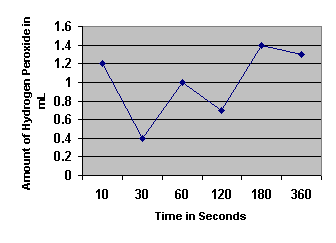
Rate of Hydrogen Peroxide Decomposition by Catalase


Time ( Seconds)
10 30 60 120 180 360
 

Baseline KMnO4


4.0 mL


4.0 mL


4.0 mL


4.0 mL


4.0 mL


4.0 mL


Initial volume KMnO4


5.0 mL


5.0 mL


5.0 mL


5.0 mL


5.0 mL


5.0 mL


Final volume KMnO4


2.2 mL


1.4 mL


2.0 mL


1.7 mL


2.4 mL


2.3 mL


Amount KMnO4 used
(baseline – final)


2.8 mL


3.6 mL


3.0 mL


3.3 mL


2.6 mL


2.7 mL


Amount H2O2 used
(KMnO4 – initial)


1.2 mL


0.4 mL


1.0 mL


0.7 mL


1.4 mL


1.3 mL


Amount of Hydrogen Peroxide Decomposed by Catalase
Exercise 2A: Test of Catalase Activity

1. Observing the reaction of catalase on hydrogen peroxide:

a. What is the enzyme in this reaction?  catalase

b. What is the substrate in this reaction? Hydrogen peroxide

c. What is the product in this reaction? Oxygen & water

d. How could you show that the gas evolved is O2? The gas could be shown to be O2 if the gas were collected in a tube, and a glowing splint was held in the tube. If the splint glowed, it would prove the gas was oxygen.

2. Demonstrating the effect of boiling on enzyme action:

a. How does the reaction compare to the one using the unboiled catalase? Explain the reason for this difference. While the unboiled catalase caused bubbles to form in the solution, the boiled catalase did not react at all because boiling an enzyme causes the protein to unfold and therefore denatures it.

3. Demonstrating the presence of catalase in living tissue:

a. What do you think would happen if the potato or liver was boiled before being added to the H2O2? The catalase in the liver would have been denatured by the boiling and would not have reacted with the H2O2.

Analysis of Results

1. Determine the initial rate of the reaction and the rates between each of the time points.


Time Intervals (Seconds)


Initial 0 to 10


10 to 30


30 to 60


60 to 120


120 to 180


180 to 360


Rates


0.12 mL/sec


-0.04 mL/sec


0.02 mL/sec


-0.005 mL/sec


0.01167 mL/sec


-0.00083

mL/sec


2. When is the rate the highest? Explain why.


The rate is the highest in the initial ten seconds because the concentration of catalase is at its highest. As more of the product is formed, it blocks the reaction between the catalase and the hydrogen peroxide.

3. When is the rate the lowest? For what reasons is the rate low?

The rate is lowest during the 180-360 seconds time period because of the law of mass action. This law says that when there is a high concentration of product as in this period, the enzymes will be blocked by the product (water) from reaching and reacting with the substrate (H2O2).


4. Explain the inhibiting effect of sulfuric acid on the function of catalase. Relate this to enzyme structure and chemistry


Sulfuric acid has an inhibiting effect on catalase function because it causes the pH level in the solution to lower considerably. Acidic solutions cause the protein structure of the enzyme to gain H+ ions causing it to denature.


5. Predict the effect lowering the temperature would have on the rate of enzyme activity. Explain your prediction.


Lowering the temperature of the catalase would slow the rate of reaction until it finally caused the enzyme to denature, and it would no longer react with the substrate. Most enzymes are only affective in a temperature range between 40° – 50° C.

6. Design a controlled experiment to test the effect of varying pH, temperature, or enzyme concentration.

Part 1: Enzyme Activity at Room Temperature

Add 10 mL of 1.5% H2O2 to a 50-mL beaker, and add 1 mL of room temperature catalase. Mix well and add 10 mL of H2SO4. Watch the reaction and record the results.

Part 2: The Effect of Excessive Heat on Enzyme Activity

Put 5 mL of catalase into a test tube and heat thoroughly over a Bunsen burner. Add 1 mL of the heated catalase to 10 mL of 1.5% H2O2 in a 50-mL beaker. Add 10 mL of H2SO4. Watch the reaction and record the results.

Part 3: The Effect of Excessive Cooling on Enzyme Activity

Put 5 mL of catalase in a freezer until completely frozen. Add 1 mL of the frozen catalase to 10 mL of 1.5% H2O2 in a 50-mL beaker. Add 10 mL of H2SO4. Watch the reaction and record the results.


Error Analysis
Any number of factors in this lab could have affected the results of this experiment. To get the desired results all of the measurements had to be precisely accurate and fully planned before hand. In Exercise D especially, the factor of planning became increasingly essential. The first attempt at 2D was unsuccessful due to several reasons. First of all, the measurements, which were taken, could have possibly been inaccurate and the 60-mL syringe containing H2SO4 also dripped into one of the cups early which did not allow the reaction to fully take place. There was also some confusion on the operation of the timer and precise planning in its use. The second attempt at 2D contained errors as well. The measurements were still not as accurate as they should have been, and the solution did not appear entirely uniform. In one cup, for example, the first drop of KMnO4 left a persistent pink color, and then after over a minute, it returned back to being clear. It then took several milliliters more to get it back to a pink color.


Discussion and Conclusion
This lab showed how catalase increased the rate of decomposition of hydrogen peroxide. In 2A, it was shown that catalase causes a visual reaction with H2O2, that when boiled catalase is no longer reactive, and that catalase is present in living tissue. Lab 2C shows that the natural decomposition of H2O2 is much slower than the enzymatic reaction. Lab 2D showed the decomposition of H2O2 over just a period of six minutes, and it had already decomposed more than the uncatalyzed H2O2 had done in 24 hours.

BACK