Graph Examples

Examples of Graphs

LINE GRAPHS

Line Graph title

A line graph is most useful in displaying data or information that changes continuously over time. The example below shows the changes in the temperature over a week in January. Notice that the title of the graph is “Average Daily Temperature for January 1-7 in degrees Fahrenheit”.

To the left is a table that shows the date in one column and the corresponding temperature in the second column. The line graph on the right shows the degrees of temperature going up the vertical axis (up and down numbers on the left of the graph) and the days of the week on the horizontal axis (going sideways from left to right). The points for the temperature for each day are connected by a line – thus the graph is a line graph.

Average Daily Temperature for January 1-7 in Degrees Fahrenheit

Date
Temperature
1 10
2 25
3 30
4 42
5 23
6 25
7 40
Line Graoh of Average Temperatures


Bar Graph Animated title

BAR GRAPHS

Bar graphs are an excellent way to show results that are one time, that aren’t continuous – especially samplings such as surveys, inventories, etc. Below is a typical survey asking students about their favorite after school activity. Notice that in this graph each column is labeled – it is also possible to label the category to the left of the bar. In this case, the numbers for each category are across the bottom of the chart.

A bar chart is marked off with a series of lines called grid lines. These lines typically mark off a numerical point in the series of numbers on the axis or line. In this case, each grid line going up and down marks a multiple of 20 as the graph is divided.  More gridlines can make it easier to be exact with the amounts being shown on the bar graph, but too many can make it confusing.  Notice that for data that does not fall evenly on a multiple of 20, the bar is in between two grid lines.  Bar graphs are useful to get an overall idea of trends in responses – which categories get many versus few responses.

Favorite Student After School Activity

Activity Number
Visit W/Friends 175
Talk on Phone 168
Play Sports 120
Earn Money 120
Use Computers 65
Bar Graph

Circle Pie Graph Title

CIRCLE/PIE GRAPHS

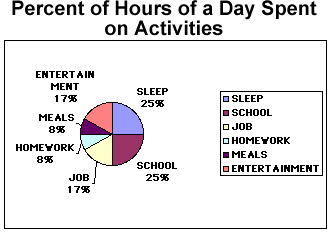
Circle or pie graphs are particularly good illustrations when considering how many parts of a whole are inception. In the table below both the number of hours in a whole day devoted to certain activities is listed as well as the percent of time for each of these activities. The pie chart is then divided very much as a baker’s pie would be into slices that represent the proportional amounts of time spent on each activity.

To the right of the pie chart is a legend that tells which color stands for which category. In addition, the percents are also near the pie slice that stands for that particular amount of time spent.

Percent of Hours of a Day Spent on Activities

ACTIVITY HOURS PERCENT OF DAY
Sleep 6 25
School 6 25
Job 4 17
Entertainment 4 17
Meals 2 8
Homework 2 8


Pie Graph of Day's Activities


Leaf Collection Instructions

Arkansas is essentially a forest state because more than half of the state is covered with trees.  The climate and soils of Arkansas also support a great variety of trees, both conifers and deciduous.  Trees are one of Arkansas’ most important crops.  Forests are also valuable in preventing erosion, in offering parks and recreational areas, and in providing homes for wildlife.  In addition, many trees have been introduced into the state as ornamentals.

Leaf collecting is a good way to learn the trees native to your area.  Collecting leaves will also help you to learn leaf margins, shapes, and  venations and how to use different taxonomic keys to identify trees.

Materials needed:

  • leaf press
  • black ink pen
  • pencil
  • small notebook
  • scissors
  • Elmer’s glue
  • art paper, poster board, etc. for mounting
  • labels
  • taxonomic keys (Trees of Arkansas published by the Arkansas Forestry Commission)

Top

Directions for making a leaf press:
1.   Cut 15 – 20 pieces of corrugated cardboard 30 cm by 50 cm in size.
2. Cut several sheets of newspaper the same size as the cardboard.
3. Lay 10 or 12 sheets of newspaper between each cardboard layer sandwich style.  These sheets will need to be changed every couple of days as they absorb moisture from your leaves; therefore, cut extra sheets.
4. Use one, preferably two, stretch belts to bind the press together.
5. Leave the press in an area so that air can circulate &  more quickly dry the leaves.

Top

Getting started with your collection:
1. Study the shapes, margins, venations, tips, bases, etc. in your Trees of Arkansas book.

Click here to view reference page

2. Learn to distinguish simple leaves from compound leaves and conifers from deciduous trees.
3. Learn to distinguish a tree from a shrub.
4. Gather your collecting materials together – press, pencil, scissors, & small notebook.
6. Always get permission before collecting leaves on someone else’s property.
7. Be sure to collect at least
two of each type of leaf so both the bottom & top side of the leaf can be shown in your collection.
8. Place leaves in your press immediately after collecting them so they do not start to dry out and wrinkle.
9. Record the name of each leaf, date collected, and place collected in your notebook as you collect.  Also record tree characteristics such as shape of the crown, color and type of bark, etc.

Top

Collecting:
1. Remember to collect two of every type of leaf!
2. Carefully remove an entire leaf, not a leaflet, from the tree, and place this in your press between newspaper layers.
3. If leaves are damaged or torn, don’t use them because you will not receive credit.
4. Make sure that none of the leaf parts extend beyond the edge of the press.
5. You may also collect &press seeds and/or fruits from some trees if they fit in your press.
6. Leave the leaf in the press for 3 – 5 days depending on its thickness and moisture content.  Remember to change the newspaper when needed.
7. Keep the press in an area where air is circulating (in front of a fan).

Top

Labeling and identifying:
1. Obtain printed labels from your teacher.
2. Use only black ink to write labels, & do not mark out or white out mistakes on the labels; rewrite them.
3. Use taxonomic keys to identify each leaf, and include both the scientific & common name of the tree on the label.
4. Determine the shape, margin, tip, base, and venation of your leaf and whether it is a simple or compound leaf; record this on your label.
5. Use you key to give a description of the tree, not the leaf.
6. Research uses for the tree, its fruit, etc. and record on your label.
7. Tell if the leaf is deciduous or coniferous.

Top

Mounting leaves:
1. Use pieces of cut poster board or art paper to mount your leaves.  Make sure all sheets are uniform in size! (The size of your sheets will be determined by your largest leaf.)
2. Use Elmer’s glue to adhere two leaves to each page — one showing the upper surface of the leaf and the other showing the underside of the leaf.
3. Each page should have only one type of leaf on it.
4. Arrange the leaves so they do not overlap each other and so there is room to glue the label in the lower right hand corner.  The leaves should look nice on the page.
5. On compound leaves, mount the topside of the complete leaf and then mount the underside of a single leaflet. Make sure the leaflet comes from another leaf to receive credit!
6. Use a small amount of Elmer’s glue to adhere the completed label in the lower right hand corner of the page.
7. LET THE PAGES DRY COMPLETELY BEFORE ASSEMBLING THEM TOGETHER IN YOUR COLLECTION OR THE PAGES WILL STICK TOGETHER!!!!!
8. Once the pages are dry, lay them in the correct order (see your list of required leaves), and then number the pages in the lower right corner with black ink.
9. Make a stiff front and back cover for your collection from poster board, cardboard, wood, etc.  Include the following items on your cover:

  • title (Tree Identification Through Leaves)
  • your complete name
  • date collection turned into teacher
  • class period
  • subject
  • teacher’s name

10. Use ribbon, string, etc. to bind the pages together or assemble the collection in a scrapbook.  DO NOT COVER THE LEAVES WITH PLASTIC!!!

Top

Required leaves:
1. Only native, Arkansas trees may be used.  Refer to your Trees of Arkansas book.
2. Leaves must be in perfect condition without damage or tears.
3. No more then 4 oaks are allowed in the collection.
4. No fruit trees such as apple, pear, orange, peach, etc. are allowed.
5. Place the following leaves in your collection first and in this order:

  • sweet gum
  • American sycamore
  • pine (any type)
  • flowering dogwood
  • redbud
  • ash (any type)
  • persimmon
  • Eastern red cedar
  • red or silver maple
  • hickory (any type)
  • pecan
  • pin oak
  • willow oak
  • water oak
  • elm (any type)

6. The remaining leaves that you include must be trees native to Arkansas!

Top

*Pre AP Biology is required to collect 30 leaves including the 15 required.

 *Biology I is required to collect 20 leaves including the 15 required.

   Pre AP      Biology I

Loss of Biodiversity Activity


Loss of Biodiversity


Students will make a PowerPoint presentation on the topic of loss of biodiverisity in one of the following areas:

  • Fauna of Arkansas
  • North American Vertebrates
  • North American Invertebrates
  • North American Plants
  • Flora of Arkansas
  • Aquatic Habitats of Arkansas
  • Florida Everglades
  • Alaskan Tundra
  • United States Deserts
  • Along the Mississippi River
  • North American Waterfowl
  • North American Raptors
  • North American Reptiles
  • North American Amphibians
  • North American Mammals

The PowerPoint presentation will be presented to the class and must include 25 slides, 15 of which must include graphics such as images from your web search (save on disk as .jpeg), pictures from books or magazines that you have scanned and inserted into your program, or photographs taken with a digital camera. You should also include three of the following as part of your slide presentation:

  1. Maps
  2. Graphs
  3. Lists
  4. Photograph of a person you interviewed

Your PowerPoint presentation must be accompanied by a written script that corresponds to the numbered order of your slides. The following must be included in your PowerPoint presentation and script:

  1. Name/Description of your chosen area (include a picture if available)
  2. Explanation of the physical environment of the area — climate, water, temperature, etc.
  3. Examples of threatened organisms ( include pictures)
  4. Reasons for organisms endangerment
  5. How the loss of these organisms is affecting other organisms &/or the environment
  6. Conservation measures being taken to prevent the loss of biodiversity in this area


Mammal Orders


Mammal Orders

Locate the orders of mammals and then list the common names of the animals in each order


A T A M E R T O N O M A C A A
M I C S Z E A L R O R R A E P
C C L T E I C O N T P O R C E
C H R A N T D C I Y A V N A R
G B I E I E A O R E K I I T I
N J R R N P D M D N T T V E S
B I G T O A U I I O T C O C S
S T I D C P C S J R I E R J O
T A L T N S T X R C P S A S D
C I Y K O G H E K A M N L Q A
U L I B D F N Y R B M I E P C
A L O X G W F Y Z A E V Q S T
V R L A G O M O R P H A N X Y
P D C A T A T N E D E L C X L
F B T T M M E L P P S O L X A


ARTIODACTYLA CARNIVORA CETACEA
CHIROPTERA EDENTATA INSECTIVORA
LAGOMORPHA MARSUPIALIA MONOTREMATA
PERISSODACTYLA PRIMATES PROBOSCIDEA
RODENTIA SIRENIA


Solution


Invertebrate Worksheet


Invertebrate Lecture Worksheet
All Materials © Cmassengale

1. Approximately what percentage of animals are invertebrates?

2. What are invertebrates?


3. Name the phyla of invertebrates and members of each phyla.


Sponges

4. __________ are in the phylum Porifera.  There are about _____ different species & most of  these are _________ organisms found in oceans & seas.  A few sponges are found in  __________, but these are small and not brightly colored.

5. Sponges are _____________ that trap __________ from water as it flows through them.

6. Sponges have no basic body arrangement and are said to be ________________.

7. Sponges live attached to one spot as adults so they are __________.

8. The skeleton of sponges is made of a flexible protein called ___________ and hard fibers  called __________ which are composed of calcium carbonate or silicon dioxide.

9. Sponges are full of holes called __________ through which water flows into their __________  bodies.

10. Sponges are the simplest animals and lack the __________ level of specialization like all other animals. Sponges do have some specialized _________ in their bodies.

11. Special cells called choanocytes line the pores and have __________ that spin to pull in water.

12. __________cells at the base of choanocytes capture plankton from the water & start digesting it.

13. _______________ are special cells that carry this food to all other parts of the sponge.

14. Wastes and excess water leave a sponge through a large opening at the top called the   __________.

15. Sponges reproduce asexually by internal or external __________ and by _______________ whenever a piece of a sponge breaks off.  This last method helps sponges form   _____________.

16. Sponges reproduce sexually also and are _______________ producing both eggs and sperm.  Sponges __________ sperm with each other and do not fertilize their own eggs.

17. Internal buds or ____________ form if the freshwater supply evaporates and are release  when the sponge __________ and become ___________ when freshwater returns.

 Cnidarians

 17. The phylum Cnidaria includes what organisms?


18. All cnidarians are _______________ organisms except for the __________ which is found in freshwater.

19. Cnidarians all have _______________ symmetry and _____________ or arms that have stinging cells called _______________.  These stinging cells shoot out like a   _______________ and contain a __________ that can kill or paralyze their prey.

20. Cnidarians have _____ body layers; an inner _______________ and an outer ____________.

21. Cnidarians have _______ opening into their hollow bodies called the __________ so food enters and wastes leave through this same opening.  This is called a ________________ digestive system.

22. The hollow cavity the mouth opens into is called the ____________________ cavity.

23. Cnidarians have 2 body forms. ___________ forms have the mouth & tentacles located at the  top like Hydra, corals, and sea anemones. _____________forms like the jellyfish have their  tentacles and mouth located at the bottom.

24. Some cnidarians like the _______________ go through both polyp and medusa forms in their life cycle.

25. Cnidarians have a simple nerve _________ and can reproduce both _____________ and  _____________.

26. Corals build _____________ cases that make underwater ___________.

Flatworms

27. Flatworms are in the phylum _______________ and are flattened ______________ with  __________ symmetry.

28. Flatworms are said to be _________________ because of their solid body.

29. ___________and ____________ are parasitic flatworms having only _______ body opening called the _____________.

30. Specialized _____________ cells remove wastes.

31. The ______________ is the most common free living flatworm.  It is found in __________ or _____________ places.

32. Planarians produce both eggs and sperm and are said to be ________________; however, they _____________ sperm with other planarians.  Planarians also reproduce asexually by  _________________.

33. Flukes and tapeworms usually live in their host’s ______________ tract resistant to digestive  _______________ allowing the __________ to digest their food.

34. Tapeworms are divided into sections called _________________ with complete  _________________ structures.  The head is called the _______________ and has both  _________________ and ______________ to attach to the host.

35. Tapeworms are ___________________ and ______________ their own eggs which pass out of the host’s body in ripe ____________________ along with feces.

36. Humans get tapeworms from eating _______________________, while children pick up tapeworm eggs from ________________ boxes.

 Nematodes

37. _______________ are in the phylum Nematoda and are _________________ in shape and  ________________ at both ends.

38. Roundworms are ____________________ because their body cavity or       ________________is not fully lined. The body cavity is filled with fluid giving them a   ____________________ skeleton against which _______________can contract.

39. Roundworms have a complete gut with both a ______________ and an _____________  giving them a ________________ digestive tract.

40. Roundworms have no ____________ and no ___________ but can digest food.

41. Most roundworms are _________________ with ________________ symmetry and no   _____________________.  They are found in _______________________.

42. A protective __________________covers them and must be _____________.

43. Roundworms reproduce _________________.

44. The roundworm called Trichinella causes the disease _______________ and is picked up when someone eats ________________________.  This disease affects the ______________ and _______________.

45. The roundworm Ascaris parasitizes human _____________________.   __________________  and _________________ are common parasites of humans, and the Filaria worm attacks the _________________ system causing great swelling.

 Rotifers

46. Rotifers are ___________________ worms found in terrestrial & aquatic habitats.

47. Rotifers have a crown of ______________ surrounding their mouth for ________________ and ______________________.  Their bodies are covered with ________________.

48. Rotifers have separate _____________, but some species reproduce by       _______________________.

49. Describe parthenogenesis.


 Mollusks

50. Name several organisms in the phylum Mollusca.


51.Mollusks have a durable shell made of ________________ and are found      ________________.

52. List several economic importance’s of this group.


53. Name the 2 largest invertebrates.


54. Mollusks have ________________ symmetry and a ___________________ containing their body organs.  Mollusks also have a muscular ____________ for movement which can be modified into arms or _________________.

55. Mollusks breathe through ________________ or________________ located below a protective layer called the _______________.  This layer can also form an external  _____________.

56. The ______________ is a rough tongue for scraping food.

57. Mollusks have a ___________________ heart and an ______________________circulatory system.

58. Mollusks reproduce ___________________ and go through a free swimming larval stage called the _______________________.

59. ____________________ mollusks have a muscular foot on their belly and include the shelled  _______________ and the unshelled ________________.

60. ___________________ mollusks have a 2 part hinged shell that is opened and closed by  _________________ muscles.  They move by ___________________ or by extending their muscular _______________, and they respire through __________________.

61. Name some bivalve mollusks.

62. _____________________ are head-foot mollusks that have a _______________ and  ________________, arms or ___________________, and ____________________ to move by jet propulsion.

63. Name some cephalopod mollusks.


64. What is the only shelled cephalopod?

65. Cephalopods breathe through _______________ .

66. Cephalopods are the most ________________________ mollusks.

67. The _____________________ & ________________ can secrete an inky substance into the water to escape predators and have an __________________ shell.

 Annelids

68. Annelids are ____________________ worms found in _________________.

69. External segments correspond to internal segments called _______________.

70. Give two ways that segmentation is an advantage for an organism.


71. Annelids have a tube within a tube body plan called the ___________________ where the body _______________ are located. This tube runs from the _________________ to the _______________ and is fully _______________.

72. Annelids show ______________________ by having bilateral symmetry with an anterior head where most sense organs are found.

73. Coelomic fluid gives annelids a ______________________ skeleton.

74. The best known member of this group is the ____________________ which moves by external bristles called _________________ on each body segment.  These bristles are made of _________________.  Earthworms respire through their ________________________ and have a ___________________ circulatory system and _____________ pairs of hearts or  aortic arches.

75. Describe how an earthworm feeds and tell how this helps the environment.


76. What are castings and where can they be found?


77. ______________ are annelids with _____________ at both the anterior and posterior end.  Anterior suckers are used to __________________________ , while posterior suckers help to  ____________________________.

78. Most leeches are _______________________ or ____________________, but blood sucking leeches are collected for ___________________________.

79. Both leeches and earthworms produce eggs and sperm and are called        _______________________; however, leeches lack ________________ and are flattened  _________________________.

80. ___________________ are marine annelids whose setae are modified into paddle like ____________________ for movement and more area for _______________________.

81. Polychaetes live commensally with what other organisms?


Arthropods

82. Arthropod means _________________ appendages.

83. Give 5 characteristics of all arthropods.


84. What is ecdysis and why is it necessary?


85. What is the exoskeleton of arthropods composed of?

86. What is meant by an open circulatory system?


87. Arthropods are divided on the type of _____________________ they have.       ______________________ have chelicerae or fangs and no_________________,  _______________________ have pincers called ___________________, and      _______________________ have mandibles or jaws.

88. ___________________ are extinct, marine arthropods with a_____________ and segmented _____________________ with a pair of legs on each section.

89. ________________________ arthropods like insects, centipedes, & millipedes breathe through hollow air tubes called _____________________;  aquatic chelicerates like the ____________________ crab have ___________________ to breathe; spiders, ticks, and  scorpions use _____________________ to get air; and crustaceans breathe through  ______________________.

90. Terrestrial mandibulates are ____________________ with one-branched appendages; while aquatic crustaceans are _______________________ with two-branched appendages.

91. Arthropods have a nervous system with an anterior ___________________ and sensory organs that include compound eyes or simple eyes called _______________;  ______________________ membranes for hearing; and ___________________ for smelling, feeling, or tasting.

92. ______________________ tubules filter wastes in arthropods.

93. The subphylum Chelicerarta contains the class ______________________ with the horseshoe Crab and the class ____________________ with spiders, ticks, scorpions, & mites.  Both classes have ___________ body regions, the ___________________ and abdomen, no ___________________, ____________________ legs, and ___________________ or fangs.

94. Appendages on the head of chelicerates called _____________________ are used for sensing the environment and getting food into the mouth.

95. Spiders have posterior glands called ________________ that help make their silken webs to get prey.  Spiders detect movement whenever their prey gets caught in their  ________________ and by sensory ________________ on their body.  Spiders produce  _______________ to kill their prey & are beneficial because they feed mainly on  ____________________.

96. Spiders are unlike insects in that they have _____________ not ___________ legs, only ___________________ eyes and not compound, and _________ body regions and not _____________.

97. Name the body regions of insects and spiders.


98. The ____________________ and ____________________ are two poisonous spiders in our  area.

99. The class Crustacea is in the subphylum _______________________ and includes  _________________, ________________, ________________, _________________,  _________________, and the terrestrial __________________ & ___________________.

100. Crustaceans have a pair of sensory __________________ and a pair of shorter ___________________ for balance.  The head also contains three types of mouthparts –  _____________________, _____________________, and _______________________.  They also have pincers called __________________ to help catch and eat food.

101. Aquatic crustaceans have an external shell or __________________ that must be molted, and they are used by man for ___________________.

102. The class _____________________ contains predators called centipedes with  ________________, _________________ glands,  posterior_______________, &  ________________ pairs of legs per body segment.

103. The class ____________________ contains millipedes which are ____________________ with _______________ pairs of legs per body segment.

104. The largest and most successful group of arthropods are the __________________.

105. Insects have _______ body regions, _________ legs, a pair of sensory ________________, and a pair of ________________ for flight. ___________________ & ___________________ are wingless insects, while flies have their second pair of wings modified into balancing organs called ____________________.

106. Insects have 4 mouthparts which include the jaw or ________________, the   _______________, the lower lip or _________________, and the upper lip or      __________________.

107. Insect mouthparts are modified according to their ___________________.  Butterflies have  ___________________ mouthparts, flies have _________________ mouthparts, mosquitoes have ________________ mouthparts, and grasshoppers have   ___________________ mouthparts.

108.  Wings and legs are both attached to the _________________ on insects, and some female insects have an egg laying tube or ____________________ on the end of their abdomen.

109. Name 2 ways insects communicate.


110. Insects detect sound by _________________ membranes on the abdomen and sensory  _______________ that cover their body.

111. _________________ along the abdomen of insects open into their breathing tubes or ___________________.

112. Insects with _________________ metamorphosis go through egg, larva, pupa, & adult stages; while those with incomplete metamorphosis go through ________________,  ___________________, and _________________ stages.

113. Give examples of insects with complete and incomplete metamorphosis.


114. __________________ control metamorphosis.

Echinoderms

115. Give some examples of echinoderms.


116. What does echinoderm mean?


117. Why are echinoderms considered to be the most advanced invertebrates?


118. All invertebrates, except echinoderms, are considered to be________________ because their blastopore becomes their _________________.

119. Echinoderms have an __________________ made of movable or fixed calcium plates called ___________________, ___________________ symmetry with a ______________ part body plan, no __________________ or _________________ as adults, and extendable ________________________ for movement.

120. Echinoderms have a ___________________________ system composed of canals.  Water enters a pore called the ______________________ and goes through a short  _________________ canal to the _______________ canal. __________________ canals  connect to the ring canal & determine the 5 part body plan.

121. How do starfish use their water vascular system when feeding?


122. _____________________ are used for respiration and________________.

123. Echinoderms reproduce asexually by _____________________ or sexually with _________________ fertilization.

124. Starfish are in the class ____________________ and are active marine _______________ With _______________ arms attached to a _______________________.  Their mouth is located on the underside or _________________ surface. ___________________ mollusks are favorite food of starfish. They can eject their _________________ into the clam and digest it.

125. ___________________ and ____________________ are in the class Echinoidea and they lack distinct __________________.  They do have five rows of protruding _____________________ which they use along with external __________________ for movement.  Triangular ________________ around the mouth help them scrap or crush their food. They graze on __________________,

____________________, & dead fish.

126. The class Crinoidea contains ______________________ & ______________________.

127. Crinoids have upright, highly branching ________________ around their mouth which they use for _________________________.  Sea lilies are attached by a _________________, while feather stars are able to ________________ and move about.

128. Brittle stars are in the class ________________ and have slender _______________ that easily break off to escape predators.

129. Holothuroidea contains ___________________ that are soft, sluglike marine creatures with ___________________ outer skin.  They usually lie ________________________ and can eject part of their _____________________ to scare away predators.  They move with         _________________ or by ____________________________.  Some of these are _________________________ which is unusual for echinoderms.


BACK