Ink Chromatography

Chromatography of Inks

Introduction:

One of the main jobs of biochemists is to unravel the complexities of chemical compounds and reduce them to their individual components.  The term chromatography comes from two Greek words, “chromat” meaning color and the word “graphon” meaning to write.  Separation of the components of chemical compounds can be done by using several methods. Liquids can be separate by High Performance liquid Chromatography (HPLC), while the components of gases are separated by Gas Chromatography.  Chromatography is a method for analyzing complex mixtures (such as ink) by separating them into the chemicals from which they are made. Chromatography is used to separate and identify all sorts of substances in police work. Drugs from narcotics to aspirin can be identified in urine and blood samples, often with the aid of chromatography.

Chromatography was first used to separate pigments (colors) in leaves, berries, and natural dyes. Paper chromatography is a technique used to separate, isolate, and identify chemical components of a compound. In paper chromatography, the solid surface is the cellulose fibers in the chromatography paper.  A solvent or developer (water, alcohol, or acetone) is placed in the bottom of the chromatography chamber. The paper acts as a wick to pull the solvent up the paper. The solvent front will “wick” up the chromatography paper by capillary action.  A minute drop of the ink or chemical mixture to be separated is placed near the bottom of the strip of chromatography paper, but slightly above the level of the solvent in the chamber.  As the solvent passes over the drop of ink, the components of the ink dissolve in the solvent. Because the components of the ink do not all dissolve at the same rate, as the components of the mixture move upward, they show up as colored streaks.  The separated substances on the chromatography paper form a color pattern called a chromatogram.

To determine the rate of migration for each pigment or component of the ink, the Rf value for each pigment must be calculated. The Rf value represents the ratio of the distance a pigment moved on the chromatogram relative to the  distance the solvent front moved. Each pigment or compound will have a unique Rf value that scientists can use to identify the substance. The Rf value is calculated using the following formula:

Rf = distance traveled by the compound / distance traveled by the solvent

Objective:

Use the process of paper chromatography to separate the pigments in various markers and then determine the Rf value for each color on your chromatogram.

Materials:

Plastic vials, paper clips, markers in assorted colors, chromatography paper, scissors, pencil

Procedure:

  1. Obtain chromatography vials and chromatography strips, and different color markers so that each person in the group will have two chromatograms.
  2. Cut one end of the chromatography strip to a point. The bottom of the point will mark the starting point for movement of the solvent (H2O).
  3. About 2.0 centimeters from the bottom of the strip, draw a faint horizontal line with pencil. This will mark the starting point for measuring the migration distance of each color.
  4. Using a different color marker for each strip, drop a dot of ink on the center of the horizontal pencil line.  Let this dry a moment & then add more ink to the dot.
  5. Add a small amount of water to the bottom of the chromatography chamber. (The ink dot should be ABOVE the surface of the water.)
  6. Straighten a paper clip and poke a hole through the top of your chromatography strip
  7. Use the paper clip to hang the strip in your chamber. (The straighten paper clip will lay across the top of the chamber.)
  8. MAKE SURE THE TIP OF THE STRIP BUT NOT THE INK IS IMMERSED IN THE WATER!
  9. Notice the separation of the ink as both the solvent and ink travel up the chromatography strip.
  10. Once the solvent front has neared the top of the strip, remove the strip from the chamber and lay it on a piece of paper towel.
  11. Immediately mark the solvent front with a faint pencil line.
  12. Immediately mark the leading edge of each color with an “x”.
  13. Measure, in millimeters, the distance the solvent migrated from the tip of the strip to your solvent front pencil line.
  14. Measure, in millimeters, the distance each color migrated from the point of origin (pencil line where the ink dot was placed) to the leading edge of the color (marked with an “x”.
  15. Record all data in Data table 1.
  16. Calculate and record the Rf value for each color using the formula below.

Rf = distance traveled by the compound / distance traveled by the solvent

Data Table 1


Color pen/marker used:

Separated colors
(list top of strip to bottom)
Distance each color traveled

(mm)

Distance solvent (H2O)
(mm)
Rf Value for each color

(Distance color traveled / Distance solvent traveled)


Color pen/marker used:

Separated colors
(list top of strip to bottom)
Distance each color traveled

(mm)

Distance solvent (H2O)
(mm)
Rf Value for each color

(Distance color traveled / Distance solvent traveled)


Questions:

1. Which color of marker did you use?

2. which color separated out first from your ink dot?

3. Why did the inks separate?


4. What was your solvent?

5. If you had used markers that weren’t water-soluble, how would you have had to change this lab?


6. Why did some inks move a greater distance than others?


7. How do scientists use paper chromatography in their investigations?


Homeostasis & Transport


HOMEOSTASIS AND TRANSPORT
All Materials © Cmassengale


I. Cell Membranes


A. Cell membranes help organisms maintain homeostasis by controlling what substances may enter or leave cells

B. Some substances can cross the cell membrane without any input of energy by the cell

C. The movement of such substances across the membrane is known as passive transport


D. To stay alive, a cell must exchange materials such as food, water, & wastes with its environment

E. These materials must cross the cell or plasma membrane

F. Small molecules like water, oxygen, & carbon dioxide can move in and out freely

G. Large molecules like proteins & carbohydrates cannot move easily across the plasma membrane

H. The Cell Membrane is semipermeable or selectively permeable only allowing certain molecules to pass through


II. Diffusion


A. Diffusion is the movement of molecules from an area of higher concentration to an area of lower concentration

B. Small molecules can pass through the cell membrane by a process called diffusion


C. Diffusion across a membrane is a type of passive transport because it does not require energy

D. This difference in the concentration of molecules across a membrane is called a concentration gradient


E. Diffusion is driven by the kinetic energy of the molecules

F. Kinetic energy keeps molecules in constant motion causing the molecules to move randomly away from each other in a liquid or a gas

G. The rate of diffusion depends on temperature, size of the molecules, & type of molecules diffusing


H. Molecules diffuse faster at higher temperatures than at lower temperatures

I. Smaller molecules diffuse faster than larger molecules

J. Most short-distance transport of materials into & out of cells occurs by diffusion

K. Solutions have two parts — the solute which is being dissolved in the solvent


L. Water serves as the main solvent in living things

M. Diffusion always occurs down a concentration gradient (water moves from an area where it is more concentrated to an area where it is less concentrated)

N. Diffusion continues until the concentration of the molecules is the same on both sides of a membrane


O. When a concentration gradient no longer exists, equilibrium has been reached but molecules will continue to move equally back & forth across a membrane


III. Osmosis


A. The diffusion of water across a semipermeable membrane is called osmosis

B. Diffusion occurs from an area of high water concentration (less solute) to an area of lower water concentration (more solute)


C. Movement of water is down its concentration gradient & doesn’t require extra energy

D. Cytoplasm is mostly water containing dissolved solutes

E. Concentrated solutions have many solute molecules & fewer water molecules

F. Water moves from areas of low solute concentration to areas of high solute concentration

G. Water molecules will cross membranes until the concentrations of water & solutes is equal on both sides of the membrane; called equilibrium


H. At equilibrium, molecules continue to move across membranes evenly so there is no net movement

I. Hypertonic Solution
1. Solute concentration outside the cell is higher (less water)
2. Water diffuses out of the cell until equilibrium is reached
3. Cells will shrink & die if too much water is lost
4. Plant cells become flaccid (wilt); called plasmolysis

J. Hypotonic Solution
1. Solute concentration greater
inside the cell (less water)
2. Water moves into the cell until equilibrium is reached
3. Animal cells swell & burst (lyse) if they take in too much water
4. Cytolysis is the bursting of cells
5. Plant cells become turgid due to water pressing outward against cell wall
6. Turgor pressure in plant cells helps them keep their shape
7. Plant cells do best in hypotonic solutions

K. Isotonic Solutions
1. Concentration of solutes same inside & outside the cell
2. Water moves into & out of cell at an equal rate so there is no net movement of water
3. Animal cells do best in isotonic solutions


IV. How Cells Deal With Osmosis


A. The cells of animals on land are usually in isotonic environment (equilibrium)

B. Freshwater organisms live in hypotonic environments so water constantly moves into their cells

C. Unicellular freshwater organisms use energy to pump out excess water by contractile vacuoles

D. Plant cell walls prevent plant cells from bursting in hypotonic environments

E. Some marine organisms can pump out excess salt


V. Facilitated Diffusion


A. Faster than simple diffusion

B. Considered passive transport because extra energy not used

C. Occurs down a concentration gradient

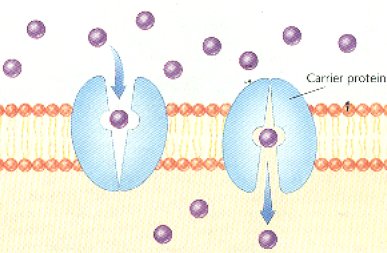
D. Involves carrier proteins embedded in a cell’s membrane to help move across certain solutes such as glucose


E. Carrier molecules change shape when solute attaches to them

F. Change in carrier protein shape helps move solute across the membrane

G. Channel proteins in the cell membrane form tunnels across the membrane to move materials

H. Channel proteins may always be open or have gates that open & close to control the movement of materials; called gated channels


I. Gates open & close in response to concentration inside & outside the cell


VI. Active Transport


A. Requires the use of ATP or energy

B. Moves materials against their concentration gradient from an area of lower to higher concentration

C. May also involve membrane proteins

D. Used to move ions such as Na+, Ca+, and K+ across the cell membrane

E. Sodium-Potassium pump moves 3 Na+ out for every 2 K+ into the cell
1. Causes a difference in charge inside and outside the cell
2. Difference in charge is called membrane potential


F. Ion pumps help muscle & nerve cells work


G. Plants use active transport to help roots absorb nutrients from the soil (plant nutrients are more concentrated inside the root than outside)


VII. Bulk Transport


A. Moves large, complex molecules such as proteins across the cell membrane

B. Large molecules, food, or fluid droplets are packaged in membrane-bound sacs called vesicles


C. Endocytosis moves large particles into a cell

D. Phagocytosis is one type of endocytosis
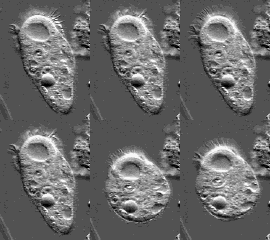
1. Cell membrane extends out forming pseudopods (fingerlike projections) that surround the particle
2. Membrane pouch encloses the material & pinches off inside the cell making a vesicle
3. Vesicle can fuse with lysosomes (digestive organelles) or release their contents in the cytoplasm
4. Used by ameba to feed & white blood cells to kill bacteria
5. Known as “cell eating”


E. Pinocytosis is another type of endocytosis
1. Cell membrane surrounds fluid droplets
2. Fluids taken into membrane-bound vesicle
3. Known as “cell drinking”


F. Exocytosis is used to remove large products from the cell such as wastes, mucus, & cell products

G. Proteins made by ribosomes in a cell are packaged into transport vesicles by the Golgi Apparatus

H. Transport vesicles fuse with the cell membrane and then the proteins are secreted out of the cell (e.g. insulin)

BACK

Insect

Insects   All Materials © Cmassengale  

Phylum Arthropoda        Subphylum Uniramia          Class Insecta

Characteristics

  • Largest arthropod group
  • Found in freshwater & terrestrial habitats, especially tropical areas
  • Legs, mouthparts, & antenna jointed
  • Body segmented into three sections — head, thorax, & abdomen
  • Six legs & up to two pairs of wings located on thorax
  • Have compound & simple eyes
  • One pair of antennae on head
  • Abdomen has 11 segments
  • Exoskeleton, covering & protecting body, is made of chitin & must be molted to grow
  • Elaborate mouthparts include:
         *  Mandibles – jaws
    *
       Maxillae – paired sensory structures that move food to mouth
      Labium – lower lip
      Labrum – upper lip
      Palpi – used for tasting
  • Known as mandibulates
  • Spiracles on abdomen open into tracheal tubes for oxygen & carbon dioxide exchange
  • Tympanic membranes on 1st abdominal segment aid in hearing
  • Thorax divided into 3 sections — prothorax, mesothorax, & metathorax
  • One pair of legs on each thoracic segment
  • Wings located on mesothorax & metathorax
  • Ovipositor located on the end of the abdomen in female insects & used to dig hole & lay eggs

Common Insect Orders

  • Orthoptera – grasshoppers, crickets, & cockroaches 2 pairs of straight wings & chewing mouthparts)
  • Isoptera – termites (feed on wood)
  • Dermaptera – earwigs (pincers on end of abdomen)
  • Anoplura – sucking lice (wingless parasites)
  • Hemiptera – true bugs (have triangular-shaped scutellum & last 1/3 of wings membranous)
  • Homoptera – aphids & cicadas (membranous wings held roof-like over body
  • Ephemeroptera – mayflies (have 2 cerci on tail, membranous wings, & nonfunctional mouthparts in adults)
  • Odonata – dragonflies & damselflies (2 pairs of equal size, membranous wings, strong fliers, feed on other insects)
  • Neuroptera – Dobson flies &  lacewings (2 pairs of membranous wings)
  • Coleoptera – beetles (hard forewings or elytra, membranous hindwings)
  • Lepidoptera – butterflies & moths (powdery scales covered wings
  • Diptera – flies & mosquitoes (one pair of wings, 2nd pair modified into balancing structure called halteres)
  • Siphonaptera – fleas (parasites on birds & mammals, wingless as adults)
  • Hymenoptera – bees, ants, & wasps (stinger on abdomen for protection, may live together in groups, pollinators)

     Click Here for Pictures of Insect Orders


Success of Insects

  • Found everywhere except in deep part of ocean
  • Very short life span & rapidly adapt to new environments
  • Small size helps minimize competition in habitats
  • Flight helps escape predators & move into other environments

Environmental Impact

  • Pollinate almost 2/3’s of all plants
  • Serve as food for fish, birds, & mammals
  • Help recycle materials (termites recycle wood)
  • Make useful byproducts such as silk & honey
  • Some spread disease
  • Agricultural pests

Grasshoppers

External Structure

  • Head with antenna, compound eyes, & chewing mouthparts
  • Walking legs on prothorax & mesothorax; jumping legs on metathorax
  • Tarsus are lower leg segments with spines, hooks, & pads
  • Leathery, protective forewings on mesothorax & membranous hindwings for flight on metathorax
  • Covering over thorax called pronotum

Internal Structure
Digestive & Excretory Systems

  • Cutting & chewing mouthparts (labium, labrum, mandibles, & maxillae)
  • Saliva added to food in mouth
  • Esophagus carries food to crop for temporary storage
  • Gizzard has chitinous plates to grind food
  • Midgut (insect’s stomach) has gastric caeca (pouches) to secrete digestive enzymes to break down food
  • Food is absorbed into the body cavity or coelom in the hindgut (composed of the colon & rectum)
  • Malpighian tubules filter chemical wastes from the blood & deposit them in the rectum where they leave through the anus

Circulatory System

  • Open circulation of blood
  • Aorta is the largest blood vessel carrying blood to the body cells
  • Hearts are muscular regions of the aorta in the posterior end of the abdomen that pump blood toward head
  • Blood flows back toward abdomen carrying digested food & re-enters the aorta through openings called ostia

Respiratory System

  • Air enters through openings called spiracles along the sides of the abdomen & enters into tracheal tubes that branch into smaller tracheoles where gas exchange with body cells occurs 
  • Tracheal tubes carry oxygen to body cells & return carbon dioxide to leave the body though spiracles

Nervous System

  • Simple brain, nerve cords, & ganglia 
  • Three simple eyes or ocelli (detect light) & a pair of compound eyes (can detect movement but not images)
  • Tympanic membrane on 1st abdominal segment
  • Pair of antenna contains sense organs for touch, taste, & smell detects sound
  • Sensory hairs found on parts of the body
  • Palpi for taste

Reproductive System

  • Reproductive organs (ovaries & testes) located  in abdomen
  • Male deposits sperm into female’s seminal receptacle
  • Stored sperm fertilizes eggs as they  are released by female
  • Ovipositor on tip of female’s abdomen is used to lay eggs
  • Separate sexes
  • Lay large number of eggs to ensure survival

Development

  • Most insects go through changes in form & size called metamorphosis
  • Some insects such as silverfish don’t go through metamorphosis
  • Incomplete metamorphosis goes from egg to nymph (immature form that looks like adult but without fully developed wings) to adult (3 stages)
  • Instars are growth periods between molts of nymphs & larva
  • Grasshoppers, termites, & true bugs go through incomplete metamorphosis


HEMIPTERAN (TRUE BUG) NYMPH

  • Complete metamorphosis goes from egg to larva (segmented & wormlike) to pupa  to adult (4 stages)


BUTTERFLY LARVA (CATERPILLAR)

  • Butterflies, beetles, & flies go through complete metamorphosis
  • In pupal stage, larval tissues break down & cells called imaginal disk develops into tissues of the adult
  • Cocoon or chrysalis is a protective case formed around the pupa


BUTTERFLY COCOON

  • Metamorphosis controlled by hormones
    * Brain hormone stimulates the release of molting hormone (ecdysone)
    * When juvenile hormone level high, larva molts
    * When juvenile hormone level low, larva pupates
    * When juvenile hormone absent, adult emerges from pupal case
  • Different stages of metamorphosis eliminates competition between larva & adults for food & space
  • Multi-stage life cycle helps insects withstand harsh weather
  • Different stages have different functions (caterpillar/growth & adult/reproduction)

Defense Mechanisms

  • Bombardier beetle sprays noxious chemical


BOMBARDIER BEETLE

  • Wasps & bees can sting
  • Some insects use camouflage to blend into their environments
  • Some insects taste bad & have warning colorations 


PAPER WASP

  • Mullerian mimicry – poisonous or dangerous species have similar patterns of warning coloration so predators avoid all the species (black & yellow stripes on bees & wasps)
  • Batesian mimicry – species that are nonpoisonous or not bad tasting have colorations that mimic other poisonous or bad tasting species (Viceroy butterfly mimics bad tasting Monarch)

Insect Communication

  • Insects may communicate with each other using sound (cricket chirps), light (firefly), or “dances” (honeybee)
  • Pheromones are chemicals released by some insects to attract mates or mark trails

Insect Behavior

  • Insects may be solitary or social
  • Social insects (bees, ants, & some wasps) live together in groups & share work (division of labor)
  • Social insects have a caste system with different individuals doing different jobs
  • Honeybee caste system:
    * Workers
    – sterile females
    – care for queen & feed her honey and pollen
    – make beeswax for hive
    – fan wings to cool hive
    – eat honey
    – collect nectar, pollen, & royal jelly
    – live about 6 weeks
    – nurse bees care for larva
    – secrete royal jelly to feed new queen
    * Drones
    – males
    – mate with queen
    – feed by workers
    – driven out of hive to conserve food during winter
    * Queen
    – reproductive female
    – mate only once but store sperm for up to 5 years in seminal receptacles
    – feed by workers
    – secretes chemical called queen factor that prevents other females from sexually maturing
    – leaves hive with 1/2 the workers if there is overcrowding


HONEYBEE HIVE

BACK


Identifying Controls and Variables

Identifying Controls and Variables


Smithers thinks that a special juice will increase the productivity of workers. He creates two groups of 50 workers each and assigns each group the same task (in this case, they’re supposed to staple a set of papers). Group A is given the special juice to drink while they work. Group B is not given the special juice. After an hour, Smithers counts how many stacks of papers each group has made. Group A made 1,587 stacks, Group B made 2,113 stacks.
 

Identify the:

1. Control Group

2. Independent Variable

3. Dependent Variable

4. What should Smithers’ conclusion be?


5. How could this experiment be improved?

Homer notices that his shower is covered in a strange green slime. His friend Barney tells him that coconut juice will get rid of the green slime. Homer decides to check this out by spraying half of the shower with coconut juice. He sprays the other half of the shower with water. After 3 days of “treatment” there is no change in the appearance of the green slime on either side of the shower.
 

6. What was the initial observation?

Identify the-
7. Control Group

8. Independent Variable

9. Dependent Variable

10. What should Homer’s conclusion be?


Bart believes that mice exposed to microwaves will become extra strong (maybe he’s been reading too much Radioactive Man). He decides to perform this experiment by placing 10 mice in a microwave for 10 seconds. He compared these 10 mice to another 10 mice that had not been exposed. His test consisted of a heavy block of wood that blocked the mouse food. he found that 8 out of 10 of the micro waved mice were able to push the block away. 7 out of 10 of the non-micro waved mice were able to do the same. Identify the-

11. Control Group12. Independent Variable

13. Dependent Variable

14. What should Bart’s conclusion be?

15. How could Bart’s experiment be improved?

Krusty was told that a certain itching powder was the newest best thing on the market, it even claims to cause 50% longer lasting itches. Interested in this product, he buys the itching powder and compares it to his usual product. One test subject (A) is sprinkled with the original itching powder, and another test subject (B) was sprinkled with the Experimental itching powder. Subject A reported having itches for 30 minutes. Subject B reported to have itches for 45 minutes. Identify the-

16. Control Group17. Independent Variable

18. Dependent Variable

19. Explain whether the data supports the advertisements claims about its product.

Lisa is working on a science project. Her task is to answer the question: “Does Rogooti (which is a commercial hair product) affect the speed of hair growth”. Her family is willing to volunteer for the experiment.

20. Describe how Lisa would perform this experiment. Identify the control group, and the independent and dependent variables in your description.