Fish

All Materials © Cmassengale
Kingdom – Animalia
Phylum – Chordata
Subphylum – Vertebrata
Vertebrates:
| Include fish, amphibians, reptiles, birds, & mammals | |
| Have a notochord (slim, flexible rod) present in early stages that may be replaced by backbone in adults | |
| Contain a dorsal, hollow bundle of nerves called the nerve or spinal cord | |
| Respire through pharyngeal or gill pouches during early development | |
| Have post-anal tail in early stages | |
| Endoskeleton made of bone &/or cartilage | |
| Anterior head with well developed brain & sensory organs (Cephalization) | |
| Closed circulatory system |
Taxonomy of Vertebrates:
| Agnatha include hagfish & lamprey with long, eel-like bodies without jaws or paired fins & cartilage skeletons |
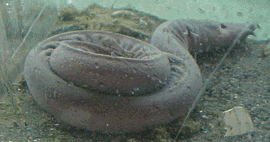
| Chondrichthyes include sharks, rays, & skates with cartilage skeletons, paired fins, & jaws |

| Osteichthyes are bony fish with jaws, paired fins, & bone and cartilage in their skeletons | |
| Amphibia include frogs, toads, & salamanders that go through an aquatic larval or tadpole stage | |
| Reptilia include snakes, turtles, lizards, & alligators that live on land, are covered with scales, & lay a tough, protective amniote egg | |
| Aves are birds covered with feathers, adapted for flying, & with hollow bones | |
| Mammalia have hair or fur & females have mammary or milk-producing glands |
Evolution:
| Fossil record shows jawless fish without paired fins appeared first about 550 million years ago | |
| Ostracoderm was a jawless, bottom-feeding ancestor to the agnathans (modern jawless fish) |

| Development of jaws & paired fins allowed better movement & increased ability to capture prey | |
| Extinct acanthodians or spiny fish were first jawed fish with paired fins |
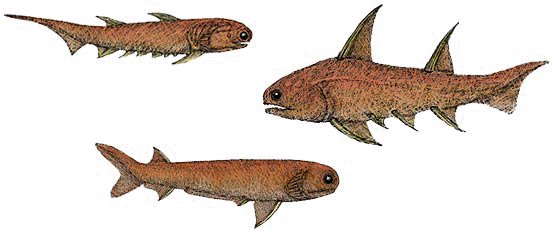
| Jaws probably developed from gill arches (bone that supports the pharynx) |
Characteristics of Fish:
| Streamlined body & muscular tail for swimming | |
| Most with paired fins for maneuvering | |
| Body covered with protective scales & mucus layer to reduce friction when swimming | |
| Have less dense body tissues & store less dense lipids to help them float | |
| Respire through gills | |
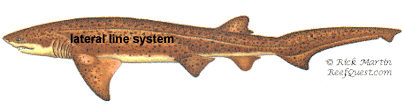
| Most have a lateral line system or a row of sensory structures running down each side of the organism to detect changes in water temperature, pressure, current, etc. |
| Most with well-developed sense of sight & smell | |
| Some can detect electrical currents | |
| Ectotherms (adjust body temperature to environment) | |
| Two chambered heart (upper atrium receives blood & lower ventricle pumps blood) |
Agnatha (Jawless Fish):
| Hagfish (live in oceans) & lampreys (found in marine & freshwater) | |
| Circular mouths | |
| Sharp teeth & strong rasp-like tongue to tear hole in prey & suck out blood & body fluids |

| Known as cyclostomes | |
| Eel-shaped body | |
| Mucus covers body | |
| Skeleton made of cartilage | |
| No paired fins | |
| Gills without bony cover (called operculum) | |
| Retain their notochord throughout their life | |
| Hagfish are bottom dwellers in cold marine waters that burrow in mud, scavenge on dead & dying fish, & have tentacles around their mouth | |
| Lampreys are usually parasites with a keen sense of smell to locate prey, lay their eggs in freshwater streams, & are covered with a poisonous slime |
Chondrichthyes
| Includes sharks, rays, & skates | |
| Endoskeleton of cartilage | |
| Hinged jaws & paired fins | |
| Placoid scales & tooth-like dermal spines on scales |

| Marine | |
| Carnivorous | |
| Sharks are torpedo shaped |
| Rays & skates have broad, flat bodies with wing-like fins and a tail |

Shark Characteristics:
| Fast swimmers | |
| Large, oily liver (20% of body weight) makes them buoyant | |
| Tough, leathery skin | |
| Fierce predators | |
| Whale shark is largest & filter feeds on plankton |
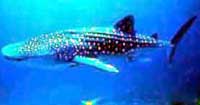
| Ventral mouth with 6-20 rows of sharp, replaceable teeth | |
| Short, straight intestine with spiral valve to slow food movement | |
| 5-7 pairs of gills for gas exchange | |
| Kidneys remove wastes & maintain water balance | |
| Electroreceptors on head help find prey & navigate | |
| Lateral line along side of body contains sensory cells to detect vibrations & pressure | |
| Separate sexes with external fertilization |
Ray & Skate Characteristics:
| Usually harmless to humans | |
| Broad, wing-like pectoral fins used to glide through water | |
| Flattened bodies with ventral mouth | |
| Both eyes on top of head | |
| Have protective coloration (darker on top & lighter on bottom) | |
| Feed on fish & invertebrates | |
| Stingray with poison spine by tip of tail |

| Electric ray gives off strong, electric shock | |
| Manta ray is largest |
Traits of Bony Fish (Osteichthyes)
| Skeleton made of bone | |
| Hinged jaws | |
| Paired fins | |
| Gills for gas exchange | |
| Lateral line | |
| Body covered with scales & mucus coating | |
| Includes lobe-finned, ray-finned, and lung fish |
Lobe-finned Fish:
| Muscular, paddle-like fins supported by bone | |
| Gills | |
| Known as coelacanths |
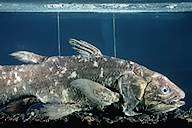
| Thought to be extinct until 1938 when species found in Africa | |
| Live in deep oceans |
Lungfish:
| Use lungs & gills | |
| Eel-shaped body |

| Live in shallow, tropical rivers of Africa, Australia, & South America | |
| Come to surface & gulp air when oxygen level is low | |
| Form mud cocoon & become dormant if stream dries up |
Ray-finned Fish: 
| Fan-like fins supported by rays | |
| Includes salmon, perch, catfish, tuna, etc. | |
| Body covered with round, overlapping cycloid or ctenoid scales & mucus |

| Four sets of gills covered by bony operculum |
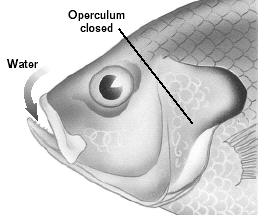
| Have movable fins | |
| Dorsal fin(s) located on top keep fish upright & used for defense | |
| Caudal fin or tail moves side to side to help steer | |
| Pectoral fins (paired) on each side behind the operculum | |
| Pelvic fins (paired) on ventral surface near the head | |
| Anal fin (single) behind anus |

| Swim bladder is thin-walled sac in abdomen that creates buoyancy from diffusion of dissolved gas from blood |

| Kidneys filter the blood & help maintain water balance | |
| Ectothermic – body temperature regulated by the environment | |
| Keen sense of smell (nostrils) & have chemical receptors over the body | |
| Can detect the earth’s magnetic field as a guide to navigate oceans | |
| Have separate sexes with external fertilization | |
| Eggs hatch into fry |

Salmon Life Cycle:
| Migrate up to 3200 kilometers following magnetic cues in the ocean | |
| Follow mucus trails when navigating rivers | |
| Return to birthplace to spawn | |
| Males change color & jaw lengthens & develops a hook |

| Female uses her tail to build gravel nest & lays up to 10,000 eggs | |
| Male deposits sperm over eggs | |
| Adults usually die after spawning | |
| Pacific salmon return to sea when 15 cm long; while Atlantic salmon may stay in river up to 7 years | |
| Secrete mucus coating in river as return to sea | |
| May stay in ocean 6 months to 5 years |