Category: Curriculum Map
Evolution Myths
| Myths About Evolution | ![]() |
|
Myth
|
Debunked
|
| 1. Charles Darwin developed the theory of evolution | The theory of evolution existed before Darwin, it was Darwin’s Theory of Evolution by Natural Selection that became widely accepted. |
| 2. Living things adapt to their environment | As a whole, living things are adapted to their environment. Individuals are unchanging, they either live or die based on the traits they are born with. |
| 3. Biologists “believe” in evolution. | Science is not based on belief. The theory of evolution provides a model for scientists to understand the relationships between organisms on the planet. |
| 4. Monkeys will eventually become human. | There are many species of primates and all are adapted to their environment. A chimpanzee would not turn into a human over time anymore than a cheetah would turn into a lion (or vice versa) |
| 5. Evolution is JUST a theory. | Saying that it is “just” a theory implies that it is a guess, or that its not well supported. There is much evidence to support the theory of evolution, as well as direct observation of species change. |
| 6. Only atheists accept the Theory of Evolution. | Scientists of many religions across the world accept evolution, and do not find it incompatible with their faith. |
| 7. If evolution is disproven, creationism must be true. | A problem with logic (disconfirming evidence). Even if you disproved evolution, you would have to develop and support another model of organism diversity. Disproving one, doesn’t prove the other. |
| 8. No one has ever seen evolution happen. | In organisms that reproduce quickly (like bacteria) changes in species can be directly observed, such as resistances to antibiotics. |
| 9. Order cannot come from disorder, so evolution is false. | Many instances in nature show molecules and substance organizing, such requires energy. The sun provides the energy that ultimately fuels all of life’s processes. |
| 10. There is evidence that dinosaurs lived with humans | There is no evidence that suggests humans and dinosaurs lived at the same time. |
| 11. Scientists regularly debate that evolution occurs. | Scientists debate elements of evolution, relationships between organisms, and fossils. The only place the evolution debate really happens is in the social settings. |
| 12. Creationism is a valid scientific theory and should be presented with evolution. | Creationism violates the scientific principle of natural causality. |
| 13. There are no transition fossils. | Museums are filled with fossils that show intermediate species. |
| 14. Carbon dating is not accurate, therefore the age of the earth cannot be determined. | Carbon dating is one of many methods used to date the earth. Taken as a whole, the evidence is overwhelming that the earth is very old. |
Evolution PPT Questions
| Evolution ppt Questions |
History of Evolutionary Thought 
1. What were Aristotle’s early ideas about life on Earth?
2. How long did these ideas last?
3. What was Linnaeus first to do?
4. What language is used for scientific naming?
5. What are the two words called in a scientific name?
6. This naming system is known as ____________ ______________.
7. Name the contribution that each of these men made to Darwin’s ideas on evolution:
a. Charles Lyell
b. George Cuvier
c. Thomas Malthus
d. James Hutton
e. Lamarck
f. Wallace
8. Which was published first – the Origin 0f Species by Darwin or Gregor Mendel’s papers on inheritance?
9. What was the name of George Cuvier’s theory on evolution?
10. What did Cuvier study in Paris and what did he find?
11. What did Cuvier decide was responsible for the disappearance of some species?
12. James ___________ was a Scottish _________ who studied fossils of _____________ in the Paris Museum.
13. Hutton’s ideas were known as _____________.
14. Briefly state Hutton’s idea on geological change.
15. Lyell proposed the theory of _________________.
16. Describe uniformitarianism.
17. How old did Lyell propose that the Earth was? How old did most people at this time believe the Earth was?
18. How did reading Lyell’s book help darwin on his voyage on the Beagle?
19. Lamarck was one of the first scientists to understand that change occurs over ___________.
20. Lamarck believed that changes were adaptations to the ____________ that organisms _____________ in their lifetime and that he thought could be passed on to _______________.
21. Explain Lamarck’s idea of the Law of Use and Disuse.
22. Lamarck’s theory of acquiring or losing traits by using or not using them led to his theory of evolution called the _____________ of ______________ _____________.
23. According to this theory new ___________ could arise over time.
24. According to Lamarck, if a blacksmith built up his muscles then he would have what type of sons?
25. According to Lamarck, if a giraffe stretched its neck reaching for leaves, what would its offspring look like?
26. What did Lamarck NOT know that made his theory incorrect?
27. Are genes changed by life activities?
Darwin the Naturalist 
28. In what year and at what age did Darwin become the naturalist for the ship the HMS Beagle?
29. How long was the Beagle voyage around the world?
30. As Darwin sailed around the coast of __________ __________, he collected many different types of plants and animals on the mainland and on the islands.
31. Where are the Galapagos Islands and how were they formed?
32. What did Darwin discover about the animals on each type of island
33. How did the island species of finches and tortoises compare with those on the islands?
34. How did the necks of the tortoises compare with each other?
35. The island finches resembled a finch on the ___________.
36. Was the available food and habitat the same on all the islands? Explain.
37. What was different about the finches and why?
Darwin’s Observations & Conclusions 
38. List three observations Darwin made on his travels that led him to propose his revolutionary idea about the way life changes over time.
a.
b.
c.
39. Give an example of the uneven distribution of species noted by darwin.
40. Darwin collected both ___________ organisms and ____________ of organisms.
41. Give 2 examples of fossils collected by Darwin in which the species were no longer in existence.
42. Give a definition for evolution.
43. Left unchecked, what did Darwin predict would happen to the number od individuals in a population?
44. In nature, what tends to happen to the size of populations over time?
45. Competition among members of a population occur due to a limited number of ____________ _______________.
46. Only a ___________ of the offspring produced survive to the next generation.
47. The struggle for environmental resources is commonly called _____________ of the ____________.
48. How do individuals in population compare with each other?
49. Variation in a population is ______________.
50. Which organisms in a population are most likely to live offspring to pass on their traits?
51. This process is known as _____________ ___________ and was proposed by Charles ___________.
52. State Darwin’s theory of natural selection.
53. New ____________ evolve according to natural selection.
Ideas that Shaped Darwin’s Thinking 
54. _____________ was an economist in 1798 that influenced Darwin’s thinking.
55. Malthus observed what about the birth rate of babies?
56. Malthus knew population size was limited by what?
57. According to Malthus, a high birth rate and limited resources caused what to happen?
58. List several things that organisms struggle for in the environment.
59. What did Malthus say would happen if the population size continued to groww unchecked?
60. The __________ rate should increase to balance the __________ of a population and the limited _____________ in the environment.
61. Did Darwin see this occurring in nature?
62. Most organisms produce ____________ offspring than can survive causing many to ________.
Darwin’s Theory of Evolution 
63. Darwin proposed that organisms descended from what?
64. Over time, according to Darwin organisms __________ their form causing evolution of new ____________.
65. ___________ __________ is the driving force for evolution.
66. During the struggle for survival, which organisms survive to pass on their traits?
Origin of Species 
67.How long after he returned to England did Darwin publish his book about evolution?
68. Why did Darwin wait so long to publish his ideas?
69. Darwin’s theory of evolution challenged both the ____________ and _____________ ideas at that time.
70. What made Darwin publish his book?
71. _______________ independently developed the same theory as Darwin.
72. Both Darwin and Wallace believed that __________ changed over time due to a _____________ for existence.
73. Both Darwin’s and Wallace’s papers were presented to the ____________ ______________ in July of __________.
74. How long after this did it take Darwin to finish writing his book?
75. Before Darwin, it was thought that species were perfectly made and _______________.
76. What group of people had been observing and using variations in organisms for a long time?
77. How were farmers using variation?
78. This process is called _____________ ______________ instead of natural selection that occurs in nature.
79. Artificial selection involves ____________ desired traits in stock or crops and __________ them to pass on the trait.
Controversy
80. Define these terms:
a. struggle for existence
b. survival of the fittest
c. descent with modification
d. Fitness
e. adaptation
81.What are the two types of adaptations?
82. Give some examples of physical adaptations.
83. Give some examples of behavioral adaptations.
84. What happens to organisms with LOW fitness?
85. How did changes in the Galapagos finches make them more FIT to survive?
86. Natural selection takes place over a _________ period of time.
87. Natural selection can be observed as changes in _______ structure, ecological _________, and ____________.
88. Do species today look them same as their ancestors?
89. Living species descended with changes from other __________ over periods of time.
90. What was a major problem in Darwin’s Theory?
91. The work of what scientists solved the problem of how variations were passed to offspring?
92. What is the complete title of Darwin’s book?
Theory of Evolution Today
93. List three main things used today to show how organisms are related.
a.
b.
c.
94. Give two examples of evolution that has occurred today in a much shorter period of time.
a.
b.
95. Define macroevolution.
96. Define microevolution.
97. Darwin argued that Earth was ____________ of years old instead of thousands of years old.
98. One of the main pieces of evidence to support this ancient age of the Earth came from ___________ collected by Darwin.
99. Fossils are found in what type of rock layers?
100. Animals on different continents living in similar habitats show similar _______________.
101. All ____________ have similar bon structures known as ______________ structures.
102. Homologous structures have the same structure but different ______________.
103. Give 3 examples of homologous structures in vertebrates.
104. __________ structures seem to have no important function.
105. Give an example of a vestigial structure in humans.
106. What is an embryo?
107. How does the embryonic development of different vertebrates compare to each other?
DNA Replication Lab
Modeling DNA Replication
Introduction
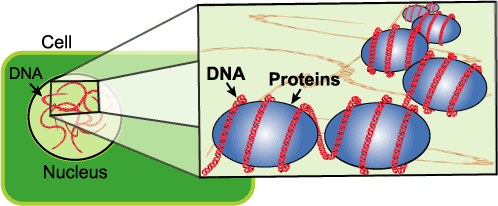
Within the nucleus of every cell are long strings of DNA, the code that holds all the information needed to make and control every cell within a living organism. DNA, which stands for deoxyribonucleic acid, resembles a long, spiraling ladder. It consists of just a few kinds of atoms: carbon, hydrogen, oxygen, nitrogen, and phosphorus. Combinations of these atoms form the sugar-phosphate backbone of the DNA — the sides of the ladder, in other words.
Other combinations of the atoms form the four bases: thymine (T), adenine (A), cytosine (C), and guanine (G). These bases are the rungs of the DNA ladder. (It takes two bases to form a rung — one for each side of the ladder.) A sugar molecule, a base, and a phosphate molecule group together to make up a nucleotide. Nucleotides are abundant in the cell’s nucleus. Nucleotides are the units which, when linked sugar to phosphate, make up one side of a DNA ladder.
During DNA replication, special enzymes move up along the DNA ladder, unzipping the molecule as it moves along. New nucleotides move in to each side of the unzipped ladder. The bases on these nucleotides are very particular about what they connect to. When the enzyme has passed the end of the DNA, two identical molecules of DNA are left behind. Cytosine (C) will “pair” to guanine (G), and adenine (A) will “pair” to thymine (T). How the bases are arranged in the DNA is what determines the genetic code.
When the enzyme has passed the end of the DNA, two identical molecules of DNA are left behind. Each contains one side of the original DNA and one side made of “new” nucleotides. It is possible that mistakes were made along the way — in other words, that a base pair in one DNA molecule doesn’t match the corresponding pair in the other molecule. On average, one mistake may exist in every billion base pairs. That’s the same as typing out the entire Encyclopedia Britannica five times and typing in a wrong letter only once!
Objectives
The replication of DNA before cell division can be shown using paper templates for the components of DNA nucleotides.
Materials
- Cut Outs of basic subunits of DNA
- Colors or markers
- Scissors
- Tape or glue
- Paper & pencil
Procedure:
- Cut out all of the units needed to make the nucleotides from the handout provided.
- Color code the Nitrogenous bases, phosphorus, and deoxyribose sugar as follows —
Adenine = red, Guanine = green, Thymine = yellow, Cytosine = blue, Phosphate = brown, and Deoxyribose = purple. - Using the small squares and stars as guides, line up the bases, phosphates and sugars.
- Now glue the appropriate parts together forming nucleotides.
- Construct DNA model using the following sequence to form a row from top to bottom – cytosine (topmost), thymine, guanine, and adenine (bottommost).
- Let this arrangement represent the left half of your DNA molecule.
- Complete the right side of the ladder by adding the complementary bases. You will have to turn them upside down in order to make them fit.
- Your finished model should look like a ladder.
- To show replication, separate the left side from the right side, leaving a space of about 6-8 inches.
- Use the remaining nucleotides to complete the molecule using the left side as the base.
- Build a second DNA model by adding new nucleotides to the right half of the original piece of the molecule.
- Tape the nucleotides together to form 2 complete DNA ladders.
Questions
1. Of the 4 bases, which other base does adenine most closely resemble?
2. List the 4 different nucleotides.
3. Which 2 molecules of a nucleotide form the sides of a DNA ladder?
4. If 30% of a DNA molecule is Adenine, what percent is Cytosine?
5. What does the term replication mean?
6. What is another name for adenine and three phosphate molecules attached to it?


Effect of Solutions on Cells

What happens when cells are place in different kinds of solutions
Plant cells placed in a hypertonic solution will undergo plasmolysis, a condition where the plasma membrane pulls away from the cell wall as the cell shrinks. The cell wall is rigid and does not shrink.
|
The Elodea cells have been placed in a 10% NaCl solution. The contents of the cells have been reduced to the spherical structures shown.
|
|
Normal Elodea cells
|
Animal cells placed in a hypertonic solution will undergo crenation, a condition where the cell shrivels up as it loses water. Red blood cells in a hypotonic solution will swell and burst or lyse.