Ecology Study Guide

Ecology Study Guide

List several biotic factors in an ecosystem.
List several abiotic factors in an ecosystem.
What serves as the ultimate energy for all life on earth?
What is transpiration & what cycle is it a part of ?
Why are the Rhizobium bacteria beneficial to plants?
What is nitrogen fixation?
What is denitrification?
Where is the intertidal zone found & list several organisms that would be found there?
Name 3 types of consumers based on their eating habits.
What is detritus & why is it important?
What are trophic levels & give an example?
What is the term for an organism’s total way of life?
How does an animal’s habitat differ from its niche?
Compare & contrast biomes.
Describe estuaries.
How does an oligotrophic lake differ from a eutrophic lake?
What is brackish water & where would it be found?
Where is the neritic zone found & what organisms would be found there?
Where would benthos organisms be found? Give an example of such a dweller.

Describe abiotic & biotic factors for each of these biomes:

Tropical rain forest
Taiga
Tundra
Grassland
Savanna
Desert
Deciduous forest
Intertidal Zone
Neritic Zone
Oceanic Zone
Oligotrophic River
Eutrophic River
Estuary
BACK


Ecology Worksheet Bi


Ecology


Chapter 19 Ecology


1. What is ecology?

2.. What is the most significant environmental change that is taking place today?

3. What is the sixth mass extinction?

4. What is the ozone layer, what does it do for earth, & what is happening to this layer & why?

5. Explain the green house effect.

6. List in order the ecological levels of organization.

7. What is the biosphere, tell where it extends, & tell why it is so important?

8. Define ecosystems & give an example.

9. What is a community?

10. What is a population?

11. What is the simplest ecological level of organization?

12. Use figure 19-6 on page 364 & explain how Lyme disease affects organisms in an ecosystem.

13. What are biotic factors & list them?

14. What are abiotic factors & list them?

15. Are abiotic factors constant? Explain by giving an example.

16.Organisms are able to survive within a _____________ range of environmental conditions.

17. Graphing the range of conditions an organism can survive is called a __________________ Curve.

18.When organisms adjust their tolerance to abiotic factors, the process is called ___________.

19. Explain how dormancy & migration help organisms escape unsuitable environmental conditions.

20. Define niche

Chapter 20 Populations

21. What is meant by population size?

22. What is meant by population density?

23. Name the 4 processes that determine whether a population will grow, shrink, or remain the same size.

24. What are immigration & emigration & how do they affect population size?

25. What are limiting factors & give some examples?

26. What affect does inbreeding have on small populations?

Chapter 21 Community Ecology

27. Interactions among species are called ____________.

28. List the 5 types of symbioses.

29. Define predator & prey & give an example.

30. What is mimicry & give an example?

31. Define these terms — parasitism, parasite, host, ectoparasites, & endoparasites.

32. When niches overlap, _________________________ results so more than one species are using the limited resources.

33. What are mutualism & commensalism?

34. Define succession.

35. Name & describe the 2 types of succession.

36. What are pioneer species & why are they important?

37. What is a climax community?

Chapter 22 Ecosystems

38. What are producers & what is another name they may be called?

39. What is biomass, why is it important, how does it accumulate, & what is its rate of accumulation called?

40. What is gross primary productivity?

41. All heterotrophs would be ______________________.

42. Define & give an example of each of these consumers — herbivore, carnivore, omnivore, detritivores, & decomposer.

43. Whenever one organism eats another, ________________ is transferred.

44. What are trophic levels?

45. All _______________ belong to the first trophic level, _______________ belong to the
Second trophic level, and the _______________ of herbivores belong to the third trophic level.

46. How many trophic levels do most ecosystems contain?

47. What is a food chain & what always begins the chain?

48. Write an example of a food chain.

49. What is a food web?

50. Draw a diagram of a food web that has at least 4 food chains.

51. Approximately __________ percent of the total energy consumed at one trophic level is incorporated into the organisms in the next level.

52. In terms of energy passage, why will there be many more producers than herbivores and fewer large carnivores than small carnivores?

53. What are biogeochemical cycles, why are they important, & name three?

54. Draw & explain the water cycle. Be sure to color your diagram!

55. List & define the 3 important processes in the water cycle.

56. What is groundwater?

57. What 2 processes form the basis for the carbon cycle?

58. Draw & explain the carbon cycle. Be sure to color your diagram!

59. What purpose do decomposers have in the carbon cycle?

60. Why do organisms need nitrogen?

61. Draw & explain the nitrogen cycle. Be sure to color your diagram!

62. Organisms such as ________________ convert _________________ gas into compounds
Called __________________ during the process known as________________________.

63. Bodies of dead organisms contain mainly in _________________ & _________________.

64. Wastes such as __________________ & _______________ also contain nitrogen that must be recycled.

65. ________________ recycle nitrogen from dead organisms & wastes by changing it into
______________________. The process is called ________________________.

66. Explain nitrification & denitrification.

67. Plants can absorb ____________________ from the soil, but animals obtain nitrogen from
their ___________________.

68. Define biome.

69. List the 7 major biomes.

70. Why don’t mountains belong to any one biome?

71. What is a tundra, where are they found, & tell organisms that would be found tree?

72. What is permafrost & how does it control plant life in the tundra?

73. What are taigas, where would they be found, & what type of vegetation dominates this area?

74. Plants & animals in the taiga must be adapted for long __________________, short
_________________, & ________________________ soil.

75. List some typical animals of the taiga.

76. What characterizes a temperate deciduous forest?

77. Deciduous forests have 4 pronounced ____________________ with _________________
summers, _______________________ winters, and__________________________ than the
taiga.

78. Grasses dominate what biome?

79. Why aren’t there more trees on grassland?

80. What are grasslands called in each of these areas —– North America, Asia, South America, & southern Africa?

81. Describe the soil of grasslands. Because of the soil condition, how is much of the grassland used?

82.What type of animals would be found on grassland?

83. What periodically occurs across grasslands & why doesn’t it kill the grasses?

84. Approximately how much rainfall do deserts receive each year?

85. Are deserts always hot? Explain.

86. What adaptation must desert vegetation make to survive?

87. What types of adaptations must desert animals make to conserve water?

88. What are savannas & where are the best known savannas found?

89. Describe temperature & rainfall on savannas?

90. Name some herbivores & carnivores found on a savanna.

91. Describe the rainy season on a savanna & tell what special problem this poses for the animals & plants there?

92. What are tropical rain forests & where are they located?

93. Rain forests have stable, year-round ______________________ & abundant ____________.

94. Plants in the rainforest must constantly compete for what?

95. Explain the canopy & epiphytes in a rainforest.

96. Describe the plant & animal life in a rainforest.

97. Tropical rainforests are more commonly called _____________________.

98.Oceans cover what percent of the earth’s surface?

99. Draw, label, & color the zones found in the ocean (see figure 22-16). Define each term labeled on your drawing.

100. What are intertidal organisms exposed to & name some intertidal organisms.

101. Which zone in the ocean is the most productive & why?

102. What small organisms are found in the neritic zone & why are they important?

103. In tropical areas, what forms in the neritic zone & why are they important?

104. Which ocean zone has fewer species & why?

105. Where does most of the earth’s photosynthesis take place?

106. Animals in the aphotic zone feed on what?

107. Organisms living deep in the ocean must cope with what 2 problems? Give some examples of deep ocean animals & explain how they adapt to their environmental problems.

108. What are volcanic vents, when were they discovered, & describe the organisms found there?

109. What are estuaries & what special problem do estuary organisms face?

110. What characterizes freshwater zones & give several examples?

111. Name & describe the 2 categories into which ecologists divide lakes 7 ponds?

112. Define a river & describe organisms found there?

Chapter 23 Environmental Science

113. Where do upwellings occur & how are they helpful?

114. Describe the event known as El Nino & tell its effect.

115. Describe chlorofluorocarbons effect on the ozone layer & tell why we should be concerned?

116. Define biodiversity.

117. Define conservation biology & use migratory birds to explain an example of this new discipline?

118. Sometimes species are reintroduced into areas. Use the Gray wolf & describe its reintroduction in the United States.

119. Where are the Everglades located & what is being done to restore them?

BACK


Crayfish Appendage Table

Crayfish Appendage Table

Appendage Function Location Attach Appendage Here
Antennules Senses touch & taste; helps crayfish maintain balance in front of the mouth .
Antenna Senses touch and taste in front of the mouth .
Mandible or jaw Crushes food mouth .
First Maxilla Moves food to the mouth behind the mandibles .
second maxilla moves water in the gill chamber behind the mandibles .
First maxilliped Holds food; Senses touch and taste at ventral and forward part of the thorax region .
Second maxilliped Holds food; Senses touch and taste at ventral and forward part of the thorax region .
Third maxilliped Holds food; Senses touch and taste at ventral and forward part of the thorax region .
Cheliped Grasps food at ventral part of thorax-posterior to the maxillipeds .
walking leg locomotion at ventral part of thorax-posterior to the maxillipeds .
Swimmeret 1st swimmeret in males transfers sperm to female; females use the 2nd-5th swimmerets to hold eggs & young; locomotion abdominal region on the ventral side .
uropod swimming posterior or tail end .
telson swimming posterior or tail end .

BACK

Crayfish Dissection


Crayfish Dissection
Objectives:
• Describe the appearance of various organs found in a crayfish.
• Name the organs that make up systems of the crayfish.


Materials:
• safety goggles, gloves, magnifying glass, a lab apron, plastic zip lock bag preserved crayfish,  pen, dissecting tray, paper towels, scissors, forceps, dissecting needle, and dissecting pins.


Purpose:
In this lab, you will observe the external structures of a crayfish and dissect it to study its internal structures and systems.


Background:
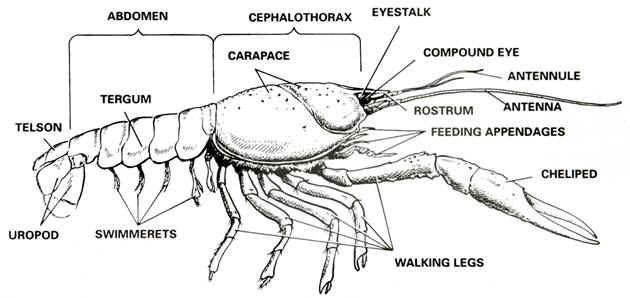
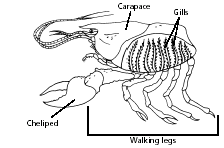
Like all crustaceans, a crayfish has a fairly hard exoskeleton that covers its body. As shown in the diagram on the next page, its body is divided into two main parts, the cephalothorax and the abdomen. The cephalothorax consists of the cephalic (or head) region and the thoracic region. The part of the exoskeleton that covers the cephalothorax is called the carapace. The abdomen is located behind the cephalothorax and consists of six clearly divided segments. The cephalothorax consists of 13 segments. Each segment of both the cephalothorax and the abdomen contains a pair of appendages. The head (or cephalic) region has five pairs of appendages. The antennules are organs of balance, touch, and taste. Long antennae are organs for touch, taste, and smell. The mandibles, or jaws, crush food by moving from side to side. Two pairs of maxillae hold solid food, tear it, and pass it to the mouth. The second pair of maxillae also helps to draw water over the gills. Of the eight pairs of appendages on the cephalothorax, the first three are maxillipeds, which hold food during eating. The chelipeds are the large claws that the crayfish uses for defense and to capture prey. Each of the four remaining segments contains a pair of walking legs. In the abdomen, the first five segments each have a pair of swimmerets, which create water currents and function in reproduction. The sixth segment contains a modified pair of uropods. In the middle of the uropods is a structure called the telson, which bears the anus. The uropod and telson together make up the tail fan. The crayfish moves backward by forcing water forward with its  tail fan.

Procedure Part 1—External Anatomy of a Crayfish

1. Put on safety goggles, gloves, and a lab apron.


2. Place a crayfish on its side in a dissection tray. Use the diagram below to locate the cephalothorax and the abdomen. The carapace, a shield of chitin, covers the dorsal surface of the cephalothorax. On the carapace, observe an indentation, the cervical groove, that extends across the midregion and separates the head and thoracic regions. On the thoracic region, locate the prominent suture or indentation on the cephalothorax that defines a central area separate from the sides. Note the individual segments of the abdomen.


What is the main difference between the cephalothorax and abdomen?

___________________________________________________________

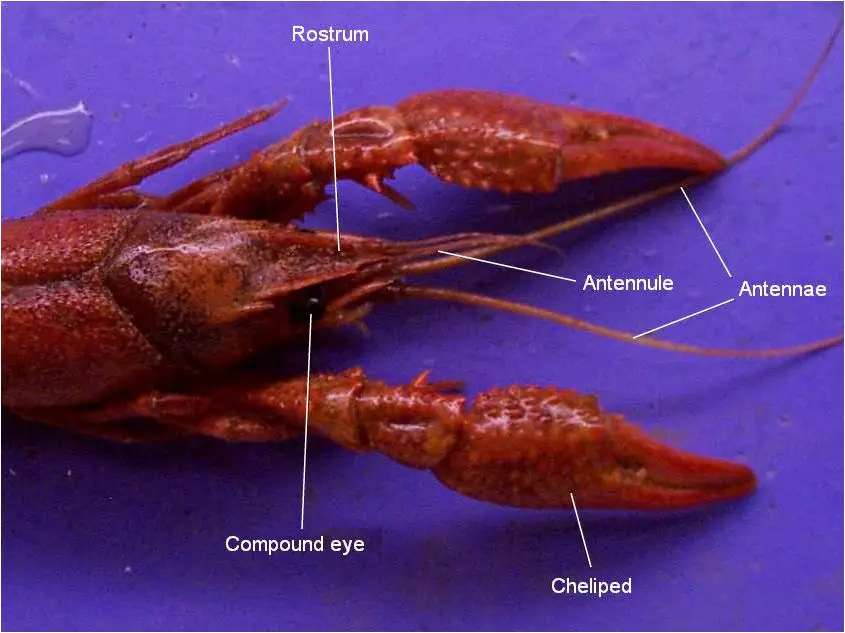
3. Turn the crayfish with its DORSAL side upward, and locate the rostrum, which is the pointed extension of the carapace at the head of the animal shown in the diagram above. Beneath the rostrum locate the two eyes. Notice that each eye is at the end of a stalk.

4. Locate the five pairs of appendages on the head region. First locate the antennules in the most anterior segment. Behind them observe the much longer pair of antennae.

Why is it useful to view the specimen on its Dorsal side for this part of your study?
______________________________________________________________

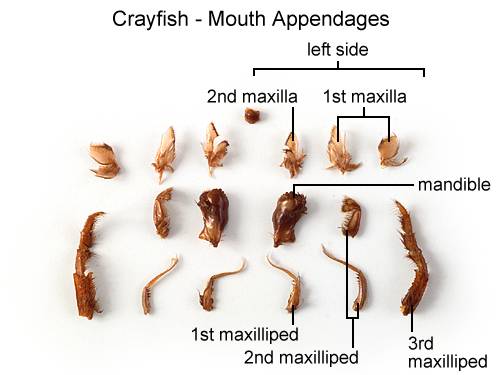
5. Locate the mouth. Then observe the mandibles, or true jaws, behind the antennae. Now locate the two pairs of maxillae, which are the last appendages in the cephalic region.

Which appendages in the cephalic region are related to the eating of food?
_____________________________________________________________


6. On the thoracic portion of the cephalothorax, observe the three pointed maxillipeds.

How are the maxillipeds related to eating?
______________________________________________________________


7. Next observe the largest prominent pair of appendages, the chelipeds, or claws. Behind the chelipeds locate the four pairs of walking legs, one pair on each segment.


8. Now use the walking legs to determine the sex of your specimen. Locate the base  segment of each pair of walking legs. The base segment is where the leg attaches to the body. Use a magnifying glass to study the inside surface of the base segment of the third pair of walking legs. If you observe a crescent-shaped slit, you have located a genital pore of a female. In a male, the sperm duct openings are on the base segment of the fourth pair of walking legs. Use a magnifying glass to observe the opening of a  genital pore.


Is your specimen a male or a female?
_____________________________________________________________

Exchange your specimen with a nearby classmate who has a crayfish of the opposite sex. Then study its genital pores.


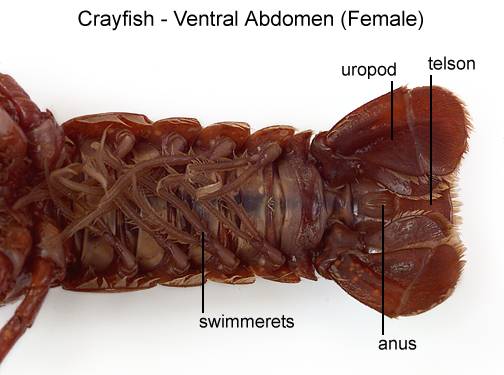
9. On the abdomen, observe the six distinct segments. On each of the first five segments, observe a pair of swimmerets.

10. On the last abdominal segment, observe a pair of pointed appendages modified into a pair of uropods. In the middle of the uropods, locate the triangular-shaped telson.


11. Now turn the crayfish ventral side up. Observe the location of each pair of appendages from the ventral side.

From which view, dorsal or ventral, can you see the location of the appendages on the segments more clearly?
______________________________________________________________

12. Remove all jointed appendages of the crayfish and attach them to the table on the crayfish worksheet.

If dissection is two day, complete steps 13 and 14 only!


13. Next you will study the internal anatomy of a crayfish. If you must store your specimen until the next lab period, cover it with a dampened paper towel. Then place the specimen on the tray in a plastic bag. Close the bag with a twist tie. Write your name on the bag with a felt-tip marking pen, and give your specimen to your teacher.


14. Clean up your work area and wash your hands before leaving the lab.


Part 2—Internal Anatomy of a Crayfish

15. Put on a lab apron, gloves, and safety goggles.


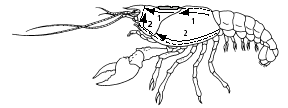
16. Using one hand to hold the crayfish dorsal side up in the dissecting tray, use scissors to carefully cut through the back of the carapace along dissection cut line 1,  as shown in the diagram below. Cut along the indentations that separate the thoracic portion of the carapace into three regions. Start the cut at the posterior edges of the carapace, and extend it along both sides in the cephalic region.


17. Use forceps to carefully lift away the carapace. Be careful not to pull the carapace away too quickly. Such action would disturb or tear the underlying structures.

18. Place the specimen on its side, with the head facing left, as shown in the diagram below. Using scissors, start cutting at the base of cut line 1. Cut along the side of the crayfish, as illustrated by cut line 2. Extend the cut line forward toward the rostrum (at the top of the head).


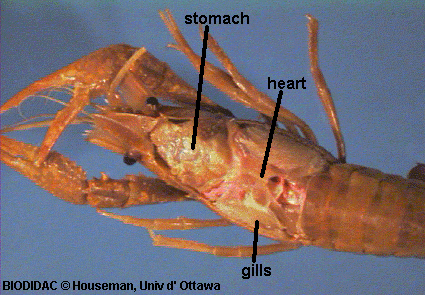
19. Use forceps to carefully lift away the remaining parts of the carapace, exposing the underlying gills and other organs.


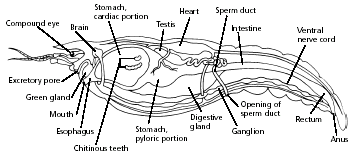
20. Use the diagram below to locate and identify the organs of the digestive system. Locate the maxillae that pass the pieces of food into the mouth. The food travels down the short esophagus into the stomach. Locate the digestive gland, which produces digestive substances and from which the absorption of nutrients occurs. Undigested material passes into the intestine. Observe that the intestine is attached to the lobed stomach. The undigested material is eliminated from the anus.

Rows of chitinous teeth line the stomach. Predict their function.
_____________________________________________________________


21. Use the diagram below to locate and identify the organs of the respiratory system. Locate the gills, which are featherlike structures found underneath the carapace and attached to the chelipeds and walking legs. A constant flow of blood to the gills releases carbon dioxide and picks up oxygen.

The feathery nature of the gills gives them a very large surface area. Why is this important?
____________________________________________________________


22. Use the diagram of the internal anatomy of the crayfish to locate and identify the organs of the circulatory system. Locate the dorsal tubular heart and several arteries. The crayfish has an open circulatory system in which the blood flows from arteries into sinuses, or spaces, in tissues. The blood flows over the gills before returning to the heart.


23. Use the same diagram to locate and identify the organs of the nervous system. Find the ventral nerve cord. Locate a ganglion, one of the enlargements of the ventral nerve cord. Locate the dorsal brain, which is located just behind the compound eyes. Note the two large nerves that lead from the brain, around the esophagus, and join the ventral nerve cord.

Many nerves leave from each ganglion. Where do you think these nerves go?
__________________________________________________________


24. Use the same diagram to locate and identify the organs of the excretory system. The blood carries cellular wastes to the disk-like green glands. Locate these organs just in front of the stomach. The green glands excrete waste through pores at the base of each antenna.

What organs in your body carry out the same function as the green glands?

      ____________________________________________________________


25. Use the diagram once again to locate and identify the organs of the reproductive system. The animal shown in the diagram is a male crayfish. If your specimen is a male, locate the testis. The testis is the long, white organ under the heart and a bit forward. The sperm ducts that carry sperm from the testis open at the fifth walking leg. If your specimen is a female, locate the bi-lobed ovary. It is in the same relative position as the testis, but the ovary appears as a large, reddish mass under the heart. Then locate the short oviducts that extend from near the center of each side of the ovary and open at the third walking leg. Exchange your specimen with a nearby classmate who has a crayfish of the opposite sex. Then study its reproductive system.

25. Dispose of your materials according to the directions from your teacher.


26. Clean up your work area and wash your hands before leaving lab.

Crayfish Worksheet Crayfish Appendage Table

BACK

Crayfish Worksheet

Name(s)__________________________________ Group______ Date ________ Period_____

Crayfish Dissection Worksheet

1. What structures are used for capturing prey and securing and eating food?


2. How are the antennae, chelipeds, other walking legs, and swimmerets related?


3. What are the main structures you could have observed when you removed the exoskeleton of the abdomen and tell the function of each?


4. Is the crayfish most vulnerable to its enemies from the dorsal or ventral side? Why?


5. The crayfish usually molts, or sheds its exoskeleton, twice a year. Why does the crayfish “hide” after it molts?


6. Name the appendages found on the head of a crayfish & tell the function of each.


.


7. Of the systems studied, which two are most unlike the related human system? Why?


8. Although the crayfish has an inflexible cephalothorax, the crayfish is classified as a segmented animal. Why?


9. Name the appendages found on the thorax of the crayfish and tell the function of each.


10. Name the appendages on the abdomen of the thorax and tell the function of each.


11. Label the drawing of the crayfish.

BACK