pH in Living Systems


pH and Living Systems


Introduction:

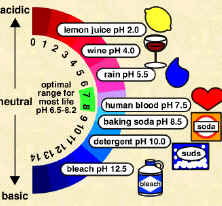
Scientists use something called the pH scale to measure how acidic or basic a liquid is. The scale goes from 0 to 14. Distilled water is neutral and has a pH of 7. Acids are found between 0 and 7. Bases are from 7 to 14. Most of the liquids you find every day have a pH near 7. They are either a little below or a little above that mark. When you start looking at the pH of chemicals, the numbers go to the extremes. Substances with the highest pH (strong bases) and the lowest pH (strong acids) are very dangerous chemicals. Molecules that make up or are produced by living organisms usually only function within a narrow pH range (near neutral) and a narrow temperature range (body temperature). Many biological solutions, such as blood, have a pH near neutral.

The biological molecule used in this lab is a protein found in milk. Proteins are used to build cells and do most of the cell’s work. They also act as enzymes. For proteins to work, they must maintain their globular shape. Changing the shape of a protein denatures and the protein will no longer work.

Materials:

Small squares of wide-range pH paper, pH color chart, paper towels, 4 dropper bottles, ammonia, lemon juice, skim milk, distilled water, forceps, 50 ml beakers, small squares of narrow-range pH paper, 2 stirring rods

Procedure (part A): Testing the pH of Substances

  1. Line up 4 squares of wide-range pH paper about 1 cm apart on a paper towel.
  2. Put one drop of distilled water on the pH square.
  3. Compare the color of the pH paper to the color chart and record the pH in data table 1.
  4. Repeat this procedure for the ammonia, lemon juice, and skim milk.

Questions (Part A): Determining the pH of Solutions

  1. Which substance was the most acidic?
  2. Which substance was the most basic?
  3. Did any of the substances have a pH close to neutral? Name them.

Procedure (part B): Showing the Effect of pH on a Biological Molecule (Milk Proteins)

  1. Place 100 drops of skim milk in a 50 ml beaker.
  2. Pick up a piece of narrow-range pH paper with forceps.
  3. Touch the pH paper to the milk and remove it.
  4. Compare the color of the pH paper to the pH color chart.
  5. Record the initial pH in data table 2.
  6. Add a drop of lemon juice to the milk in the cup & stir with a stirring rod. Keep track of how many drops you add to the milk!
  7. Measure and record the pH of the solution with the narrow-range pH paper.
  8. Repeat step 7 until you notice an obvious change in the appearance of the milk. record this final pH and appearance of the milk in your data table.
  9. Repeat steps 1-8 using a clean 50 ml beaker and fresh milk, and substitute ammonia for the lemon juice.
  10. Add drops of ammonia to the milk until the change in pH of the milk is equal to the change in pH you measured in step 8. Be sure to keep track of the number of drops added. HINT: If the pH changed by 2 units with the lemon juice, then add ammonia until you also get 2 pH units of change!

Data:

Table 1


Substance Tested pH Acid Base Neutral


Table 2

Substance Tested Substance used to Produce Change Starting pH of Milk Final pH of Milk Original Appearance of Milk Final Appearance of Milk Total Number of drops added to Produce the change
100 drops Skim Milk Lemon Juice
100 drops Skim Milk Ammonia

Questions:

1. Which substance tested from table 1 was the most acidic?

2. Which substance was most basic?

3. Did any substance from table 1 have a neutral, or near neutral pH? If so, which substance was neutral?

4. Why did you use narrow-range pH paper to measure the milk’s change in pH?


5. Describe the change in appearance of the milk as more lemon juice was added. Explain why this change occurred.


6. How much did the pH of milk change when lemon juice was added?

7. Why do you think lemon juice “curdled”  (precipitated out the proteins) from the milk?


8. Did you get the same change when ammonia was used? Why or why not?


Origin of life PPT Qs

Origin Of Life
ppt Questions

Early Thoughts on Life

1. What was Aristotle’s idea about how life arose called?

2. What is another name for spontaneous generation?

3. Explain spontaneous generation of life.


4. How long did the idea of abiogenesis or spontaneous generation last?

5. The idea of abiogenesis lasted so long because, instead of testing their ideas, people based their beliefs on what?


6. Were their observations tested?

7. Did they use the scientific method for their observations?

Examples of Spontaneous Generation

8. What observation about new life did Egyptians make when the Nile River flooded each year?


9. What observation about new life did Medieval farmers make when they stored their grain each year?


10. The English people centuries ago, threw their garbage and sewage out on the streets. What observation about new life did these people make?


11. This practice led to a plague that killed many Europeans. What was this plague called and what carried the disease organism?


12.Before refrigerators, large slabs of meat were hung after being purchased. What observation about new life was made from this practice?


13. People believed so strongly in abiogenesis that they had recipes for making living things. Name two organisms that had accepted recipes.


Disproving Spontaneous Generation

14. Francesco ____________ was an early scientists who conducted experiments to try and disprove spontaneous generation.

15. What was Redi’s hypothesis?


16. Explain how Redi tried to prove this.


17. What were the results Redi found in the closed jars & why?


18. What were the results in the open jars?


19. How did maggots appear in the open jars?


20. Complete this table summarizing Redi’s experiment:


Evidence Against Spontaneous Generation
Unsealed Jar
Sealed Jar
Gauze Covered jar


21. Redi’s experiment disproved spontaneous generation for _____________ organisms.

Use of the Scientific Method

22. Did Francesco Redi use the scientific method in his experiment?

23. What served as the control in Redi’s experiment?


24. What jars served as the experimental groups?

25. What was Redi’s conclusion?


Disproving Spontaneous Generation of Microbes

26. Anton Van _______________ made one of the first simple microscopes.

27. Leeuwenhoek called the living things he saw in pond water ______________.

28. By the end of the 19th century, these organisms were known as ______________.

29. John _____________ did experiments with microorganisms growing in broths.

30. Needham believed there was a __________ __________ present in nonliving substances like air.

31. Why were bacteria able to grow in Needham’s soups?


32. What could have been done to the broths to kill the bacteria already present?

33. What scientists repeated this experiment but with boiled broth?

34. After boiling, what did Spallanzani do to the tops of the bottles? how did this help?


35. Critics of Spallanzani’s experiment said there was not enough _______ for the bacteria to survive and that boiling had destroyed the _________ __________.

The Theory Changes

36. What did the Paris Academy of Science do in 1860 to solve the problem?


37.Who won the prize? 

38. What was Pasteur’s experimental hypothesis?


39. What was the shape of Pasteur’s flasks? Include a sketch.


40. What was the special S-shaped neck intended to do?


41. Did Pasteur boil the broth in his flasks? Why?


42. The flasks were left at ___________ locations.

43. Did the broth change cloudy because microbes were growing in it?


44. What was visible in the neck of the flask after collecting there?

45. Once the S-shaped stem was broken off the top of the flasks, what happened to the broth and why?


46. Pasteur’s S-shaped flasks kept ___________ out but let ______ inside.

47. Pasteur’s experiment proved that living things only come from other _________ ___________.

48. What is the name of Pasteur’s theory?

Review

49. Where did the maggots come from in Redi’s experiment?

50. What was the purpose of the sealed jars?

51. Redi was trying to disprove – spontaneous generation or biogenesis?

52. Where did the microbes come from in Needham’s broth?

53. Needham & Spallanzani were trying to disprove – spontaneous generation or biogenesis?

54.Who proved biogenesis?


Osmosis & Diffusion in Egg Lab


Osmosis & Diffusion in an Egg


Objective:
In this investigation, you will use a fresh hen’s egg to determine what happens during osmosis & diffusion across membranes.

Materials: (per lab group)
1-2 fresh hen eggs in their shells, masking tape & marker, distilled water, clear sugar syrup (Karo, for example), vinegar, clear jar with lid, tongs, electronic balance, paper towels, paper, pencil

Procedure:

Day 1   

  1. Label the jar with your lab group & the word “vinegar”.
  2. Mass the egg with the electronic balance & record in the data table.
  3. Carefully place the raw egg into the jar & cover the egg with vinegar.
  4. Loosely re-cap the jar & allow the jar to sit for 24 to 48 hours until the outer calcium shell is removed.

Day 2   

  1. Open the jar & pour off the vinegar.
  2. Use tongs to carefully remove the egg to a paper towel & pat it dry.
  3. Record the size & appearance of your egg in your data table.
  4. Mass the egg on an electronic balance & record.
  5. Clean and re-label the jar with your lab group & the word “distilled water”.
  6. Carefully place the egg into the jar & cover the egg with distilled water.
  7. Loosely re-cap the jar & allow it to sit for 24 hours.

Day 3   

  1. Open the jar & discard the distilled water.
  2. Use tongs to carefully remove the egg to a paper towel & pat it dry.
  3. Record the size & appearance of your egg in your data table.
  4. Mass the egg on an electronic balance & record.
  5. Clean and re-label the jar with your lab group & the word “syrup”.
  6. Carefully place the egg into the jar & cover the egg with clear syrup.
  7. Loosely re-cap the jar & allow it to sit for 24 hours.

Day 4   

  1. Open the jar & pour off the syrup.
  2. Use tongs to very carefully remove the egg & rinse off the excess syrup under slow running water.
  3. Pat the egg dry on a paper towel.
  4. Record the size & appearance of your egg in your data table.
  5. Mass the egg on an electronic balance & record.
  6. Clean up your work area & put away all lab equipment.

Data:


RESULTS OF DIFFUSION

Original Mass Final Mass Appearance of Egg
VINEGAR
WATER
SYRUP


Questions & Conclusion:

1. Vinegar is made of acetic acid & water. Explain how it was able to remove the calcium shell.


2. (a) What happened to the size of the egg after remaining in vinegar?

(b) Was there more or less liquid left in the jar?

   (c) Did water move into or out of the egg? Why?


3. (a) What happened to the size of the egg after remaining in distilled water?

(b) Was there more or less liquid left in the jar?

   (c) Did water move into or out of the egg? Why?


4. (a) What happened to the size of the egg after remaining in syrup?

(b) Was there more or less liquid left in the jar?

   (c) Did water move into or out of the egg? Why?


5. Was the egg larger after remaining in water or vinegar? Why?


6. Why are fresh vegetables sprinkled with water at markets?


7. Roads are sometimes salted to melt ice. What does this salting do to the plants along roadsides & why?


Mollusk

Mollusks


All Materials © Cmassengale  

Phylum Mollusca
Characteristics

  • Soft-bodied invertebrate covered with protective mantle that may or may not form a hard, calcium carbonate shell
  • Includes chitons, snails, slugs, clams, oysters, squid, octopus, & nautilus
  • Second largest animal phylum
  • Have a muscular foot for movement which is modified into tentacles for squid & octopus
  • Complete, one-way digestive tract with a mouth & anus
  • Have a fully-lined coelom
  • Cephalization – have a distinct head with sense organs & brain
  • Have a scraping, mouth-like structure called the radula
  • Go through free-swimming larval stage called trochophore


Trochophore Larva

  • Body organs called visceral mass lie below mantle
  • Have circulatory, respiratory, digestive, excretory, nervous, & reproductive systems
  • Bilaterally symmetrical
  • Most have separate sexes that cross-fertilize eggs
  • Gills between the mantle & visceral mass are used for gas exchange
  • Includes 4 classes — Polyplacophora (chitons), Gastropoda (snails, slugs, nudibranchs, conchs & abalone), Pelecypoda or Bivalvia (clams, oysters, & mussels), & Cephalopoda (squid, octopus, & nautilus)


SNAIL, CLAM, CHITON, & SQUID

Class Polyplacophora
Characteristics

  • All marine
  • Have a shell divided into 8 over-lapping plates
  • Live on rocks along seashore feeding on algae


CHITON

Class Gastropoda
Characteristics

  • Head has a pair of retractable tentacles with eyes located at the ends
  • Have a single shell or valve (snails) or none (slugs)
  • Known as univalves
  • Snails
    * May be marine, freshwater, or terrestrial
    * Aquatic snails breathe through gills & use their radula to scrape algae for food
    * Terrestrial snails use their mantle cavity as a modified lung & saw off leaves
    * Retreat into shell in dry periods & seals opening with mucus
    * Have open circulatory system
    * Secrete mucus & use muscular foot to move
    * Land snails are hermaphrodites
    * Aquatic snails have separate sexes
    * Use internal fertilization

  • Slugs
    * Live in moist terrestrial areas
    * Lack a shell


SLUG

  • Pteropods
    * Called “sea butterflies”
    * Marine
    * Have a wing-like flap for swimming


“SEA BUTTERFLY”

  • Oyster Drills
    * Radula modified to drill into oyster shells


OYSTER DRILL

  • Nudibranch
    * Marine slug
    * Lacks shell


NUDIBRANCH

Class Bivalvia or Pelecypoda
Characteristics

  • Sessile or sedentary
  • Includes marine clams, oysters, shipworms, & scallops and freshwater mussels
  • Filter feeders
  • Have two-part, hinged shell (2 valves)
  • Have muscular foot that extends from shell for movement
  • Scallops clap valves together to move

  • Shell secreted by mantle & made of 3 layers — outer horny layer protects against acids, middle prismatic layer made of calcium carbonate for strength, & inner pearly layer next to soft body
  • Mantle secretes substance called “mother of pearl” to surround irritants like grains of sand
  • Oldest, raised part of shell called umbo
  • Powerful anterior & posterior adductor muscles open & close shell
  • Lack a distinct head
  • Have an incurrent & excurrent siphon that circulate water over the gills to remove food & oxygen

INTERNAL CLAM ANATOMY

  • Have heart & open circulatory system
  • Nervous system made of 3 pairs of ganglia, nerve cords, & sensory cells that detect light, chemicals, & touch
  • Separate sexes with external fertilization of eggs

Class Cephalopoda or Amphineura
Characteristics

  •  Includes octopus, squid, cuttlefish, & chambered nautilus  
  • All marine  


NAUTILUS OCTOPUS SQUID


  • Most intelligent mollusk
  • Well developed head
  • Active, free swimming predators
  • Foot divided into tentacles with suckers
  • Use  their radula & beak to feed
  • Closed circulatory system
  • Lack an external shell
  • Highly developed nervous system with vertebrate-like eyes
  • Separate sexes with internal fertilization

  • Squid
    * Largest invertebrate is the Giant Squid
    * Large, complex brain
    * Ten tentacles with longest pair to catch prey
    * Use jet propulsion to move by forcing water out their excurrent siphon
    * Chromatophores in the skin can help change squid color for camouflage
    * Can squirt an inky substance into water to temporarily blind predators
    * Have internal shell called pen
    * Female lays eggs in jellylike material & protects them until hatching


GIANT SQUID

  • Octopus
    * Eight tentacles
    * Similar to squid
    * Crawls along bottom looking for prey


OCTOPUS

  • Chambered Nautilus
    * Has an exterior shell
    * Lives in the outer chamber of the shell
    * Secretes gas into the other chambers to adjust buoyancy


NAUTILUS

Economic Importance of Mollusks

  • Used  by humans for food
  • Pearls from oysters
  • Shells used for jewelry
  • Do crop & garden damage
  • Serve as intermediate hosts for some parasites such as flukes
Back