8 Websites with the Best AP Practice Exams

 High school is a challenging time in everyone’s life. And for students enrolled in AP courses, the end of the year is particularly challenging. As high-achieving students gear up for long exams that offer the potential for early college credit, many students are searching high and low for reliable study materials.

One favorite way to practice for an important exam is by taking practice exams. But finding high-quality AP practice exams is challenging. That’s why we curated this list of websites for you. Whether you’re looking for AP Biology practice exams or one for AP Art History, these websites will help you in your quest for a good score.

Why You Should Take a Practice Exam

The best way to gauge how ready you are for an exam is by taking a practice test. While its best to drill yourself with a wide variety of study materials throughout the year, use of a full-length practice test will help you to prepare for the exam in a whole new way. In addition to helping you study, taking a practice exam can offer the following benefits:

  • Enables you to acclimate to the test format.
  • Relieves unwanted test anxiety.
  • Familiarizes you with test content.
  • Offers an opportunity to customize your study plan.
  • Gives testers a sense of readiness.

Practice exams are a helpful tool for getting yourself in tip-top test shape. But don’t forget to apply the knowledge you gain from taking practice tests. For example, if you come across the material in the practice test that you don’t understand, bring it up with your teacher as soon as possible.

girl studying

Source: Pexels.com

Below you’ll find a list of websites that offer AP practice exams in one format or another. Not all of them provide full-length tests, but all of them will help you get ready for your AP exams. Keep in mind, that AP tests are different each year and the practice questions you find online won’t necessarily be the ones you encounter on your exam.

8 Websites with the Best AP Practice Exams

College Board

image by: College Board

If you’re looking for a good starting place when it comes to mastering an AP exam, start with the official College Board website. There are many useful resources available on this website for students who are preparing for any of the AP Exams. In addition to study materials, the College Board website provides all of the information students need about the AP exams.

In addition to general information about each of the AP exams, the College Board website also offers sample questions for curious students. While a limited number of multiple choice sample questions are provided, a wide array of free response questions are typically available. Also, you’ll find a handful of student responses for comparison.

While this website doesn’t provide full-length practice exams, it is a great starting place. College Board is the official company behind all of the AP exams, and therefore the study materials they provide will be most like the AP tests.

APPracticeExams.com

image by: appracticeexams

This website is an all-purpose study site from students preparing for AP exams. From AP Biology practice exams to class notes on Statistics, this website has a little something for everyone. It’s also worth noting that all of the resources on this web page are provided free of charge.

Unlike some websites that maintain their database of practice materials, AP Practice Exams provides links to the best free AP practice exams online. Students love using this site because it is easy to navigate and understand. Parents like this website because all of the materials are free.

While you can find a lot of resources through this web page, it does have its limitations. More specifically, the site is not backed by any testing or tutoring service. This drawback means that you’re on your own with the resources provided. However, for those who are self-driven, this site can be a treasure trove of information.

Also, it’s worth noting that the website is very low-key and doesn’t feature many stunning visual features or modern conventions. However, because the resources are all free, it’s a good option for many.

Albert

image by: albert

Albert is a study and test-prep website designed to help students get the most out of the learning experience. Unlike the sites already mentioned above, the resources available through this website are not free of charge. However, they do offer a comprehensive program for preparing for many of the AP exams.

Pricing for the materials on this website varies by subject area, but for the most part, you can expect it to be relatively affordable. Unfortunately, it doesn’t seem that there are any concessions made for students who can’t afford the costs associated with using Albert.

Albert provides a variety of study materials including practice multiple choice questions, practice free response questions, and at least one full-length practice exam. Additionally, there are numerous study tips and testing tricks to help students make the most of test day. Albert also offers an overview of the core concepts that are tested in each subject.

This website features an attractive and easy-to-use interface that simplifies the study process. However, the fact that you must pay to use these study materials means that many students won’t be able to take advantage of this program. All in all, this is a good website for students whose parents have a little extra cash to spare.

Get A Five

image by: getafive

Get A Five is a web-based tutoring program that is available to students and teachers free of charge. However, unlike some other websites, this one is somewhat limited in scope. But, if your AP class is available, we highly recommend taking advantage of this valuable resource.

Unlike other programs, Get A Five offers a virtual study room, a diagnostic test, practice tests, and video-based lessons. Each program available in this online resource is customized to provide users with the ultimate learning experience.

Despite being limited to the few materials available, this website is an excellent resource for AP students in the classes offered. And, for a small fee, you can have your practice free response questions hand graded. We love that this resource doesn’t cost anything to use, but provides excellent value nonetheless.

Get A Five currently offers four courses for students preparing for the AP exam period. The subjects offered include AP Calculus AB, AP Biology, AP US History, and AP World History. While this selection is limited, it’s worth checking back from time to time to see if new courses become available later on.

High School Test Prep

Highschooltestprep

image by: highschooltestprep

High School Test Prep is another free resource available for students preparing to take an AP exam. The materials available on this website are relatively limited but can prepare you for the general idea of how the test will be. However, it’s worth noting that this resource does not provide full-length exams. Also, it only covers multiple choice questions.

To help students understand the subject area they are testing over, each multiple choice question on this website gives a brief explanation of the correct answer. And while we wouldn’t recommend relying on this website alone, it serves as an excellent way to see where you stand.

After reviewing the materials on this website, you’ll be better prepared to formulate a study plan that will adequately prepare you for your upcoming test. Once you’ve studied the areas that are more difficult for you, use one or more of the other resources listed here to prepare yourself even more.

Study.com

logo

image by: study.com

Study.com offers students a variety of materials for preparing for several different AP exams. They even provide several short practice exams to help you evaluate where you stand concerning the test you’ll be taking later in the school year.

In addition to the short practice tests they offer, study.com also offers test prep services. However, it’s worth noting that these services are not free of charge. Information on pricing is not disclosed without starting a “free trial” so explore these options carefully.

We like that there are several free practice tests available, but the lack of clarity when it comes to plans and pricing seems a bit dubious. Still, if you’re willing to spend a little money, it may be worth it to explore this option.

If you feel that you still need extra practice after thoroughly searching through these websites, consider visiting your local library. There, you may find practice books that contain additional practice questions or exams.

Keep in mind, not all study resources are free, and you should be extremely cautious when choosing how to spend your extra money. Also, always use caution when you have to input a credit card number online. And never purchase online materials without your parent’s permission.

With the resources listed above, you should be well on your way to finding the practice exam that’s right for you. Also, don’t forget that practice exams are only part of the study equation. Remember to brush up on necessary vocabulary and time management strategies as well.


Six Resources with the Best AP Textbook Prices

Advanced Placement classes were once limited to select groups of students, but today, these classes dominate the high school experience. During the 2016-2017 school year, 111,000 students in American schools took the computer science course with a growth of more than 54,000 students from the previous year. We’ve put together a list of excellent resources for finding the best AP Biology textbook prices including some brand-new publishers that focus on cutting the costs of AP courses.

Biology and other sciences are also on the rise. A total of 2.7 million students took five million AP exams according to College Board, the test designer and proctor.

Unfortunately, growth in enrolment hasn’t meant a decline in costs. While some low income students see their test fees covered, recent cuts from the Every StudentSucceedsAct mean that some students need additional dollars.

Finding financially accessible textbooks has never been more critical as more students prepare for more AP tests. Fortunately, these textbooks don’t have to break the bank and with greater student enrolment comes more options for new books.

Six Places to Find the Best AP Textbook Prices

Searching for your AP biology book and think you might get a better price? Check out these resources before placing your order.

[amazon box=”1524757950,1524757969,0133458148,1438079206,0544784685,194755610X” grid=”2″]

Amazon

amazon-logo

image by: Amazon

Buying AP biology test books from Amazon means you have access to almost every brand and publisher imaginable including off-the-beaten-path books. You’re not only offered the most up-to-date editions of each book, but they come in various formats. Both comprehensive reviews and Cliff’s Notes versions of each book are available online.

Why buy Amazon?

Amazon offers excellent back-to-school prices and a simple returns policy. If you’re a Prime member, you’ll also benefit from free, fast shipping.

Additionally, Amazon hosts customer reviews that give you insight into the book. If you’re looking for complete coverage in specific areas or a particular learning style, the reviews section provides excellent coverage of what it’s like to use the book.

Finally, some books come in both used and new varieties as well as Kindle editions, so there are plenty of ways to save extra cash or even get more books.

Google Books

Google_Book

image by: Google books

Buying the digital version of AP books is a great way to save money and make test prep more accessible wherever you are.

Google Books offers a range of AP test prep e-books including AP Biology. Google’s library hosts most of the major test prep brands including:

  • Kaplan
  • Barron’s
  • CliffsNotes
  • The Princeton Review
  • McGraw Hill

There are also plenty of unknown authors that offer a different or cheaper way to study.

You can access Google Books on any device as long as you log into your Google account. You can even use them on your computer if you prefer a bigger screen. Visit the desktop version of the Google Play store for access.

Google Books also offers refunds on unread books. If you find digital versions don’t work for you or you’re one chapter into a book unsuited to your learning style, it’s possible to return it. Visit the My Account section the Google Play store and click the item you want to return.

You may return any e-book up to seven days after buying it. E-book rentals are final sales. If the e-book malfunctions, you may receive a refund within 65 days of the purchase date.

Textbooks.com

textbook.com

image by: textbook

Looking for an AP Biology textbook rather than test prep?

Visit Textbooks.com to search through the vast marketplace of competitively priced books. You’ll find new, used, and e-book versions of most of the primary textbooks all from different sellers.

Type “AP biology” into the search bar to find precisely what you need. When we last looked, 274 results were available and included:

  • Biology (AP 11thEdition) (Mader)
  • Cliff’s AP: Biology (2ndEdition)
  • SparkNotes Guide to AP Biology
  • Barron’s AP Biology
  • Campbell Biology, AP Edition
  • Cracking the AP Biology Exam 2017

Textbooks.com offers the best prices we’ve seen with some books.

While the prices can’t be beaten, it’s good to be wary of buying used books. While used books are ideal, an older book might miss something covered on the test. New books tend to include the latest edition of the test more precisely as well, which helps give you an edge.

eBay

EBay_logo

image by: ebay

If one internet giant comes to mind for textbook purchases, it’s Amazon. But eBay is also an excellent resource for AP biology books. Much of what you’ll find on eBay falls under the category of gently used, but our searches showed that you’re more likely to get the very latest version of the book on eBay compared to other sites.

eBay was partly eclipsed by Amazon because it relied so heavily on seller’s ability to ship things in good time. Shipping was also previously based on zip codes. It quickly made up the bulk of the price on cheaper items.

Today, free shipping is standard on eBay items including on AP history books.

Why choose eBay over Amazon or another used book marketplace?

eBay demands more of a description of the book before posting. Amazon and other sellers tend to note whether the book is in excellent, good, or poor condition. On eBay, sellers indicate the state of the book, but many also describe any damage to the book such as any writing included in the book or if the cover is frayed.

Buying a New Book and Worried About the Price?

If the price of a textbook seems to good to be true, it often isn’t. Bookstores tend to sell U.S. versions of textbooks featuring hardcovers and quality materials. The international version, which is what is usually found significantly cheaper on eBay, is a softcover with cheaper paper. In most cases, the international version is a carbon copy of the same book. Some anomalies arise, but you are likely to see those in the seller reviews.

Regardless of where you buy, double check the edition to make sure it’s not a reprint. Fortunately, most AP course books include the date or version on the cover, so it’s easy to spot in the photos.

OpenStax

OpenStax

image by: openstax

Have you already looked at Barron’s, the Princeton Review, Cliff Notes, and others without finding much success?

AP biology students now have a new option: OpenStax.

OpenStax is a non-profit textbook developer from Rice University. Their goal is to improve access to AP tests, college, and education generally by providing open-licensed college textbooks. Because these books are open-license and OpenStax isn’t out to make money, you’ll receive a high quality, current book for far less money than traditional textbooks.

OpenStax started out providing STEM subjects including biology. Today, they are available for many AP topics including:

  • Biology
  • Physics
  • Macroeconomics
  • SparkNotes Guide to AP Biology

These books aren’t just test prep books. They’re suitable for students taking AP or college courses to prepare for the tests.

The OpenStax Biology for AP® Courses book covers all the requirements of the standard two-semester AP course. It meets core concepts and foundational research and uses the evolutionary lens mandated by AP. The company designed its book not just to meet but exceed the requirements set by College Board, which makes it an essential learning book and an excellent companion to AP study books for those working independently.

HOW MUCH WILL YOU PAY FOR THESE HIGH-QUALITY BOOKS?

Students are expected to pay nothing. These books are free and licensed under Creative Commons, which means everyone has access to them.

Before you worry about quality, don’t. Each book is written by experts in their field. The content is sourced and vetted by peer reviewers, just like the traditional course books you’d otherwise buy.

In 2016 alone, 392,000 students used these books to save a good amount of money. So, head over to OpenStax, and give them a try.

Pearson

pearson-logo

Pearson is an industry-leading education company that publishes books known for their academic rigor. Their AP® Honors & Electives series is no different.Each Pearson book comes with a both an AP Exam Preparation Guide and Test Prep Workbook written according to the College Board course outline. Inside the books, you’ll find:

  • Overview of the program
  • Test-taking tips
  • Strategies for achieving the best score
  • Practice tests

Pearson’s test prep series is competitively priced and maybe even cheaper if you find yourself a promo code.

Are You Ready for Your AP Exam?

[amazon fields=”1438008686″ value=”thumb” image_size=”large”]

AP classes aim to prepare you for the exam, but the help of test prep books and a good textbook are invaluable to the process. While exam prices continue to climb, test prep books remain competitive, and some quality materials are now free to all student.

What books would you recommend for scoring a 5 on an AP Biology exam? Share your favorite study materials and tricks in the comments below.

Earthworm Anatomy and Dissection Guide

Earthworm Dissection and Earthworm Anatomy

Pictures: Modern Biology, Holt

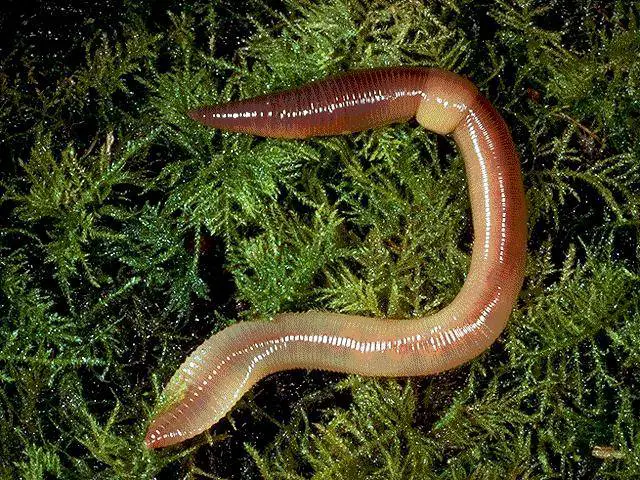
The following is a classification of a species in the earthworm family Lumbricidae. This common species is Lumbricus terrestris also known as the night crawler or dew worm. In this article, we will cover earthworm anatomy and an introduction on dissecting an earthworm. 

Phylum –
Class –
Family –
Genus –
Species –
Annelida
Oligochaeta
Lumbricidae
Lumbricus
terrestris

Objectives:

In this earthworm dissection guide, you will learn to:


• Describe the appearance of various organs found in the earthworm.
• Name the organs that make up various systems of the earthworm.

Materials:
Safety goggles, dissecting pins, gloves, forceps, lab safety apron, scissors, paper towel, scalpel, water, dissecting probe, preserved earthworm, hand lens, dissection tray.

Purpose:
In this lab, you will dissect an earthworm in order to observe the external and internal structures of earthworm anatomy, whilst following the all-important lab safety procedures.

This guide is perfect for students in colleges or universities. 

Can you do my homework?

Background:


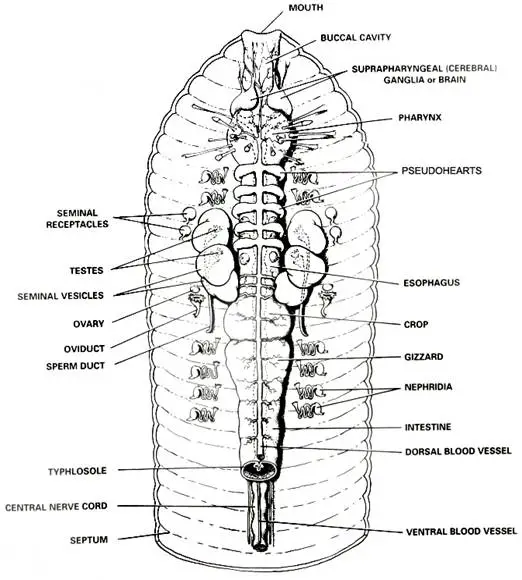
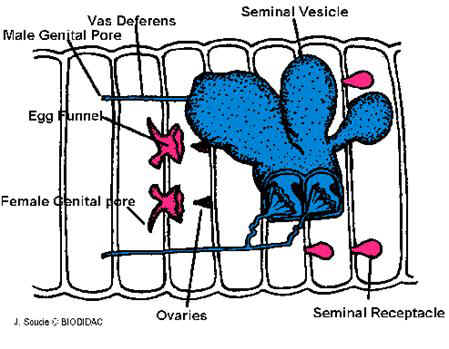
Among the most familiar invertebrate animals are the earthworms, members of the phylum Annelida. The word annelida means “ringed” and refers to a series of rings or segments that make up the bodies of the members of this phylum. Internally, septa, or dividing walls, are located between the segments. External segments are called metameres. There may be more than 100 segments in an adult worm. The clitellum is a swelling of the body found in sexually mature worms and is active in the formation of an egg capsule, or cocoon. This is the earthworm reproductive organ. Eggs are produced in the ovaries and pass out of the body through female genital pores. Sperm are produced in the testes and pass out through tiny male genital pores. During mating, sperm from one worm travel along the sperm grooves to the seminal receptacles of another worm. Fertilization of the eggs takes place outside the body as the cocoon moves forward over the body, picking up the eggs of one worm and the sperm of its mate. The pumping organs of the circulatory system are five aortic arches. Circulatory fluids travel from the arches through the ventral blood vessel to capillary beds in the body. The fluids then collect in the dorsal blood vessel and reenter the aortic arches. The earthworm takes in a mixture of soil and organic matter through its mouth, which is the beginning of the digestive tract. The mixture enters the pharynx, which is located in segments 1–6. The esophagus, in segments 6–13, acts as a passageway between the pharynx esophagus and the crop. The crop stores food temporarily. The mixture that the earthworm ingests is ground up in the gizzard. In the intestine, which extends over two-thirds of the body length, digestion and absorption take place. Soil particles and undigested organic matter pass out of the worm through the rectum and anus. The nervous system consists of the ventral nerve cord, which travels the length of the worm on the ventral side, and a series of ganglia, which are masses of tissue containing many nerve cells. The nerve collar surrounds the pharynx esophagus and consists of ganglia above and below the pharynx. Nervous impulses are responsible for movement and responses to stimuli. Each segment contains an enlargement, or ganglion, along the ventral nerve cord. Excretory functions are carried on by nephridia, which are found in pairs in each body segment. They appear as tiny white fibers on the dorsal body wall. The earthworm has no gills or lungs. Gases are exchanged between the circulatory system and the environment through the moist skin.

earthworm anatomy

External Earthworm Anatomy

What is the external anatomy of an earthworm?

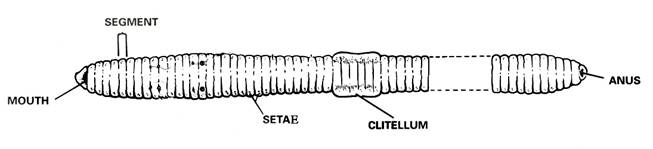
The external body of an earthworm is well adapted for living in the soil, similar to the external structure of other insects. The front or head of the worm is called the anterior. The very first section of the anterior contains the mouth and prostomium. The prostomium is a kind of lip which is located on the front of the mouth. Earthworms lose moisture and breathe via their skin. They have light-sensitive cells across their external structure, which are scattered around the skin. These cells give earthworms the ability to detect changes in lighting, and these cells are also sensitive to chemicals and touch. The body is separated in segments which resemble rings. Each segment has a number of bristly hairs attached to it, which helps the earthworm to move around. On mature earthworms, you will find a saddle or glandular ring called a clitellum. When an earthworm has mated, the clitellum will secrete a sack of eggs. The final segment of an earthworm contains the anus which is where waste is secreted. 

Dissection Guide:


1. Put on safety goggles, gloves, and a lab apron.

2. Place earthworm in the dissecting tray & rinse off the excess preservative. Identify the dorsal side, which is the worm’s rounded top, and the ventral side, which is its flattened bottom. Turn the worm ventral side up, as shown in the earthworm anatomy diagram below.

earthworm anatomy

3. Use a hand lens as you observe all parts of the worm, externally and internally. Locate the conspicuous clitellum, a saddle-like swelling on the dorsal surface.  The clitellum produces a mucus sheath used to surround the worms during mating and is responsible for making the cocoon within which fertilized eggs are deposited.  The anterior of the animal is more cylindrical than the flattened posterior and is the closest to the clitellum.  The ventral surface of the earthworm is usually a lighter colour than the dorsal surface.  The mouth is located on the ventral surface of the first segment while the anus is found at the end of the last segment. Find the anterior end by locating the prostomium (lip), which is a fleshy lobe that extends over the mouth. The other end of the worm’s body is the posterior end, where the anus is located.

earthworm anatomy

4. Locate the clitellum (the reproductive organ), which extends from segment 33 to segment 37. Look for the worm’s setae, which are the minute bristle-like spines located on every segment except the first and last one. Run your fingers over the ventral surface of the earthworm’s body.  You should be able to feel bristle-like setae used for locomotion

5. Refer again to the diagram of the ventral view of the worm to locate and identify the external parts of its reproductive system. Find the pair of sperm grooves that extend from the clitellum to about segment 15, where one pair of male genital pores is located. Look also for one pair of female genital pores on segment 14. There is another pair of male genital pores on about segment 26. Try to find the two pairs of openings of the seminal receptacles on segment 10.   Note: These openings are not easy to see.

Internal Earthworm Anatomy

What is the internal anatomy of an earthworm?

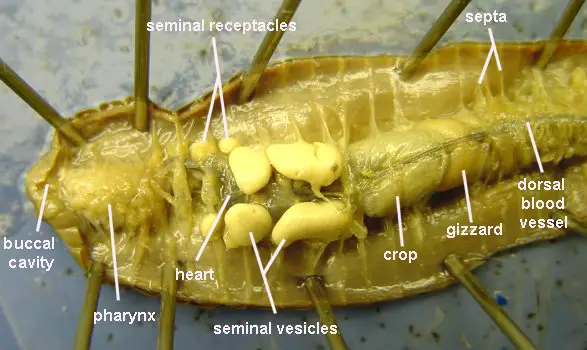
At the very front of an earthworm, you will find the pharynx. Earthworms push the pharynx from inside their mouths to grab hold of things. They pull food into their mouths and then soak it in saliva. As earthworms don’t have teeth, they have to use strong muscles called a gizzard, along with sand and soil, to grind up the food they are eating. Once the food has been fully ground up, it travels to the intestines where it is further broken down so that it can be absorbed. The majority of earthworms have five aortic arches which are like hearts and these move around their bodies. A large blood vessel runs across the top of the earthworm and this is called the dorsal blood vessel. This vessel contracts and pumps blood around to the aortic arches. There is a further blood vessel on the lower side of the earthworm which is called the ventral blood vessel. An earthworm has a very simple nervous system. A ventral nerve cord which runs the entire length of its body connects to the cerebral ganglion, which is an earthworm’s brain. Each segment is connected to the cord so that they can sense light and touch, and can move. Each segment is also wrapped in circular muscles, which contract to help the earthworm move. 

Continued: Dissection Procedure

Hint: Position your preserved earthworm dorsal side up and pin it down through the first segment and then again further back behind the clitellum.  Cut a slit in the dorsal surface near the posterior pin.  Using fine scissors extend the cut forward to the first segment.  Be careful not to cut too deep as to affect the internal organs.  Starting at the first segment, cut the septa (thin membranes) that internally divide the segments, so the skin can be laid flat.  Use additional pins to hold the integument open and expose the internal organs.  Continue to lay the skin back until you have uncovered a centimeter or so of the intestine.

6. Turn the worm dorsal side up. Using a scalpel and scissors, make a shallow incision in the dorsal side of the clitellum at segment 33. CAUTION: Scalpels and scissors are very sharp. Report any cuts to your teacher. Using the forceps and scalpel, spread the incision open, little by little. Separate each septum from the central tube using a dissecting needle, and pin down each loosened bit of skin. Continue the incision forward to segment 1.

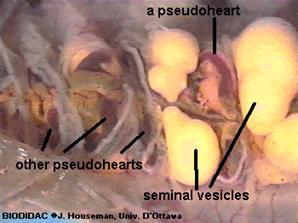
7. Use the diagram below to locate and identify the five pairs of aortic arches, or hearts. Then find the dorsal blood vessel. Look for smaller blood vessels that branch from the dorsal blood vessel.

earthworm anatomy

earthworm anatomy

earthworm anatomy

earthworm anatomy

Digestive System

The earthworm is an example of a foraging herbivorous annelid, obtaining food by eating its way through the soil and extracting nutrients from the soil as it passes through the digestive tract.

Hint: Starting at the anterior end, locate the muscular pharynx (food ingestion).  This is followed by a tube-like esophagus which terminates in a crop (the wider organ) which serves as a storage stomach.  Posterior to the crop you will find the gizzard.  Gently press on the crop and gizzard to test their firmness.  While the crop is soft and thin, the gizzard is muscular (soil is ground up and churned within the gizzard).  The gizzard is followed by a long intestine in which both digestion and absorption occur.  Undigested material is voided through the anus.

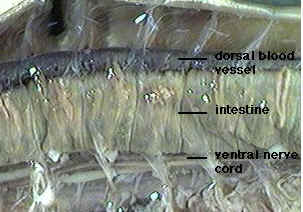
8. Locate the digestive tract, which lies below the dorsal blood vessel. Refer to the diagram above to locate the pharynx, esophagus, crop, gizzard, and intestine.

earthworm anatomy

9. To find organs of the nervous system, push aside the digestive and circulatory system organs. Use the diagram below to locate the ventral nerve cord. Trace the nerve cord forward to the nerve collar, which circles the pharynx. Find one pair of ganglia under the pharynx and another pair of ganglia above the pharynx. The ganglia above the pharynx serve as the brain of the earthworm.

earthworm anatomy

earthworm anatomy

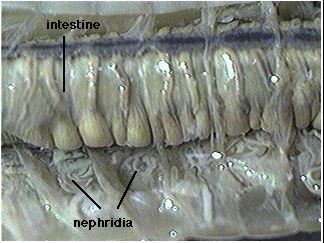
10. The worm’s excretory organs are tiny nephridia. There are two in every segment. Use the preceding diagram to locate some nephridia.

earthworm anatomy

11. Use the diagram below to locate and identify a pair of ovaries in segment 13. Look for two pairs of tiny testes in segments 10 and 11. To find these organs, you will again have to push aside some parts already dissected.

earthworm anatomy

earthworm anatomy

earthworm anatomy

12. Dispose of your materials according to the directions from your teacher in your college or university.

13. Clean up your work area and wash your hands before leaving the lab.

Earthworm worksheet Earthworm facts

BACK

Everything You Need to Know About the Calvin Cycle

The Calvin Cycle occurs during photosynthesis and consists of light independent redox reactions that convert carbon dioxide into glucose. This conversion happens in the chloroplast, or more specifically the stroma of the chloroplast. The chloroplast region is an area between the thylakoid membrane and the inner membrane of the organelle which is typically located in the leaves of plants.

This cycle used to create carbon sugars, mostly, was discovered by Melvin Calvin, Andrew Benson, and James Bassham in 1950 at the University of California. The used radioactive material to trace the pathways carbon atoms took during the carbon fixation step in plant life.

You’ve probably heard the Calvin Cycle called a few other names including the CBB Cycle, C3 Cycle, and dark reactions to name a few.

This process of carbon fixing by plants is essential to all life on the planet. Most new organic growth stems from plants converting carbon to sugars either directly or indirectly. Other plants, or animals, can use these sugars to forms more complex sugars and amino acids when they consume them. It all stems from little plants working day and night to capture light and water.

A Technical Take on the Calvin Cycle

The Calvin Cycle

The Calvin Cycle occurs during photosynthesis and is repeated until it forms a glucose molecule. Photosynthesis goes through two stages to create food and building materials for plants to grow. During the first stage, chemical reactions from light produce ATP and NADPH. The second stage is when the Calvin Cycle takes place. In this stage, carbon dioxide and water get converted to organic materials like glucose. These reactions are called dark reactions which confuses people, but they do not take place at night.

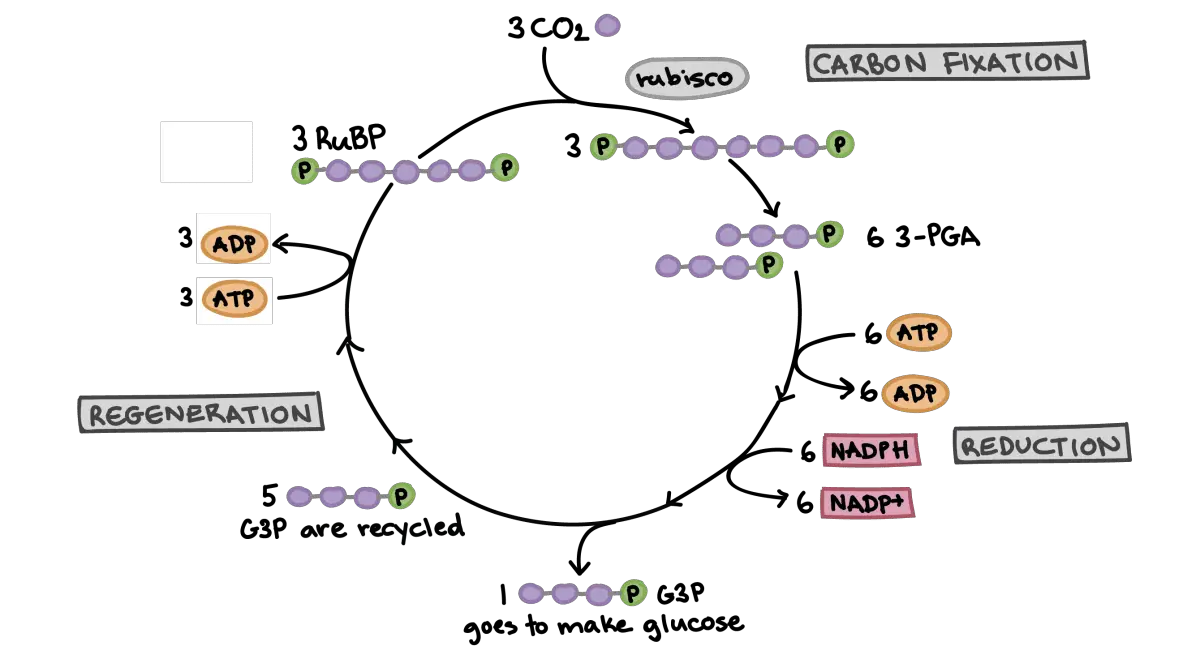
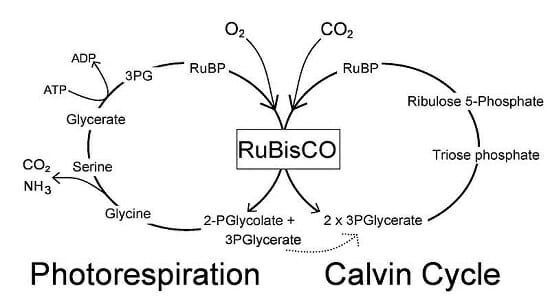
The short explanation of the Calvin Cycle is that it begins with carbon fixation. Carbon dioxide molecules are plucked out of the air to produce glyceraldehyde 3-phosphate. RuBisCO, an enzyme found abundantly around the planet, brings on the carboxylation of a 5-carbon compound and provides a 6-carbon compound that halves itself form two 3-phosphoglycerate. The enzyme phosphoglycerate kinase uses the phosphorylation to create biphosphoglycerate.

Next, the enzyme glyceraldehyde 3-phosphate dehydrogenase uses the reduction of biphosphoglycerate by NADPH. This is called the reduction reactions. Eventually, when the cycle ends, the reactions and reductions produce one glyceraldehyde 3-phosphate molecule per every three carbon dioxide molecules.

That’s a lot of massive words. What that means is the plant uses light and water to convert carbon dioxide into nutrients and oxygen. It takes six turns on the Calvin Cycle for the plant to produce a single glucose molecule. Now that we simplified the process, let’s look at the chemical equation for the Calvin Cycle:

3 CO2 + 6 NADPH + 5 H2O + 9 ATP → glyceraldehyde-3-phosphate (G3P) + 2 H+ + 6 NADP+ + 9 ADP + 8 Pi (Pi = inorganic phosphate)

The Simplified Function of the Calvin Cycle

Simplified-Calvin-Cycle-diagram

How plants create sugar from sunlight, water, and carbon dioxide is complicated as you probably noted from the previous section. However, plants toil away day and night creating glucose, starch, and cellulose so they can grow. The Calvin Cycle plucks carbon molecules right out of the air and creates new plant growth.

The Calvin Cycle is vital to every ecosystem, and it reaches far beyond the plants using it. Plants are the building blocks of all the food in any ecosystem. Herbivores eat plants for energy and growth while carnivores eat herbivores for the same reasons. In the end, everything goes back into the ground and plants start the process all over again.

If plants stopped all their hard work tomorrow, it would only take a few days for animals to start feeling the effects and starving. Herbivores lose their food right away. Carnivores would follow behind the herbivores. Plants make most of the basic building blocks we all need to continue life as we know it. Without their hard work, we’d all be doomed.

While plants are supplying us with the building blocks, we need to continue living, and they help out the environment in other ways. Because the Calvin Cycle depends on carbon dioxide, plants indirectly play a role in regulating carbon dioxide and other gases proven to be harmful to the atmosphere. Plants perform an essential role in helping us clean the air we breathe.

The Calvin Cycle Step by Step

Calvin Cycle step by step

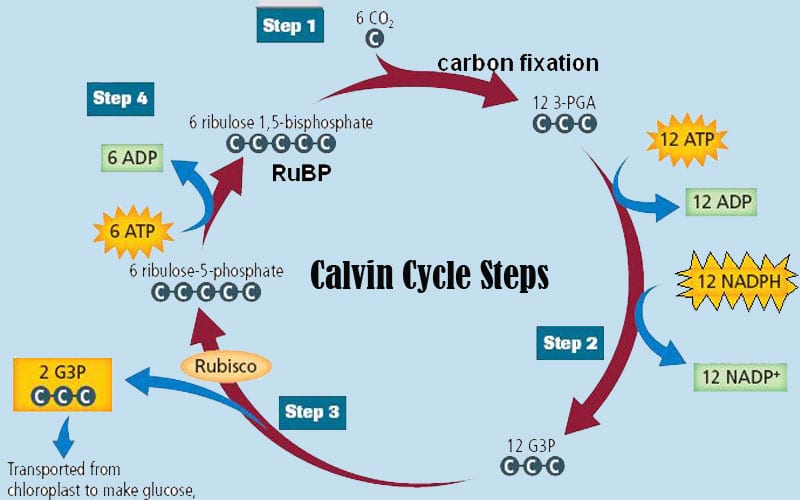
Carbon fixation is the first step. We explained it in brutal technical detail above, but let’s look at it in simpler terms in this section. A carbon dioxide molecule is plucked from the air and combined with a five-carbon acceptor molecule called ribulose-1,5-bisphosphate, or RuBP for short. The result is a six-carbon molecule.

The six-carbon molecule is split in half to form a set of new carbon molecules called 3-phosphoglyceric acid, or 3-PGA for short. The new three-carbon molecules are catalyzed by an enzyme called RuBisCo. This creates the simple sugar molecules the Calvin Cycle needs for stage two. On a side note, because it is used by every plant during photosynthesis, the RuBisCo enzyme if the most common catalyst on Earth. The result of this step is passed on to the next phase.

Step two of the Calvin Cycle is called the reduction step. The 3-PGA molecules created in the carbon fixation step are used in phase two to develop glyceraldehyde-3 phosphate or G3P for short. G3P is a simple sugar. This process uses energy and reactions captured during light-dependent stages of photosynthesis.

This step is called the reduction step because electrons are stolen from molecules created during photosynthesis and given to our new sugars. In chemistry, when you take electrons from a molecule, it’s called a reduction hence the name of this stage. Technically, the electrons are donated and not taken. Taking electrons by force is called oxidation, and that’s not what happens in this stage.

At this point, our plant has created sugar it can store for a long time and use for energy. Anything that eats this plant gets to take advantage of these sugars as well including humans. The plant may choose to use these stored molecules to form new plant materials or repair itself, but that’s not part of the Calvin Cycle so we won’t get into it. This is the end of the sugar-producing phase of the Calvin Cycle.

The final stage of the Calvin Cycle is called the regeneration step. Some of the G3P are held back and not used to make sugars. Instead, they are used to revitalize the five – carbon compound the Calvin Cycle needs to start the process over again. It takes six carbon molecules to make glucose, so plants have to go through the Calvin Cycle six times to make one glucose molecule.

Once the plant has completed this cycle six times, the Calvin Cycle ends and begins again. So, technically, the Calvin Cycle is all three steps done six times each. Plants repeat this process over and over during daylight hours. At night they continue to work making various compounds that don’t require light. This makes plants the most efficient lifeforms on the planet.

Bonus Information About Plants and Their Internal Food Factories

plants

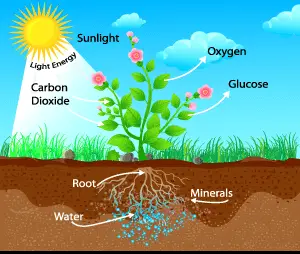
We usually consider waste products bad or at least not edible. However, we need the waste materials plants to produce to survive. An essential waste, or by-product, plants produce is oxygen. While plants are using water and carbon dioxide to make sugars, they release oxygen into the air around them as a waste product.

The delicious fruits and vegetables we all enjoy get most of their flavor from the carbon sugars plants store for energy. From the crunchy stalk of the celery plant to the succulent meat of the peach, plants developed all using just carbon dioxide, water, sunlight, and a few minerals leeched from the soil. I think we can assume these tasty treats are little gifts from the plant kingdom.

The tiny organelles called chloroplasts on the surface of a plant’s leaves can move. Ok, they can’t move individually, but in many plants, they can turn the leaf, so it gets better exposure to sunlight. These plant-based solar cells help capture sunlight so being able to point yourself in the sun makes sense. Some plants take it to another level and bend their stalk or branches to help reach the sunlight.

Some Final Notes

photosynthesis diagram

The fantastic plants we ignore all around us are vital to our survival. They use energy from the Sun in little energy reactors called chloroplasts to do all sorts of cool things. If you glance at the bigger picture and oversimplify it, plants take light from the Sun and turn it into carbon sugars they can store for long periods of time. We could call them solar powered batteries if we want to be humorous about the process.

Plants pitch in and help everywhere they can from cleaning the air to enriching the soil they grow in for the next plants. Plants give us so many things from apples to steak. Without plants toiling away at the bottom of the food chain, nothing in the top of the food chain could survive. Every food we consume comes from plants either directly or indirectly.