Homeostasis & Transport Study Guide B1


Homeostasis & Transport Study Guide


What effect does diffusion have on the concentration of substances on either side of a membrane?
In which direction does diffusion take place?
The dispersal of ink in a beaker of water is an example of what process?
By what process do sugar molecules enter a cell?
In which direction do channels using facilitated diffusion work?
Does facilitated diffusion occur against or with a concentration gradient?
Besides energy, what else is needed for facilitated diffusion to occur?
What happens to the shape of carrier proteins in facilitated diffusion?
Electrical or chemical signals may control the movement of _________ across cell membranes.
Which of these processes requires energy to occur — chemiosmosis, active transport, or a sodium-potassium pump?
Does diffusion require energy?
A potassium ion would enter a cell by what process?
What is osmosis?
Sugar dissolving in water is an example of what process?
Ridding a cell of waste by discharging it in sacs from the cell surface is known as ______.
__________ is used to remove materials from a cell that are too large to pass through the cell membrane.
Large molecules that can’t pass through the cell membrane enter a cell by a process called ________.
What is turgor pressure?
What is plasmolysis?
Explain solute concentration and water movement for cells in hypotonic solutions solution.
Explain solute concentration and water movement for cells in hypertonic solutions solution.
If solute concentration is lower outside a cell than inside a cell, where is their the greatest concentration of water? Which direction will water move?


Homeostasis & Transport


HOMEOSTASIS AND TRANSPORT
All Materials © Cmassengale


I. Cell Membranes


A. Cell membranes help organisms maintain homeostasis by controlling what substances may enter or leave cells

B. Some substances can cross the cell membrane without any input of energy by the cell

C. The movement of such substances across the membrane is known as passive transport


D. To stay alive, a cell must exchange materials such as food, water, & wastes with its environment

E. These materials must cross the cell or plasma membrane

F. Small molecules like water, oxygen, & carbon dioxide can move in and out freely

G. Large molecules like proteins & carbohydrates cannot move easily across the plasma membrane

H. The Cell Membrane is semipermeable or selectively permeable only allowing certain molecules to pass through


II. Diffusion


A. Diffusion is the movement of molecules from an area of higher concentration to an area of lower concentration

B. Small molecules can pass through the cell membrane by a process called diffusion


C. Diffusion across a membrane is a type of passive transport because it does not require energy

D. This difference in the concentration of molecules across a membrane is called a concentration gradient


E. Diffusion is driven by the kinetic energy of the molecules

F. Kinetic energy keeps molecules in constant motion causing the molecules to move randomly away from each other in a liquid or a gas

G. The rate of diffusion depends on temperature, size of the molecules, & type of molecules diffusing


H. Molecules diffuse faster at higher temperatures than at lower temperatures

I. Smaller molecules diffuse faster than larger molecules

J. Most short-distance transport of materials into & out of cells occurs by diffusion

K. Solutions have two parts — the solute which is being dissolved in the solvent


L. Water serves as the main solvent in living things

M. Diffusion always occurs down a concentration gradient (water moves from an area where it is more concentrated to an area where it is less concentrated)

N. Diffusion continues until the concentration of the molecules is the same on both sides of a membrane


O. When a concentration gradient no longer exists, equilibrium has been reached but molecules will continue to move equally back & forth across a membrane


III. Osmosis


A. The diffusion of water across a semipermeable membrane is called osmosis

B. Diffusion occurs from an area of high water concentration (less solute) to an area of lower water concentration (more solute)


C. Movement of water is down its concentration gradient & doesn’t require extra energy

D. Cytoplasm is mostly water containing dissolved solutes

E. Concentrated solutions have many solute molecules & fewer water molecules

F. Water moves from areas of low solute concentration to areas of high solute concentration

G. Water molecules will cross membranes until the concentrations of water & solutes is equal on both sides of the membrane; called equilibrium


H. At equilibrium, molecules continue to move across membranes evenly so there is no net movement

I. Hypertonic Solution
1. Solute concentration outside the cell is higher (less water)
2. Water diffuses out of the cell until equilibrium is reached
3. Cells will shrink & die if too much water is lost
4. Plant cells become flaccid (wilt); called plasmolysis

J. Hypotonic Solution
1. Solute concentration greater
inside the cell (less water)
2. Water moves into the cell until equilibrium is reached
3. Animal cells swell & burst (lyse) if they take in too much water
4. Cytolysis is the bursting of cells
5. Plant cells become turgid due to water pressing outward against cell wall
6. Turgor pressure in plant cells helps them keep their shape
7. Plant cells do best in hypotonic solutions

K. Isotonic Solutions
1. Concentration of solutes same inside & outside the cell
2. Water moves into & out of cell at an equal rate so there is no net movement of water
3. Animal cells do best in isotonic solutions


IV. How Cells Deal With Osmosis


A. The cells of animals on land are usually in isotonic environment (equilibrium)

B. Freshwater organisms live in hypotonic environments so water constantly moves into their cells

C. Unicellular freshwater organisms use energy to pump out excess water by contractile vacuoles

D. Plant cell walls prevent plant cells from bursting in hypotonic environments

E. Some marine organisms can pump out excess salt


V. Facilitated Diffusion


A. Faster than simple diffusion

B. Considered passive transport because extra energy not used

C. Occurs down a concentration gradient

D. Involves carrier proteins embedded in a cell’s membrane to help move across certain solutes such as glucose


E. Carrier molecules change shape when solute attaches to them

F. Change in carrier protein shape helps move solute across the membrane
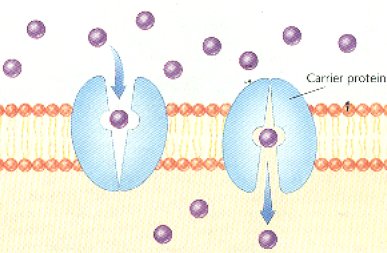
G. Channel proteins in the cell membrane form tunnels across the membrane to move materials

H. Channel proteins may always be open or have gates that open & close to control the movement of materials; called gated channels


I. Gates open & close in response to concentration inside & outside the cell


VI. Active Transport


A. Requires the use of ATP or energy

B. Moves materials against their concentration gradient from an area of lower to higher concentration

C. May also involve membrane proteins

D. Used to move ions such as Na+, Ca+, and K+ across the cell membrane

E. Sodium-Potassium pump moves 3 Na+ out for every 2 K+ into the cell
1. Causes a difference in charge inside and outside the cell
2. Difference in charge is called membrane potential


F. Ion pumps help muscle & nerve cells work


G. Plants use active transport to help roots absorb nutrients from the soil (plant nutrients are more concentrated inside the root than outside)


VII. Bulk Transport


A. Moves large, complex molecules such as proteins across the cell membrane

B. Large molecules, food, or fluid droplets are packaged in membrane-bound sacs called vesicles


C. Endocytosis moves large particles into a cell

D. Phagocytosis is one type of endocytosis
1. Cell membrane extends out forming pseudopods (fingerlike projections) that surround the particle
2. Membrane pouch encloses the material & pinches off inside the cell making a vesicle
3. Vesicle can fuse with lysosomes (digestive organelles) or release their contents in the cytoplasm
4. Used by ameba to feed & white blood cells to kill bacteria
5. Known as “cell eating”


E. Pinocytosis is another type of endocytosis
1. Cell membrane surrounds fluid droplets
2. Fluids taken into membrane-bound vesicle
3. Known as “cell drinking”


F. Exocytosis is used to remove large products from the cell such as wastes, mucus, & cell products

G. Proteins made by ribosomes in a cell are packaged into transport vesicles by the Golgi Apparatus

H. Transport vesicles fuse with the cell membrane and then the proteins are secreted out of the cell (e.g. insulin)

BACK

Genetics Study Guide

Genetics Study Guide 

The two genes or alleles that combine to determine a trait would be the organism’s _______________.
Type AB blood, having two genes dominant for a trait, is an example of ________.
State Mendel’s law of segregation.
Rr x Rr is an example of what type of cross —– P1, F1, or F2?
If both alleles are the same in a genotype, is the genotype homozygous or heterozygous?
Which cross is a cross between two hybrids —– P1, F1, or F2?
__________ dominance results in the blending of genes in the hybrid. Give an example using flower color.
What is another term for a heterozygous genotype?
The _____________ is the physical feature such as round peas that results from a genotype.
How many traits are involved in a monohybrid cross?
What type of organism was used in the first genetic studies done by Gregor Mendel?
What is a karyotype?
The two genes for a trait represented by capital & lower case letters are called __________.
How many traits are involved in a dihybrid cross?
Which of Mendel’s laws states that the dominant gene in a pair will be expressed?
If both alleles are the same, is the genotype homozygous or heterozygous? Write an example.
Write an example of a hybrid or heterozygous genotype.
The genes for sex-linked traits are only carried on which chromosome?
Who is considered to be the “father of genetics”?
A second filial or F2 cross is also called a ____________ cross.
The failure of chromosomes to separate during meiosis (egg & sperm formation) is known as _________________.
A cross between two pure or homozygous organisms is called what type of cross —– P1, F1, or F2?
What genetic disorder results from a sex-linked trait that affects color vision?
The genetic disorder called _______________ is known as the “free bleeders” disease.
Having three 21st chromosomes causes the genetic disorder known as _________.
A person suffering from the genetic disorder called ______________ can not digest fats.
_____________________ disease is a genetic disorder where red blood cells carry less oxygen.
Work a P1 cross for plant height in peas.
Work an F1 cross for plant height in peas.
BACK


Genetics Study Guide BI

Genetics Study Guide 

The two genes or alleles that combine to determine a trait would be the organism’s _______________.
Type AB blood, having two genes dominant for a trait, is an example of ________.
State Mendel’s law of segregation.
Rr x Rr is an example of what type of cross —– P1, F1, or F2?
If both alleles are the same in a genotype, is the genotype homozygous or heterozygous?
Which cross is a cross between two hybrids —– P1, F1, or F2?
__________ dominance results in the blending of genes in the hybrid. Give an example using flower color.
What is another term for a heterozygous genotype?
The _____________ is the physical feature such as round peas that results from a genotype.
How many traits are involved in a monohybrid cross?
What type of organism was used in the first genetic studies done by Gregor Mendel?
What is a karyotype?
The two genes for a trait represented by capital & lower case letters are called __________.
How many traits are involved in a dihybrid cross?
Which of Mendel’s laws states that the dominant gene in a pair will be expressed?
If both alleles are the same, is the genotype homozygous or heterozygous? Write an example.
Write an example of a hybrid or heterozygous genotype.
The genes for sex-linked traits are only carried on which chromosome?
Who is considered to be the “father of genetics”?
A second filial or F2 cross is also called a ____________ cross.
The failure of chromosomes to separate during meiosis (egg & sperm formation) is known as _________________.
A cross between two pure or homozygous organisms is called what type of cross —– P1, F1, or F2?
What genetic disorder results from a sex-linked trait that affects color vision?
The genetic disorder called _______________ is known as the “free bleeders” disease.
Having three 21st chromosomes causes the genetic disorder known as _________.
A person suffering from the genetic disorder called ______________ can not digest fats.
_____________________ disease is a genetic disorder where red blood cells carry less oxygen.
Work a P1 cross for plant height in peas.
Work an F1 cross for plant height in peas.
BACK


Genetics Worksheet Bi Chapter 9

 Fundamentals of Genetics

Section 9-1 Mendel’s Legacy

1. What scientist is responsible for our study of heredity?

2. Define heredity.

3. What plant did Mendel use for his hereditary experiments?

4. Name the 7 characteristics, giving both dominant and recessive forms of the pea plants, in Mendel’s experiments.

5. In order to study pea plant traits, Mendel had to control __________________ among the plants.

6. Define pollination & name 2 types.

7. How do pea plants normally pollinate?

8. How can cross-pollination of pea plants be done?

9. How did Mendel obtain pure pea plants?

10. What is the P1 generation? How is it obtained?

11. What is the F1 generation &how is it obtained?

12. How did Mendel obtain his F2 generation?

13. When Mendel crossed his P1 plants to get the F1 generation, what ratio did he get?

14. What is the difference between dominant & recessive genes?

15. State Mendel’s law of segregation.

16. What are alleles?

Section 9-2 Genetic Crosses

17 What is the difference between genotypes & phenotypes?

18. Write the 2 genotypes for a purple flower.

19. Write the genotype for a white flower.

20. What is the difference in a homozygous and a heterozygous genotype?

21. What is  probability & tell 3 ways they can be expressed.

22. What is the probability that you will get “heads” each time you flip a coin?

23. What is a monohybrid cross?

24. Give an example of a monohybrid cross.

25. What is a Punnett Square used for?

26. Sketch the Punnett Square for crossing a pure purple flower with a white flower.

27. Use a Punnett Square to solve this cross — PP x pp.

28. What percentage of the offspring from this cross are purple? White?

29. Use a Punnett Square to solve this cross in guinea pigs — BB x Bb. Hint: See page 174.

30. In the above cross, what coat colors & percents did you get?

31. What phenotype (coat color) would each of these guinea pig genotypes result in:

        a. Bb?

        b. BB?

        c. bb?

32. Use a Punnett Square to solve this cross for coat color in rabbits: Bb x Bb?

33. What percent of the rabbits will have black fur? Brown fur? What ratio does this give for coat color?

34. Define genotypic ratio.

35. What is the genotypic ratio for all F1 crosses (bb x Bb)?

36. Define phenotypic ratio.

37. What is the phenotypic ratio for all F1 crosses?

38. What is a testcross?

39. A testcross can determine which individual’s phenotype is ________________________.

40. Use a Punnett Square to solve the following 2 testcrosses:

        a. BB x Bb

        b. bb x Bb

41. In each of the above testcrosses, tell how many offspring have black coats (dominant) and how many will have brown (recessive) coats?

42. What does complete dominance mean?

43. Give an example of complete dominance in pea plants.

44. What is incomplete dominance?

45. How many alleles influence the phenotype in:

        a. complete dominance?

        b. incomplete dominance?

46. Using four-o-clocks, give an example of how incomplete dominance occurs. Be sure to tell all possible genotypes & phenotypes.

47. Give the following ratios for crossing 2 pink four-o-clocks (Rr x Rr):

        a. Genotypic ratio?

        b. Phenotypic ratio?

48. Define codominance.

49. In what genotype does codominance appear?

50. In horses, _________________ coat color is a result of codominance.

51. Write the genotype for roan coat color & tell the color of each allele in the genotype.

52. What is a dihybrid cross?

53. How many different genotypes will result in a dihybrid cross when 2 homozygous organisms are crossed?

54. The offspring from a dihybrid cross of 2 homozygous organisms will all be __________________________.

55. Use a Punnett Square to show the results of the following cross: RrYy x RrYy

56. How many different genotypes resulted from this cross?

57. How many different phenotypes resulted from this cross?

58. Write the genotypes for each of these phenotypes:

        a. Round, green seeds

        b. Wrinkled, yellow seeds

        c. Wrinkled, green seeds