Evolution PPT Questions


Evolution
ppt Questions

History of Evolutionary Thought

1. What were Aristotle’s early ideas about life on Earth?


2. How long did these ideas last?

3. What was Linnaeus first to do?


4. What language is used for scientific naming?

5. What are the two words called in a scientific name?

6. This naming system is known as ____________ ______________.

7. Name the contribution that each of these men made to Darwin’s ideas on evolution:

     a. Charles Lyell

     b. George Cuvier

     c. Thomas Malthus

     d. James Hutton

     e. Lamarck

     f. Wallace

8. Which was published first – the Origin 0f Species by Darwin or Gregor Mendel’s papers on inheritance?

9. What was the name of George Cuvier’s theory on evolution?

10. What did Cuvier study in Paris and what did he find?


11. What did Cuvier decide was responsible for the disappearance of some species?


12. James ___________ was a Scottish _________ who studied fossils of _____________ in the Paris Museum.

13. Hutton’s ideas were known as _____________.

14. Briefly state Hutton’s idea on geological change.


15. Lyell proposed the theory of _________________.

16. Describe uniformitarianism.


17. How old did Lyell propose that the Earth was? How old did most people at this time believe the Earth was?

18. How did reading Lyell’s book help darwin on his voyage on the Beagle?


19. Lamarck was one of the first scientists to understand that change occurs over ___________.

20. Lamarck believed that changes were adaptations to the ____________ that organisms _____________ in their lifetime and that he thought could be passed on to _______________.

21. Explain Lamarck’s idea of the Law of Use and Disuse.


22. Lamarck’s theory of acquiring or losing traits by using or not using them led to his theory of evolution called the _____________ of ______________ _____________.

23. According to this theory new ___________ could arise over time.

24. According to Lamarck, if a blacksmith built up his muscles then he would have what type of sons?


25. According to Lamarck, if a giraffe stretched its neck reaching for leaves, what would its offspring look like?


26. What did Lamarck NOT know that made his theory incorrect?


27. Are genes changed by life activities?

Darwin the Naturalist

28. In what year and at what age did Darwin become the naturalist for the ship the HMS Beagle?


29. How long was the Beagle voyage around the world?

30. As Darwin sailed around the coast of __________ __________, he collected many different types of plants and animals on the mainland and on the islands.

31. Where are the Galapagos Islands and how were they formed?


32. What did Darwin discover about the animals on each type of island


33. How did the island species of finches and tortoises compare with those on the islands?


34. How did the necks of the tortoises compare with each other?

35. The island finches resembled a finch on the ___________.

36. Was the available food and habitat the same on all the islands? Explain.


37. What was different about the finches and why?


Darwin’s Observations & Conclusions

38. List three observations Darwin made on his travels that led him to propose his revolutionary idea about the way life changes over time.

     a.

     b.

     c.

39. Give an example of the uneven distribution of species noted by darwin.


40. Darwin collected both ___________ organisms and ____________ of organisms.

41. Give 2 examples of fossils collected by Darwin in which the species were no longer in existence.


42. Give a definition for evolution.


43. Left unchecked, what did Darwin predict would happen to the number od individuals in a population?


44. In nature, what tends to happen to the size of populations over time?

45. Competition among members of a population occur due to a limited number of ____________ _______________.

46. Only a ___________ of the offspring produced survive to the next generation.

47. The struggle for environmental resources is commonly called _____________ of the ____________.

48. How do individuals in population compare with each other?

49. Variation in a population is ______________.

50. Which organisms in a population are most likely to live offspring to pass on their traits?

51. This process is known as _____________ ___________ and was proposed by Charles ___________.

52. State Darwin’s theory of natural selection.


53. New ____________ evolve according to natural selection.

Ideas that Shaped Darwin’s Thinking

54. _____________ was an economist in 1798 that influenced Darwin’s thinking.

55. Malthus observed what about the birth rate of babies?

56. Malthus knew population size was limited by what?

57. According to Malthus, a high birth rate and limited resources caused what to happen?


58. List several things that organisms struggle for in the environment.


59. What did Malthus say would happen if the population size continued to groww unchecked?


60. The __________ rate should increase to balance the __________ of a population and the limited _____________ in the environment.

61. Did Darwin see this occurring in nature?

62. Most organisms produce ____________ offspring than can survive causing many to ________.

Darwin’s Theory of Evolution
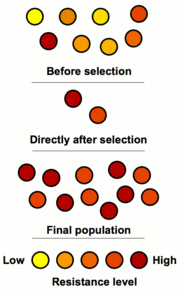
63. Darwin proposed that organisms descended from what?

64. Over time, according to Darwin organisms __________ their form causing evolution of new ____________.

65. ___________ __________ is the driving force for evolution.

66. During the struggle for survival, which organisms survive to pass on their traits?

Origin of Species

67.How long after he returned to England did Darwin publish his book about evolution?

68. Why did Darwin wait so long to publish his ideas?


69. Darwin’s theory of evolution challenged both the ____________ and _____________ ideas at that time.

70. What made Darwin publish his book?


71. _______________ independently developed the same theory as Darwin.

72. Both Darwin and Wallace believed that __________ changed over time due to a _____________ for existence.

73. Both Darwin’s and Wallace’s papers were presented to the ____________ ______________ in July of __________.

74. How long after this did it take Darwin to finish writing his book?

75. Before Darwin, it was thought that species were perfectly made and _______________.

76. What group of people had been observing and using variations in organisms for a long time?

77. How were farmers using variation?

78. This process is called _____________ ______________ instead of natural selection that occurs in nature.

79. Artificial selection involves ____________ desired traits in stock or crops and __________ them to pass on the trait.

Controversy

80. Define these terms:

     a. struggle for existence

     b. survival of the fittest

     c. descent with modification

     d. Fitness

     e. adaptation

81.What are the two types of adaptations?

82. Give some examples of physical adaptations.


83. Give some examples of behavioral adaptations.


84. What happens to organisms with LOW fitness?


85. How did changes in the Galapagos finches make them more FIT to survive?


86. Natural selection takes place over a _________ period of time.

87. Natural selection can be observed as changes in _______ structure, ecological _________, and ____________.

88. Do species today look them same as their ancestors?

89. Living species descended with changes from other __________ over periods of time.

90. What was a major problem in Darwin’s Theory?


91. The work of what scientists solved the problem of how variations were passed to offspring?

92. What is the complete title of Darwin’s book?


Theory of Evolution Today

93. List three main things used today to show how organisms are related.

     a.

     b.

     c.

94. Give two examples of evolution that has occurred today in a much shorter period of time.

     a. 

     b.

95. Define macroevolution.


96. Define microevolution.


97. Darwin argued that Earth was ____________ of years old instead of thousands of years old.

98. One of the main pieces of evidence to support this ancient age of the Earth came from ___________ collected by Darwin.

99. Fossils are found in what type of rock layers?

100. Animals on different continents living in similar habitats show similar _______________.

101.  All ____________ have similar bon structures known as ______________ structures.

102. Homologous structures have the same structure but different ______________.

103. Give 3 examples of homologous structures in vertebrates.


104. __________ structures seem to have no important function.

105. Give an example of a vestigial structure in humans.

106. What is an embryo?


107. How does the embryonic development of different vertebrates compare to each other?


Food Testing


Chemical Tests for Nutrients in Food

INTRODUCTION:

Cells are made up of small molecules like water; ions such as sodium and magnesium, and large organic molecules. There are four important types of large organic molecule in living organisms — proteins, carbohydrates (sugars & starches), lipids (fats), and nucleic acids. Proteins, carbohydrates, and fats serve as nutrients in the food that we eat.

In this experiment you will evaluate the nutrient content of unidentified food samples. You will use chemical reagents to test the unknown for specific nutrients. By comparing the color change a reagent produces in the unknown with the change it produces in the known nutrient, you can estimate the amount of that nutrient. Use small samples.

MATERIALS:

400-ml beaker
Hot plate
8 test tubes
Test tube rack
4 medicine droppers
Glass stirring rod
Tongs
Several unknown food substances
Glucose
Cornstarch
Non-fat dry milk
Lard
Distilled water
Benedict’s solution
Iodine-potassium iodide solution
10% aqueous sodium hydroxide solution
0.5% Copper sulfate solution
Sudan III solution

PROCEDURE:

Monosaccharide (simple sugar) test

1. Fill a 400-ml beaker to about 300 ml with water and heat on the hot plate.

Be sure to label all test tubes.

2. Place pea-sized portions of glucose and the unknown substance you are testing in separate test tubes. Add about 2.5 ml of distilled water and 10 drops of Benedict’s solution to each test tube. Mix with a stirring rod, or holding the tube between the thumb and index finger of one hand, thump it with the middle finger of the other hand to mix.

REMEMBER: If you use a stirring rod, wash it after every use, so you won’t contaminate one solution with another.

3. When the water boils, use tongs to place the test tubes in the water bath. Leave the test tubes in the water bath for 10 minutes.

Do not let the water bath boil hard. Control the boiling by turning the hot plate on and off as needed.

4. Remove the test tubes with tongs and place the tubes in a test tube rack. Unplug the hot plate to cool. When the tubes cool, an orange or red precipitate will form if large amounts of glucose are present. Small amounts of glucose will form a yellow or green precipitate. Record your observations in the DATA TABLE.

Polysaccharide complex sugar) test

5. Place cornstarch in a clean test tube and some of the unknown substance in another. Use a clean dropper to add 10 drops of iodine-potassium iodide solution to each test tube. Observe the results and record in the DATA TABLE.

Protein test

6. Place non-fat dry milk in a clean test tube and some of the unknown in another. With a clean dropper slowly add an amount of sodium hydroxide solution about equal to the amount of the milk sample, and mix carefully. Then add 10 drops of copper sulfate solution one drop at a time. Mix gently between drops. Observe the results and record in the DATA TABLE.

7. Repeat step 6 with the unknown substance.

Lipid test

8. Place a small piece of lard in a clean test tube and some of the unknown in another. Use a clean dropper to add 10 drops of Sudan III solution to each test tube. Mix well, observe and record your results in the DATA TABLE.

DATA TABLE:

Mark your results in the appropriate boxes. Indicate relative amount by H for high, M for medium, L for low, or 0 for none.

Monosaccharide test Polysaccharide test
SUBSTANCE: RELATIVE
AMOUNT:
SUBSTANCE: RELATIVE
AMOUNT:
Unknown Unknown
Glucose Corn starch


Protein test Lipid test
SUBSTANCE: RELATIVE
AMOUNT:
SUBSTANCE: RELATIVE
AMOUNT:
Unknown Unknown
Non-fat dry milk Lard

CONCLUSIONS:

Question 1 . What is the main nutrient in the unknown?

Question 2. What are the controls in this investigation?


Evolution Study Guide BI

Evolution Study Guide

What idea was used to explain the appearance of maggots on rotting meat?
Explain how Redi tested the hypothesis of spontaneous generation.
What did Pasteur do in his experiments on spontaneous generation that other scientists before him had not done?
What is the estimated age of the earth?
If the half-life of a radioactive isotope is 4000 years, how much will be left in a fossil after 4000 years? after 8000 years?
Does the half-life of a radioactive isotope change?
How can the age of a fossil be determined?
Which of these gases was thought by Oparin to be part of the early Earth’s atmosphere — carbon dioxide, ozone, oxygen , &/or ammonia?
Why did Miller & Urey not use oxygen in their experiment?
What organic compound did Miller & Urey make in their experiment?
Miller & Urey’s experiments were designed to show that life on Earth might have originated from what type of molecules?
Was RNA or DNA probably the first genetic molecule?
Can RNA undergo natural selection & cause evolution or change?
Do scientists think DNA or RNA was made first?
What layer protects the Earth from harmful ultraviolet rays of light?
Give 3 examples of different types of fossils.
Describe several ways in which fossils can be formed.
On what islands did Darwin conduct much of his research?
Darwin’s finches that had various types of beaks probably shared what in common with each other?
The process by which a population becomes better suited to its environment is known as what?
According to Darwin, evolution is the result of _____________ ___________.
If organisms are well suited to their environment, what will be true of their ability to reproduce?
Limited resources and a growing population results in ___________ among organisms.
Give an example of homologous structures found in the wing of a bat & the forearm of a human.
The human tailbone is an example of a __________ structure.
The beak of a bird & the beak of a giant squid have the same function and would be examples of _____________ structures.
When two or more species change in response to each other, the process is known as _____________.
Back


Frog Dissection

Frog Dissection
Pictures:  Modern Biology, Holt

Background:
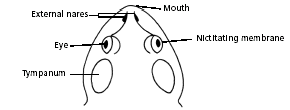
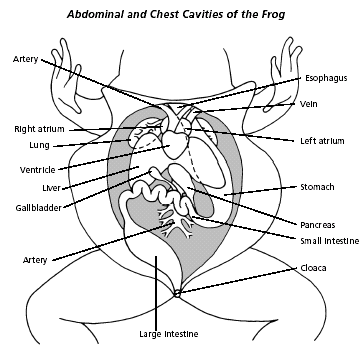
As members of the class Amphibia, frogs may live some of their adult lives on land, but they must return to water to reproduce. Eggs are laid and fertilized in water. On the outside of the frog’s head are two external nares, or nostrils; two tympani, or eardrums; and two eyes, each of which has three lids. The third lid, called the nictitating membrane, is transparent. Inside the mouth are two internal nares, or openings into the nostrils; two vomerine teeth in the middle of the roof of the mouth; and two maxillary teeth at the sides of the mouth. Also inside the mouth behind the tongue is the pharynx, or throat.

In the pharynx, there are several openings: one into the esophagus, the tube into which food is swallowed; one into the glottis, through which air enters the larynx, or voice box; and two into the Eustachian tubes, which connect the pharynx to the ear. The digestive system consists of the organs of the digestive tract, or food tube, and the digestive glands. From the esophagus, swallowed food moves into the stomach and then into the small intestine. Bile is a digestive juice made by the liver and stored in the gallbladder. Bile flows into a tube called the common bile duct, into which pancreatic juice, a digestive juice from the pancreas, also flows. The contents of the common bile duct flow into the small intestine, where most of the digestion and absorption of food into the bloodstream takes place.

Indigestible materials pass through the large intestine and then into the cloaca, the common exit chamber of the digestive, excretory, and reproductive systems. The respiratory system consists of the nostrils and the larynx, which opens into two lungs, hollow sacs with thin walls. The walls of the lungs are filled with capillaries, which are microscopic blood vessels through which materials pass into and out of the blood. The circulatory system consists of the heart, blood vessels, and blood. The heart has two receiving chambers, or atria, and one sending chamber, or ventricle. Blood is carried to the heart in vessels called veins. Veins from different parts of the body enter the right and left atria. Blood from both atria goes into the ventricle and then is pumped into the arteries, which are blood vessels that carry blood away from the heart.

The urinary system consists of the frog’s kidneys, ureters, bladder, and cloaca. The kidneys are organs that excrete urine. Connected to each kidney is a ureter, a tube through which urine passes into the urinary bladder, a sac that stores urine until it passes out of the body through the cloaca. The organs of the male reproductive system are the testes, sperm ducts, and cloaca. Those of the female system are the ovaries, oviducts, uteri, and cloaca. The testes produce sperm, or male sex cells, which move through sperm ducts, tubes that carry sperm into the cloaca, from which the sperm move outside the body. The ovaries produce eggs, or female sex cells, which move through oviducts into the uteri, then through the cloaca outside the body.

The central nervous system of the frog consists of  the brain, which is enclosed in the skull, and the spinal cord, which is enclosed in the backbone. Nerves branch out from the spinal cord. The frog’s skeletal and muscular systems consist of its framework of bones and joints, to which nearly all the voluntary muscles of the body  are attached. Voluntary muscles, which are those over which the frog has control, occur in pairs of flexors and extensors. When a flexor of a leg or other body part contracts, that  part is bent. When the extensor of that body part contracts, the part straightens.

Objectives:
Describe the appearance of various organs found in the frog.
Name the organs that make up various systems of the frog.

Purpose:
In this lab, you will dissect a frog in order to observe the external and internal structures of frog anatomy.

Materials:
• safety goggles, gloves, and a lab apron
forceps
preserved frog
dissecting pins (6–10)
dissecting tray and paper towels
plastic storage bag and twist tie
scissors
marking pen
dissecting needle

Procedure:

  1. Put on safety goggles, gloves, and a lab apron.
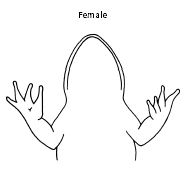
  2. Place a frog on a dissection tray. To determine the frog’s sex, look at the hand digits, or fingers, on its forelegs. A male frog usually has thick pads on its “thumbs,” which is one external difference between the sexes, as shown in the diagram below. Male frogs are also usually smaller than female frogs. Observe several frogs to see the difference between males and females.
  1.  Use the diagram below to locate and identify the external features of the head. Find the mouth, external nares, tympani, eyes, and nictitating membranes.

  1. Turn the frog on its back and pin down the legs. Cut the hinges of the mouth and open it wide. Use the diagram below to locate and identify the structures inside the mouth. Use a probe to help find each part: the vomerine teeth, the maxillary teeth, the internal nares, the tongue, the openings to the Eustachian tubes, the esophagus, the pharynx, and the slit-like glottis.

  1. Look for the opening to the frog’s cloaca, located between the hind legs. Use forceps to lift the skin and use scissors to cut along the center of the body from the cloaca to the lip. Turn back the skin, cut toward the side at each leg, and pin the skin flat. The diagram above shows how to make these cuts
  2. Lift and cut through the muscles and breast bone to open up the body cavity. If your frog is a female, the abdominal cavity may be filled with dark-colored eggs. If so, remove the eggs on one side so you can see the organs underlying them.
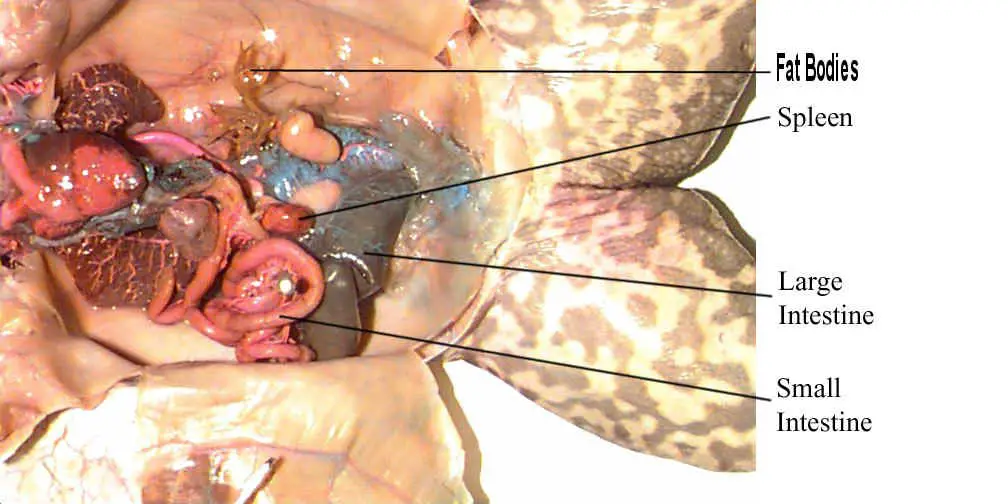
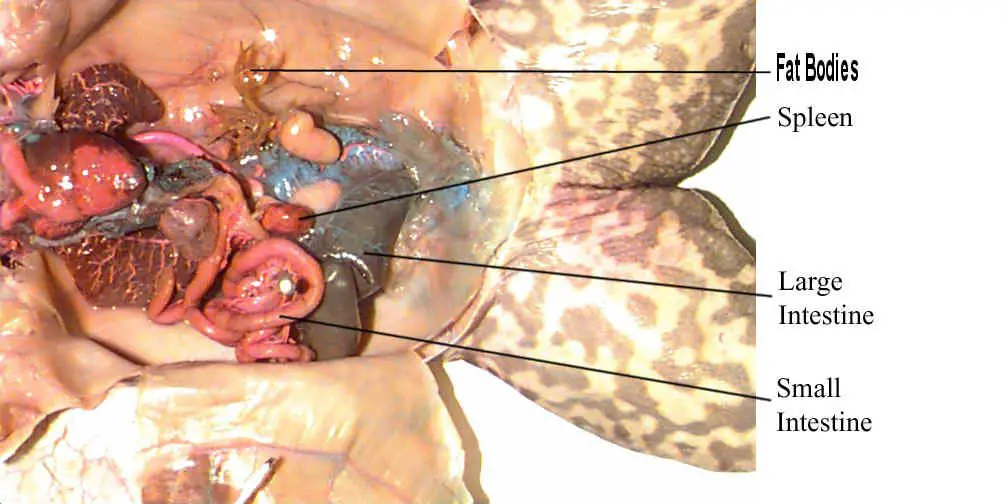
  3. Use the diagram below to locate and identify the organs of the digestive system: esophagus, stomach, small intestine, large intestine, cloaca, liver, gallbladder, and pancreas.

  1. Again refer to the diagram below to identify the parts of the circulatory and respiratory systems that are in the chest cavity. Find the left atrium, right atrium, and ventricle of the heart. Find an artery attached to the heart and another artery near the backbone. Find a vein near one of the shoulders. Find the two lungs.

  1. Use a probe and scissors to lift and remove the intestines and liver. Use the diagram on the next page to identify the parts of the urinary and reproductive systems. Remove the peritoneal membrane, which is connective tissue that lies on top of the red kidneys. Observe the yellow fat bodies that are attached to the kidneys. Find the ureters; the urinary bladder; the testes and sperm ducts in the male; and the ovaries, oviducts, and uteri in the female.

  1. Remove the kidneys and look for threadlike spinal nerves that extend from the spinal cord. Dissect a thigh, and trace one nerve into a leg muscle. Note the size and texture of the leg muscles.
  2. Dispose of your materials according to the directions from your teacher.
  3. Clean up your work area and wash your hands before leaving the lab.
Click here for worksheet

BACK

DNA Quiz

DNA QUIZ QUESTIONS


1. What is the general name for chemicals like DNA and RNA
2. What general shape does the DNA molecule have?
3. List 4 differences between RNA and DNA
4. Describe the function of the mRNA in Protein Synthesis
5. What is the definition of a codon
6. What is the definition of an anti-codon
7. How many amino acids will result from the following strand of DNA?
A C G C C C A A A T A C
8. Name the two stages that make up protein synthesis
9. Where in the cell does replication take place?
10. Describe the function of the tRNA in Protein Synthesis?
11. Describe briefly the events that occur during transcription?
12. Name 2 common environmental mutagens
13. Describe briefly the events that occur during translation?
14. What is the definition of     a) translation       b) transcription
16. Define complementary base pairing and give an example?
17. Describe the function of the ribosome during protein synthesis
18. From a given strand of DNA. Show the results of Transcription or Replication
19. Make a drawing of DNA or RNA nucleotide and label the parts
20. Give 2 examples of     a) purines          b) pyrimidines
21. Name the 4 bases that make up DNA or RNA molecules
22. Describe how an environmental mutagen could cause a mutation
23. Describe briefly the events that occur during replication?
24. List 3 functions of DNA
25. Describe the function of the DNA in Protein Synthesis
26. What is the definition of a chromosomal mutation
27. What is the definition of a gene mutation
28. If the Nucleic acids are like ladders: What chemicals form the backbone of DNA or RNA molecules?
29. If the Nucleic acids are like ladders: What chemicals form the rungs of DNA or RNA molecule?
30. Briefly describe what occurs during Protein synthesis 

31. What is recombinanant DNA. Give two uses of recombinant DNA


DNA SUBJECTIVE QUESTIONS
1. Describe 2 differences between the following pairs of terms
a. codon and anti codon                  b. replication and transcription              c. RNA and DNA  

d. transcription and translation          e. chromosomal and gene mutation       f. mRNA and tRNA           

g. purine and pyrimidine                    h. complementary base pairing and joining of adjacent nucleotides
2. Describe complementary base pairing. Show an example. 

3. Explain the roles/function of the following during Protein Synthesis:
a. DNA in the nucleus       b. Transfer RNA (tRNA)            c. Messenger RNA (mRNA)             d. Ribosome
4. Name 2 environmental mutagens and describe how they could cause a mutation in an organism 

5. Explain the process of DNA replication 

6. Make a drawing of an RNA or DNA nucleotide and label the parts 

7. Compare DNA and RNA with respect to the following things:
a. shape         b. chemical makeup         c. function         d. abundance in the cell

8. Explain the process of translation

9. Explain the process of transcription

10. Describe in sequence, the process of protein synthesis. Include in your answer the names of the various steps, the organelles involved, and the names of the major molecules.

11. Describe how radiation or another such substance could cause mutations to occur. 

12. From a given strand of DNA be able to determine the sequence of mRNA codons, and the amino acid strand produced.