Egg Osmosis Sample 2 lab


Osmosis through the Cell Membrane of an Egg


Introduction:
Transport can be either passive or active. Passive transport is the movement of substances across the membrane without any input of energy by the cell. Active transport is the movement of materials where a cell is required to expend energy. In the case of this lab the discussion will be centered on passive transport.
The simplest type of passive transport is diffusion. Diffusion is the movement of molecules from an area of higher to an area of lower concentration without any energy input. Diffusion is driven by the kinetic energy found in the molecules. Diffusion will eventually cause the concentration of molecules to be the same throughout the space the molecules occupy, causing a state of equilibrium to exist.
Another type of passive transport is that of osmosis. Osmosis is the movement of water across a semi-permeable membrane. The process by which osmosis occurs is when water molecules diffuse across a cell membrane from an area of higher concentration to an area of lower concentration. The direction of osmosis depends on the relative concentration of the solutes on the two sides. In osmosis, water can travel in three different ways.
If the molecules outside the cell are lower than the concentration in the cytosol, the solution is said to be hypotonic to the cytosol, in this process, water diffuses into the cell until equilibrium is established. If the molecules outside the cell are higher than the concentration in the cytosol, the solution is said to be hypertonic to the cytosol, in this process, water diffuses out of the cell until equilibrium exists. If the molecules outside and inside the cell are equal, the solution is said to be isotonic to the cytosol, in this process, water diffuses into and out of the cell at equal rates, causing no net movement of water.
In osmosis the cell is selectively permeable, meaning that it only allows certain substances to be transferred into and out of the cell. In osmosis, the proteins only on the surface are called peripheral proteins, which form carbohydrate chains whose purpose is used like antennae for communication. Embedded in the peripheral proteins are integral proteins that can either be solid or have a pore called channel proteins. Channel proteins allow glucose, or food that all living things need to live, pass through.


Hypothesis:
In the syrup solution, there will be a net movement of molecules out of the egg, and in the water solution, the molecules will diffuse in and out of the cell at equal rates.


Materials:
The materials used in this lab were 2 fresh eggs in the shell, an overhead marker, 400 ml of water, graduated cylinder, 1 large beaker, 2 medium beakers, 1 small beaker, white vinegar, Karo syrup, distilled water, pencil, paper, lab apron, lab goggles, saran wrap, masking tape, plastic tray, tongs, electronic balance, osmosis lab sheet, and computer.


Methods:
On day 1, measure the masses of both the eggs with the shell. Label 1 beaker vinegar, and then use the graduated cylinder to measure 400 mL of vinegar to put in the labeled beaker. Place both eggs in the solution (place a small beaker on top of the eggs, if necessary) then cover. Let the eggs stand for 24 hours or more to remove the shell.


On day 2, record the observations of what happened to the eggs in the vinegar solution. Carefully, remove the eggs from the vinegar, gently rinsing the eggs off in water. Clean the beakers used for the vinegar solution preparing them for the syrup solution, and then label the 2 medium beakers syrup. Before the eggs are placed in the syrup solution record the mass of both eggs then put it on the datasheet. After that has been done, place the eggs in the beaker, pouring enough syrup to cover the eggs, cover them loosely and let them stand for 24 hours.

On day 3, record the observations of the egg from the syrup solution. Carefully, remove the eggs from the beakers, gently rinsing the syrup off of the eggs. Pour the remaining syrup in the container provided by the teacher. Clean the two beakers used in the syrup solution, preparing them for the water solution. Before the eggs are placed in the water solution record the mass of both eggs then put it on the datasheet. After that has been done, using a graduated cylinder, measure out 200 mL of water for each beaker. Place the eggs in the water solution, cover and let stand 24 hours.

On day 4, record the observations of the egg from the water solution. Carefully remove the eggs from the beakers, gently rinsing them off. Mass both of the eggs. After the teacher has came and looked at the eggs, discard in the proper place.


Results:


Isotonic Solution Hypotonic (Vinegar is acid in Water)
Hypertonic


Table 1- Egg 1 Data


Egg mass before added into the solution (g)


Egg mass after added into the solution (g)


Observations


Vinegar

70.8 g (with shell) 98.0 g (without shell) Before the egg was added into the vinegar, it was large, but the after effect was that the egg increased in size and had become hard. After two days, the shell was completely removed.
 

Syrup

98.0 g 65.0 g When the egg was removed from the syrup, it had shrunk and it was softer than before it was added into the solution
 

Water

65.0 g 105.3 g When the egg was removed out of the water, the color looked of a pale yellow. The water had diffused into the egg, because the egg was larger in size before it was added into the water.


Table 2- Egg 2 Data


Egg mass before added into the solution (g)


Egg mass after added into the solution (g)


Observations


Vinegar

71.6 g (with shell) 99.1 g (without shell) Egg 2s’ mass was greater than egg 1s’ mass before and after it was added into the vinegar solution. The mass had increased some 20 grams with the shell off.
 

Syrup

99.1 g 64.0 g The mass of the egg had decreased some 30 grams after it the egg was removed from the syrup solution. The mass of the egg 2 was smaller than the mass of egg1.
 

Water

64.0 g 105.2 g The mass of egg 2 had increased some 50 grams after being added into the water solution. The mass of egg 1, though, was larger than the mass of 2 by 1 gram. If the egg would have remained in the water a little while longer, the egg would have probably went through cytolysis.


1. When the egg was placed in the water in which direction did the water molecules move?     The water molecules moved in the egg.

2. On what evidence do you base this? The molecules moved in, because the size of the egg increased

3. How do you explain the volume of liquid remaining when the egg was removed from the syrup? Since, the cell is selectively permeable, it only allowed a certain amount of the syrup to be present in the cell, just enough to shrink it and also equilibrium was reached..

4. When the egg was placed in the water after being removed from the syrup in which direction did the water move? The water moved in.

5. Why did the water molecules travel better inside the cell than the syrup molecules? The water molecules traveled better into the cell because smaller molecules travel better than other larger molecules.

6. What was the purpose of placing the egg in vinegar? The  vinegar solution was only used to remove the shell off the egg.

Error Analysis:
A possible error in this lab occurred by having to leave the egg in vinegar for two days instead of one to remove the shell. This caused the egg to initially take in more water.


Discussion and Conclusion:
Based on the data collected and the results of the experiment, the hypothesis was  correct. The egg appeared shriveled after removing it from the syrup because of the movement of water out of the egg. The syrup solution was hypertonic so water moved out of the egg from an area where water was more concentrated to the outside of the egg where water was less concentrated due to the high amount of sugar or solute. The acetic acid in vinegar did remove the shell from the egg, because the egg required two days to completely remove the shell, some water did move into the egg causing its initial mass without the shell to be higher than the egg’s mass with its shell. Whenever the egg was transferred from the syrup to the distilled water, the concentration of water outside the shriveled egg was greater than the water concentration inside the egg; therefore, water moved into the egg until equilibrium was reached. At that point, movement into and out of the egg continued with no net movement of water molecules.
Additional research  to see if the egg would have went through cytolysis in another 24 or more hours in the water solution would have been interesting.

BACK

DNA History


History of DNA WebQuest


1.     Friedrich (Fritz) Miescher

http://www.dnai.org/timeline/index.html

Find Miescher on the timeline and click on the bucket with the Red Cross to watch the animation.  In 1869, he extracted a substance from white blood cells that he called nuclein.  What do you think he was actually extracting?


2.     Frederick Griffith

  http://biology.clc.uc.edu/courses/Bio104/dna.htm


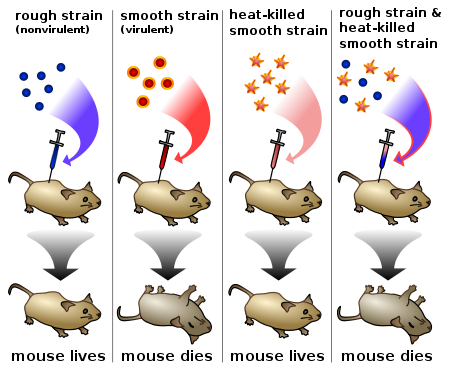
Frederick Griffith’s famous experiment was conducted in 1928.  In his experiment, ______________ smooth virulent bacteria plus live rough ______________ bacteria killed mice.  His experiment demonstrated that DNA was the _______________ material.


Griffith’s Famous Experiment: Transformation


3.     Oswald Avery

http://library.thinkquest.org/20465/avery.html

In 1944, what did he discover that DNA is responsible for?


4.     Alfred Hershey and Martha Chase

http://users.rcn.com/jkimball.ma.ultranet/BiologyPages/H/Hershey_Chase.html


a.      In 1952, their experiments showed that ______ is the genetic material instead of ____________.


5.     Erwin Chargaff

http://www.dnai.org/timeline/index.html

Watch “Chargaff’s Ratios.”  Chargaff used relative proportions of bases in DNA to come up with his rules for base pairing.  What are four sources of DNA that he used?


http://fig.cox.miami.edu/~cmallery/150/gene/chargaff.htm

Adenine (A) pairs with _____________

Guanine (G) pairs with _____________

The bases that are purines include ___________ & ____________.

The bases that are pyrimidines include ___________ & ______________.


6.     Rosalind Franklin.

http://www.accessexcellence.org/RC/AB/BC/Rosalind_Franklin.php


http://www.dnai.org/timeline/index.html – Watch Franklin’s X-ray diffraction pattern


What is X-ray crystallography (a.k.a. X-ray diffraction)?


What did she discover about the shape of DNA?


7.     Linus Pauling

http://www.dnai.org/timeline/index.html – Watch the animation.

Linus Pauling proposed a structure for DNA that was incorrect.  Describe or draw it below:


8.     Maurice Wilkins

http://www.nzedge.com/heroes/wilkins.html

His research, with the help from ________________, led to the discovery of the DNA molecule structure.  This discovery was made by American biologist, ________________, and British physicist, ________________.


9.     James Watson and Francis Crick.

http://www.dnai.org/timeline/index.html


a.      What did they receive the Nobel Prize for in 1962?


b.     What is the difference between Pauling’s structure and the actual structure of DNA?


10. DNA Game

    http://nobelprize.org/educational_games/medicine/dna_double_helix/

    Play the game and record what three organisms you had:

1.

2.

3.


Elements in Living Things


Elements in Living Things


Use the following Interactive Periodic Table to determine the physical and chemical properties of the most common elements found in organisms.

http://www.webelements.com/


Carbohydrates – C H O          Lipids – C H O

Proteins – CHON S     Nucleic Acids – CHON P

Common Minerals – Fe, I, Zn, Na, K, Ca


CARBON

Family ______________   Period ___________________

Atomic # ___________    Atomic Mass ____________

Biological Role:


Amount of C in your body ___________________

Hazards & Risks:


HYDROGEN

Family ______________   Period ___________________

Atomic # ___________    Atomic Mass ____________

Biological Role:


Amount of C in your body ___________________

Hazards & Risks:


OXYGEN

Family ______________   Period ___________________

Atomic # ___________    Atomic Mass ____________

Biological Role:


Amount of C in your body ___________________

Hazards & Risks:


NITROGEN

Family ______________   Period ___________________

Atomic # ___________    Atomic Mass ____________

Biological Role:


Amount of C in your body ___________________

Hazards & Risks:


SULFUR

Family ______________   Period ___________________

Atomic # ___________    Atomic Mass ____________

Biological Role:


Amount of C in your body ___________________

Hazards & Risks:


POTASSIUM

Family ______________   Period ___________________

Atomic # ___________    Atomic Mass ____________

Biological Role:


Amount of C in your body ___________________

Hazards & Risks:


IRON

Family ______________   Period ___________________

Atomic # ___________    Atomic Mass ____________

Biological Role:


Amount of C in your body ___________________

Hazards & Risks:


ZINC

Family ______________   Period ___________________

Atomic # ___________    Atomic Mass ____________

Biological Role:


Amount of C in your body ___________________

Hazards & Risks:


IODINE

Family ______________   Period ___________________

Atomic # ___________    Atomic Mass ____________

Biological Role:


Amount of C in your body ___________________

Hazards & Risks:


CALCIUM

Family ______________   Period ___________________

Atomic # ___________    Atomic Mass ____________

Biological Role:


Amount of C in your body ___________________

Hazards & Risks:


SODIUM

Family ______________   Period ___________________

Atomic # ___________    Atomic Mass ____________

Biological Role:


Amount of C in your body ___________________

Hazards & Risks:


POTASSIUM

Family ______________   Period ___________________

Atomic # ___________    Atomic Mass ____________

Biological Role:


Amount of C in your body ___________________

Hazards & Risks:


Now write the symbol for each element in the proper place on the periodic table.


DNA Replication Lab

Modeling DNA Replication


Introduction

Within the nucleus of every cell are long strings of DNA, the code that holds all the information needed to make and control every cell within a living organism. DNA, which stands for deoxyribonucleic acid, resembles a long, spiraling ladder. It consists of just a few kinds of atoms: carbon, hydrogen, oxygen, nitrogen, and phosphorus. Combinations of these atoms form the sugar-phosphate backbone of the DNA — the sides of the ladder, in other words.

Other combinations of the atoms form the four bases: thymine (T), adenine (A), cytosine (C), and guanine (G). These bases are the rungs of the DNA ladder. (It takes two bases to form a rung — one for each side of the ladder.) A sugar molecule, a base, and a phosphate molecule group together to make up a nucleotide. Nucleotides are abundant in the cell’s nucleus. Nucleotides are the units which, when linked sugar to phosphate, make up one side of a DNA ladder.

During DNA replication, special enzymes move up along the DNA ladder, unzipping the molecule as it moves along. New nucleotides move in to each side of the unzipped ladder. The bases on these nucleotides are very particular about what they connect to. When the enzyme has passed the end of the DNA, two identical molecules of DNA are left behind. Cytosine (C) will “pair” to guanine (G), and adenine (A) will “pair” to thymine (T). How the bases are arranged in the DNA is what determines the genetic code.


When the enzyme has passed the end of the DNA, two identical molecules of DNA are left behind. Each contains one side of the original DNA and one side made of “new” nucleotides. It is possible that mistakes were made along the way — in other words, that a base pair in one DNA molecule doesn’t match the corresponding pair in the other molecule. On average, one mistake may exist in every billion base pairs. That’s the same as typing out the entire Encyclopedia Britannica five times and typing in a wrong letter only once!

Objectives

The replication of DNA before cell division can be shown using paper templates for the components of DNA nucleotides.

Materials

  • Cut Outs of basic subunits of DNA
  • Colors or markers
  • Scissors
  • Tape or glue
  • Paper & pencil

Procedure:

  1. Cut out all of the units needed to make the nucleotides from the handout provided.
  2. Color code the Nitrogenous bases, phosphorus, and deoxyribose sugar as follows —
    Adenine = red, Guanine = green, Thymine = yellow, Cytosine = blue, Phosphate = brown, and Deoxyribose = purple.
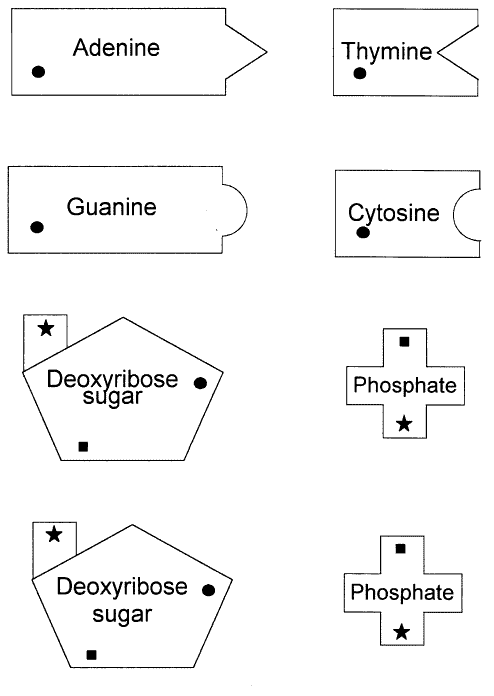
  3. Using the small squares and stars as guides, line up the bases, phosphates and sugars.
  4. Now glue the appropriate parts together forming nucleotides.
  5. Construct DNA model using the following sequence to form a row from top to bottom – cytosine (topmost), thymine, guanine, and adenine (bottommost).
  6. Let this arrangement represent the left half of your DNA molecule.
  7. Complete the right side of the ladder by adding the complementary bases. You will have to turn them upside down in order to make them fit.
  8. Your finished model should look like a ladder.
  9. To show replication, separate the left side from the right side, leaving a space of about 6-8 inches.
  10. Use the remaining nucleotides to complete the molecule using the left side as the base.
  11. Build a second DNA model by adding new nucleotides to the right half of the original piece of the molecule.
  12. Tape the nucleotides together to form 2 complete DNA ladders.

Questions

1. Of the 4 bases, which other base does adenine most closely resemble?

2. List the 4 different nucleotides.

3. Which 2 molecules of a nucleotide form the sides of a DNA ladder?

4. If 30% of a DNA molecule is Adenine, what percent is Cytosine?

5. What does the term replication mean?

6. What is another name for adenine and three phosphate molecules attached to it?


Elephants Can’t Jump


It is a known fact that, unlike other animals, elephants can not jump! The bones in an elephant’s feet are too tightly packed and they’re too heavy.

On this page, you will find interesting questions  about other living things. Use the Google search engine on this page to help find the answers & then e-mail me your correct answer for test coupons.

The scientific name for the giraffe is Giraffa camelopardalis. What does this Latin name mean?

HOME