Evolution Quiz 2

Name: 

Theory of Evolution 


True/False
Indicate whether the sentence or statement is true or false.
1.
Within populations, divergence leads to speciation.
2.
Genetic similarities between species is evidence of common ancestry.
3.
Shared common traits are a clue to common ancestry.
4.
The pelvic (hip) bones of a snake are vestigial organs.
5.
Darwin would have explained giraffes having long necks as a trait that allowed the fittest to survive.
6.
Darwin was the first scientist to propose that living things evolve.
7.
Most organisms produce more offspring than can possibly survive.
 

Multiple Choice
Identify the letter of the choice that best completes the statement or answers the question.
8.
The change that results in a species being better suited to its environment is known as
a.
reproduction.
c.
adaptation.
b.
variation.
d.
selection.
9.
New species form
a.
when ecological races diverge more and more.
b.
because of natural selection.
c.
when members of the same species become adapted to new environments.
d.
All of the above
10.
Natural selection causes
a.
changes in the environment.
b.
plants and animals to produce more offspring than can survive.
c.
changes in the frequency of certain alleles in a population.
d.
All of the above
11.
The theory of evolution predicts that
a.
closely related species will show similarities in nucleotide sequences.
b.
if species have changed over time, their genes should have changed.
c.
closely related species will show similarities in amino acid sequences.
d.
All of the above
12.
Mutations are important to the understanding of evolution because they increase the
a.
value of natural selection of animals
c.
use of organs in animals
b.
production of variations in animals
d.
differentiation of animal embryos
13.
The human appendix is an example of a structure that is
a.
homologous
c.
a variation
b.
acquired
d.
vestigial
14.
The modern theory of evolution supports the concept that inheritable variations within a species may result from
a.
recombination of genes during fertilization
c.
changes in autosomes
b.
use and disuse
d.
acquired characteristics
15.
The occurrence of the same blood protein in a group of species provides evidence that these species
a.
evolved in the same habitat
c.
descended from a common ancestor
b.
evolved in different habitats
d.
descended from different ancestors
16.
According to modern ideas of evolution, the fittest individuals are those that
a.
are stronger
c.
are best adapted to their environment
b.
move faster
d.
have the largest brains
17.
After all the grass was eaten, early horses had to stretch for food on trees.  Consequently these horses developed longer legs and necks. This statement is consistent with the views of
a.
Darwin only
c.
both men
b.
Lamarck only
d.
neither man
18.
It has been observed that white mice live in areas with white soil and brown mice live in areas with dark soil.  Which statement best describes the situation?
a.
All organisms tend to increase in numbers at a geometric rate
b.
In each generation, the number of individuals in a species remains constant
c.
There is a struggle to survive
d.
Variations are passed to offspring.  Favorable variations aid survival and reproduction
19.
Squirrels on the north rim of the Grand Canyon differ in many respects from those on the south rim (the river prevents passage from one to the other).  Which statement best describes the situation?
a.
In each generation, the number of individuals in a species remains constant
b.
Variations, which may be inherited, are found among individuals in each species
c.
The inheritance of favorable variations may eventually lead to the development of a new species
d.
All organisms tend to increase in numbers at a geometric rate
20.
The idea of the survival of the fittest is part of the explanation of the theory of evolution called
a.
use and disuse
c.
natural selection
b.
inheritance of acquired characteristics
d.
continuity of the germ plasm
21.
The process of change with time during successive generations among living things is
a.
evolution
c.
extinction
b.
law of use and disuse
d.
none of these
22.
Which of the following is an example of a morphological adaptation?
a.
hibernation
c.
an enzyme
b.
crab’s claws
d.
migration
23.
Competition between individuals of a species occurs primarily because of
a.
a scarcity of resources
c.
low birth rates
b.
advantageous variations
d.
acquired characteristics
24.
The book, Origin of the Species, was written by
a.
Charles Darwin
c.
Jean Baptiste de Lamarck
b.
Alfred Russell Wallace
d.
Thomas Malthus
25.
Variation is most important to Darwin’s theory of evolution because it
a.
provides material on which natural selection acts
b.
allows individuals to explore new habitats
c.
minimizes competition within a species
d.
allows individuals to make the best use of limited resources
26.
Evolutionary change is a(n)
a.
assumption
c.
collection of hypotheses
b.
fact
d.
debatable opinion
27.
Unlike Lamarck’s theory of evolution, Darwin’s theory included the idea
a.
that species change over time
b.
of natural selection
c.
that acquired characteristics are inherited
d.
that organisms change by a desire to better themselves
28.
According to Darwin, the process in which organisms best suited to their environment survive and reproduce is called
a.
convergent evolution
c.
natural selection
b.
divergent evolution
d.
artificial selection
29.
Genes that are active during the early development of fishes, birds, and humans are the shared heritage from a(an)
a.
fish
c.
common ancestor
b.
bird
d.
early human
30.
Darwin began to formulate his concept of evolution by natural selection after
a.
experimentation with animals.
b.
observations of many species and their geographical location.
c.
reading the writings of Wallace.
d.
agreeing with Lamarck about the driving force behind evolution.
31.
Charles Lyell’s work suggests that
a.
Earth is many millions of years old.
b.
Earth is several thousand years old.
c.
all fossils were formed in the last 1000 years.
d.
all rocks on Earth contain fossils.
32.
Which is a major concept included in Lamarck’s theory of evolution?
a.
Change is the result of survival of the fittest.
b.
Body structure can change according to the actions of the organism.
c.
Population size decreases the rate of evolution.
d.
Artificial selection is the basis for evolution.
33.
An adaptation is an inherited characteristic that can be
a.
physical or behavioral.
b.
physical or geographical.
c.
acquired during the organism’s lifetime.
d.
the result of artificial selection.
34.
The hypothesis that species change over time by natural selection was proposed by
a.
James Hutton.
b.
Jean-Baptiste Lamarck.
c.
Thomas Malthus.
d.
Charles Darwin.
35.
Charles Darwin’s theory of evolution explains all of the following EXCEPT
a.
how species become extinct.
b.
how inherited traits are passed from parent to offspring.
c.
how species change over time.
d.
how evolution takes place in the natural world.


Check Your Work     Reset

Conclusions

Writing a Good Conclusion

The Conclusion is where you make it clear to the lab instructor what you learned in the lab experience. Since the purpose of the lab is to learn something about science, take the time to write a Conclusion that convinces the lab instructor of what you have learned.

Step 1: Restate your hypothesis.

Step 2: Write one or more paragraphs that completely summarizes what you have learned from each part of the lab about the scientific concept of the lab from doing the lab. Back up your statement with supporting details (data) from your lab experience.

Step 3: Make sure that you interpret all of your data (Explain what your data means).

Additional Tips:

·         Strive for logic and precision and avoid ambiguity, especially with pronouns and sequences

·         Keep your writing impersonal; avoid the use of the first person (i.e. I or we)

·         Use the past tense and be consistent within the report
note: “data” is plural and “datum” is singular; species is singular and plural

·         Italicize all scientific names (genus and species)

·         Use the metric system of measurement and abbreviate measurements without periods (i.e. cm  kg)

·         Spell out all numbers beginning sentences or less than 10 (i.e. “two explanations of six factors”).

·         Write numbers as numerals when greater than ten (i.e. 156) or associated with measurements (i.e. 6 mm or 2 g)


Data and Statistics


Data and Statistics

Line graphs
Pie charts
Bar graphs
Mean
Median
Mode


Line Graphs

A line graph is a way to summarize how two pieces of information are related and how they vary depending on one another. The numbers along a side of the line graph are called the scale.

Example 1:

The graph above shows how John’s weight varied from the beginning of 1991 to the beginning of 1995. The weight scale runs vertically, while the time scale is on the horizontal axis. Following the gridlines up from the beginning of the years, we see that John’s weight was 68 kg in 1991, 70 kg in 1992, 74 kg in 1993, 74 kg in 1994, and 73 kg in 1995. Examining the graph also tells us that John’s weight increased during 1991 and 1995, stayed the same during 1991, and fell during 1994.

Example 2:

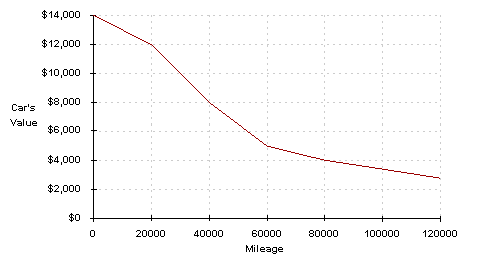
This line graph shows the average value of a pickup truck versus the mileage on the truck. When the truck is new, it costs $14000. The more the truck is driven, the more its value falls according to the curve above. Its value falls $2000 the first 20000 miles it is driven. When the mileage is 80000, the truck’s value is about $4000.

Pie Charts

A pie chart is a circle graph divided into pieces, each displaying the size of some related piece of information. Pie charts are used to display the sizes of parts that make up some whole.

Example 1:

The pie chart below shows the ingredients used to make a sausage and mushroom pizza. The fraction of each ingredient by weight is shown in the pie chart below. We see that half of the pizza’s weight comes from the crust. The mushrooms make up the smallest amount of the pizza by weight, since the slice corresponding to the mushrooms is smallest. Note that the sum of the decimal sizes of each slice is equal to 1 (the “whole” pizza”).

Example 2:

The pie chart below shows the ingredients used to make a sausage and mushroom pizza weighing 1.6 kg. This is the same chart as above, except that the labels no longer tell the fraction of the pizza made up by that ingredient, but the actual weight in kg of the ingredient used. The sum of the numbers shown now equals 1.6 kg, the weight of the pizza. The size of each slice is still the same, and shows us the fraction of the pizza made up from that ingredient. To get the fraction of the pizza made up by any ingredient, divide the weight of the ingredient by the weight of the pizza. What fraction of the pizza does the sausage make up? We divide 0.12 kg by 1.6 kg, to get 0.075. This is the same value as in the pie chart in the previous example.

Example 3:

The pie chart below shows the ingredients used to make a sausage and mushroom pizza. The fraction of each ingredient by weight shown in the pie chart below is now given as a percent. Again, we see that half of the pizza’s weight, 50%, comes from the crust. Note that the sum of the percent sizes of each slice is equal to 100%. Graphically, the same information is given, but the data labels are different. Always be aware of how any chart or graph is labeled.

Example 4:

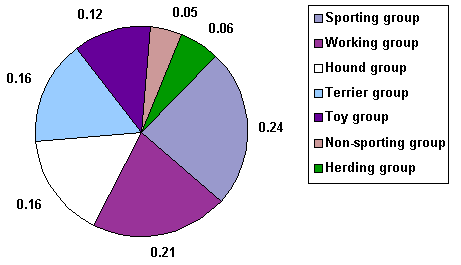
The pie chart below shows the fractions of dogs in a dog competition in seven different groups of dog breeds. We can see from the chart that 4 times as many dogs competed in the sporting group as in the herding group. We can also see that the two most popular groups of dogs accounted for almost half of the dogs in the competition. Suppose 1000 dogs entered the competition in all. We could figure the number of dogs in any group by multiplying the fraction of dogs in any group by 1000. In the toy group, for example, there were 0.12 × 1000 = 120 dogs in the competition.

Bar Graphs

Bar graphs consist of an axis and a series of labeled horizontal or vertical bars that show different values for each bar. The numbers along a side of the bar graph are called the scale.

Example 1:

The bar chart below shows the weight in kilograms of some fruit sold one day by a local market. We can see that 52 kg of apples were sold, 40 kg of oranges were sold, and 8 kg of star fruit were sold.

Example 2:

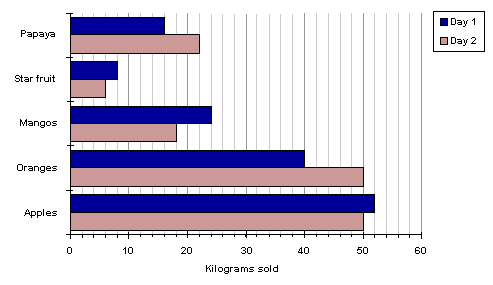
A double bar graph is similar to a regular bar graph, but gives 2 pieces of information for each item on the vertical axis, rather than just 1. The bar chart below shows the weight in kilograms of some fruit sold on two different days by a local market. This lets us compare the sales of each fruit over a 2 day period, not just the sales of one fruit compared to another. We can see that the sales of star fruit and apples stayed most nearly the same. The sales of oranges increased from day 1 to day 2 by 10 kilograms. The same amount of apples and oranges was sold on the second day.

Mean

The mean of a list of numbers is also called the average. It is found by adding all the numbers in the list and dividing by the number of numbers in the list.

Example:

Find the mean of 3, 6, 11, and 8.

We add all the numbers, and divide by the number of numbers in the list, which is 4.

(3 + 6 + 11 + 8) ÷ 4 = 7

So the mean of these four numbers is 7.

Example:

Find the mean of 11, 11, 4, 10, 11, 7, and 8 to the nearest hundredth.

(11 + 11 + 4 + 10 + 11 + 7 + 8) ÷ 7 = 8.857…

which to the nearest hundredth rounds to 8.86.

Median

The median of a list of numbers is found by ordering them from least to greatest. If the list has an odd number of numbers, the middle number in this ordering is the median. If there is an even number of numbers, the median is the sum of the two middle numbers, divided by 2. Note that there are always as many numbers greater than or equal to the median in the list as there are less than or equal to the median in the list.

Example:

The students in Bjorn’s class have the following ages: 4, 29, 4, 3, 4, 11, 16, 14, 17, 3. Find the median of their ages. Placed in order, the ages are 3, 3, 4, 4, 4, 11, 14, 16, 17, 29. The number of ages is 10, so the middle numbers are 4 and 11, which are the 5th and 6th entries on the ordered list. The median is the average of these two numbers:

(4 + 11)/2 = 15/2 = 7.5

Example:

The tallest 7 trees in a park have heights in meters of 41, 60, 47, 42, 44, 42, and 47. Find the median of their heights. Placed in order, the heights are 41, 42, 42, 44, 47, 47, 60. The number of heights is 7, so the middle number is the 4th number. We see that the median is 44.

Mode

The mode in a list of numbers is the number that occurs most often, if there is one.

Example:

The students in Bjorn’s class have the following ages: 5, 9, 1, 3, 4, 6, 6, 6, 7, 3. Find the mode of their ages. The most common number to appear on the list is 6, which appears three times. No other number appears that many times. The mode of their ages is 6.


Visit the Math League

© 1997-2001 by Math League Multimedia
This page may not be mirrored or reproduced on any other internet site.
Last updated March 2001 by Mark Motyka.

Description

Description: The purpose of this experiment is to determine the types of pigments found in various vegetation. The students will gather plants, soak them in acetone and use coffee filter strips to separate the pigments. Then the students will determine the pigments found in each type of leaf. The pigments found in spinach leaves, lettuce leaves and marigold leaves are all different. Paper Chromatography is a technique that enables us to separate plant pigments. The pigments found in plants vary and the process of chromatography is important in the detection of the types of pigments found in each.

Needed Materials: Acetone fingernail polish remover, test tubes or other empty containers (enough for 5 containers per group), felt tip markers, coffee filters, pigment guide, masking tape, scissors, spinach leaves, mum leaves, iceberg lettuce and leaves of various plants found in your schoolyard.

Safety Rule: Avoid inhaling the vapors from the acetone and spilling it on your clothing.

Procedure:

Student Information: The following information will provide you with the steps for conducting your plant chromatography experiment. It is important to hold all of the variables constant except for those that are being manipulated. Constant (or controlled variables) would be such things as: the length of the filter paper strip, the amount of time the paper is left in the solution, the amount of acetone in the container, the size of the container being used, etc. Manipulated (or independent) variables would be those things that we change to see if the response will be different, such as: type of plant being studied. The responding (or dependent) variable for this experiment will be the different pigments found in each of the different types of vegetation.

The reporting form for this experiment is set up so that you can determine how many different kinds of vegetation you would like to use, the kind of container you would like to use and how long your strips of filter paper will be. Also remember that a good scientific experiment is repeated a minimum of three times. Therefore, your data will be more accurate if you conduct several experiments that are exactly the same and then compile an average of your data before submitting it.

Procedural Steps for Conducting the Investigation

  • 1. Collect two different plants from your schoolyard. You are going to test these two plants along with the spinage, mum leaves, and iceburg lettuce.
  • 2. Label each container with the kind of plant you are testing.
  • 3. Place a different leaf in the bottom of each test tube and crush it.
  • 4. Pour about 2 cm. of acetone (fingernail polish remover) into each of your test tubes.
  • 5. Let this sit twenty-four hours.
  • 6. Cut five strips out of the middle of a coffee filter.
  • 7. Place the end of one coffee filter strip in each of the test tubes. The solvent will travel up the paper, and as it does, it will dissolve and deposit the separate pigments.
  • 8. After twenty-four hours, check your results.
  • 9. Remove the strips of paper from the test tubes and lay them on dry paper towels that are labeled with the type of plant extract found on that strip.
  • 10. Use a magnifying glass and a pigmentation guide to determine the types of pigments in each extract.

Discussion Questions

  • What were your conclusions for this experiment?
  • What could you infer based on your conclusions?
  • How would you design this experiment differently the next time?
  • What types of pigments were found in each type of plant?
  • Did the color of the leaf affect the pigments found it them?
  • If the answer to the above question is “yes”, which leaves had the most variation in the kinds of pigments found in them?
  • Did certain leaves have the exact same pigments?
  • If the answer to the above question was “yes”, were the leaves similar in other ways?
  • Do you think the amount of sunlight a plant receives affects the pigments found in the plants? How could you test your predictions experimentally?
    • Would you expect to find the same results year round? How could you test your predictions experimentally?