Crayfish Dissection


Crayfish Dissection
Objectives:
• Describe the appearance of various organs found in a crayfish.
• Name the organs that make up systems of the crayfish.


Materials:
• safety goggles, gloves, magnifying glass, a lab apron, plastic zip lock bag preserved crayfish,  pen, dissecting tray, paper towels, scissors, forceps, dissecting needle, and dissecting pins.


Purpose:
In this lab, you will observe the external structures of a crayfish and dissect it to study its internal structures and systems.


Background:
Like all crustaceans, a crayfish has a fairly hard exoskeleton that covers its body. As shown in the diagram on the next page, its body is divided into two main parts, the cephalothorax and the abdomen. The cephalothorax consists of the cephalic (or head) region and the thoracic region. The part of the exoskeleton that covers the cephalothorax is called the carapace. The abdomen is located behind the cephalothorax and consists of six clearly divided segments. The cephalothorax consists of 13 segments. Each segment of both the cephalothorax and the abdomen contains a pair of appendages. The head (or cephalic) region has five pairs of appendages. The antennules are organs of balance, touch, and taste. Long antennae are organs for touch, taste, and smell. The mandibles, or jaws, crush food by moving from side to side. Two pairs of maxillae hold solid food, tear it, and pass it to the mouth. The second pair of maxillae also helps to draw water over the gills. Of the eight pairs of appendages on the cephalothorax, the first three are maxillipeds, which hold food during eating. The chelipeds are the large claws that the crayfish uses for defense and to capture prey. Each of the four remaining segments contains a pair of walking legs. In the abdomen, the first five segments each have a pair of swimmerets, which create water currents and function in reproduction. The sixth segment contains a modified pair of uropods. In the middle of the uropods is a structure called the telson, which bears the anus. The uropod and telson together make up the tail fan. The crayfish moves backward by forcing water forward with its  tail fan.

Procedure Part 1—External Anatomy of a Crayfish

1. Put on safety goggles, gloves, and a lab apron.


2. Place a crayfish on its side in a dissection tray. Use the diagram below to locate the cephalothorax and the abdomen. The carapace, a shield of chitin, covers the dorsal surface of the cephalothorax. On the carapace, observe an indentation, the cervical groove, that extends across the midregion and separates the head and thoracic regions. On the thoracic region, locate the prominent suture or indentation on the cephalothorax that defines a central area separate from the sides. Note the individual segments of the abdomen.


What is the main difference between the cephalothorax and abdomen?

___________________________________________________________

3. Turn the crayfish with its DORSAL side upward, and locate the rostrum, which is the pointed extension of the carapace at the head of the animal shown in the diagram above. Beneath the rostrum locate the two eyes. Notice that each eye is at the end of a stalk.

4. Locate the five pairs of appendages on the head region. First locate the antennules in the most anterior segment. Behind them observe the much longer pair of antennae.

Why is it useful to view the specimen on its Dorsal side for this part of your study?
______________________________________________________________

5. Locate the mouth. Then observe the mandibles, or true jaws, behind the antennae. Now locate the two pairs of maxillae, which are the last appendages in the cephalic region.

Which appendages in the cephalic region are related to the eating of food?
_____________________________________________________________


6. On the thoracic portion of the cephalothorax, observe the three pointed maxillipeds.

How are the maxillipeds related to eating?
______________________________________________________________


7. Next observe the largest prominent pair of appendages, the chelipeds, or claws. Behind the chelipeds locate the four pairs of walking legs, one pair on each segment.


8. Now use the walking legs to determine the sex of your specimen. Locate the base  segment of each pair of walking legs. The base segment is where the leg attaches to the body. Use a magnifying glass to study the inside surface of the base segment of the third pair of walking legs. If you observe a crescent-shaped slit, you have located a genital pore of a female. In a male, the sperm duct openings are on the base segment of the fourth pair of walking legs. Use a magnifying glass to observe the opening of a  genital pore.


Is your specimen a male or a female?
_____________________________________________________________

Exchange your specimen with a nearby classmate who has a crayfish of the opposite sex. Then study its genital pores.


9. On the abdomen, observe the six distinct segments. On each of the first five segments, observe a pair of swimmerets.

10. On the last abdominal segment, observe a pair of pointed appendages modified into a pair of uropods. In the middle of the uropods, locate the triangular-shaped telson.


11. Now turn the crayfish ventral side up. Observe the location of each pair of appendages from the ventral side.

From which view, dorsal or ventral, can you see the location of the appendages on the segments more clearly?
______________________________________________________________

12. Remove all jointed appendages of the crayfish and attach them to the table on the crayfish worksheet.

If dissection is two day, complete steps 13 and 14 only!


13. Next you will study the internal anatomy of a crayfish. If you must store your specimen until the next lab period, cover it with a dampened paper towel. Then place the specimen on the tray in a plastic bag. Close the bag with a twist tie. Write your name on the bag with a felt-tip marking pen, and give your specimen to your teacher.


14. Clean up your work area and wash your hands before leaving the lab.


Part 2—Internal Anatomy of a Crayfish

15. Put on a lab apron, gloves, and safety goggles.


16. Using one hand to hold the crayfish dorsal side up in the dissecting tray, use scissors to carefully cut through the back of the carapace along dissection cut line 1,  as shown in the diagram below. Cut along the indentations that separate the thoracic portion of the carapace into three regions. Start the cut at the posterior edges of the carapace, and extend it along both sides in the cephalic region.


17. Use forceps to carefully lift away the carapace. Be careful not to pull the carapace away too quickly. Such action would disturb or tear the underlying structures.

18. Place the specimen on its side, with the head facing left, as shown in the diagram below. Using scissors, start cutting at the base of cut line 1. Cut along the side of the crayfish, as illustrated by cut line 2. Extend the cut line forward toward the rostrum (at the top of the head).


19. Use forceps to carefully lift away the remaining parts of the carapace, exposing the underlying gills and other organs.


20. Use the diagram below to locate and identify the organs of the digestive system. Locate the maxillae that pass the pieces of food into the mouth. The food travels down the short esophagus into the stomach. Locate the digestive gland, which produces digestive substances and from which the absorption of nutrients occurs. Undigested material passes into the intestine. Observe that the intestine is attached to the lobed stomach. The undigested material is eliminated from the anus.

Rows of chitinous teeth line the stomach. Predict their function.
_____________________________________________________________


21. Use the diagram below to locate and identify the organs of the respiratory system. Locate the gills, which are featherlike structures found underneath the carapace and attached to the chelipeds and walking legs. A constant flow of blood to the gills releases carbon dioxide and picks up oxygen.

The feathery nature of the gills gives them a very large surface area. Why is this important?
____________________________________________________________


22. Use the diagram of the internal anatomy of the crayfish to locate and identify the organs of the circulatory system. Locate the dorsal tubular heart and several arteries. The crayfish has an open circulatory system in which the blood flows from arteries into sinuses, or spaces, in tissues. The blood flows over the gills before returning to the heart.


23. Use the same diagram to locate and identify the organs of the nervous system. Find the ventral nerve cord. Locate a ganglion, one of the enlargements of the ventral nerve cord. Locate the dorsal brain, which is located just behind the compound eyes. Note the two large nerves that lead from the brain, around the esophagus, and join the ventral nerve cord.

Many nerves leave from each ganglion. Where do you think these nerves go?
__________________________________________________________


24. Use the same diagram to locate and identify the organs of the excretory system. The blood carries cellular wastes to the disk-like green glands. Locate these organs just in front of the stomach. The green glands excrete waste through pores at the base of each antenna.

What organs in your body carry out the same function as the green glands?

      ____________________________________________________________


25. Use the diagram once again to locate and identify the organs of the reproductive system. The animal shown in the diagram is a male crayfish. If your specimen is a male, locate the testis. The testis is the long, white organ under the heart and a bit forward. The sperm ducts that carry sperm from the testis open at the fifth walking leg. If your specimen is a female, locate the bi-lobed ovary. It is in the same relative position as the testis, but the ovary appears as a large, reddish mass under the heart. Then locate the short oviducts that extend from near the center of each side of the ovary and open at the third walking leg. Exchange your specimen with a nearby classmate who has a crayfish of the opposite sex. Then study its reproductive system.

25. Dispose of your materials according to the directions from your teacher.


26. Clean up your work area and wash your hands before leaving lab.

Crayfish Worksheet Crayfish Appendage Table

BACK

Chromosomes & Inheritance Worksheet Bi


Chromosomes & Inheritance

Section 12-1 Sex Determination

1. Geneticist Thomas Hunt Morgan conducted breeding experiments with what animal?

2. How many pairs of chromosomes are found in Drosophila.

3. Are the chromosomes in male & female fruit flies the same? Explain.

4. What did Morgan name the 2 chromosomes in the non-identical pair?

5. Describe the shape of the 2 chromosomes in the non-identical pair.

6. Morgan hypothesized that the non-identical pair were the _____________ chromosomes.

7. All other chromosomes except X and Y are called ______________________________.

8. What is the genotype for males? Females?

9. When male & female fruit flies are crossed, what percent of the offspring will be male? Female?

10. Because the X chromosome was much bigger than the Y chromosome, what did Morgan hypothesize?

11. Genes on the X chromosome are ____________________________ genes.

12. What is meant by sex linkage?

13. Did Morgan’s experiments prove or disprove the existence of sex-linked traits?

14. Name a trait that Morgan discovered was carried on the X chromosome in fruit flies.

15. Use a Punnett Square to show the results of crossing a red-eyed female (XRXR) with a white-eyed male XrY.

16. Use a Punnett Square to show the results of crossing a red-eyed female (XRXr) with a red-eyed male XRY.

17. What are linkage groups?

18. What 2 fruit fly traits did Morgan discover were linked?

19. What is the effect of crossing-over on genes?

20. Do genes that are close together or far apart get crossed over more often?

21. What is a chromosome map?

22. What scientist made a chromosome map of Drosophila?

23. How is one amp unit determined?

24. What is germ cell mutation & what is its effect?

25. What are somatic mutations, give an example, & can they be passed on to offspring?

26. What are lethal mutations?

27. What are chromosome mutations?

28. Name & describe 4 types of chromosome mutations.

29. What are gene mutations?

30. What are point mutations?

31. What are substitutions & give an example of a disease caused by this type of gene change?

32. What are frame shift mutations?

Section 12-2 Human Genetics

33. What is a pedigree?

34. Write the symbol that would appear on a pedigree for each of the following:

a. Male carrier?

b. Male with trait?

c. Female carrier?

d. Female with trait?

35. Name several single allele traits (both dominant & recessive).

36. Name 3 sex-linked traits.

37. What are polygenic traits and name four.

38. What influences the expression of a sex-influenced trait?

39. Name & describe 2 types of nondisjunction.

40. What causes Down syndrome?

41. When would genetic screening be useful?

42. What is amniocentesis?

43. What disease is genetically screened fro immediately after birth in the U.S.?

Crayfish Worksheet

Name(s)__________________________________ Group______ Date ________ Period_____

Crayfish Dissection Worksheet

1. What structures are used for capturing prey and securing and eating food?


2. How are the antennae, chelipeds, other walking legs, and swimmerets related?


3. What are the main structures you could have observed when you removed the exoskeleton of the abdomen and tell the function of each?


4. Is the crayfish most vulnerable to its enemies from the dorsal or ventral side? Why?


5. The crayfish usually molts, or sheds its exoskeleton, twice a year. Why does the crayfish “hide” after it molts?


6. Name the appendages found on the head of a crayfish & tell the function of each.


.


7. Of the systems studied, which two are most unlike the related human system? Why?


8. Although the crayfish has an inflexible cephalothorax, the crayfish is classified as a segmented animal. Why?


9. Name the appendages found on the thorax of the crayfish and tell the function of each.


10. Name the appendages on the abdomen of the thorax and tell the function of each.


11. Label the drawing of the crayfish.

BACK


Clam Dissection Questions


  Clam Dissection Questions


Pre-lab:
1. Give the kingdom, phylum, and class for the clam.


2. Describe the body of bivalves.

3. How do bivalves move?

4. Why are they called bivalves?

5. Is their digestive tract complete or incomplete?  Explain your answer.


6. Do bivalves show cephalization?  Explain your answer.


7. What are siphons & what is their purpose?


8. How can you distinguish a mussel from a clam?


9. Adults are usually sessile, but the larva or _________________ is free-swimming.

10. Are bivalves protostomes or deuterostomes?

11. Their body cavity is called the _____________ cavity.

12. Body organs make up the ___________ mass and are protected by the _____________ which secretes the ___________.

13. Is circulation open or closed?

14. Give several examples of bivalves.

Lab Questions:
1. What is the oldest part of a clam’s shell called and how can it be located?


2. What do the rings on the clam’s shell indicate?

3. Name the clam’s siphons.

4. What holds the two shells together?

5. What muscles open & close the clam?

6. Describe the inside lining of the shell.

7. What is the function of the tooth-like projections at the dorsal edge of the clam’s valves?

8. Where is the mantle located in the clam?  What is its function?


9. Describe the clam’s foot.


10. What is the mantle cavity?


11. How do clams breathe?

12. What helps direct water over the gills?

13. Where are the palps found and what is their function?


14. Describe the movement of food from the current siphon through the digestive system of the clam.


15. Where is the clam’s heart located?


16. What are the parts of the clam’s nervous system?


17. Why are clam’s referred to as “filter feeders”?


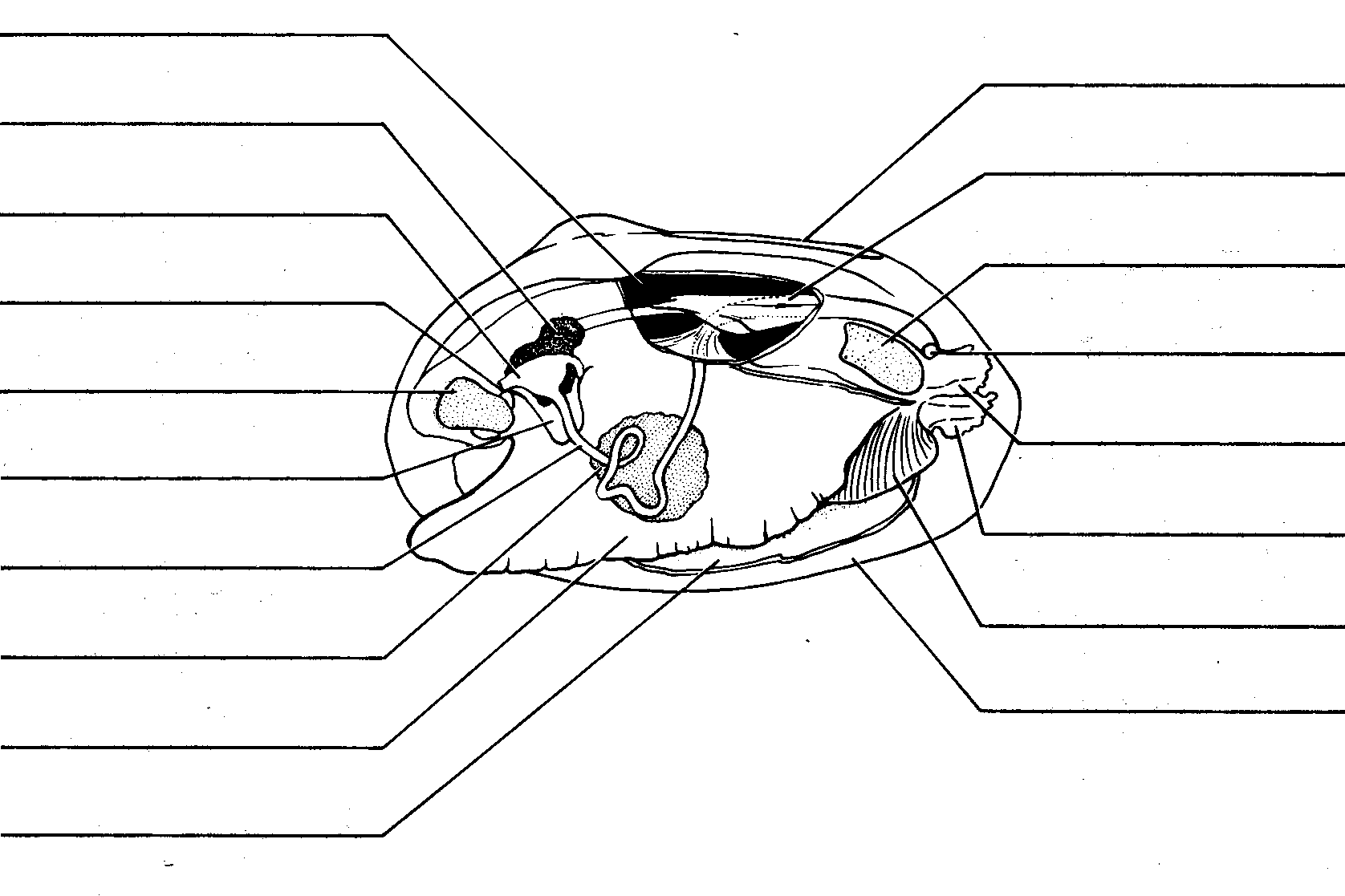
18. Label the internal structures of the clam and draw arrows showing the pathway of food as it travels to the clam’s stomach:

BACK


Crime Scene Investigation

Crime Scene Investigation


Scenario: 

The Case of the Illegal Dumpsite

John Smith had worked for the same company in the shipping and receiving department for 15 years.  John was proud of his attendance record, and even though he wasn’t always giving his job 100%, he believed he was doing a good job.  Everyone goofs off at work part of the time, don’t they?

One morning when John arrived at work, he stopped at the bulletin board where new job listings were posted.  One of the postings was for a supervisor position in a department in which he had always wanted to work.  The pay was a nice increase too, and with the extra money, he could have his truck with the new tires and rims customized.  That night John filled out the necessary papers for the job and hurriedly turned them in the next day.

Weeks later, he and all the other employees that had applied, were called in for an interview.  John just knew that he would land the job.  However, when the person to fill the position was announced a few weeks later, another employee that had worked less time than John got the job.  John was furious at being overlooked!  That night when John clocked out and was getting into his car in the parking lot, he said, “I’ll get even with them for this.”

Tony Harris loved the outdoors and he loved photography, so many years ago when he relocated his family to a wetland area near a major river, he put his two “loves” together and started doing outdoor photography.  Some of Tony’s photographs had even been published in several naturalist journals.  Tony was very familiar with the wetland area and the wildlife because he spent most of his free time photographing there.

Tony had set out very early on a cool, crisp morning to spend the weekend camping and taking pictures at his favorite wetland area.  Tony was excited about his trip and the great pictures he expected to get so when he came across the cove with its terrible stench, Tony was unprepared for what he found.  In a tree-surrounded cove of the river, Tony found several dead waterfowl and turtles that had washed ashore.  When he examined them, there weren’t any markings to show injuries, and the animals appeared to have been healthy when they died.  Tony took several pictures of the area and the dead animals and decided to call the Game and Fish Commission when he returned home.

A new hunting season had opened and with it came lots of calls about poaching problems and hunting accidents.  Chelsea Brown had worked for the Game and Fish for several years since her graduation from college.  She had been raised to love animals and the environment so this job was great for her.  Today she was spending time in the office to catch up on some reports and to answer the hotline.  She was in a very relaxed mood when the phone hotline rang, and she took a call from a Mr. Tony Harris.  She remembered Mr. Harris from an awards banquet when the Game and Fish Commission gave Tony an award for some of his outstanding waterfowl photographs that they had published in their G & F magazine.

Tony reported the incident with the dead waterfowl and turtles he had witnessed in the cove and said he would send the photographs of the area and the dead animals to the Game and Fish.  Chelsea thanked Mr. Harris and told him she would make a report.  The call didn’t seem to be too serious to Chelsea at the time.  However, when Chelsea went to the G & F logbook to register the incident, she found numerous other reports called in from other hunters and campers stating that they had noticed a lot of unexplained deaths in the waterfowl and turtle populations in this area of the wetlands.  This couldn’t be ignored.  Chelsea said, “Guess we better get some people out there to check on this.”

When the Game and Fish officers traveled to the wetlands, they found more than just dead wildlife.  The scene they discovered might be the cause of the reported deaths of wildlife in this aquatic habitat.  Near the area of several of the reported hotline sightings, the officers found a large amount of industrial waste that had been dumped.  The waste included large piles of discarded plastics, metals, and wood.  A first inspection of the wastes didn’t give the officers a clue where the trash came from or who had left it there.  However, there were several deep tire tracks and shoe prints from a man’s athletic shoe in places where the ground had been extremely wet at one time.  Like many areas of the wetlands with clay-based soils, when the water had receded from this area, the tracks and the ground dried hard like cement.

There was a possibility that the waste could have a negative effect on the environment and the animals in the area.  The EPA, Environmental Protection Agency, would have to be called to help identify the unknown plastics, metals, etc. and to determine if they were or were not hazardous.  The officers closed off the area and the investigation began!

STUDENT ROLE

As a student, you will be a scientist on the team that the EPA sent to the wetland area to study the dump site and its effect.  You will work along with the people from the Game and Fish to solve three problems —

1.      What type of plastics and metal are dumped at the site?

2.    Could any of the plastics or metals cause death like the waterfowl and turtles?

3.    Who is responsible for the illegal dumping and subsequent clean-up and damages?

EXTENSION:

Devise a plan for a safe method of disposal for the trash found at the dump site? and an estimated cost for removal and damages.

Evidence:

Plastics, metals, tire tracks, shoe prints

Teacher Preparation:


ACTIVITY # 1 – Identifying Plastics

Handout – Industrial Park

References:

Plastic Recycling Codes

Plastic Identification Tests

Plastics Tests

Types of Plastics PowerPoint

Toxic Plastics — Fact or Myth?  PowerPoint

ACTIVITY # 2 – Identifying Metals

References:

Metals Color test

Metal Identification

Metal Properties 

ACTIVITY # 3 – Shoe Print & Tire Tread Patterns

Shoe Size versus Height Chart 

Sneaker Patterns 

Tire Treads

If the Shoe Fits  PowerPoint

Handout – Shoe Imprint from Dumpsite

Handout – Tire Tread Pattern from Dumpsite

Lab Investigations:

ACTIVITY #1 – Plastics Identification

ACTIVITY #2 – Metals Identification

ACTIVITY #3 – Shoe Pattern & Tire Track Identification


All Materials © Cmassengale