
 |
Biology Chapter Worksheets |
All Materials © Cmassengale
 |
|
Biology Chapter Worksheets |
All Materials © Cmassengale
| |
 |
Build-a-Bug | |
Introduction:
Most adult insects have the following characteristics:
There are approximately 30 orders of insects. Choose one of the insects from these orders.
Click on the link to learn more about the characteristics of that order. There are links to specific insects on each page. Visit the Field Guide Index to see a listing of all insects featured in the Field Guide.
Objective:
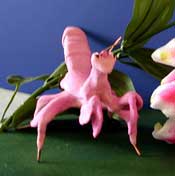
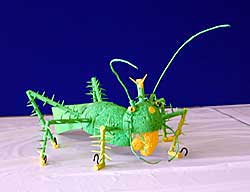
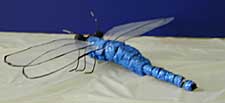
Students will build biologically correct insects in order to learn insect structure and adaptations.
Materials:
Any non-food item such as cardboard, egg cartons, clay, wire, felt, Styrofoam, pipe cleaners, nylon stockings, pipe cleaners, paint, glue, string, etc.
Guidelines:
Examples of Models:
 |
 |
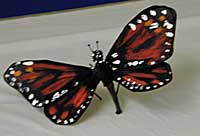 |
| Spiny Katydid | Monarch | |
 |
 |
 |
| Dragonfly | Damselfly | Luna Moth |
 |
 |
 |
| Walking Stick | Grasshopper | Yellow jacket |
 |
 |
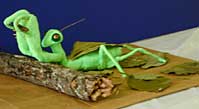 |
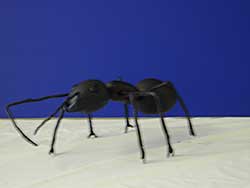
| Atlas Moth | Carpenter ant | Praying Mantid |
| Bullfrog Skeleton Reconstruction |
Introduction:
The skeleton of the frog consists chiefly of bony and cartilaginous elements. The functions of a skeleton include providing support for the body, protection of delicate internal organs and attachment surfaces for muscles. In vertebrates, the axial skeleton consists of the skull, vertebral column, sternum (breast bone) and ribs (which are not present in amphibians). The vertebral column of frogs is made up of 10 vertebrae, the first of which (called the atlas) articulates with the base of the skull. The atlas is the only cervical vertebra in the frog. The next seven vertebrae are abdominal vertebrae, which is the large sacrum with two strong transverse processes that join with the ileum. The last vertebra is the long and highly modified urostyle. Note: Most vertebrates have a tail supported by caudal vertebrate, but frogs and toads are atypical in that they lack any tail and are therefore called anurans (“tail less amphibians”).
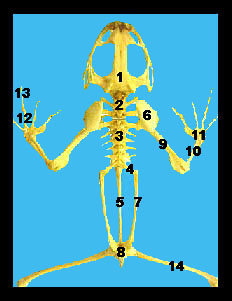 |
1. Skull
|
The appendicular skeleton includes the limbs and the pectoral and pelvic girdles that support them. In most vertebrates the forelimbs consist of three major bones — the humerus, radius and ulna, along with the smaller bones of the hand (carpals, metacarpals and phalanges). Note that in the frog the radius and ulna have become fused into a single bone, the radio-ulna. Likewise, the hindlimbs consist of three major bones — the femur, tibia and fibula, along with the smaller bones that make up the feet (tarsals, metatarsals and phalanges). Once again, in frogs and toads the tibia and fibula have become fused into a single bone, the tibio-fibula. The pectoral girdle consists of four pairs of bones (the suprascapula, scapula, coracoid, and clavicle). The last three pairs are connected to the sternum. In frogs, the pelvic girdle, which supports the hindlimbs, is formed by the fusion of the ilium, ischium and non-ossified pubis. Each femur fits into a socket on the pelvic girdle called an acetabulum. Note that the pelvic girdle and limb structure are well adapted for giving a powerful, synchronous thrust of both hind limbs in swimming and jumping
Objective:
By reassembling an amphibian skeleton, students will learn the bones and modifications of a vertebrate.
Materials:
Dermestid beetles, small aquarium with air-vented lid, dermestid bedding, food, & water supply, freeze-dried bullfrogs, tweezers, small container with lid for bones, 20% H2O2, thin piece of wood, paints, and glue.
Procedure:
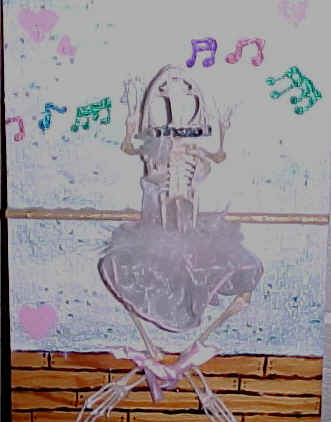
Examples:
 |
 |
 |
Biology By the Month

| Monday | Tuesday | Wednesday | Thursday | Friday |
| 1
|
2
|
3
|
4
|
|
| 7
|
8
|
9
|
10
|
11
|
| 14
|
15
|
16
|
17
|
18
|
| 21
|
22
|
23
|
24
|
25
|
| 28
|
29
|
30
|
31
|

| Monday | Tuesday | Wednesday | Thursday | Friday |
| 1 | ||||
| 4 | 5 | 6 | 7 | 8 |
| 11 | 12 | 13 | 14 | 15 |
| 18 | 18 | 20 | 21 | 22 |
| 25 | 26 | 27 | 28 | 29 |

| Monday | Tuesday | Wednesday | Thursday | Friday |

| Monday | Tuesday | Wednesday | Thursday | Friday |

| Monday | Tuesday | Wednesday | Thursday | Friday |

| Monday | Tuesday | Wednesday | Thursday | Friday |

| Monday | Tuesday | Wednesday | Thursday | Friday |

| Monday | Tuesday | Wednesday | Thursday | Friday |

| Monday | Tuesday | Wednesday | Thursday | Friday |

| Monday | Tuesday | Wednesday | Thursday | Friday |

| Monday | Tuesday | Wednesday | Thursday | Friday |


