Bar Graph Problems

Sample Problems on Bar Graphs

Problem 1:

The following table illustrates the average employee salary at Smith, Inc. for each of the last fifteen years. Mrs. Smith, the general manager of Smith, Inc., has been asked to submit to the local newspaper a bar graph illustrating the average employee salary in her company for each of the last 15 years.


Year Salary
1983 32,500
1984 33,250
1985 33,350
1986 37,400
1987 32,000
1988 35,800
1989 37,800
1990 34,480
1991 40,000
1992 39,500
1993 36,100
1994 35,400
1995 37,500
1996 38,000
1997 36,900


Problem 2:

Your basketball team, the Ricebirds, has been asked to create a bar graph illustrating your team’s scores for each of its last ten games. The following table illustrates these scores.


Game Score
1 67
2 72
3 71
4 68
5 70
6 65
7 75
8 78
9 77
10 80


Problem 3:

Quality Motor Company is claiming that their cars have increased in quality more significantly than the cars of their competitors. They want to use bar graphs showing the average longevity of cars from each company, as well as their own, for each of the last 12 years. Given the following data for the company, create this bar graph.


Year Avg. # Years Until
Repairs are Needed
1986 2.6
1987 2.3
1988 2.5
1989 2.5
1990 2.8
1991 1.9
1992 3.0
1993 3.1
1994 2.8
1995 3.2
1996 3.6
1997 3.5


Problem 4:

You are the manager of the local mall, and you want to express to the public the safety of your mall. Use the following data that has been collected during the past year to make a bar graph.


Month # Crimes
Reported
Jan. 2
Feb. 1
Mar. 1
Apr. 3
May 4
June 5
July 5
Aug. 4
Sept. 1
Oct. 2
Nov. 1
Dec. 3


Bi Sample Metric Measure


Metric Measurement Lab   

Introduction:

            Every scientific experiment in some way involves measurement.  Scientists worldwide use the metric system to display the results of measurements.  This system simplifies calculations based on a decimal system (powers of ten), opposed to the confusing English system of measurement.  Less confusion and better communication between scientists around the world makes the metric system more efficient than the English system for use in experiments.  The useful prefixes of the metric system are also known as the International System of Units (SI).

            Two measurements explored in this lab are mass and volume.  Mass is represented by grams, while volume is represented by milliliters (liquid) and cubic centimeters (solids with ruler measurement).  The purpose of this investigation is to get acquainted with and be accurate with the metric system.

Hypothesis:

By using a graduated cylinder, mass balance, and metric ruler, mass and volume can be found.  

Materials:

The materials used in this experiment include a graduated cylinder, an eyedropper, and a beaker of water for Part A; 20 ml of water, a graduated cylinder, and three marbles for Part B; a metric ruler, mass balance, three marbles, and a graduated cylinder for Part C; a metric ruler for Part D; and a graduated cylinder, eyedropper, six labeled test tubes, and three 25ml beakers of colored water (one with red, one with blue, and one with yellow) for Part E.  

Methods:

Part A:  Count you drops!

Fill a small graduated cylinder with 10 ml of water.  Count and record the number of drops it takes to raise the water to 11ml.  Leave the water in the graduated cylinder and count and record the number of drops it takes to raise the water to 12ml.  Leave the water in the graduated cylinder and count and record the number of drops it takes to raise the water to 13ml.  Calculate the average number of drops and round to the nearest tenth.

Part B:  Water Displacement

Add 20ml of water to a 100ml graduated cylinder.  Record this amount in the chart.  Add three marbles to the cylinder and measure and record the volume.  Find the difference between the two measurements and record it in the chart.  The difference between the two measurements will be the volume of the three marbles.

Part C:  Mass Mania

Check to see that the Pinter on the balance is pointing to zero.  If it is not, check to see that all the Riders (weights) are all the way to the left at the Zero mark.  Adjust the balance by turning the Adjustment Screw slowly until it points at zero.  Place the metric ruler on the pan and read and record the ruler’s mass.  After resetting the balance to zero, measure and record the mass of the empty 50ml graduated cylinder and then the three marbles.  Reset the balance to zero when all items have been massed. 

Part D:  Volume by Formula

Use the formula Volume=length x width x height to find the volume of the box.  Measure to the nearest centimeter before calculating the answer.  If necessary, round the answer to two decimal places.

Part E:  Color Challenge

Obtain the following items from the teacher:  3 beakers with colored water-25ml of each color (red, blue, and yellow), 1 graduated cylinder (25ml to 50ml), 1 eyedropper, and 6 test tubes labeled A, B, C, D, E, and F.  Perform each of the following steps using accurate measurements.  Measure 17ml of red water from the beaker and po9ur it into test tube A.  Measure 21ml of yellow water from the beaker and pour it into test tube C.  Measure 22ml of blue water from the beaker and pour it into test tube E.  Measure 5ml of water from test tube A and pour it into test tube B.  Measure 6ml of water from test tube C and pour it into test tube D.  Measure 8ml of water from test tube E and pour it into test tube F.  Measure 5ml of water from test tube C and pour it into test tube B.  Measure 2ml of water from test tube A and pour it into test tube F.  Measure 4ml of water from test tube E and pour it into test tube D.  Record the results in the chart.

Results:

Part A:  Count your drops!

# of drops to 11ml # of drops to 12ml # of drops to 13ml Average
24 26 25 25
  1. Take a guess—how many drops of water will it take to equal 1 milliliter?  18 drops.
  2. Based on your average, how close were you to your guess?  7 drops off of average.
  3. Based on your average, how many drops would it take to make 1 liter?  25,000 drops.

Part B:  Water Displacement


Volume of Water Before Adding Marbles (ml) Volume of Water After Adding Marbles (ml) Difference in Volume (ml) Volume of 3 marbles (ml)
20ml 25ml 5ml 5ml


Part C:  Mass Mania


Mass of Metric Ruler (g) Mass of Empty 50ml graduated cylinder (g) Mass of 3 Marbles (g)
3.0g 31.5g 11.0g


Part D:  Volume by Formula

Volume= length x width x height

7.0 cm x 1.0 cm x 3.0 cm = 21.0 cubic centimeters

Part E:  Color Challenge


Test Tube Color Final Volume (ml)
A Red 10ml
B Orange 10ml
C Yellow 10ml
D Green 10ml
E Blue 10ml
F Purple 10ml


Discussion and Conclusion:

By using a graduated cylinder, mass balance, and metric ruler, mass and volume can be found.  The purpose of Part A was to be accurate with reading graduated cylinders and how many drops of water make one milliliter.  This was accomplished by using an eyedropper to count the drops and reading the bottom of the meniscus to see when to stop dropping.  The average was found by adding the number of drops it took to reach the next milliliter (three times repeated) together and dividing by how many times the experiment was repeated which was three times.  (24+26+25)/3=25 average drops.  The purpose of Part B was to use water displacement to find volume.  In this particular experiment, water displacement was used to find the volume of three marbles.  To do this, the volume of the water before adding the marbles (20ml) was subtracted from the volume of the water after adding the marbles (25ml), to get the difference in the two volumes (5ml) which ultimately was the volume of the three marbles (5ml).  25ml-20ml=5ml.  The purpose of part C was to learn to use the balance accurately to determine the mass of an object(s).  To use a balance, the pointer and weights must be set at zero.  The mass of the three marbles, empty graduated cylinder, and metric ruler were found by placing them on the pan of the balance and moving the weights until the pointer was at zero again.  Mass is measured in grams.  The purpose of Part D was to use a metric ruler properly and apply your measurements to a formula to find volume.  To fill in the volume formula, length, width, and height of the box was found in the nearest centimeter with the metric ruler.  After those measurements were found, they had to be multiplied together to find the volume in cubic centimeters.  7cm x 1cm x 3cm=21 cubic cm.  Volume is expressed with cubic centimeter for solids and milliliters for liquids.  The purpose of Part e was to be accurate in liquid measurements to find the color and volume of the six test tubes.  This was accomplished by taking certain amounts of colored water from some beakers of test tubes and adding them to other test tubes.  If something was not measured right, the water in the test tube would not be the correct color.  It is important to always use accurate methods and measurements because details matter in science and experiments.

 

AR Wildflowers

Arkansas Wildflowers


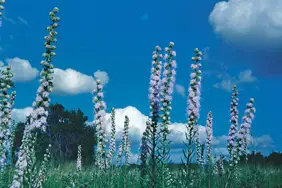
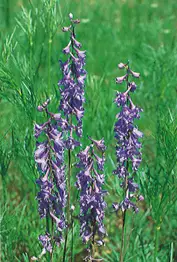
Carolina Larkspur (Delphinum carolinium) – 4′ tall.
Blooms May – July.  These spurred flowers may be deep blue, reddish – blue, or white.  Native perennial.  OZ, OU, CP.


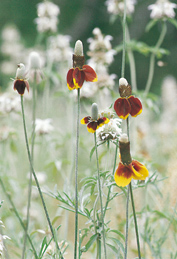
Mexican Hat  (Ratibida columnifera) ― 2 – 3′ tall.
Blooms June – October.  A widely planted form of a native perennial.  Statewide.


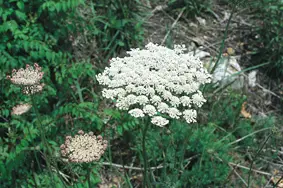
Queen Ann’s Lace (Daucus carota)  ― 1 – 4′ tall

Blooms May – frost.  This is the ancestor of the cultivated carrot.  Introduced biennial. Statewide.


Black-eyed Susan  (Rudbeckia hirta) ― 2 – 3′ tall with one 2″ flower head on each hairy stem.

Blooms May – October.  Native Biennial or short-lived perennial.  Statewide.


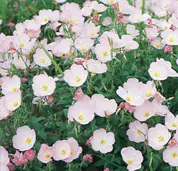
Showy Evening Primrose  (Oenothera speciosa) ― 1 – 2′ tall.

Blooms April – July.  White or pink flowers.  Native perennial.  Statewide.


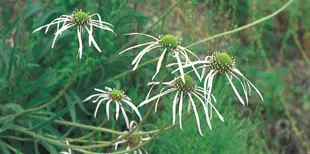
Pale Purple Coneflower (Echinacea pallida) – 3′ tall.

Blooms May – July.  Native perennial.  OZ, OU, CP.


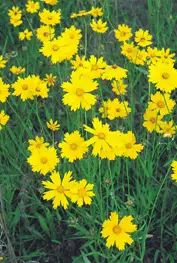
Lance-leaved Coreopsis (Coreopsis lanceolata) – 3′ tall.

Blooms April – June.  Native perennial.  Statewide.


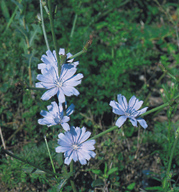
Chicory  (Coreopsis intybus) – 4′ tall.

Blooms May – October.

This European native’s roots are sometimes used as a coffee substitute or additive.  Perennial.  OZ, OU.


Rough Blazing Star  (Liatrus aspera)  ― 3 – 4′ tall.
Blooms July – October.  The unopened flower buds resemble small cabbages.  Native perennial.  Statewide.


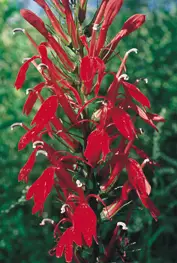
Cardinal Flower (Lobelia cardinalis) – 3′ tall.
Blooms August – October. This flower attracts hummingbirds.  Native perennial. Statewide.


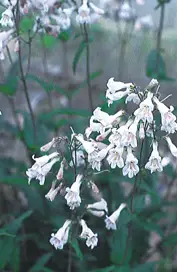
Arkansas Beard Tongue (Penstemon arkansanus) – Less than 2′ tall.
Blooms April – June.  The 3/4″ whitish flowers have lavender streaking.  Native perennial. OZ, OU.


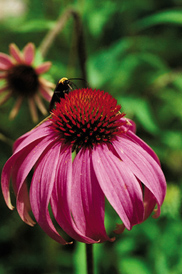
Purple Coneflower  (Echinacea purpurea) – Up to 4′ tall.
Blooms from June – October.
The ray flowers are more purple than those of pale purple coneflower. Native perennial. OZ, OU.
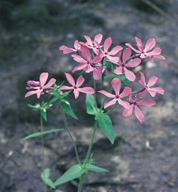
Downy Phlox (Phlox pilosa) – 2′ tall.

Blooms April – July.

Flowers can be pink, pale pink, or sometimes white with purple centers.  Native perennial.  OZ, OU, CP.


Spider Lily (Hymenocallis caroliniana) – 3′ tall.

Blooms May – August.  These large white flowers have a distinctive spider-like shape. Native perennial. OU, GP, AP.


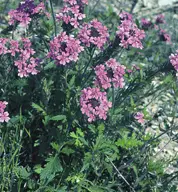
Rose Vervain (Glandularia canadensis) – Plants less than 2′ tall.

Blooms March – September.  The source of many garden hybrids.  Native perennial.  OZ, OU, CP, AP.


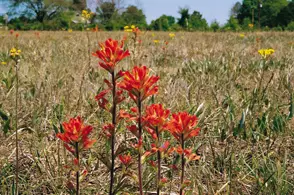
Indian Paintbrush (Castilleja coccinea) ― 1 – 2′ tall.  The bracts that surround the small flowers displays brilliant colors.

Blooms April – June.  Native annual.  Found on prairies in the OZ, CP, AP.


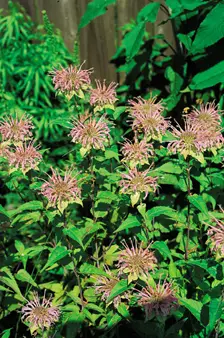
Wild (Monarda fistulosa) ― 2 – 4′ tall.
Blooms June – September.  Also called Bee Balm.  Flowers pinkish, lavender, or lilac.  Statewide.


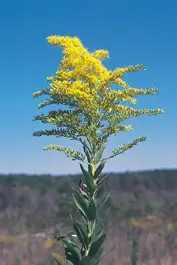
Goldenrod (Solidago canadensis) ― 4 – 6′ tall.

Blooms July – September.  Native perennial.  Statewide.


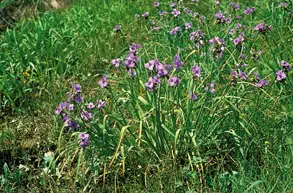
Ohio Spiderwort (Tradescantia ohiensis) – Stems 3′ tall.
Blooms May – July.
So named because the internal jellylike substance resembles a spider’s web.  Native perennial.  OZ, OU, CP.
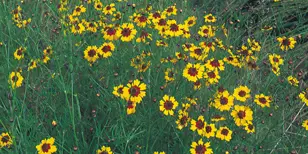
Plains Coreopsis (Coreopsis tinctoria) – 3′ tall.

Blooms June – September.  Native annual.  Statewide.

Bird’s Foot Violet (Viola pedata) – 6″ tall.

Blooms April – May.  This violet occurs in several different colors:  light violet, dark violet, or dark violet with 2 dark purple petals. Native perennial.  OZ, OU, CP.


Butterfly Weed (Asclepias tuberosa) ― 1 – 2′ tall.

Blooms May – September.  Flower’s nectar attractive to butterflies.  Native perennial.  Statewide.


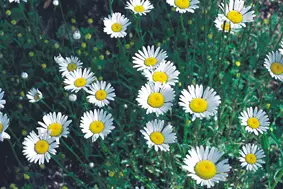
Ox-eyed Daisy (Chrysanthemum leucanthemum) – 2″ flower heads.

Blooms May – July.  Introduced perennial.  OZ, OU, CP.


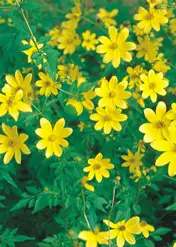
Tickseed (Bidens aristosa) ― 1 – 6′ tall.

Blooms August – November.  This late bloomer is often found in large stands.  Native perennial.  Statewide.


Bicalendar 2010-11 Revised


1st Semester Biology 2010-2011


AUGUST SEPTEMBER OCTOBER NOVEMBER DECEMBER JANUARY FEBRUARY MARCH APRIL MAY


THESE ARE APPROXIMATE DATES FOR ASSIGNMENTS!


2010

Monday Tuesday Wednesday Thursday Friday
16 17 18 19 20
 

23 24 25 26 27


30 31


TOP


2010

Monday Tuesday Wednesday Thursday Friday
1 2 3
TARGET PRE-TEST

6 7 8 9 10


13 14 15 16 17


20 21 22 23 24

INTERIMS
P-T Conference SHS


P-T Conference SJHS


27 28 29 30  


TOP


2010

Monday Tuesday Wednesday Thursday Friday
1
4 5 6 7 8


11 12 13 14 15

Professional Development
 

END OF FIRST 9 WEEKS

18 19 20 21 22

25 26 27 28 29


TOP


2010

Monday Tuesday Wednesday Thursday Friday
1 2 3 4 5
TARGET TEST #1 MC

8 9 10 11 12


15 16 17 18 19
22 23 24 25 26
 
29 30


TOP


2010

Monday Tuesday Wednesday Thursday Friday
1 2 3
SHS SCIENCE FAIR


6 7 8 9 10
TARGET TEST #2 EBR


13 14 15 16 17

Proficient-Advanced Students Out

TEST REVIEW
Proficient-Advanced Students Out
SEMESTER TEST
Proficient-Advanced Students Out
SEMESTER TEST
Proficient-Advanced Students
Out
 

SEMESTER TEST
Proficient-Advanced Students
Out
END OF 2ND 9 WEEKS


Enjoy Your Christmas Vacation December18, 2010 – January 4, 2011!


TOP


2nd Semester Biology


2011

Monday Tuesday Wednesday Thursday Friday
 3 4 5 6 7

10 11 12 13 14

17 18 19 20 21

MLK DAY!
24 25 26 27 28
31


TOP


2011

Monday Tuesday Wednesday Thursday Friday
1 2 3 4

P-T Conference SJHS


P-T Conference SHS


7 8 9 10 11
TARGET TEST #3 HE

14 15 16 17 18
President’s Day


21 22 23 24 25

  • Protist worksheet DUE
  • Continue Protist & Fungi PowerPoint

28


TOP


2011

Monday Tuesday Wednesday Thursday Friday
1 2 3 4


7 8 9 10 11

LITERACY TEST

LITERACY TEST


14 15 16 17 18

END OF 3RD 9 WEEKS

TARGET TEST #4 CDL


21 22 23 24 25
BREAK BREAK BREAK BREAK BREAK
28 29 30 31


TOP


2011

Monday Tuesday Wednesday Thursday Friday
1
4 5 6 7 8


11 12 13 14 15
  • TEST over Vertebrates
  • Handout: Notes on Plants and Plant Worksheet

  • Work on Plant Worksheet

  • Work on Plant Worksheet
  • Work on Plant Worksheet


  • Plant Worksheet DUE
18 19 20 21 22


EOC GEOMETRY

EOC GEOMETRY

25 26 27 28 29
EOC BIOLOGY
EOC BIOLOGY
  • Start Birds PowerPoint and answer worksheet questions


TOP


2011

Monday Tuesday Wednesday Thursday Friday
 2 3 4 5 6
  •  Continue Birds PowerPoint and answer worksheet questions

9 10 11 12 13

16 17 18 19 20
  • Teach wing spreading
  • Identify Insects (KEY)
  • Teach Card pointing
  • Identify Insects (KEY)
TARGET POST TEST


23 24 25 26 27


SEMESTER TEST
REVIEWBOOK RETURN
SEMESTER TEST
REVIEWBOOK RETURN
SEMESTER TEST
30 31
MEMORIAL DAY SEMESTER TEST


  2011

Monday Tuesday Wednesday Thursday Friday
1 2 3
    SEMESTER TEST

 MAKE UP EXAMS

TEACHERS LAST DAY


BACK

Arthropod

Arthropods
Non-Insects

Characteristics

  • Makes up 3/4’s of all animal species
  • Includes insects, spiders, scorpions, millipedes, centipedes, crabs, lobsters, & crayfish
  • Arthropod means “jointed foot”
  • Jointed appendages (legs, antenna, mouthparts)
  • Segmented body with paired appendages on each segment)
  • External exoskeleton made of chitin (carbohydrate) & protein for protection & support
  • Exoskeleton has 3 layers — outer waxy layer repels water, middle layer has calcium for extra strength, & inner layer has flexible joints for movement
  • Protostomes (blastopore develops into mouth)
  • Coelomate (mesoderm-lined body cavity)
  • Ventral nervous system
  • Open circulatory system
  • Specialized sensory receptors & high degree of cephalization
  • Have simple or compound eyes & segmented antenna

Movement & Growth

  • Muscles occur in bundles & are attached to inside of exoskeleton on each side of joints
  • Exoskeleton must be periodically molted (shed) for organism to grow
  • Molting called ecdysis
  • Molting hormone released & causes epidermal cells to secrete enzymes that digest & loosen inner exoskeleton
  • New exoskeleton secreted by epidermal cells flexible at first & must harden so arthropod not vulnerable to predators so often stay in hiding after molting
  • Arthropods go through numerous molts


Butterfly Molting Pupal Case

Evolution & Taxonomy

  • Evolved from ancestral arthropod with many body segments each with appendages
  • Modern arthropod segments fused into larger, specialized structures called tagmata
  • Four subphyla
    * Trilobita – extinct trilobites
    * Crustacea – shrimps, lobsters, crayfish, & barnacles
    * Chelicerata – spiders, scorpions, & ticks
    * Uniramia -centipedes, millipedes, & insects

Subphylum Trilobita
Characteristics

  • Includes extinct trilobite
  • Marine
  • Have a head & segmented trunk with one pair of legs on each segment
  • Breathe through gills
  • Single pair of antenna


TRILOBITE

Subphylum Chelicerata
Characteristics

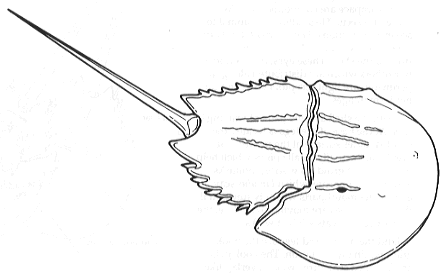
  • Includes 2 classes — Xiphosura (horseshoe crab) and Arachnida (spiders, ticks, scorpions, & mites)
  • Have a cephalothorax (fused head& thorax) and abdomen
  • No antenna
  • Simple eyes or ocelli
  • Have 6 pairs of jointed appendages:
    * Chelicerae – claws or fangs (1 pair)
    * Pedipalps – used for feeding, walking, sensing, transferring sperm (1 pair)
    * Walking legs – movement (4 pairs)
  • Horseshoe crab
    * Marine
    * Not true crabs
    * Fanglike pincers or chelicerae
    * Use book gills to breathe


HORSESHOE CRAB

  • Arachnids
    * Terrestrial
    * Eight legs
    * Chelicerae or fangs with venom
    * Ocelli
    * No antenna
    * Breathe by book lungs &/or tracheal tubes
  • Spiders
    * Arachnid that feeds on insects (carnivores)
    *  Have oval shaped, unsegmented abdomen
    * Cephalothorax connected by narrow waist to abdomen
    * Have 8 simple eyes or ocelli
    * Fangs pierce prey, inject poison, & suck out body fluids
    * Pedipalps on head help sense prey & move it to the mouth
    * Open circulatory system
    * Ostia are openings in heart where blood reenters
    * Body cavity called hemocoel
    * Hemocycanin is oxygen-carrying pigment in blood
    * Have silk glands to make silk & spinnerets to release silk for webs
    * Breathe by book lungs & tracheal tubes
    * Malpighian tubules filter wastes & reabsorb water


GARDEN SPIDER

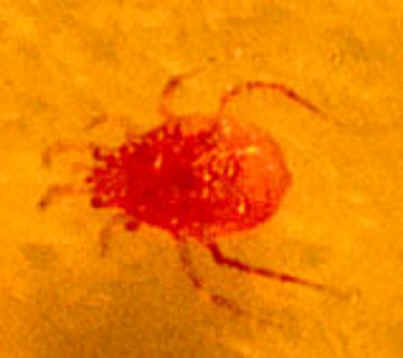
  • Ticks & Mites
    * Parasitic arachnid
    * Fused cephalothorax & abdomen
    * Most abundant arachnid
    * Need blood meal to molt
    * Mites can damage fruit & feed on dead skin at base of hair follicle
    * Ticks carry Lyme disease & Rocky Mountain Spotted Fever


MITE

TICK


  • Scorpions
    * Have a cephalothorax & long segmented abdomen curled over body
    * Prefer dry regions
    * Poisonous stinger on end of abdomen
    * Breathe through book lungs
    * Pedipalps modified into claws
    * Nocturnal predators


SCORPION

Subphylum Crustacea
Characteristics

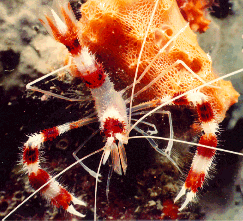
  • Marine members include shrimp, lobster, copepods, barnacles, & crabs


CRAB SHRIMP


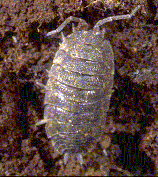
  • Terrestrial crustaceans called isopods include pillbugs & sowbugs


PILLBUG

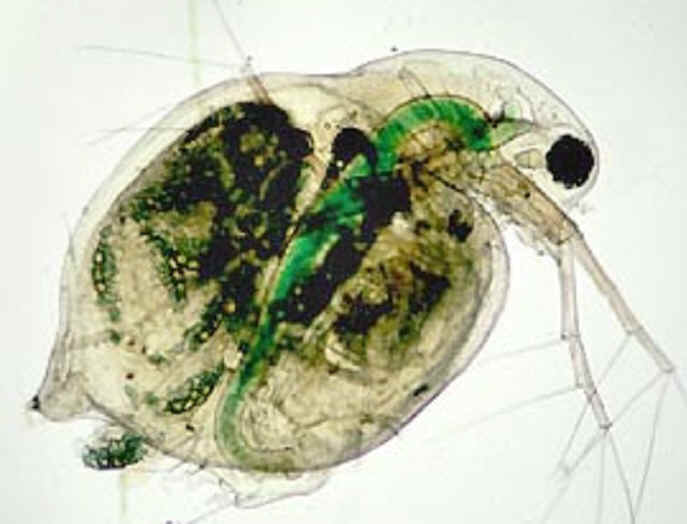
  • Freshwater members include crayfish & Daphnia (water fleas)


DAPHNIA

  • All have jaws are mandibles for chewing or tearing
  • Known as mandibulates
  • Have cephalothorax & abdomen
  • Have 10 pairs of jointed appendages
  • Breathe through gills
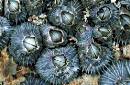
  • Barnacles
    * Marine
    * Sessile crustaceans that live in limestone case
    * Filter plankton with 12 appendages called cirri


BARNACLE

  • Isopods (pillbugs & sowbugs)
    * Live on land in dark places
    * Have 7 pairs of legs on a segmented body
    * Can roll into a ball for protection
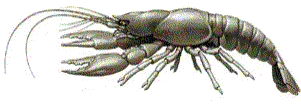
  • Crayfish
    * Cephalothorax made of 13 fused segments & covered by protective carapace
    * Antennules located on head help in balance, touch, & taste
    * Statocysts – balancing organs at the base of antennules
    * Antenna on head used for touch & taste
    * Maxillae – paired mouthparts that move side to side to tear food
    * Maxillipeds – help hold food
    * Chelipeds – claws used to capture food & for protection
    * Mandibles – jaws that move up & down to crush  food
    * Walking legs – 8 pairs used for movement
    * Swimmerets – under abdomen to swim, gas exchange, & protect eggs/young
    * Abdomen ends in flat segment called telson with flat uropods on each side


CRAYFISH

               * Compound eyes on stalks
* Chitinous teeth in stomach grind food
* Wastes leave through anus
*  Green glands filter wastes from blood & help with salt balance
*  Open circulatory system with heart to pump blood to gills & body cells
* Ostia – one way valves allowing blood from dorsal sinus to reenter heart
* Gills attached to walking legs
* Separate sexes that mate in fall & sperm stored in seminal receptacle
*  Eggs attach to swimmerets of female & hatch in several weeks

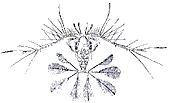
  • Copepods
    * Largest group of crustaceans
    *  Make up most of the marine plankton
    *  Serve as food for many marine animals
    *  Found in freshwater, marine, & moist terrestrial environments


COPEPOD

Subphylum Uniramia
Characteristics

  • All have antenna, mandibles (jaws), & unbranched appendages
  • Includes 3 classes — Chilopoda (centipedes), Diplopoda (millipedes), & Insecta
  • Known as myriapods
  • Most are terrestrial
  • Exoskeleton prevents desiccation (water loss)

Class Chilopoda

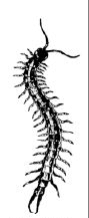
  • Terrestrial centipedes
  • Flattened body with longer legs for fast movement
  • Have 1 pair of legs per body segment
  • Predators
  • Mandibles & maxilla for chewing prey (insects & earthworms)
  • Claw-like appendages or pincers on 1st body segment that can inject venom
  • Can coil up for defense


CENTIPEDE

Class Diplopoda

  • Terrestrial millipedes
  • Have 2 pairs of legs per body segment
  • Rounded body
  • Scavengers on decaying vegetation as they burrow through soil
  • Roll into ball when threatened & spray noxious chemical containing cyanide


MILLIPEDE

BACK