| Amphibians All Materials © Cmassengale |
 |
Amphibian Evolution:
|
Arose from lobe-fined ancestor called Crossopterygians |
|
Land plants & insects provided new food source |
|
Had primitive lungs & short, limb like fins for short periods on land |
|
Appeared during late Devonian |
|
Icthyostega early amphibian with 4 limbs, lungs, & a tail for swimming |
Adaptations:
|
Four limbs with claws on digits (toes) |
|
Lungs instead of gills |
|
Both internal & external nares (nostrils) |
|
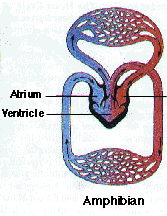
Three chambered heart (two atria & one ventricle) |
|
Double loop blood circulation to lungs & rest of body cells |
|
Skin with keratin (protein) to prevent water loss |
|
Necks to more easily see & feed |
|
Most with smooth, moist skin to take in dissolved oxygen |
|
Some with oral glands to moisten food they eat |
|
Webbed toes without claws |
|
Ectothermic – body temperature changes with environment |
|
Show dormancy or torpor (state of inactivity during unfavorable environmental conditions) |
|
Hibernate in winter and aestivate in summer |
|
Aquatic larva called tadpole goes through metamorphosis to adult |
|
Metamorphosis controlled by hormone called thyroxine |
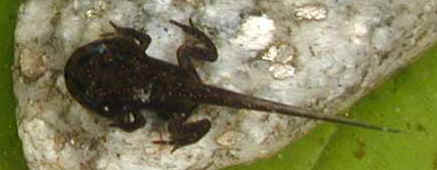
Tadpole
|
External fertilization with amplexus (male clasps back of female as sperm & eggs deposited into water) |
|
Eggs coated with sticky, jelly like material so they attach to objects in water & do not float away |
|
Eggs hatch into tadpoles in about 12 days |

Eggs
- Males with vocal sacs to croak
- Digested system adapted to swallow prey whole
- Well developed muscular system
Classification:
- Anura – frogs & toads
- Urodela – salamanders & newts
- Apoda – caecilians
- Trachystoma – sirens or mud eels
Anuran Characteristics:
- Both terrestrial & freshwater species
- Tadpole with tail, gills, & two-chambered heart
- Adults without a tail, four limbs, & lungs
- Frog skin smooth & moist for cutaneous respiration, while toads is rough & warty (poison glands)
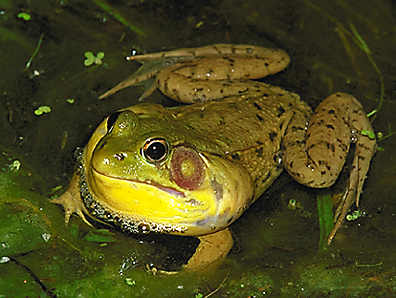
Frog |
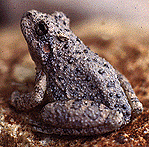
Toad |
- Long hind limbs for jumping
- Long, forked tongue hinged at front of mouth
Urodela Characteristics:
- Includes salamanders & newts
- Have elongated bodies with a tail & four limbs
- Smooth, moist skin for cutaneous respiration
- Less able to stay on dry land than anurans
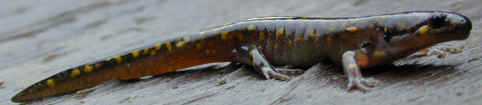
Spotted Salamander
- Size from a few centimeters long to 1.5 meters
- Nocturnal when live in drier areas
- Newts are aquatic species
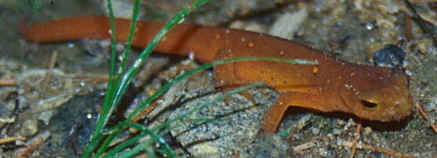
Red Spotted Newt
- Lay eggs in water or damp soil
- Some bear live young
- May or may not go through tadpole stage (some hatch & look like small adult)
Apodan Characteristics:
- Includes caecilians
- Tropical, burrowing, worm like amphibians
- Legless
- Small eyes & often blind
- Eat worms & other invertebrates
- Average length 30 centimeters, but can grow up to 1.3 meters
- internal fertilization
- Female bear live young
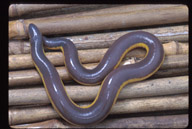
Caecilian
Trachystoma Characteristics:
- Includes mud eels or sirens
- Known as “rough mouth” amphibians
- Found in eastern U.S. & southern Europe
- Have minute forelimbs & no hindlimbs
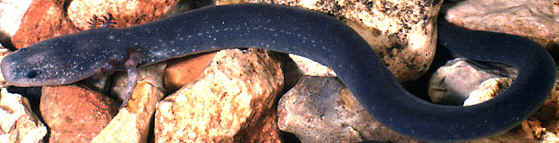
Mud Eel or Siren
External Frog Anatomy:
- Live double life on land & water
- Powerful hind legs for jumping & swimming fold under body when at rest
- Bulging eyes to stay submerged but still see predators
- Blinking eyelids protect eyes from dust & dehydration
- Nictitating membranes clear to moisten eye & see underwater
- Internal nostrils or nares allow frog to breathe underwater
- Tympanic membranes or eardrums behind each eye transmit sound through bone called columella to inner ear
- Eustachian tubes connect mouth & middle ear to equalize pressure

- Males croak or make sound to attract females & ward off other males
- Have protective coloration from cells called chromatophores
- Granular glands secrete foul tasting or poisonous substance
- Mucus glands lubricate skin for oxygen to be dissolved & absorbed
Internal Frog Anatomy:
Skeletal System
- Nine spinal vertebrae (1 cervical in neck, 7 trunk, & 1 sacral supporting hind legs)
- Urostyle long, slim bone connecting sacral vertebrae & trunk
- No rib cage, but pectoral girdle forms shoulders & connects front legs
- Pelvic girdle connects to hind legs
Digestive System
- Tongue sticky, forked, & hinged at front of mouth so can be extended out to catch insects
- Can pull eyes inward to help swallow food
- Two, sharp, backward-pointing vomerine teeth in roof of mouth help prevent prey from escaping
- Maxillary teeth line the edge of the upper jaw
- Alimentary canal (mouth, esophagus, stomach, small & large intestines, and cloaca) is where food is digested, absorbed & wastes eliminated
- Stomach makes gastric juices to break down food
- Pyloric sphincter muscle controls movement of food from stomach into first part of small intestine called duodenum
- Liver makes bile to digest fats; stored in gall bladder
- Pancreas makes pancreatic juice to digest food in small intestine
- Ileum is coiled mid portion of small intestine
- Mesentery is a fanlike membrane holding the intestine in place
- Wastes collect in large intestine & then move into cloaca along with eggs, sperm, & urine until they leave body through the anus
Circulatory System
- Need more oxygen to burn increased amount of food needed to live on land
- 3 chambered heart (right atrium receives deoxygenated blood from body, left atrium receives oxygenated blood from lungs, & ventricle pumps blood to lungs & rest of the body)
- Double loop blood circulation (pulmonary from heart to lungs & systemic from heart to rest of body)
- Conus arteriosus carries blood from ventricle to body cells
Respiratory System
- Tadpoles use gills to breathe
- Adult frogs breathe through lungs & moist skin (cutaneous respiration)
- Glottis is the opening into throat & lungs
Excretory System
- Carbon dioxide excreted through skin & lungs
- Kidneys filter blood & store urine in urinary bladder until leaves cloaca
Nervous System
- Olfactory lobes at base of brain detect smells
- Cerebrum behind olfactory lobes controls muscles
- Optic lobes detect sight
- Cerebellum controls balance & coordination
- Medulla oblongata controls heart rate & breathing
- Cranial nerves connect brain & spinal cord, while spinal nerves branch off the spinal cord to muscles & sensory receptors



 AP Biology
 AP Biology
 AP Biology
 AP Biology
 AP Biology
 AP Biology
 AP Biology
 AP Biology
 AP Biology
![Structure of alanine. [str5ala.jpg]](https://biologyjunction.com/images/str5ala.jpg)
![Structure of arginine. [str5arg.jpg]](https://biologyjunction.com/images/str5arg.jpg)
![Structure of asparagine. [str5asn.jpg]](https://biologyjunction.com/images/str5asn.jpg)
![Structure of aspartic acid. [str5asp.jpg]](https://biologyjunction.com/images/str5asp.jpg)
![Structure of cysteine. [str5cys.jpg]](https://biologyjunction.com/images/str5cys.jpg)
![Structure of glutamic acid. [str5glu.jpg]](https://biologyjunction.com/images/str5glu.jpg)
![Structure of glutamine. [str5gln.jpg]](https://biologyjunction.com/images/str5gln.jpg)
![Structure of glycine. [str5gly.jpg]](https://biologyjunction.com/images/str5gly.jpg)
![Structure of histidine. [str5his.jpg]](https://biologyjunction.com/images/str5his.jpg)
![Structure of isoleucine. [str5ile.jpg]](https://biologyjunction.com/images/str5ile.jpg)
![Structure of leucine. [str5leu.jpg]](https://biologyjunction.com/images/str5leu.jpg)
![Structure of lysine. [str5lys.jpg]](https://biologyjunction.com/images/str5lys.jpg)
![Structure of methionine. [str5met.jpg]](https://biologyjunction.com/images/str5met.jpg)
![Structure of phenylalanine. [str5phe.jpg]](https://biologyjunction.com/images/str5phe.jpg)
![Structure of proline. [str5pro.jpg]](https://biologyjunction.com/images/str5pro.jpg)
![Structure of serine. [str5ser.jpg]](https://biologyjunction.com/images/str5ser.jpg)
![Structure of threonine. [str5thr.jpg]](https://biologyjunction.com/images/str5thr.jpg)
![Structure of tryptophan. [str5trp.jpg]](https://biologyjunction.com/images/str5trp.jpg)
![Structure of tyrosine. [str5tyr.jpg]](https://biologyjunction.com/images/str5tyr.jpg)
![Structure of valine. [str5val.jpg]](https://biologyjunction.com/images/str5val.jpg)


