Only You Can Help Save Sam


Only You Can Help Save Sam!


Sam has been spending his summer boating on the great lakes.  However, he’s not too bright (after all, the brains of worms are pretty small).  He’s never learned how to swim, and he never wears his life preserver.  The worst has happened!  His boat has capsized and he’s stuck!  Fortunately, his life preserver is in the boat, but unfortunately he does not know how to reach it without falling off and drowning.

Save Sam!!


Use the Scientific Method to:


Problem:

How can you and your partner save Fred using only 4 paper clips. You may not touch Fred, the boat, or the life preserver directly with your hands.


Materials:

·        Gummy Worm

·        Gummy life preserver

·        1 Plastic Cup

·        4 Paper Clips


Procedures:

1.      Work with your partner and “Save Fred”.

2.    Follow the rules.

§        Fred, the boat, the life preserver can be touched only with the paper clips.  NO HANDS.

3.    Develop a data section that includes

§        Diagrams of how you saved Fred

§        A detailed protocol describing the diagrams.

4.    Homework:

§        Analyze and conclude the experiment.

·        This means that you must discuss (tell me what you think) about the difficulty of the task, what other strategies you and your partner worked on before you succeeded, and what you think the critical steps were for solving this problem.

§        Although this is working backwards, and not how scientists normally work, please develop a hypothesis for this lab.  (Remember that a hypothesis is an ‘if-then’ statement: if I do this, then this will happen)


Teacher Notes:

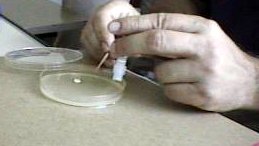
Fred sits on the inverted cup.  The cup sits covering the life preserver on the tabletop.  No real water is involved.  If the group size is 3 or 4, each person gets only 1 paper clip. Have a camera ready.

There are not any real answers – since it’s more of a team-building problem solving initiative rather than a yes/no answer.  However, what they need to figure out is that if they work together, then one person maneuvers Fred (without hooking him) and the other uses the paper clips to stretch the gummy lifesaver for him to slip on.  (The lifesaver will have a smaller inner diameter than Fred’s outer diameter by a fairly obvious amount.)

Ask them typical debriefing-type questions: what worked, what didn’t, did you plan, did you share ideas, did you just mangle poor Fred trying to make it work?, etc.

Groups of 3 and make it more of a challenge by allowing only 1 paperclip per student – that takes more thought and coordination to save Fred without drowning him.  (No mouth-to0mouth resuscitation allowed!)


Organism Classification Webquest


Living Thing #1

Color: Black
Location: in forest on a rotting tree
Eats decaying plant material
Has many cells
Releases spores to reproduce.
Stays in one spot (immobile)
Cells have no chlorophyll
Feels soft and smooth


BACK

LIVING THING #2

Cells  have chlorophyll
Is autotrophic (produces its own food) and heterotrophic (eats insects) to supplement its diet
Has many cells
Lives in swampy areas
Immobile though catches prey as shown.
Reproduces by seeds

BACK

Living Thing #3


Adults live underground or under logs and rocks
They breed and lay eggs in the water
Young live in the water, have external gills, budding arms and legs and a fish like tail
Adults must keep skin moist
Ectothermic (an animal whose body temperature is determined by the temperature of its immediate environment.)
Do not have scales
Have Slimy skin

No external ears

Eats insects and small fish

BACK

Living Thing #4

Has webbed feet
Lays eggs
50 cm long and weighs 1.5 kilograms
Covered with 2 layers of waterproof hair
Eats insects, frogs and fish
Has no external ears
Lives in fresh water lakes
Endothermic an animal whose body temperature is determined by its own metabolic heat production)
Bill has two nostrils
Care for their young and have mammary glands
Sounds like a puppy barking


BACK

Living Thing #5


Click on picture to hear its call


Has rough, shaggy hair-like feathers

Tiny wings

Sharp claws

Endothermic (an animal whose body temperature is determined by its own metabolic heat production)

Lays eggs

Eats insects and worms

Has whiskers to find way in the dark


BACK

Living Organism #6


Click on picture to view video and see sight about these amazing creatures.

Breathe air

Has tough wrinkly skin

Bristled hairs cover entire body

Eats algae and crustaceans

Has teeth

Babies are born live and cared for by mother for up to 2 years

Have mammary glands

Live in warm coastal waters

Are Endothermic.

BACK


Osmosis

Osmosis
Osmosis: the movement of water molecules from an area of high concentration to an area of low concentration.

Cell membranes are completely permeable to water, therefore, the environment the cell is exposed to can have a dramatic effect on the cell.

Hypertonic Solutions: contain a high concentration of solute relative to another solution (e.g. the cell’s cytoplasm). When a cell is placed in a hypertonic solution, the water diffuses out of the cell, causing the cell to shrivel.

Hypotonic Solutions: contain a low concentration of solute relative to another solution (e.g. the cell’s cytoplasm). When a cell is placed in a hypotonic solution, the water diffuses into the cell, causing the cell to swell and possibly explode.

Isotonic Solutions: contain the same concentration of solute as an another solution (e.g. the cell’s cytoplasm). When a cell is placed in an isotonic solution, the water diffuses into and out of the cell at the same rate. The fluid that surrounds the body cells is isotonic.

Back
Reproduction without permission is strictly prohibited.
© Copyright 1999 Terry Brown. All rights reserved.

Bacteria Virus Worksheet Bl


Bacteria Worksheet    


Bacterial Cell Evolution

1. Bacteria are microscopic _____________.

2. Fossils evidence shows bacteria are about __________ years old, while eukaryotes are about __________ years old.

3. Discuss where bacteria can be found.


4. Ribosomal differences have put bacteria into what two kingdoms? Which is the older group?


5. What is absent in the cell wall of Archaebacteria? Describe this substance.


6. Describe the environments in which you would find Archaebacteria.


7. Compare & contrast these tree groups of Archaebacteria — methanogens, extreme halophiles, and thermoacidophiles.


8. Most bacteria are found in what kingdom?

9. Name & describe the three shapes of Eubacteria.


10. Are Eubacteria aerobic or anaerobic? Explain.


11. Eubacteria may be heterotrophic or photosynthetic. Explain what this means & give an example of each type.


12. What type of staining is used to group Eubacteria?

13. Describe the appearance of gram-positive and gram-negative bacteria under a microscope.


14. Explain why Eubacteria do not all stain the same color during Gram staining.


15. Describe, in detail, cyanobacteria.


16. Cyanobacteria, also known as ______________ bacteria lack a membrane bound __________ & _____________.

17. How are heterocysts helpful to cyanobacteria?


18. What is eutrophication?


19. Explain the role of cyanobacteria in eutrophication.


20. What bacterium causes syphilis? Describe this bacteria.


21. Streptococci bacteria causing strep throat are in what group?

22. Why are actinomycete bacteria important?


23. Compare & contrast these three groups of Proteobacteria — enteric bacteria, chemoautotrophs, and nitrogen-fixing bacteria.


24.Name a genus of nitrogen-fixing bacteria found on the roots of soybeans in our area.


Characteristics of Bacteria

25. Name the three main parts of all bacteria.


26. Describe the cell wall of bacteria. How does this differ from a plant cell wall?


27. Compare & contrast the cell membrane of Eubacteria with that of other eukaryotes.


28.Are Gram positive or negative bacteria more protected against antibiotics & why?


29. Where does cell respiration take place in eukaryotes? in bacteria?

30. Describe how the cell membrane of photosynthetic bacteria are adapted for this process. Where does this process take place in plants?


31. Compare & contrast the cytoplasm of bacteria with that of eukaryotes.


32. Describe the DNA (hereditary material) found in bacteria. Make a sketch of what you think this would look like.


33. Where is the capsule of a bacteria, what is it made of, and give two ways it helps a bacterium?


34. Where is the glycoclayx of a bacteria, what is it made of, and how does it help a bacterium?


35. How do pili help the bacteria that have them?


36. How do Gram positive bacteria protect themselves against harsh environments?


37. Describe two methods of locomotion in bacteria.


38. Compare & contrast saprophytic and photoautotrophic bacterial nutrition.


39. Distinguish among these three bacteria & give an example of each — obligate anaerobes, facultative anaerobes, & obligate aerobes.


40. Compare & contrast these three methods of bacterial reproduction — transformation, conjugation, and transduction.


Bacteria and Humans

41. What does a pathologist do for a living?


42. Compare & contrast the two types of toxins bacteria produce.


43. Besides injuring the body by releasing toxins, how else do bacteria hurt the body?


44. Describe four antibiotics against bacteria.


45. Explain how antibiotic resistance occurs.


46. Name two  bacterial diseases carried by ticks.

47. name two bacterial diseases caused by eating contaminated food.

48. Name a sexually transmitted bacterial disease.

49. Name a bacterium that can cause disease whenever it gets into deep wounds.

50. Name a bacterium that is transmitted by coughing & infects the lungs.

51. Describe, in detail, how bacteria can be useful to humans.


BACK