Taxonomy Quiz %CODE1% Taxonomy Which of the following pairs is MOST closely related? dog & tapeworm tapeworm & bacteria mushroom & tree ameba & bacteria Organisms in the Kingdom Animalia are: multicellular & heterotrophic multicellular & autotrophic unicellular & autotrophic unicellular & autotrophic Which of the following groups would contain the largest number of organisms? class order phylum family A scientific name contains information about its: family & species genus & species phylum & order class & family What do plants and animals have in common? both are heterotrophic both are autotrophic both are prokaryotic both are eukaryotic The current classification system was devised by: Aristotle Plato Linnaeus Darwin Instead of phylum, plants use which category? division subspecies class subkingdom If two organisms are in the same phylum, they must also be in the same: class species family kingdom Which kingdom contains “extreme halophiles”? eubacteria archaebacteria fungi protista A dichotomous key is used to: locate an organism identify an organism divide a kingdom interbreed species Score = Correct answers:
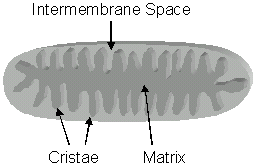
Cell Quiz %CODE1% Cells 1. What part of the cell is responsible for breaking down and digesting things? ribosomes lysosomes endoplasmic reticulum vacuole 2. Identify the organelle pictured. chloroplast endoplasmic reticulum golgi apparatus mitochondria 3. What part of the cell serves as the intracellular highway? endoplasmic reticulum golgi apparatus cell membrane mitochondria 4. Which of the following would you NOT find in a bacterial cell? DNA cell membrane golgi apparatus ribosomes 5. Which of the following is found in plant cells, but not animal cells? cell wall vacuole mitochondria endoplasmic reticulum 6. The jellylike interior of the cell is called the: vacuole cytoplasm cytoskeleton nucleus 7. Identify the organelle. golgi apparatus endoplasmic reticulum mitochondria lysosome 8. What part of the cell makes proteins? ribosomes mitochondria lysosomes vacuole 9. Where are ribosomes usually located in animal and plant cells? inside the nucleus near the cell membrane on the endoplasmic reticulum inside the vacuole 10. What part of the cell serves to process, package and export proteins? mitochondria endoplasmic reticulum nucleolus golgi apparatus Score = Correct answers:
Reptile Quiz %CODE1% Reptiles Which of the following made it possible for reptiles to make a complete transition to land? amniote egg 3 chambered heart double loop circulation nictitating membrane Which of the following pairs is most closely related? snake & lizard crocodile & tuatara alligator & komodo dragon alligator & alligator snapping turtle Which part of the amniote egg is responsible for storing waste? chorion yolk sac amnion allantois Sea snakes and turtles breathe: with gills with lungs through their skin through their chorion Turtles and Tortoises belong to the ORDER: Squamata Crocodilia Chelonia Rynchocephalia Which organ on the snake is responsible for detecting odors? cloaca pit organ Jacobson’s organ venom gland Which of the following reptiles is known as a “living fossil”? tuatara komodo dragon sea turtle anaconda The top of a turtle’s shell is called the: plastron amnion carapace ventricle Snakes are thought to have evolved from: crocodilians lizards eels salamanders Ovoviviparous snakes: are venomous incubate eggs within the body lay eggs in nests do not have an amnion Score = Correct answers:
Cell Respiration Quiz %CODE1% Cellular Respiration Quiz 1. Which of the following occurs in both photosynthesis and respiration? chemiosmosis glycolysis calvin cycle krebs cycle2. Which of the following statements is FALSE? glycolysis can occur with or without oxygen glycolysis occurs in the mitochondria glycolysis is the first step in both aerobic and anaerobic respiration glycolysis produces 2 ATP, 2 NADH, and 2 pyruvate 3. This process uses NADH and FADH2 to produce ATP oxidative phosphorylation fermentation glycolysis krebs cycle 4. This process begins with the production of Acetyl-CoA: chemiosmosis glycolysis fermentation krebs cycle 5. Cramps during exercise are caused by: alcohol fermentation glycolysis inhibition lactic acid fermentation chemiosmosis 6. Oxidative phosphorylation is also known as: chemiosmosis glycolysis fermentation electron transport chain 7. The final electron acceptor during oxidative phosphorylation is: oxygen water carbon dioxide ATP 8. Which of the following processes produces the most ATP? glycolysis oxidative phosphorylation fermentation krebs cycle 9. Which of the following is necessary for oxidative phosporylation to occur? ATP oxygen carbon dioxide lactic acid 10. Which of the following is the products of the Krebs cycle? ATP NADH FADH all of these Score = Correct answers: BACK
What’s Your Style %CODE1% What’s Your Learning Style For these questions, choose the first answer that comes to mind and click on a, b, or c. Don’t spend too much time thinking about any one question. Question 1 When you study for a test, would you rather a) read notes, read headings in a book, and look at diagrams and illustrations. b) have someone ask you questions, or repeat facts silently to yourself. c) write things out on index cards and make models or diagrams. Question 2 Which of these do you do when you listen to music? a) daydream (see things that go with the music) b) hum along c) move with the music, tap your foot, etc. Question 3 When you work at solving a problem do you a) make a list, organize the steps, and check them off as they are done b) make a few phone calls and talk to friends or experts c) make a model of the problem or walk through all the steps in your mind Question 4 When you read for fun, do you prefer a) a travel book with a lot of pictures in it b) a mystery book with a lot of conversation in it c) a book where you answer questions and solve problems Question 5 To learn how a computer works, would you rather a) watch a movie about it b) listen to someone explain it c) take the computer apart and try to figure it out for yourself Question 6 You have just entered a science museum, what will you do first? a) look around and find a map showing the locations of the various exhibits b) talk to a museum guide and ask about exhibits c) go into the first exhibit that looks interesting, and read directions later Question 7 What kind of restaurant would you rather not go to? a) one with the lights too bright b) one with the music too loud c) one with uncomfortable chairs Question 8 Would you rather go to a) an art class b) a music class c) an exercise class Question 9 Which are you most likely to do when you are happy? a) grin b) shout with joy c) jump for joy Question 10 If you were at a party, what would you be most likely to remember the next day? a) the faces of the people there, but not the names b) the names but not the faces c) the things you did and said while you were there Question 11 When you see the word “d – o – g”, what do you do first? a) think of a picture of a particular dog b) say the word “dog” to yourself silently c) sense the feeling of being with a dog (petting it, running with it, etc.) Question 12 When you tell a story, would you rather a) write it b) tell it out loud c) act it out Question 13 What is most distracting for you when you are trying to concentrate? a) visual distractions b) noises c) other sensations like, hunger, tight shoes, or worry Question 14 What are you most likely to do when you are angry? a) scowl b) shout or “blow up” c) stomp off and slam doors Question 15 When you aren’t sure how to spell a word, which of these are you most likely to do? a) write it out to see if it looks right b) sound it out c) write it out to see if it feels right Question 16 Which are you most likely to do when standing in a long line at the movies? a) look at posters advertising other movies b) talk to the person next to you c) tap your foot or move around in some other way Total your a’s, b’s, and c’s