Scientific Method & Hand Size Lab


Using the Scientific Method


Introduction:

Humans are classified as a separate species because of all the special characteristics that they possess. These characteristics are controlled by strands of DNA located deep inside their cells. This DNA contains the code for every protein that an organism has the ability to produce. These proteins combine with other chemicals, within the body, to produce the cells, tissues, organs, organ systems, and finally the organism itself. The appearance of these organs, such as the shape of ones nose, length of the fingers, or the color of the eyes is called the phenotype.

Even though humans contain hands with five fingers, two ears, or one nose, there are subtle differences that separate these organs from another. There are subtle differences in a person’s genes that allows for these different phenotypes. In this lab, we are going to observe some of these differences in phenotype. All human hands look pretty much alike, but there are genes on your chromosomes that code for the characteristics making up your hand. We are going to examine two of these characteristics (hand width and hand length) and try to determine why these phenotypic differences occurred.

Materials:

  • metric ruler (see end of lab)
  • pencil
  • calculator

Procedures:

Day 1

  1. Choose a partner and have them measure the length of your right hand in centimeters. (Measure from the tip of your middle finger to the beginning of your wrist as shown in figure 1.)  Record your measurements in Table 1.
  2. Now measure and record the length in centimeters of your partners hand.
  3. Have your partner measure the width of your right hand, straight across the palm, and record the data in Table 1. (see figure 1.)
  4. Now measure & record the width of your partner’s hand.

Figure 1.


Table 1


Group Data on Right Hand Width and Length
Student Name Length of Hand (cm) Width of Palm (cm)


  1. After the entire class has completed Table 1, record your group data on the Class Data Table at the front of the room
  2. Record the Class Data Table information on your lab sheet’s Table 2.

Table 2

Class Data on Right hand Width and Length (cm)

Class Period:

Student Gender
(M / F)
Hand Length (cm) Hand Width (cm)
1. M / F
2. M / F
3. M / F
4. M / F
5. M / F
6. M / F
7. M / F
8. M / F
9. M / F
10. M / F
11. M / F
12. M / F
13. M / F
14. M / F
15. M / F
16. M / F
17. M / F
18. M / F
19. M / F
20. M / F
21. M / F
22. M / F
23. M / F
24. M / F

Click for Class Data Table

Day 2

  1. In order to form a more accurate conclusion, the collection of additional data is necessary. Using the Class

. The teacher has the option to include the data from all the classes running this experiment. Below find tables that will allow the tabulation of several classes of data.


Table 3: All Classes Hand Length

Measurement of Hand length in cm. # of Males # of Females Total # ( Male + Female )
1.—————— ——————– ——————- ——————
2.—————— ——————- ——————- ——————-
3.—————— ——————- ——————- ——————-
4.—————— ——————- ——————- ——————-
5.—————— ——————- ——————- ——————-
6.—————— ——————- ——————- ——————-
7.—————— ——————- ——————- ——————-
8.—————— ——————- ——————- ——————-
9.—————— ——————- ——————- ——————-


Table 4: All Classes Hand Width

Measurement of Hand width in cm. # of Males # of Females Total # ( Male + Female )
1.—————— ——————– ——————- ——————
2.—————— ——————- ——————- ——————-
3,—————- ——————- ——————- ——————-
4.—————— ——————- ——————- ——————-
5.—————— ——————- ——————- ——————-
6.—————— ——————- ——————- ——————-
7.—————— ——————- ——————- ——————-
8.—————— ——————- ——————- ——————-
9.—————— ——————- ——————- ——————-


Line Graph the data from Tables 3 and 4. and then answer the questions that follow. Use the measurements of the width and length as your independent variable and the number of times that measurement appeared as your dependent variable.

Graph Tile: ___________________________________________________________


Analysis:

1. Examine the above graph. What is the shape of the line for hand length? _____________

________________________________________________________________________

2. What is the most abundant measurement for hand length? __________________.

3. What is (are) the least abundant measurement(s)? _________________________.

4. If we are to assign letters to represent the various lengths, what value(s) would we assign to the dominant genotype (HH)? ________________; the recessive genotype (hh)? ___________, and he heterozygous genotype (Hh)? _________________.

5. What would be the phenotypic name for the ( HH ) genotype? ___________________.

6. What would be the phenotypic name for the ( Hh ) genotype? ___________________.

7. What would be the phenotypic name for the ( hh ) genotype? ____________________.

8. Examine the above graph. What is the shape of the line for hand width ? ____________

________________________________________________________________________

9. What is the most abundant measurement for hand width? __________________.

10. What is (are) the least abundant measurement(s)? _________________________.

11. If we are to assign letters to represent the various lengths, what value(s) would we assign to the dominant genotype (WW)? ________________; the recessive genotype (ww)? ___________, and he heterozygous genotype (Ww)? _________________.

12. What would be the phenotypic name for the ( WW ) genotype? __________________.

13. What would be the phenotypic name for the ( Ww ) genotype? ___________________.

14. What would be the phenotypic name for the ( ww ) genotype? ___________________.

15. Are there any similarities in the graph of the above two characteristics? ____________.

16. If so, what are they? ____________________________________________________

17. Are there any differences in the graph of the above two characteristics? ____________.

18. If so, what are they? ____________________________________________________

19. Is there a difference in the length and width of the male and female hand? ___________.

20. Does the gender of a person have an effect on the phenotype of a trait? _____________.

Explain _________________________________________________________________

_______________________________________________________________________

________________________________________________________________________


Cut and use:

________________________________________________________________________


Teddy Graham Natural Selection Lab

Natural Selection in Teddy Grahams

Introduction

You are a bear-eating monster. There are two kinds of bears that you like to eat: happy bears and sad bears. You can tell the difference between them by the way they hold their hands. Happy bears hold their hands high in the air, and sad bears hold their hands down low. Happy bears taste sweet and are easy to catch. Sad bears taste bitter, are devious and hard to catch. Because of this you only eat happy bears. The happy trait in bears is caused by the expression of a recessive allele. The homozygous recessive condition is being happy. The sad trait is caused by a dominant allele. New bears are born every year (when they are hibernating in their den, the cardboard box), and the birth rate is one new bear for every old bear left from last year.

Materials:

Teddy Bear Grahams, lab worksheet, pencil

Procedure:

1. Obtain a population of 10 bears and record he number of happy and sad bears and the total population number. Using the equation for Hardy-Weinberg equilibrium, calculate the frequencies of both the dominant and recessive alleles and the genotypes that are represented in the population. Example: If 5 of the 10 bears are happy, then 10 out of 20 alleles would be happy alleles. Therefore the q2 number would be 0.5. You must then determine the q number by taking the square of 0.5.

2. Now, go hunting! Eat 3 happy bears. (If you do not have 3 happy bears then eat the difference in sad bears.)

3. Once you have consumed the bears obtain a new generation from your den (the box). You should only remove seven additional bears from the den for a total of 14 bears.

4. Repeat the procedures again. Be sure to record the number of each type of bear and the total population.

Table:


Generations P2 (sad) 2pq (sad) q2 (happy) P q
1. Initial
2.
3.
4.


Questions:

1. Describe what is happening to the genotype and allele frequencies in the population of Teddy Grahams?


2. What would you expect to happen if you continued the selection process for additional generations?


3. How would the frequencies change if you were to now select for the sad bears?


4. Why doesn’t the recessive allele disappear from the population? How is it protected?


TRAINING – HOW TO USE SMART BOAR

TRAINING – HOW TO USE SMART BOARDS
http://www.teacheronlinetraining.com/complimentary/ – Online training(60 minutes)
SMART BOARD FORUMS
Learn and share with other educators.
http://smartboardrevolution.ning.com/ – All SMART Board educators, unite! Let’s share ideas, tips, and lesson files and collaborate to maximize our students’ learning.
http://projects.minot.k12.nd.us/groups/smarttechnologies/ – SMART board Technology site: area to share and learn.
LESSONS AND TEMPLATES
http://www1.center.k12.mo.us/edtech/SB/templates.htm – Templates available for K-12 classes. http://eduscapes.com/sessions/smartboard/ – all grades
http://www1.center.k12.mo.us/edtech/resources/SBsites.htm – Interactive sites to use with your SMART board.
GAMES AND QUIZZES
Class Tools – Use this site to create your own interactive games using your curriculum.
http://tinyurl.com/27sbntd – Classroom games and quizzes, and other teacher resources
http://www.jigsawdoku.com/ – Jig Saw Doku http://tinyurl.com/25km2uo – SMART Boards and the Fifty Nifty States and Capitals
SCIENCE
http://www.getbodysmart.com/index.htm – AN ONLINE TEXTBOOK ABOUT HUMAN ANATOMY AND PHYSIOLOGY
SOCIAL STUDIES
http://tinyurl.com/25km2uo – SMART Boards and the Fifty Nifty States and Capitals

Understanding Graphs

Understanding Graphs

Graph 1: Rabbits Over Time

a. The graph shows a __________ growth curve.
b. The carrying capacity for rabbits is ______
c. During which month were the rabbits in exponential growth?


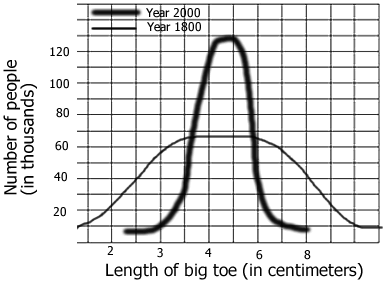
Graph 2: Average Toe Length

a. In 1800, about how many people surveyed had a 3 cm toe? _______
How many in 2000? _______
b. The data shows the ____________ selection has occurred?
c. In 2000, what is the average toe length? ______ What is the average toe length in 1800 _______?


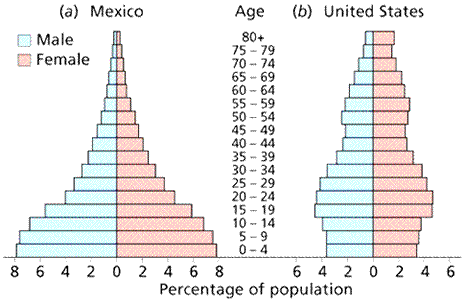
Graph 3: Mexico and US

a. In Mexico, what percentage of the population is between 0-4 years of age? _______ In the US? ______
b. Which population is growing the fastest? ________
c. Which age group has the smallest number in both countries? _____


Chart 4: Trapping Geese

In order to estimate the population of geese in Northern Wisconsin, ecologists marked 10 geese and then released them back into the population. Over a 6 year period, geese were trapped and their numbers recorded.

a. Use the formula to calculate the estimated number of geese in the area studied? _____________
b. This technique is called ____________ & ______________.
c. Supposing more of the geese found in the trap had the mark, would the estimated number of geese in the area be greater or lesser? _____


Year Geese Trapped Number with Mark
1980 10 1
1981 15 1
1982 12 1
1983 8 0
1984 5 2
1985 10 1

Chart 5: Mushroom Plots

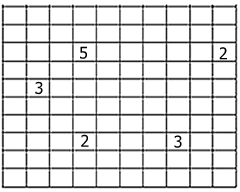
Another ecologist uses a different method to estimate the number of mushrooms in a forest. She plots a 10×10 area and randomly chooses 5 spots, where she counts the number of mushrooms in the plots and records them on the grid.

a. Calculate the number of mushrooms in the forest based on the grid data: _________________
b. This technique is called _______________


Chart 6: Snakes & Mice

The data shows populations of snake and mice found in an experimental field.

a. During which year was the mouse population at zero population growth? ______
b. What is the carrying capacity for snakes ? ______
c. What is the carrying capacity for mice? _____
d. What is the rate of growth (r) for mice during 1970? _____ During 1980? ______

Year Snakes Mice born Mice died
1960 2 1000 200
1970 10 800 300
1980 30 400 500
1990 15 600 550
2000 14 620 600
2001 15 640 580

Click here for printable copy (landscape) 

BACK

Study of Biology pptQ


Study of Biology
ppt Questions

What is Biology?

1. Define biology.


2. What are organisms?

3. Name 5 groups of organisms.


4. Living things share common _______________.

5. What is the basic unit of life that makes up all organisms?

6. To survive, populations of organisms must be able to _____________ offspring.

7. All organisms have a _________ code carried in  a molecule called _______.

8. Organisms require ____________ such as food and need __________ for their activities.

9. Living things _________ to their environment.

10. Organisms must maintain what type of internal environments ?

11. What does evolve mean?


12. Do groups or individuals evolve?

Characteristics

13. All ____________ are made of cells.

14. Most cells are so __________, they can’t be seen without a microscope.

15. What is cytoplasm?


16. What surrounds all cells?

17. What is the function of the cell membrane?


18. Cells are complex and highly ___________.

19. What are organelles and give an example?


20. The simplest type of cells are known as ______________.

21. Describe prokaryotic cells.


22. Name one of the most common prokaryotes.

23. More complex cells are called ______________.

24. Eukaryotes have a true _________ and _________________ organelles.

25. Name 3 types of eukaryotic cells.

26. Organisms can be grouped by their __________ of cells.

27. Define unicellular organisms.

28. What are multicellular organisms?


Reproduction

29. When organisms reproduce they pass what on to their offspring?

30. Name 2 types of reproduction.

31. What type of reproduction involves 2 parents?

32. A fertilized egg is called a ___________.

33. Are sexually reproduce organisms genetically identical to their parents?

34. asexual reproduction involves a _____________ parent or _________.

35. In asexual reproduction, a single cell __________ to form two new cells.

36. How do asexually reproduced organisms genetically compare  to their parents?

Genetic Code

37. What carries the genetic code for all organisms?

38.DNA stands for ____________________ ___________.

39. Do all organisms have DNA?

40. What does DNA code for in a cell?

41. Why are proteins so important to cells?


Growth and Development 

42. Name the stages of development in the life of a frog.


43. Name two ways that organisms grow.

44. When organisms change into adults they ___________ and may change.

Requiring Food and Energy

45. What organisms can make their own food?

46. What is a photoautotroph and give an example.


47. What food making process is used by photoautotrophs?

48. What do chemoautotrophs use to get energy?

49. ___________ cannot make their own food.

50. How do heterotrophs meet their food requirements?

51. Name 3 groups of heterotrophs.

52. Explain the difference among herbivores, carnivores, and omnivores.


53. Define metabolism.


54. All metabolic processes require ____________.

55. What is the ultimate energy for all life on earth?

56. What metabolic process uses sunlight for energy?

57. Write the balanced overall equation for the photosynthesis process and label the reactants & products.


58. What metabolic process releases the chemical energy stored in food?

59. Write the balanced overall equation for cellular respiration .


60. Name several environmental factors that organisms respond to.


61. Give an example of an organism responding to their environment to promote survival.


62. Define homeostasis.


63. Give 3 examples of internal conditions in which organisms must maintain stability.


64. Why do populations evolve?


65. What record do we have that populations evolve?

Organization Levels

66. Name 3 nonliving levels into which life is organized.

67. At what level of organization does life begin?

68. Cells organize into ____________.

69. What makes up organs?

70. Organs working together become a ____________, and these working together make the entire _____________.

71. From simplest to most complex, list the levels of life above organism.

72. What is the most inclusive level of life?


BACK