Pre AP Lab Reports


Pre AP Lab Reports

Calorimetry of Food Energy
Sample 1     Sample 2     Sample 3
Scientific Method – All Thumbs!
Sample 1     Sample 2
Osmosis Through an Egg Membrane
Sample 1     Sample 2    Sample 3     Sample 4
Environmental pH
Sample 1     Sample 2
Chromatography of Plant Pigments
Sample 1     Sample 2     Sample 3
Planarian Regeneration
Sheep Heart Dissection Chromatography of Pigments
Metric Measurement Water Properties
 
BACK

Osmosis Lab Report Sample 4 PreAP

Osmosis Through a Cell membrane of an Egg

Joe Lockwood

Introduction:

When a cell membrane is said to be selectively permeable, it means that the cell membrane controls what substances pass in and out through the membrane.  This characteristic of cell membranes plays a great role in passive transport.  Passive transport is the movement of substances across the cell membrane without any input of energy by the cell.  The energy for passive transport comes entirely from kinetic energy that the molecules have. The simplest type of passive transport is diffusion, which is the movement of molecules from an area of high concentration to an area of lower concentration.  Diffusion moves down the concentration gradient, which is the difference in the concentration of molecules across a space.  Osmosis is a type of diffusion in which water molecules move down the concentration gradient.

When the concentration of solute molecules outside the cell is lower than the concentration of solute in the cytosol , the solution outside is hypotonic to the cytosol.  If the concentration of solute molecules is higher outside of the cell, the solution outside is said to be hypertonic.  The solution outside is isotonic if the concentration is equal on both sides of the cell membrane.

The egg shell is made of calcium carbonate and vinegar contains acetic acid.  These two can react to produce calcium acetate and carbonic acid which then decompose into water and carbon dioxide as shown in the two chemical equations:

Text Box:

Text Box:

 Hypothesis:

The eggs will increase in mass in all three solutions, showing that diffusion and osmosis occur when the concentration of two solutions is different, so that equilibrium can be established. 

Materials:

To conduct this experiment, these materials will be needed:  1-2 fresh hen eggs in their shells, masking tape and marker, distilled water, clear sugar syrup, vinegar, clear jar with lid, tongs, electronic balance, paper towels, paper, and a pencil.

 Methods:

On Day 1, the first step should be to label the jar with your lab group and the word “vinegar”.  Next, the group will mass the egg with the electronic balance and record the results in the data table.  After this, the group will carefully place the raw egg into the jar and cover the egg with vinegar.  Finally, the group is to loosely recap the jar and allow the jar to sit for 24 to 48 hours until the outer calcium shell is removed.

On Day 2, the day should begin with the group opening the jar and pouring off the vinegar.  Next, they will use tongs to carefully remove the egg to a paper towel and pat it dry.  When this is done, the group should mass the egg on an electric balance and record the size, mass, and appearance of the egg.  After this, they will clean and re-label the jar with their lab group and the word “distilled water”.  They will carefully place the egg into the jar and cover the egg with distilled water.  Finally, they will loosely re-cap the jar and allow it to sit for 24 hours.

On Day 3, the first step is to open the jar and clean out the distilled water.  Then tongs should be used to carefully remove the egg to a paper towel and pat it dry. The size is to be recorded and so should the appearance of the egg on the table.  Next, the group will mass the egg on an electric balance and record the results.  After this, the jar should be cleaned and re-labeled with the name of the group and the word “syrup”.  Finally, the group should place the egg into the jar cover it with clear syrup, loosely re-cap the jar and allow it to sit for 24 hours.

On Day 4, the day should begin by the group opening the jar and pouring off the syrup.  Next, the group will use tongs to very carefully remove the egg, rinse off the excess syrup under slow running water, and pat the egg dry on a paper towel.  After this, the size and appearance of the egg should be recorded in the data table.  Then, the mass of the egg should be taken on an electronic balance and recorded.  Finally, the work area should be cleaned and all the lab equipment should be put away.

 Results:         

Questions:

1. Vinegar is made of acetic acid and water.  Explain how it was able to remove the calcium shell.  The reaction of the acetic acid and calcium carbonate of the egg shell produces calcium acetate and carbonic acid, which then decomposes into water and carbon dioxide.


2.(a) What happened to the size of the egg after remaining in vinegar? The egg got bigger.

(b) Was there more or less liquid left in the jar?  There was less liquid left in the jar.

(c) Did water move into or out of the egg? Why?  Water moved into the egg because there was a lower concentration of solute molecules in the vinegar than there was inside the egg.

3.(a) What happened to the size of the egg after remaining in distilled water? The egg got a little bit bigger, but not by very much.

(b) Was there more or less liquid left in the jar?  There was a little bit less liquid left in the jar, but the change was very small.

(c) Did water move into or out of the egg? Why?  A small amount of water moved into the egg because the distilled water had a slightly lower concentration of solute molecules than inside the egg.

4. (a) What happened to the size of the egg after remaining in syrup? The egg became smaller.

(b) Was there more or less liquid left in the jar?  There was more liquid left in the jar.
(c) Did water move into or out of the egg? Why?  Water moved out of the cell because the syrup molecules were hypotonic to the solute molecules inside the egg.

5.  Was the egg larger after remaining in water or vinegar? Why?  The egg was larger after remaining in water because the water has the lower concentration of solute molecules than the vinegar so more water would diffuse to an area of higher concentration of solute particles.

6.  Why are fresh vegetables sprinkled with water at markets?  They do this so that water will diffuse into the vegetables and keep them plump and allow them to keep their look of freshness.

7.  Roads are sometimes salted to melt ice.  What does this salting do to the plants along roadside and why?  This salting dehydrates the plants because the higher salt concentration causes the water to diffuse out of the plant to even up the concentration.


Error Analysis:

A few errors may have happened over the course of this experiment. The washing of the egg could have affected the mass.  Also, the jars might not have been thoroughly cleaned out before putting in the next substance.  This could have affected the rate of diffusion because it would have changed the concentration of the solute particles.  These errors and a few others may have occurred.

 Discussion and Conclusion:

The hypothesis was not correct.  While two of the solutions caused the eggs to increase in mass, syrup caused the egg to lose mass.  This shows that the syrup was hypertonic to the solution inside of the egg, causing water to diffuse out of the egg to try and establish equilibrium. The egg’s mass increased in the distilled water and vinegar because they were hypotonic to the solution in the egg, causing water to diffuse into the cell.  The shell on the egg dissolved because    the egg shell is made of calcium carbonate and vinegar contains acetic acid.  These two can react to produce calcium acetate and carbonic acid which then decompose into water and carbon dioxide.


BACK

Chromatography of Plant Pigments Sample 2 PreAP


Chromatography of Plant  Pigments


Introduction

Chromatography is a way of separating a mixture using differences in the abilities of the components to move through a material. All chromatography involves two phases – a stationary phase and a mobile phase. The movement of the mobile phase through the stationary phase allows separation to take place. Because the components of a mixture move at different rates, they eventually separate.

Paper chromatography is a common way to separate various components of a mixture. The components of the mixture separate because different substances are selectively absorbed by paper due to differences in polarity. A solution can be separated by allowing it to flow along a stationary substance. Water or some other solvent is used as the mobile phase. The solvent moves upward along the paper because of capillary action. As it reaches the spot, the mixture dissolves in the solvent. For instance, the pigments in an ink solution can be separated by passing the ink through a piece of paper. The pigments respond differently to the paper. The differences in the migration rates result in differences in the distances the separated components travel, some pigments are held back while other moves ahead. Eventually, a pattern of colors results that shows the separated pigments.

Hypothesis

Paper can be used to separate mixed chemicals.

Materials

The materials used for this lab are paper, pencil, scissors, eraser, filter paper, test tube, cork, paper clip, metric ruler, black felt-tip pen, and a calculator.

Methods

The first step to this experiment was to bend a paper clip so that it is straight with a hook at one end. Push the straight end of the paper clip into the bottom of a cork stopper. Next, hang a thin strip of filter paper on the hooked end of the paper clip. Insert the paper strip into the test tube so it does not touch the sides, but almost the bottom of the test tube. Next, remove the paper strip from the test tube and draw a solid 5 mm wide band about 25 mm from the bottom of the paper, using a black felt tip pen. Use a pencil to draw a line across the top of the paper strip 10 cm from the top.

Pour about 2 mL of water into the test tube with the bottom of the paper in the water and the black band above the water. Observe what happens as the liquid travels up the paper. Record the changes you see. When the solvent has reached the pencil line, remove the paper from the test tube. Let the paper dry on the desk. With a metric ruler, measure the distances form the starting point to the top edge of each color. Record the data in a data table. Calculate a ration for each color by dividing the distance the color traveled by the distance the solvent traveled.

Results

The results of the experiment are shown in a chart and a graph.

Distance color traveled and Rf value.


Color of ink (list in order Distance traveled by each color (mm) Distance solvent traveled (mm) Ration traveled =
Distance color moved /Distance water moved
Yellow 50 120 5/12
Orange 85 120 17/24
Pink 100 120 5/6
Red 105 120 7/8
Blue 115 120 23/24
Violet 120 120 1


Questions

1. How many colors separated from the black ink? Six colors separated from the black ink: yellow, orange, pink, red, blue, violet.

2. What served as the solvent for the ink? Water served as the solvent because it is the universal solvent.

3. As the solvent travel up the paper, what color appeared first? Orange appeared first as the solvent traveled up the paper.

4. List the colors in order from top to bottom that separated from the black ink? The colors that separated from top to bottom: violet, blue, red, pink, orange, and yellow.

5. In millimeters, how far did the solvent travel. The solvent traveled 120mm.

6. From your results, what can you conclude is true about black ink. That black ink is a combination of several colors and that can be separated by water.

7. Why did the inks separate? The ink separated because each pigment has its own characteristics and molecular structure.

8. Why did some inks move a greater distance? Different pigments were absorbed at different rates.

Error analysis

There could be an error by the way the ink was distributed on the paper or by the amount of water put in the test tube.

Conclusion

The hypothesis was correct. This experiment showed the way black ink could be separated. Black ink is made from a various colors— yellow, orange, pink, red, blue, and violet. The colors separate because of the differences in their molecular characteristics, their solubility in water and their rate of absorption by the paper.

BACK


Darwin Day PreAP 2003


Galapagos Finches H.M.S. Beagle
Voyage of the Beagle Ship’s Naturalist
Beaks of Galapagos Finches Five Year Voyage
 

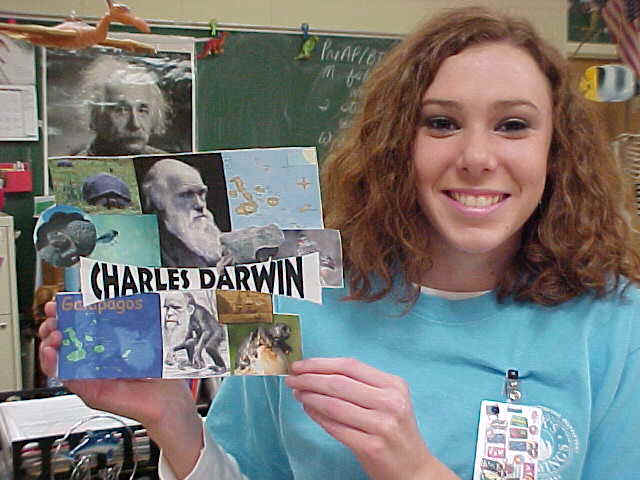
Charles Darwin’s Life and Studies

Charles Robert Darwin was his name.
The evolution theory was his claim to fame.
He studied theology and received his bachelor’s degree,
from a highly noted school, Cambridge University.

Darwin was a naturalist on a British expedition.
To study plants and animals was his mission.
The H.M.S Beagle sailed far and near.
Darwin found new animals in places rare.

Darwin had a large collection of fossils
He knew that his finds were colossal.
The fossils connected life old and new.
And from this his theory grew.

After studying his organism collection.
He developed the theory, natural selection.
Survival of the fittest was another name,
for the natural selection game.

The people of his time were shocked by his theory.
Of humans from monkeys, they were wary.
Darwin’s theories impacted religious thought.
And changed the science that was taught. 

Darwin lived until 1882,
but his work is still studied by me and you.


The Man Behind Evolution 

An English Naturalist named Charles Darwin made many contributions
For he was best known for his statement on the theory of evolution.
In his revolutionary book, “The Origin of Species by Natural Selection,”
Darwin stated the facts he knew about evolution and with that he started a collection.
He presented the vast array of facts based on the development of animals and plants,
He studied from flowers, trees, and shrubs all the way to finches and ants.
In a 2nd book “The Descent of Man”,
Darwin applied his theory to the human race and he knew he had discovered a plan.
Darwin was born in the town of Shrewsbury and at the University of Edinburgh and Cambridge is where he began to learn,
His father wanted him to be a clergyman, but without his interest at cause, his fame he would not have earned.
After graduation he began an expedition on the H.M.S. Beagle where he set sail,
He explored for five years of different animals and plants that he would soon prevail.
Back to England to study the theory of evolution he came,
Darwin received credit for the development of the theory and to this is how he earned his well-known name.
While in South America in April 19, 1882, a disease called charges soon infected him,
But his theory of evolution and his facts worldwide and truly just began.

Galapagos Islands Ancestors of Birds
Galapagos Tortoises Volcanic Islands
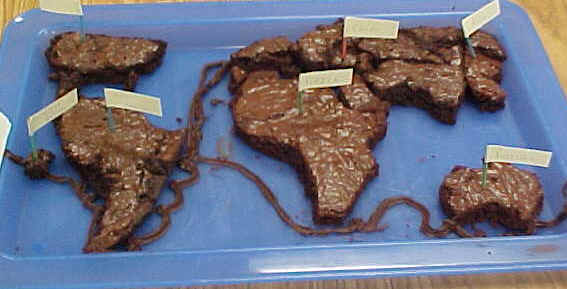
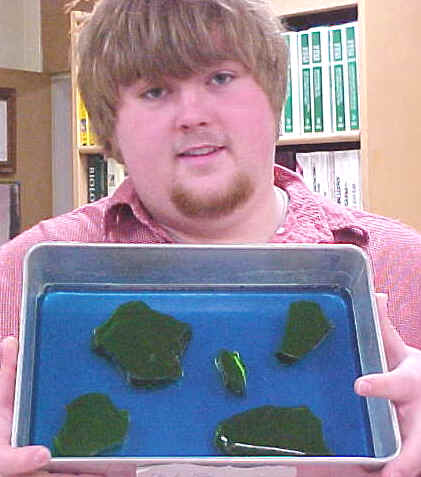
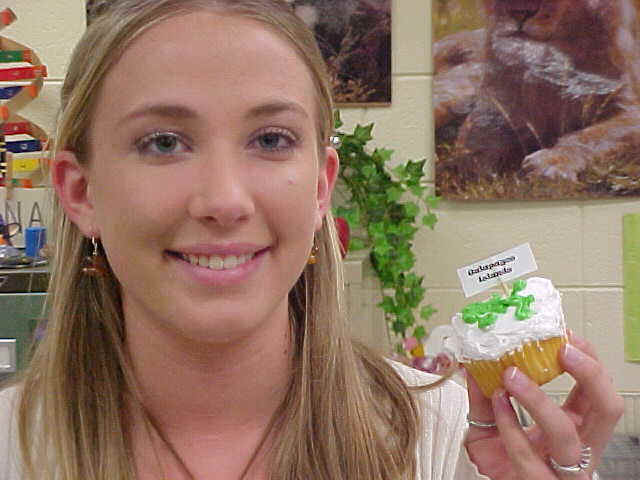
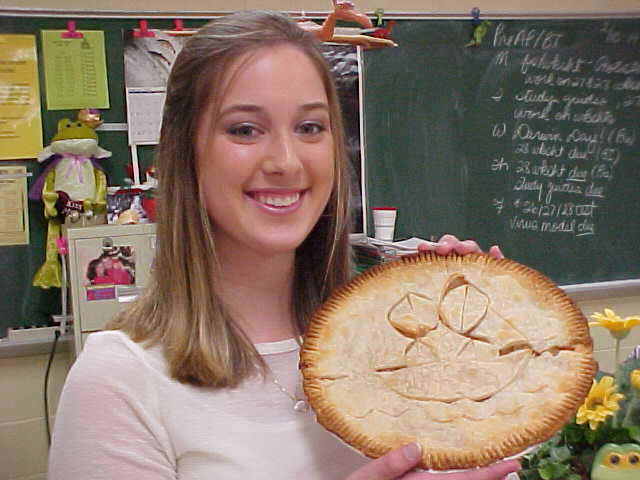
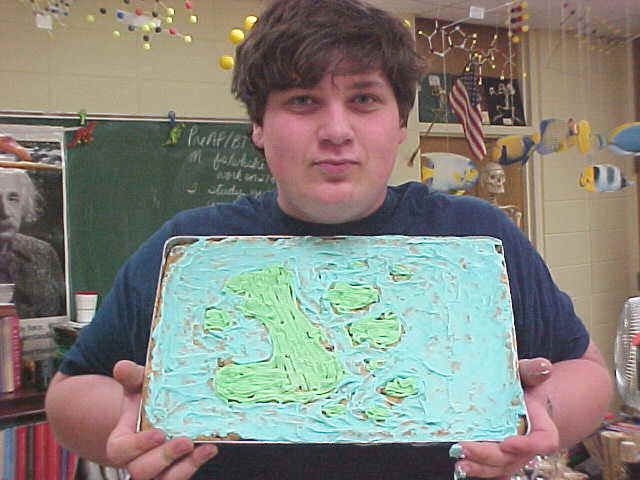
Galapagos Island “cupcakes” H.M.S. Beagle “pie”
Beaks of Finches Ground Finch
Off the Coast of South America Captain Fitzroy’s Ship
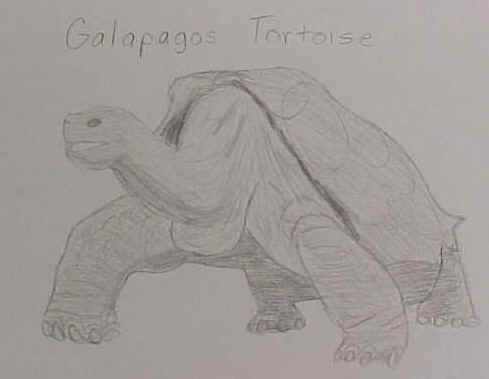
Galapagos Tortoise Darwin’s Life


   BACK


Calorimetry Sample Lab 3 PreAP


The Heat Is On    


Introduction:

Energy comes in a variety of forms: light, heat, motion, electricity, and so forth. The energy in food is measured in units of Calories. A Calorie is defined as the quantity of heat it takes to raise the temperature of 1 kg of water 1 degree Celsius. The energy in food is defined in terms of heat because the quantity measured is heat produced upon burning the food. Burning in the presence of oxygen is the process of combustion. Complete combustion results in the production of energy as well as carbon dioxide and water.

Plants utilize sunlight throughout photosynthesis to convert carbon dioxide and water into glucose and oxygen.  This certain glucose has energy stored in its chemical bonds that can also be used by other organisms.  This stored energy can be released whenever these chemical bonds are broken in metabolic processes for instance cellular respiration.  When this experiment partakes you will have to measure the amount of energy that is available for use from types of nuts, preferably pecan because they have the most oil to burn.  The process you are doing is known as calorimetry.

Hypothesis:

            If calories are measured by the heat given off from the burning nut changing the temperature in the given amount of water, then the energy stored in the nut can be measured.

Materials:

The materials needed to construct this experiment are a large paper clip, thermometer, soft drink can, soft drink can with openings cut into the side, one whole pecan, matches, water, pencil and paper, scissors, plastic tray, graduated cylinder, calculator, and a electronic balance.

Methods:

            First, carefully cut out two openings along the side of a soft drink can.  This will serve as your support for the second drink can that will contain water and sit on top. Then bend a large size paper clip so that a nut can be attached on one end and the other end will sit flat inside the cut out soft drink can.  Next, use the graduated cylinder to accurately measure 100g of water. Pour this water into the uncut soft drink can.  Then use the thermometer to measure the temperature©.  Record this temperature on the data table.  Mass the nut (g) that you will burn and record this mass on your data table.  Next, attach the nut to the bent end of your paper clip and carefully set the clip and nut into the cut-out soft drink can on bottom.  Make sure the cans are sitting on a flat, nonflammable surface!  Carefully light the nut using a match and record the change in water temperature as the nut burns.  Record the final water temperature as the nut burned.  Then measure the mass (g) of the remaining nut and record this in the data table.  Complete the data table by calculating the change in mass of the nut and the temperature of the water.  If you have enough time repeat this experiment with a different type of nut but remember to always start with cold water and to take the initial and final water temperature and mass of the nut.

Results:

Data Table 1

Nut used pecan

Before Burning

After Burning

Difference

Mass of nut (g) 1.4 g .1 g 1.3 g
Temperature of water © 22 © 41 © 19 ©

Data Table 2

Mass of the burned pecan 1.3 g
Temperature change of 100mL of water 19 degrees C
Calories required to produce temperature change in 100mL of water 1900 calories
Calories per gram contained in the pecan 1357.1

 Questions:

  1. What is the relationship between matter and energy? The more the matter the more the energy.
  2. What do we call stored energy and where is energy stored in compounds such as glucose? We call it glycogen, and its stored in the bonds.
  3. Discuss what happened to the energy stored in the nut? It was released by the heat.
  4. Why was the mass of the less after burning?  The oils in the nut were evaporated.
  5. How do our bodies make use of this process? They break down the glucose to form energy known as glycogen.

Error Analysis:

Errors could have occurred if all the oils were not all evaporated during the process of burning of the pecan.  Also if you didn’t use the correct amount of water this could have caused an inaccurate measurement.

Discussion and Conclusion:

The temperature of the can with 100mL of water in it changed from the energy stored in the pecan.  The temperature of the water started out being 22 degrees C and as the pecan burned it released the energy and heated the water to 41 ©.  Also the mass of the pecan before it was burned was 1.4g and after burning was .1g.  One calorie equals the heat required to change the temperature of 1 gram of water 1degree C.  In this experiment, the temperature change was 19degrees C which meant 1900 calories were produced to change the temperature of the water.  With the mass of the nut before burning and the amount of calories required to change the temperature gave me the information to find that my pecan had 1357.1 calories in it.

BACK