Potato Osmosis Bi Lab


Potato Osmosis


Introduction:

A shipwrecked sailor is stranded on a small desert island with no fresh water to drink. She knows she could last without food for up to a month, but if she didn’t have water to drink she would be dead within a week. Hoping to postpone the inevitable, her thirst drove her to drink the salty seawater. She was dead in two days. Why do you think drinking seawater killed the sailor faster than not drinking any water at all? Today we explore the cause of the sailor’s death. We’ll prepare solutions of salt water to represent the sea, and we’ll cut up slices of potato to represent the sailor. Potatoes are made of cells, as is the sailor!

Objective:

The concentration of solute in a solution will affect the movement of water across potato cell membranes.

Materials:

potato, corer, 3 plastic cups, marker, salt, sugar, distilled water, paper, pencil, electronic balance, clock with second hand or timer, metric ruler, small ziplock plastic bag, foil or plastic wrap

Procedure:

Day 1

  1. Use a knife to square off the ends of your potato. Your potato’s cells will act like the sailor’s cells.
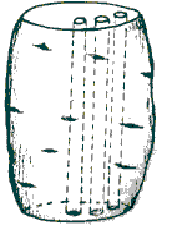
  2. Stand your potato on end & use your cork borers to bore 3 vertical holes.
  1. Remove the potato cylinders from the cork borer & measure their length in centimeters.
  2. Cut the 3 potato cylinders to the same length (about 4 -5 centimeters long).
  3. Record the length & turgidity of the potato cylinders in your data table (day 1).
  4. Place the 3 potato cylinders in a small ziplock bag to prevent them from dehydrating before they’re used.
  5. Take 3 plastic cups and label them with the solution that will be placed in each one — sugar, salt, distilled water.
  6. Prepare a saturated solution of salt by mixing as much salt as you can with water.
  7. Repeat this step by making a saturated sugar solution.
  8. Now fill each cup 2/3’s full of the correct solution —- sugar water, salt water, or distilled water.
  9. Mass each of the potato cylinders & record this mass in grams on your data table.
  10. Place one of your potato cylinders into each cup and cover the top of the cup with foil or plastic.
  11. Leave the potato cylinders in the solution for 24 hours.

Day 2

  1. Carefully remove the potato cylinder from the distilled water solution & pat it dry on a paper towel.
  2. Measure the length of the potato cylinder & record this length & the appearance of the cylinder on your data table. (day 2)
  3. Measure & record the mass of this cylinder.
  4. Repeat steps 13-15 for the potato cylinders in the salt solution & the sugar solution.
  5. Clean up your equipment & area and return materials to their proper place.

Data:


Results of Osmosis in Potato Cells
Solution Initial length
cm
(day1)
Final length
cm
(day2)
Change in length
cm
Initial Mass
g
(day1)
Final Mass
g
(day2)
Change in mass
g
Initial Turgidity
(flaccid or crisp)
Final Turgidity
(flaccid or crisp)
Tonicity of Solution
(iso-, hypo-, or hpertonic)
Distilled water
Salt Solution
Sugar Solution


Results & Conclusions:

1. Did any of the potato cylinders change in their turgidity (flexibility), and if so, which ones changed?


2. Explain why the flexibility of the potato slices changed.


3. Define isotonic, hypotonic, & hypertonic solutions.


4. If potato slices changed in length or turgidity, what process was responsible for this?


5. Make a sketch of your potato cylinder in the distilled water and use arrows to show the direction of water movement across the potato cell membranes.


6. What type of solutions were the salt & sugar solutions. Explain how you know this.


7. Which solution served as the control for this experiment & why?


8. In which solutions was their a greater solute concentration outside of the cells?


9. In which direction did water move through these cell membranes?


10. In what type of solution do plant cells do best & why?


11. Using the information you’ve discovered from this experiment, explain why the sailor died that drank saltwater.


BACK

Pedigree Lab

Constructing a Pedigree

Introduction

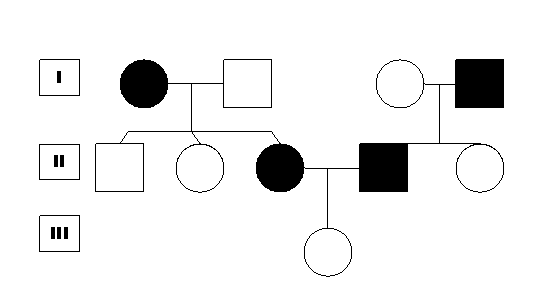
A pedigree is a special chart or family tree that uses a particular set of standardized symbols. Pedigrees are used to show the history of inherited traits through a family. In a pedigree, males are represented by squares and females by circles . An individual who exhibits the trait in question, for example, someone who suffers from hemophilia, is represented by a filled symbol or . A horizontal line between two symbols represents a mating . The offspring are connected to each other by a horizontal line above the symbols and to the parents by vertical lines. Roman numerals (I, II, III, etc.) symbolize generations. Arabic numerals (1,2,3, etc.) symbolize birth order within each generation. In this way, any individual within the pedigree can be identified by the combination of two numbers (i.e., individual II3).

Objective

Inherited traits can be traced through a family’s history by constructing a pedigree chart.

Materials

Large sheet of paper or poster board
Markers
Ruler
Protractor

Procedure
Part 1

1.      Examine Figure 1 that traces the ability to roll your tongue through three generations in a family. Remember: Blackened circles show the trait and circles are females and squares are male.

2.    Determine which parents and which offspring would be able to roll their tongue.  

FIGURE 1


Part 2

3.    Read the Passage 1 about the Smith family and their inherited trait of dimples.

4.    After reading the passage, construct a pedigree showing all family members in each generation that does and does NOT have dimples.

5.    Once the pedigree is constructed, write the correct genotype by each person in the family.


Passage 1

Grandfather and Grandmother Smith smiled a lot and showed off their dimples each time. They had a son named John, who had dimples, and daughter named Julie, who did not. Julie died at an early age, but her brother John Smith met and married Mary Jones because she had the most beautiful dimples when she smiled. They had 5 children, 2 boys and 3 girls. Only one of their sons, Tom, had dimples, but both girls, Judy and Kay, had dimpled smiles. Their sister June lacked dimples. After college, Tom met and married Jane Kennedy who also had dimples. They had 3 children, all girls, who shared their parent’s dimpled smile. Tom’s sister Kay married a lawyer named James who seldom smiled and didn’t have dimples. Their only son Matthew was like his mother when he smiled. Judy never married. Tom’s sister, June, married a doctor and had 5 children. Three of the children were boys, Jay, Fred, and Mike. Mike and Fred had dimples like dad, but Jay’s smile was like his mom’s lacking dimples. One sister, Susan, had dimples, but the other, Katherine, didn’t.


Questions

1.      What type of information does a pedigree contain?

2.    How do you show the presence of a trait in a pedigree?

3.    How do you denote males & females in a pedigree?

4.    From your pedigree, is the presence of dimples a dominant or recessive trait?

5.     How could examining a family pedigree be helpful to a couple wanting to have children?


Perch Dissection 2


Perch Dissection


Introduction:

The fish in the class Osteichthyes have bony skeletons. There are three groups of the bony fish — ray-finned fish, lobe-finned fish, and the lung fish. The perch is an example of a ray-finned fish. Its fins have spiny rays of cartilage &/or bone to support them. Fins help the perch to move quickly through the water  and steer without rolling. The perch also has a streamline body shape that makes it well adapted for movement in the water. All ray-finned fish have a swim bladder that gives the fish buoyancy allowing them to sink or rise in the water. The swim bladder also regulates the concentration of gases in the blood of the fish. Perch have powerful jaws and strong teeth for catching and eating prey. Yellow perch are primarily bottom feeders with a slow deliberate bite. They eat almost anything, but prefer minnows, insect larvae, plankton, and worms.  Perch move about in schools, often numbering in the hundreds.

The scientific name for the yellow perch, most often used in dissection, is Perca flavescens (Perca means “dusky”; flavescens means “becoming gold colored”). The sides of the yellow perch are golden yellow to brassy green with six to eight dark vertical saddles and a white to yellow belly. Yellow perch have many small teeth, but no large canines. Yellow perch spawn from mid-April to early May by depositing their eggs over vegetation or the water bottom, with no care given. The eggs are laid in large gelatinous adhesive masses.

Prelab Questions (Click Here)

Materials:

Preserved perch, dissecting pan, scalpel, scissors, forceps, magnifying glass, dissecting pins, apron, gloves, eye cover, tape measure

Procedure (External Anatomy):

  1. Obtain a perch & rinse off the excess preservative. Place the perch in your dissecting pan.
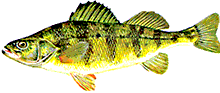
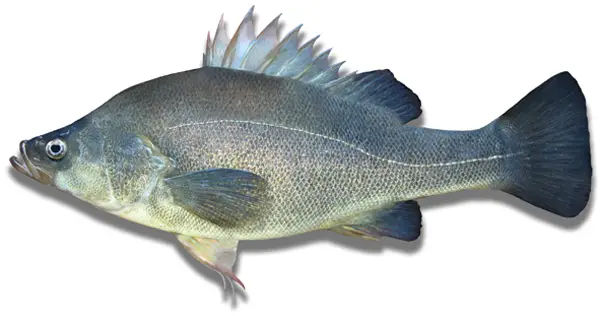
  2. Label the anterior, posterior, dorsal, and ventral sides of the perch on Figure 1.
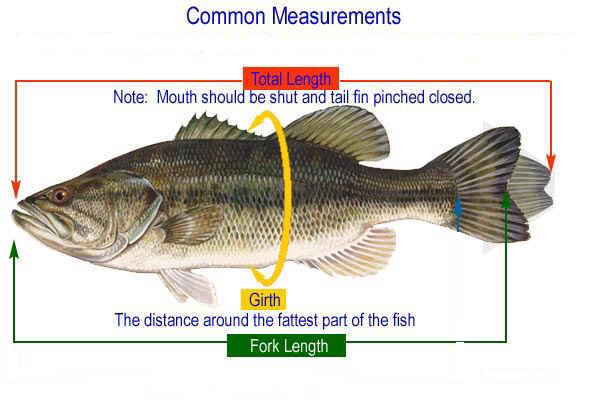
  3. Use your tape measure to determine the total length, fork length, and girth of your fish. Record  this in Table 1.

Table 1 – Fish Measurements (inches)


Total Length
Fork Length
Girth


  1. Locate the 3 body regions of the perch — head, trunk, and tail. Label these on Figure 1.
  2. Open the perch’s mouth and observe its bony jaws. Locate and label the upper jaw or maxilla and the lower jaw or mandible.
  3. Feel the inside of the mouth for the teeth. Locate & label the tongue & teeth on Figure 1.
  4. Open the mouth wider and use a probe to reach back to the gill chamber.
  5. Locate the nostrils and label on Figure 1.
  6. Locate and note the location of the eyes. Label on Figure 1.
  7. Find the bony covering on each side of the fish’s head called the operculum. The opercula cover & protect the gills. Label these on Figure 1.

Figure 1 – External Perch anatomy

  1. Use a probe to lift the operculum and observe the gills. Note their color.
  2. Use a scissors to cut away one operculum to view the gills. Find the gill slits or spaces between the gills.
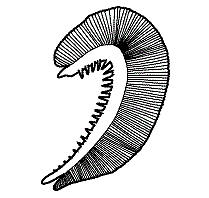
  3. Use your scalpel to carefully cut out one gill. Find the cartilage support called the gill arch and the soft gill filaments that make up each gill. Label the parts of the gill in Figure 2.

Figure 2 – Gill Structure

  1. Observe the different fins on the perch. Locate the pectoral, dorsal, pelvic, anal, and caudal fins. Note whether the fin has spines. Label these on Figure 1 and complete Table 2 on fins.

Table 2 – Fins


Name of Fin Spines
(yes or no)
Number of Fins Location Function


  1. Locate the anus on the perch anterior to the anal fin. In the female, the anus is in front of the genital pore, and the urinary pore is located behind the genital pore. The male has only one pore (urogenital pore) behind the anus. Determine the sex of your perch.
  2. Find the lateral line on the side of your perch. Label this line on Figure 1.
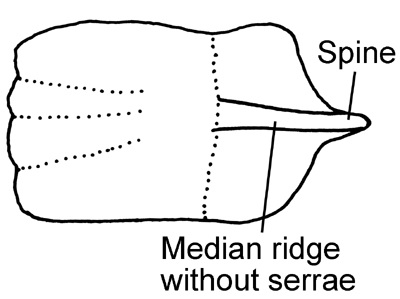
  3. Use forceps to remove a few scales from your fish. Observe the scales under the magnifying glass. Sketch a scale on Figure 3.

Figure 3 – Structure of a Scale


  1. Count the growth rings on your scale to tell the age of your fish. (Hint: each ring represents one year’s growth.)


Procedure (Internal Anatomy):

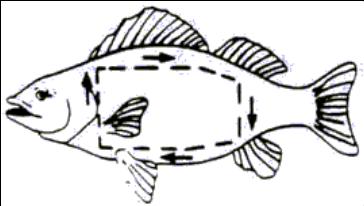
  1. Use dissecting pins to secure the fish to the dissecting pan. Use scissors to make the cuts through skin and muscle shown in Figure 4.

Figure 4 – Cut Lines for Internal dissection

  1. After making the cuts, carefully lift off the flap of skin and muscle to expose the internal organs in the body cavity.
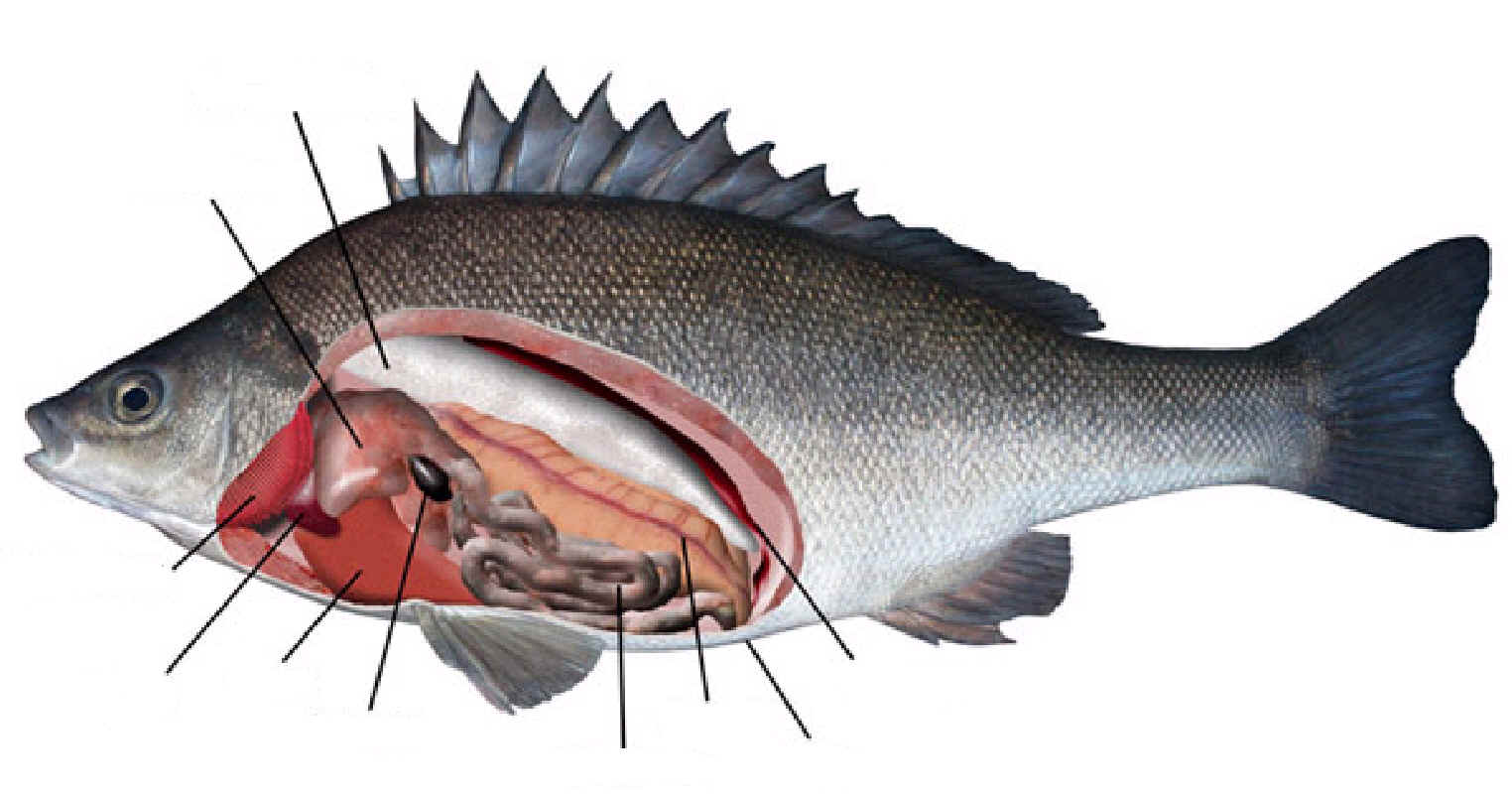
  2. Locate the cream colored liver in the front of the body cavity. Also locate the gall bladder between the lobes of the liver. Label these on Figure 5.
  3. Remove the gall bladder & liver to observe the short esophagus attached to the stomach. Label the stomach on Figure 5
  4. At the posterior end of the stomach are the coiled intestines. Locate and then label these on Figure 5.
  5. Find the small reddish brown spleen near the stomach and label this on Figure 5.
  6. Below the operculum, are the bony gill rakers. Locate these & them label them on Figure 5.
  7. In front of the liver & behind the gill rakers is the pericardial cavity containing the heart. The heart of a fish only has 2 chambers — an atrium & and a ventricle. Locate the heart & label it on Figure 5.
  8. In the upper part of the body below the lateral line is the swim bladder. This sac has a thin wall and gives the fish buoyancy. Label the swim bladder on Figure 5.
  9. Below the swim bladder are the gonads, testes or ovaries. In a female, these may be filled with eggs. Label the gonads on Figure 5.
  10. Find the 2 long, dark kidneys in the posterior end of the perch. These filter wastes from the blood. Label the kidneys in Figure 5.
  11. Wastes exit the body through the vent located on the ventral side of the perch. Label this structure on figure 5.

Figure 5 – Internal Perch Anatomy

Questions & Observations:

1. Are both jaws of the fish equally movable? Explain your answer.


2. Does the perch have eyelids?

3. How many gills are located on each side of the perch? What covering protects them?

4. What is the function of the gill rakers?

5. Explain how gas exchange occurs at the gills.


6. Which fin was the largest? What other difference do you notice in this fin when it was compared to the others?


7. What was the sex of your fish?

8. What is the function of the lateral line?


9. Describe how the scales are arranged on the trunk & tail of your fish.


10. Explain how the swim bladder controls buoyancy.

pH in Living Systems


pH and Living Systems


Introduction:

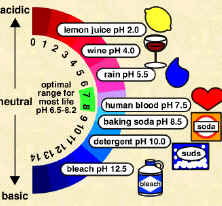
Scientists use something called the pH scale to measure how acidic or basic a liquid is. The scale goes from 0 to 14. Distilled water is neutral and has a pH of 7. Acids are found between 0 and 7. Bases are from 7 to 14. Most of the liquids you find every day have a pH near 7. They are either a little below or a little above that mark. When you start looking at the pH of chemicals, the numbers go to the extremes. Substances with the highest pH (strong bases) and the lowest pH (strong acids) are very dangerous chemicals. Molecules that make up or are produced by living organisms usually only function within a narrow pH range (near neutral) and a narrow temperature range (body temperature). Many biological solutions, such as blood, have a pH near neutral.

The biological molecule used in this lab is a protein found in milk. Proteins are used to build cells and do most of the cell’s work. They also act as enzymes. For proteins to work, they must maintain their globular shape. Changing the shape of a protein denatures and the protein will no longer work.

Materials:

Small squares of wide-range pH paper, pH color chart, paper towels, 4 dropper bottles, ammonia, lemon juice, skim milk, distilled water, forceps, 50 ml beakers, small squares of narrow-range pH paper, 2 stirring rods

Procedure (part A): Testing the pH of Substances

  1. Line up 4 squares of wide-range pH paper about 1 cm apart on a paper towel.
  2. Put one drop of distilled water on the pH square.
  3. Compare the color of the pH paper to the color chart and record the pH in data table 1.
  4. Repeat this procedure for the ammonia, lemon juice, and skim milk.

Questions (Part A): Determining the pH of Solutions

  1. Which substance was the most acidic?
  2. Which substance was the most basic?
  3. Did any of the substances have a pH close to neutral? Name them.

Procedure (part B): Showing the Effect of pH on a Biological Molecule (Milk Proteins)

  1. Place 100 drops of skim milk in a 50 ml beaker.
  2. Pick up a piece of narrow-range pH paper with forceps.
  3. Touch the pH paper to the milk and remove it.
  4. Compare the color of the pH paper to the pH color chart.
  5. Record the initial pH in data table 2.
  6. Add a drop of lemon juice to the milk in the cup & stir with a stirring rod. Keep track of how many drops you add to the milk!
  7. Measure and record the pH of the solution with the narrow-range pH paper.
  8. Repeat step 7 until you notice an obvious change in the appearance of the milk. record this final pH and appearance of the milk in your data table.
  9. Repeat steps 1-8 using a clean 50 ml beaker and fresh milk, and substitute ammonia for the lemon juice.
  10. Add drops of ammonia to the milk until the change in pH of the milk is equal to the change in pH you measured in step 8. Be sure to keep track of the number of drops added. HINT: If the pH changed by 2 units with the lemon juice, then add ammonia until you also get 2 pH units of change!

Data:

Table 1


Substance Tested pH Acid Base Neutral


Table 2

Substance Tested Substance used to Produce Change Starting pH of Milk Final pH of Milk Original Appearance of Milk Final Appearance of Milk Total Number of drops added to Produce the change
100 drops Skim Milk Lemon Juice
100 drops Skim Milk Ammonia

Questions:

1. Which substance tested from table 1 was the most acidic?

2. Which substance was most basic?

3. Did any substance from table 1 have a neutral, or near neutral pH? If so, which substance was neutral?

4. Why did you use narrow-range pH paper to measure the milk’s change in pH?


5. Describe the change in appearance of the milk as more lemon juice was added. Explain why this change occurred.


6. How much did the pH of milk change when lemon juice was added?

7. Why do you think lemon juice “curdled”  (precipitated out the proteins) from the milk?


8. Did you get the same change when ammonia was used? Why or why not?


Photosynthesis Worksheet Ch6 BI


Photosynthesis


Section 6-1 Capturing Light Energy

1. All organisms require ___________________ to carry out their life functions.

2. ___________________ is the ultimate energy for all life on earth.

3. During photosynthesis, the energy from the sun is stored within _____________________

compounds, mainly the sugar _______________________.

4. What organisms can carry on photosynthesis?

5. Name several autotrophic organisms.

6. What is a biochemical pathway and give an example?

7. What gas is used by autotrophs & what gas is produced?

8. What organisms release stored energy from organic compounds through cellular respiration?

9. Draw the diagram showing energy storage & transfer between autotrophs & heterotrophs. (Figure 6.1)

10. What are the light reactions of plants and in what organelle do they occur?

11. Draw & label the parts of a chloroplast. Tell the function of each labeled part.

12. Flattened sacs in chloroplasts are known as ____________________ and are

_______________________ to each other.

13. Thylakoid sacs in chloroplasts are called _____________________________.

14. What gel-like solution surrounds the thylakoids inside the chloroplast?

15. What is the visible spectrum?

16. Name the 7 colors that make up the visible spectrum.

17. What 3 things can happen to light that strikes an object?

18. What are pigments & what is their function in plants?

19. Is red light reflected or absorbed by an object if the object appears red to your eyes?

20. Name the most important chloroplast pigment & tell the 2 most important types of this pigment.

21. Only ________________________ is directly in capturing light energy.

22. Chlorophyll b is an example of an ______________________ pigment in plants.

23.Name another accessory pigment & tell what colors it includes. When could you see these colors?

24. Chlorophyll is most abundant in the _____________________ of a plant, while accessory
pigments appear more in the _________________________ and fruits.

25. The _________________________ and ________________________ pigments are grouped
into clusters in the thylakoid membrane.

26. What is a photosystem?

27. Name the 2 types of photosystems.

28. The light reactions start when __________________ pigments absorb ______________.

29. Absorbed light is passed to a pair of ________________________ pigment molecules in
photosystem ________.

30. When light energy is absorbed by chlorophyll a molecules, what happens to its electrons?

31. Once these electrons become “excited”, they have enough energy to do what?

32. What are the chemicals called that pick up these freed electrons & where are they located?

33. These electrons lose _________________ as they are passed through a series of molecules
called the ______________________________________ chain.

34. Photosystem I chlorophyll molecules also absorb ________________, and its electrons
eventually combine with ______________________ to form NADPH.

35. What would happen if the electrons lost from photosystem II weren’t replaced?

36. ________________________ provides the replacement electrons for photosystem II when
water is __________________________.

37. Write the equation for the splitting of a water molecule.

38. What important gas is released when water is split?

39. ______________ or energy for a cell is synthesized during the light reactions in a process
called ________________________________.

Section 6-2 Calvin Cycle

40. The _________________ cycle is the second set of photosynthetic reactions that uses energy
stored in ________________ and _____________________ to make __________________
compounds.

41. Carbon atoms from ______________ are “fixed” into organic compounds in the Calvin
cycle in a process called carbon _________________________.

42. In what part of the chloroplast does the Calvin cycle occur?

43. Carbon dioxide combines with _______________ to make two molecules of
_____________________________.

44. PGA is converted into ________________, ADP, _________________, and
phosphate.

45. Carbohydrates made from PGAL in the Calvin cycle include the monosaccharides
______________________ and ______________________, the disaccharide
_______________________, and polysaccharides such as _____________________,
________________________, and _______________________.

46. Write the balanced equation for photosynthesis. (See bottom of page 118.)

47. Plants that fix carbon through the Calvin cycle are called what type of plants?

48. What are stomata & where are they located?

49. When would plant cells need to close or partially close their stomata?

50. Name 2 alternate carbon-fixing pathways used by plants in hot climates.

51. Plants that close their stomata during the hottest part of the day thus fixing carbon into four
carbon compounds are called ______________________. Name three.

52. CAM plants open stomata at ______________ and close during the _________________.

53. Name 3 environmental factors that affect the rate of photosynthesis.

BACK