Natural Selection Activity


Survival of the Fittest


Introduction:

  Within a population, organisms will vary.  Charles Darwin stated that in the struggle for existence, those variant organisms that have favorable variations are “better adapted” to their environment and will survive and reproduce in greater numbers.  Favorable variations may mean that they are faster, or stronger, or able to eat different types of food, or better camouflaged to avoid predators.  In this lab you will simulate the effect of predation by a hawk on a large population of assorted mice.  Your population of mice will consist of black, white, and speckled mice.  You will represent the hawk.

Objectives:

 to simulate the effect of hawk predation on the appearance of mice
-to simulate the natural selection of traits

Materials:

large sheet of newspaper  4 hawks (students)
30 white mice (paper squares) 1 petri dish
30 speckled mice (paper squares)
30 black mice (paper squares)

Procedure:

  1. Open your sheet of newspaper and place it on the lab table.  This will serve as the environment for your mice.
  2. Place the petri dish on the other side of the lab table.  This will be the nest.
  3. Select one person from your group to act as a hawk.  This person should stand by the nest.
  4. Spread the mice on their environment evenly.
  5. The hawk now swoops over and has 1 minute to pick up as many mice as possible. The hawk may only pick up one mouse at a time, and must place it in their nest (a petri dish) before flying back to pick up another.  The goal is to pick up as many mice as possible in the time period.
  6. When the time is up record the number of mice left in the environment in the data table below.
  7. Repeat this procedure for each person in the lab group or 4 times. 
  8. After all data is collected, construct a bar graph. Be sure to label the graph and its axes.
  9. Data:


White
mice
Speckled mice
Black
mice
Hawk #1  


Hawk #2  


Hawk #3  


Hawk #4  


Total  


Conclusion:
 Write a paragraph describing;

* the purpose of the lab

* what you thought the results would be

* what the results were (discussing numbers from data)

*how the mouse population and hawk population may change over time from natural selection


Natural Selection Peanut Activity


Natural Selection Within a Species


Introduction:

Natural selection is the evolutionary process by which the most adaptable individuals survive. An adaptation is an inherited variation that helps an organism to survive. When the organism survives, its chances of reproduction are increased as well as its ability to pass on its inherited traits.  All members of a species are different from one another.  In this activity, you will investigate two variations among peanut plants — length of shell and number of seeds per shell.   Most shells contain a certain number of seeds which is an adaptation to its survival.  

Objective:

Students will investigate natural selection in peanuts.

Materials:

50 peanuts in shells, metric ruler, pencil, graph paper

Procedure:

  1. Count out 50 peanuts in their shells.
  2. Use a metric ruler to measure the length of each shell in millimeters.  Put a check mark in Table 1 in the space indicating the length of the shell.
  3. Open the shell and count the number of seeds inside.  Put a check mark in Table 2 in the space next to the number of seeds that you counted. 
  4. Repeat steps 1 – 3 for the other 49 peanuts.
  5. Set up two bar graphs using the headings from each table as the axes for each graph.
  6. Plot a bar graph from the data in each table.

Data:

Table 1


Length of Shell
(mm)
Number of Shells
5-10
10-15
15-20
20-25
25-30
30-35
35-40
40-45
45-50
50-55
55-60
60-65
65-70
70-75


Table 2


Number of Seeds Per Shell Number of Shells
1
2
3


Title: ________________________________________________________


Title: ________________________________________________________


Questions:

  1. What is the most common length of the shells you measured?
  2. What was the most common number of seeds in the peanut shells that you opened?
  3. What might happen if each shell contained fewer than normal seeds and why?
  4. What might happen if each shell contained more than the normal number of seeds and why?
  5. Was there a relationship between the most common length of shells and the number of seeds they contained? Explain your answer.
  6. Write 1-2 paragraphs explaining how shell length and seed number in peanuts illustrates natural selection within this species.


Nucleotide Model preap


Model of a Nucleotide


Introduction

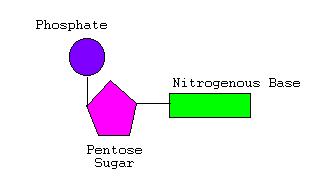
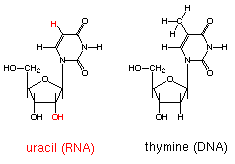
Nucleotides consist of three parts — a pentose sugar, a nitrogen-containing base, and a phosphate group. A pentose sugar is a five-sided sugar. There are 2 kinds of pentose sugars — deoxyribose and ribose. Deoxyribose has a hydrogen atom attached to its #2 carbon atom (designated 2′), and ribose has a hydroxyl group atom there. Deoxyribose-containing nucleotides are the monomers of DNA, while Ribose-containing nucleotides are the monomers of RNA.

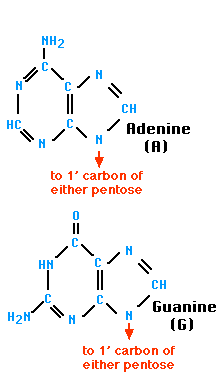
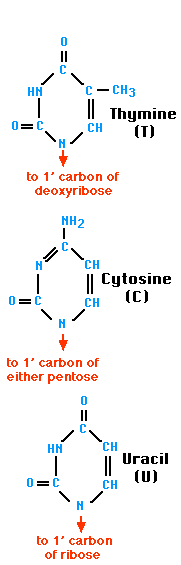
A nitrogen-containing ring structure is called a base. The base is attached to the 1′ carbon atom of the pentose. In DNA, four different bases are found — two purines, called adenine (A) and guanine (G) and two pyrimidines, called thymine (T) and cytosine (C). RNA contains The same purines, adenine (A) and guanine (G).  RNA also uses the pyrimidine cytosine (C), but instead of thymine, it uses the pyrimidine uracil (U).


The Purines The Pyrimidines

The combination of a base and a pentose is called a nucleoside.  A phosphate group is attached to the 5′ carbon of the pentose sugar.

Objective

Students will construct a 3-dimensional model of a single nucleotide, the monomer of which nucleic acids are composed.

Materials

Various materials may be used for the atoms that make up a nucleotide such as styrofoam balls, plastic coke bottle caps, beads, etc. Bonds between atoms may be made from toothpicks, plastic stirring sticks, popsicle sticks, etc. Single & double bonds must be represented by the correct number of “sticks”. The atoms and bonds may NOT be made of any food item. Your model should be glued together to make the model rigid for hanging. Attach string and a label with the nucleotide’s name to your model. Models must be sturdy, light weight, and small enough to hang from the ceiling.

Color Code for atoms:

CARBON – BLACK
HYDROGEN – YELLOW
OXYGEN – RED
NITROGEN – BLUE

Structural Formulas of Nucleotides:

Uracil Nucleotide (Ribose ) & Thymine Nucleotide (Deoxyribose)


Adenine Nucleotide (Deoxyribose)
Cytosine Nucleotide (Deoxyribose)
Guanine Nucleotide (Deoxyribose)


Origin of life PPT Qs

Origin Of Life
ppt Questions

Early Thoughts on Life

1. What was Aristotle’s idea about how life arose called?

2. What is another name for spontaneous generation?

3. Explain spontaneous generation of life.


4. How long did the idea of abiogenesis or spontaneous generation last?

5. The idea of abiogenesis lasted so long because, instead of testing their ideas, people based their beliefs on what?


6. Were their observations tested?

7. Did they use the scientific method for their observations?

Examples of Spontaneous Generation

8. What observation about new life did Egyptians make when the Nile River flooded each year?


9. What observation about new life did Medieval farmers make when they stored their grain each year?


10. The English people centuries ago, threw their garbage and sewage out on the streets. What observation about new life did these people make?


11. This practice led to a plague that killed many Europeans. What was this plague called and what carried the disease organism?


12.Before refrigerators, large slabs of meat were hung after being purchased. What observation about new life was made from this practice?


13. People believed so strongly in abiogenesis that they had recipes for making living things. Name two organisms that had accepted recipes.


Disproving Spontaneous Generation

14. Francesco ____________ was an early scientists who conducted experiments to try and disprove spontaneous generation.

15. What was Redi’s hypothesis?


16. Explain how Redi tried to prove this.


17. What were the results Redi found in the closed jars & why?


18. What were the results in the open jars?


19. How did maggots appear in the open jars?


20. Complete this table summarizing Redi’s experiment:


Evidence Against Spontaneous Generation
Unsealed Jar
Sealed Jar
Gauze Covered jar


21. Redi’s experiment disproved spontaneous generation for _____________ organisms.

Use of the Scientific Method

22. Did Francesco Redi use the scientific method in his experiment?

23. What served as the control in Redi’s experiment?


24. What jars served as the experimental groups?

25. What was Redi’s conclusion?


Disproving Spontaneous Generation of Microbes

26. Anton Van _______________ made one of the first simple microscopes.

27. Leeuwenhoek called the living things he saw in pond water ______________.

28. By the end of the 19th century, these organisms were known as ______________.

29. John _____________ did experiments with microorganisms growing in broths.

30. Needham believed there was a __________ __________ present in nonliving substances like air.

31. Why were bacteria able to grow in Needham’s soups?


32. What could have been done to the broths to kill the bacteria already present?

33. What scientists repeated this experiment but with boiled broth?

34. After boiling, what did Spallanzani do to the tops of the bottles? how did this help?


35. Critics of Spallanzani’s experiment said there was not enough _______ for the bacteria to survive and that boiling had destroyed the _________ __________.

The Theory Changes

36. What did the Paris Academy of Science do in 1860 to solve the problem?


37.Who won the prize? 

38. What was Pasteur’s experimental hypothesis?


39. What was the shape of Pasteur’s flasks? Include a sketch.


40. What was the special S-shaped neck intended to do?


41. Did Pasteur boil the broth in his flasks? Why?


42. The flasks were left at ___________ locations.

43. Did the broth change cloudy because microbes were growing in it?


44. What was visible in the neck of the flask after collecting there?

45. Once the S-shaped stem was broken off the top of the flasks, what happened to the broth and why?


46. Pasteur’s S-shaped flasks kept ___________ out but let ______ inside.

47. Pasteur’s experiment proved that living things only come from other _________ ___________.

48. What is the name of Pasteur’s theory?

Review

49. Where did the maggots come from in Redi’s experiment?

50. What was the purpose of the sealed jars?

51. Redi was trying to disprove – spontaneous generation or biogenesis?

52. Where did the microbes come from in Needham’s broth?

53. Needham & Spallanzani were trying to disprove – spontaneous generation or biogenesis?

54.Who proved biogenesis?


Osmosis & Diffusion in Egg Lab


Osmosis & Diffusion in an Egg


Objective:
In this investigation, you will use a fresh hen’s egg to determine what happens during osmosis & diffusion across membranes.

Materials: (per lab group)
1-2 fresh hen eggs in their shells, masking tape & marker, distilled water, clear sugar syrup (Karo, for example), vinegar, clear jar with lid, tongs, electronic balance, paper towels, paper, pencil

Procedure:

Day 1   

  1. Label the jar with your lab group & the word “vinegar”.
  2. Mass the egg with the electronic balance & record in the data table.
  3. Carefully place the raw egg into the jar & cover the egg with vinegar.
  4. Loosely re-cap the jar & allow the jar to sit for 24 to 48 hours until the outer calcium shell is removed.

Day 2   

  1. Open the jar & pour off the vinegar.
  2. Use tongs to carefully remove the egg to a paper towel & pat it dry.
  3. Record the size & appearance of your egg in your data table.
  4. Mass the egg on an electronic balance & record.
  5. Clean and re-label the jar with your lab group & the word “distilled water”.
  6. Carefully place the egg into the jar & cover the egg with distilled water.
  7. Loosely re-cap the jar & allow it to sit for 24 hours.

Day 3   

  1. Open the jar & discard the distilled water.
  2. Use tongs to carefully remove the egg to a paper towel & pat it dry.
  3. Record the size & appearance of your egg in your data table.
  4. Mass the egg on an electronic balance & record.
  5. Clean and re-label the jar with your lab group & the word “syrup”.
  6. Carefully place the egg into the jar & cover the egg with clear syrup.
  7. Loosely re-cap the jar & allow it to sit for 24 hours.

Day 4   

  1. Open the jar & pour off the syrup.
  2. Use tongs to very carefully remove the egg & rinse off the excess syrup under slow running water.
  3. Pat the egg dry on a paper towel.
  4. Record the size & appearance of your egg in your data table.
  5. Mass the egg on an electronic balance & record.
  6. Clean up your work area & put away all lab equipment.

Data:


RESULTS OF DIFFUSION

Original Mass Final Mass Appearance of Egg
VINEGAR
WATER
SYRUP


Questions & Conclusion:

1. Vinegar is made of acetic acid & water. Explain how it was able to remove the calcium shell.


2. (a) What happened to the size of the egg after remaining in vinegar?

(b) Was there more or less liquid left in the jar?

   (c) Did water move into or out of the egg? Why?


3. (a) What happened to the size of the egg after remaining in distilled water?

(b) Was there more or less liquid left in the jar?

   (c) Did water move into or out of the egg? Why?


4. (a) What happened to the size of the egg after remaining in syrup?

(b) Was there more or less liquid left in the jar?

   (c) Did water move into or out of the egg? Why?


5. Was the egg larger after remaining in water or vinegar? Why?


6. Why are fresh vegetables sprinkled with water at markets?


7. Roads are sometimes salted to melt ice. What does this salting do to the plants along roadsides & why?