DNA Replication Lab

Modeling DNA Replication


Introduction

Within the nucleus of every cell are long strings of DNA, the code that holds all the information needed to make and control every cell within a living organism. DNA, which stands for deoxyribonucleic acid, resembles a long, spiraling ladder. It consists of just a few kinds of atoms: carbon, hydrogen, oxygen, nitrogen, and phosphorus. Combinations of these atoms form the sugar-phosphate backbone of the DNA — the sides of the ladder, in other words.

Other combinations of the atoms form the four bases: thymine (T), adenine (A), cytosine (C), and guanine (G). These bases are the rungs of the DNA ladder. (It takes two bases to form a rung — one for each side of the ladder.) A sugar molecule, a base, and a phosphate molecule group together to make up a nucleotide. Nucleotides are abundant in the cell’s nucleus. Nucleotides are the units which, when linked sugar to phosphate, make up one side of a DNA ladder.

During DNA replication, special enzymes move up along the DNA ladder, unzipping the molecule as it moves along. New nucleotides move in to each side of the unzipped ladder. The bases on these nucleotides are very particular about what they connect to. When the enzyme has passed the end of the DNA, two identical molecules of DNA are left behind. Cytosine (C) will “pair” to guanine (G), and adenine (A) will “pair” to thymine (T). How the bases are arranged in the DNA is what determines the genetic code.


When the enzyme has passed the end of the DNA, two identical molecules of DNA are left behind. Each contains one side of the original DNA and one side made of “new” nucleotides. It is possible that mistakes were made along the way — in other words, that a base pair in one DNA molecule doesn’t match the corresponding pair in the other molecule. On average, one mistake may exist in every billion base pairs. That’s the same as typing out the entire Encyclopedia Britannica five times and typing in a wrong letter only once!

Objectives

The replication of DNA before cell division can be shown using paper templates for the components of DNA nucleotides.

Materials

  • Cut Outs of basic subunits of DNA
  • Colors or markers
  • Scissors
  • Tape or glue
  • Paper & pencil

Procedure:

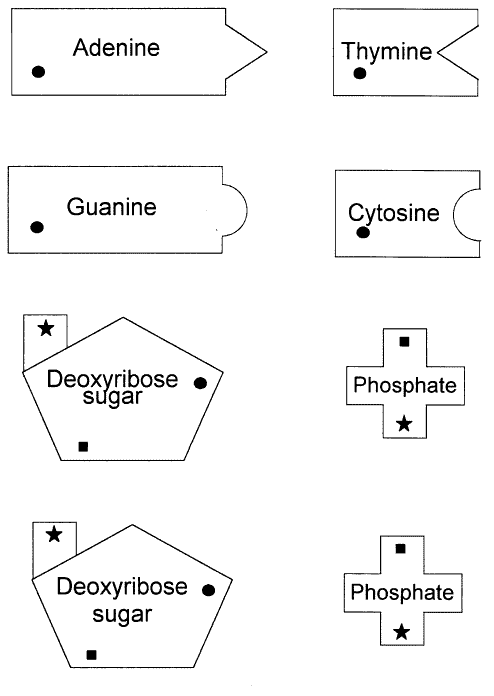
  1. Cut out all of the units needed to make the nucleotides from the handout provided.
  2. Color code the Nitrogenous bases, phosphorus, and deoxyribose sugar as follows —
    Adenine = red, Guanine = green, Thymine = yellow, Cytosine = blue, Phosphate = brown, and Deoxyribose = purple.
  3. Using the small squares and stars as guides, line up the bases, phosphates and sugars.
  4. Now glue the appropriate parts together forming nucleotides.
  5. Construct DNA model using the following sequence to form a row from top to bottom – cytosine (topmost), thymine, guanine, and adenine (bottommost).
  6. Let this arrangement represent the left half of your DNA molecule.
  7. Complete the right side of the ladder by adding the complementary bases. You will have to turn them upside down in order to make them fit.
  8. Your finished model should look like a ladder.
  9. To show replication, separate the left side from the right side, leaving a space of about 6-8 inches.
  10. Use the remaining nucleotides to complete the molecule using the left side as the base.
  11. Build a second DNA model by adding new nucleotides to the right half of the original piece of the molecule.
  12. Tape the nucleotides together to form 2 complete DNA ladders.

Questions

1. Of the 4 bases, which other base does adenine most closely resemble?

2. List the 4 different nucleotides.

3. Which 2 molecules of a nucleotide form the sides of a DNA ladder?

4. If 30% of a DNA molecule is Adenine, what percent is Cytosine?

5. What does the term replication mean?

6. What is another name for adenine and three phosphate molecules attached to it?


Ecology Worksheet Bi


Ecology


Chapter 19 Ecology


1. What is ecology?

2.. What is the most significant environmental change that is taking place today?

3. What is the sixth mass extinction?

4. What is the ozone layer, what does it do for earth, & what is happening to this layer & why?

5. Explain the green house effect.

6. List in order the ecological levels of organization.

7. What is the biosphere, tell where it extends, & tell why it is so important?

8. Define ecosystems & give an example.

9. What is a community?

10. What is a population?

11. What is the simplest ecological level of organization?

12. Use figure 19-6 on page 364 & explain how Lyme disease affects organisms in an ecosystem.

13. What are biotic factors & list them?

14. What are abiotic factors & list them?

15. Are abiotic factors constant? Explain by giving an example.

16.Organisms are able to survive within a _____________ range of environmental conditions.

17. Graphing the range of conditions an organism can survive is called a __________________ Curve.

18.When organisms adjust their tolerance to abiotic factors, the process is called ___________.

19. Explain how dormancy & migration help organisms escape unsuitable environmental conditions.

20. Define niche

Chapter 20 Populations

21. What is meant by population size?

22. What is meant by population density?

23. Name the 4 processes that determine whether a population will grow, shrink, or remain the same size.

24. What are immigration & emigration & how do they affect population size?

25. What are limiting factors & give some examples?

26. What affect does inbreeding have on small populations?

Chapter 21 Community Ecology

27. Interactions among species are called ____________.

28. List the 5 types of symbioses.

29. Define predator & prey & give an example.

30. What is mimicry & give an example?

31. Define these terms — parasitism, parasite, host, ectoparasites, & endoparasites.

32. When niches overlap, _________________________ results so more than one species are using the limited resources.

33. What are mutualism & commensalism?

34. Define succession.

35. Name & describe the 2 types of succession.

36. What are pioneer species & why are they important?

37. What is a climax community?

Chapter 22 Ecosystems

38. What are producers & what is another name they may be called?

39. What is biomass, why is it important, how does it accumulate, & what is its rate of accumulation called?

40. What is gross primary productivity?

41. All heterotrophs would be ______________________.

42. Define & give an example of each of these consumers — herbivore, carnivore, omnivore, detritivores, & decomposer.

43. Whenever one organism eats another, ________________ is transferred.

44. What are trophic levels?

45. All _______________ belong to the first trophic level, _______________ belong to the
Second trophic level, and the _______________ of herbivores belong to the third trophic level.

46. How many trophic levels do most ecosystems contain?

47. What is a food chain & what always begins the chain?

48. Write an example of a food chain.

49. What is a food web?

50. Draw a diagram of a food web that has at least 4 food chains.

51. Approximately __________ percent of the total energy consumed at one trophic level is incorporated into the organisms in the next level.

52. In terms of energy passage, why will there be many more producers than herbivores and fewer large carnivores than small carnivores?

53. What are biogeochemical cycles, why are they important, & name three?

54. Draw & explain the water cycle. Be sure to color your diagram!

55. List & define the 3 important processes in the water cycle.

56. What is groundwater?

57. What 2 processes form the basis for the carbon cycle?

58. Draw & explain the carbon cycle. Be sure to color your diagram!

59. What purpose do decomposers have in the carbon cycle?

60. Why do organisms need nitrogen?

61. Draw & explain the nitrogen cycle. Be sure to color your diagram!

62. Organisms such as ________________ convert _________________ gas into compounds
Called __________________ during the process known as________________________.

63. Bodies of dead organisms contain mainly in _________________ & _________________.

64. Wastes such as __________________ & _______________ also contain nitrogen that must be recycled.

65. ________________ recycle nitrogen from dead organisms & wastes by changing it into
______________________. The process is called ________________________.

66. Explain nitrification & denitrification.

67. Plants can absorb ____________________ from the soil, but animals obtain nitrogen from
their ___________________.

68. Define biome.

69. List the 7 major biomes.

70. Why don’t mountains belong to any one biome?

71. What is a tundra, where are they found, & tell organisms that would be found tree?

72. What is permafrost & how does it control plant life in the tundra?

73. What are taigas, where would they be found, & what type of vegetation dominates this area?

74. Plants & animals in the taiga must be adapted for long __________________, short
_________________, & ________________________ soil.

75. List some typical animals of the taiga.

76. What characterizes a temperate deciduous forest?

77. Deciduous forests have 4 pronounced ____________________ with _________________
summers, _______________________ winters, and__________________________ than the
taiga.

78. Grasses dominate what biome?

79. Why aren’t there more trees on grassland?

80. What are grasslands called in each of these areas —– North America, Asia, South America, & southern Africa?

81. Describe the soil of grasslands. Because of the soil condition, how is much of the grassland used?

82.What type of animals would be found on grassland?

83. What periodically occurs across grasslands & why doesn’t it kill the grasses?

84. Approximately how much rainfall do deserts receive each year?

85. Are deserts always hot? Explain.

86. What adaptation must desert vegetation make to survive?

87. What types of adaptations must desert animals make to conserve water?

88. What are savannas & where are the best known savannas found?

89. Describe temperature & rainfall on savannas?

90. Name some herbivores & carnivores found on a savanna.

91. Describe the rainy season on a savanna & tell what special problem this poses for the animals & plants there?

92. What are tropical rain forests & where are they located?

93. Rain forests have stable, year-round ______________________ & abundant ____________.

94. Plants in the rainforest must constantly compete for what?

95. Explain the canopy & epiphytes in a rainforest.

96. Describe the plant & animal life in a rainforest.

97. Tropical rainforests are more commonly called _____________________.

98.Oceans cover what percent of the earth’s surface?

99. Draw, label, & color the zones found in the ocean (see figure 22-16). Define each term labeled on your drawing.

100. What are intertidal organisms exposed to & name some intertidal organisms.

101. Which zone in the ocean is the most productive & why?

102. What small organisms are found in the neritic zone & why are they important?

103. In tropical areas, what forms in the neritic zone & why are they important?

104. Which ocean zone has fewer species & why?

105. Where does most of the earth’s photosynthesis take place?

106. Animals in the aphotic zone feed on what?

107. Organisms living deep in the ocean must cope with what 2 problems? Give some examples of deep ocean animals & explain how they adapt to their environmental problems.

108. What are volcanic vents, when were they discovered, & describe the organisms found there?

109. What are estuaries & what special problem do estuary organisms face?

110. What characterizes freshwater zones & give several examples?

111. Name & describe the 2 categories into which ecologists divide lakes 7 ponds?

112. Define a river & describe organisms found there?

Chapter 23 Environmental Science

113. Where do upwellings occur & how are they helpful?

114. Describe the event known as El Nino & tell its effect.

115. Describe chlorofluorocarbons effect on the ozone layer & tell why we should be concerned?

116. Define biodiversity.

117. Define conservation biology & use migratory birds to explain an example of this new discipline?

118. Sometimes species are reintroduced into areas. Use the Gray wolf & describe its reintroduction in the United States.

119. Where are the Everglades located & what is being done to restore them?

BACK


Energy in food


The Heat is On – The Energy Stored in Food
Introduction:

Plants utilize sunlight during photosynthesis to convert carbon dioxide and water into glucose (sugar) and oxygen. This glucose has energy stored in its chemical bonds that can be used by other organisms. This stored energy is released whenever these chemical bonds are broken in metabolic processes such as cellular respiration.

Cellular respiration is the process by which the chemical energy of “food” molecules is released and partially captured in the form of ATP. Cellular respiration is the general term which describes all metabolic reactions involved in the formation of usable energy from the breakdown of nutrients. In living organisms, the “universal” source of energy is adenosine triphosphate (ATP). Carbohydrates, fats, and proteins can all be used as fuels in cellular respiration, but glucose is most commonly used as an example to examine the reactions and pathways involved.

Marathon runners eat a large plate of pasta the night before a competition because pasta is a good source of energy, or fuel for the body. All foods contain energy, but the amount of potential energy stored will vary greatly depending on the type of food. Moreover, not all of the stored energy is available to do work. When we eat food, our bodies convert the stored energy, known as Calories, to chemical energy, thereby allowing us to do work. A calorie is the amount of heat (energy) required to raise the temperature of 1 gram (g) of water 1 degree Celsius (°C). The density of water is 1 gram per milliliter (1g/ml) therefore 1 g of water is equal to 1 ml of water. When we talk about caloric values of food, we refer to them as Calories (notice the capital “C”), which are actually kilocalories. There are 1000 calories in a kilocalorie. So in reality, a food item that is listed as having 38 Calories has 38,000 calories. Calories are a way to measure the energy you get from the food you eat.

Just as pasta can provide a runner energy to run a marathon, a tiny peanut contains stored energy that can be used to heat a container of water. For this lab exercise, you will indirectly measure the amount of Calories in couple of food items using a calorimeter. A calorimeter (calor = Latin for heat) is a device that measures the heat generated by a chemical reaction, change of state, or formation of a solution. There are several types of calorimeters but the main emphasis of all calorimeters is to insulate the reaction to prevent heat loss. We will be using a homemade calorimeter modeled after a constant-volume calorimeter. A particular food item will be ignited, the homemade calorimeter will trap the heat of the burning food, and the water above will absorb the heat, thereby causing the temperature (T) of the water to increase. By measuring the change in temperature (∆T) of a known volume of water, you will be able to calculate the amount of energy in the food tested


Objective:


In this experiment, you will measure the amount of energy available for use from three types of nuts, a plant product. This process of measuring the energy stored in food is known as calorimetry.

Materials:
large paper clip, oC thermometer, soft drink can, soft drink can with openings cut into the side, mixed nuts, matches, water, electronic balance, pencil & paper, 100 ml graduated cylinder, calculator

Procedure:

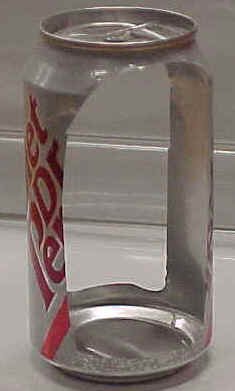
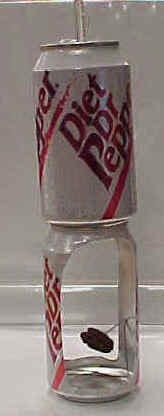
  1. Carefully, cut out two openings along the side of a soft drink can. This will serve as your support for the second drink can that will contain water & sit on top.

  1. Bend a large size paper clip so that a nut can be attached on one end and the other end will sit flat inside the cut-out soft drink can.


  1. Use the graduated cylinder to accurately measure 100g (100ml) of water. Pour this water into the uncut soft drink can.
  2. Place the thermometer in the uncut can and measure the water temperature after 3 minutes.  Record this temperature on  data table 1.

  1. Mass the nut (g) that you will burn and record this mass on  data table 1.
  2. Attach the nut to the bent end of your paper clip and carefully set the clip & nut into the cut-out soft drink can on bottom. Make sure the cans are sitting on a flat, nonflammable surface!

  1. Carefully light the nut from the bottom using a match and record the change in water temperature as the nut burns (thermometer in the can during burning). Immediately after the nut finishes burning, record the final (highest) water temperature on data table 1.
  2. Measure the mass (g) of the remaining nut & record this in the data table 1. (Mass the burned nut and paper clip together and then subtract the mass of the nut to get the mass of the nut alone.)
  3. Complete the data table1 by calculating the change in mass of the nut.
  4. Repeat this experiment with the other two types of nuts .
  5. When all three nuts have been burned, complete the analysis on data table 2.

Results:


Table 1 – Results of Burning

PECAN WALNUT ALMOND
oC  H2O temperature Before burning
oC
 
oC  H2O temperature After burning
oC
Difference in oC H2O temperature
oC
Mass of Paper Clip
g
Mass of Nut Before Burning
Mass of Paper Clip and Nut After Burning
g
Mass of Nut ALONE After Burning
(Subtract paper clip mass from mass of nut & paper clip after burning)
g
(Subtract paper clip mass from mass of nut & paper clip after burning)
g


Table 2 – Data Analysis from Nut Calorimetry

PECAN WALNUT ALMOND
Mass Difference of Nut Before & After Burning

(Subtract mass of nut after burning from Mass of nut before burning)
g

Temperature Difference of H2O Before & After Burning
(Subtract original water temp. from final water temp.)
oC
Calories Required to Change the Temperature of 100 g of H2O
(Multiply temperature change by 100)Cal
Average Calories per gram in the Nut
(Divide the total calories by the mass difference of the nut before & after burning)Cal/g
Average kilocalories or food calories per gram
(Divide the calories per gram by 1000)kcal/g


Questions & Conclusion:

  1. Where did the energy stored in the nut originally come from?
  2. During what process was this energy stored in the nut, & where specifically was it stored?
  3. What simple sugar made by plants is a common source for stored energy?
  4. Which group of macromolecules would a nut contain — carbohydrates, lipids, or protein?
  5. What is the name for stored energy?
  6. Give some examples of how organisms would use this stored energy.
  7. In this experiment, discuss what happened to the energy stored in the nut.
  8. Why was the final mass of the nut less than the original mass of the nut? (Remember that matter can’t be destroyed in a chemical reaction.)


BACK

Crossword Puzzles

Crossword Puzzles

All Materials © Cmassengale


BACK