Bird Adaptations


It’s For the Birds!  


Introduction:

Did you ever wonder why there are so many types of bird beaks (scientists call them bills)? The most important function of a bird bill is feeding, and it is shaped according to what a bird eats. You can use the type of bill as one of the characteristics to identify birds. Here are some common bill shapes and the food they are especially adapted to eat:


SHAPE TYPE ADAPTATION
Cracker Seed eaters like sparrows and cardinals have short, thick conical bills for cracking seed.
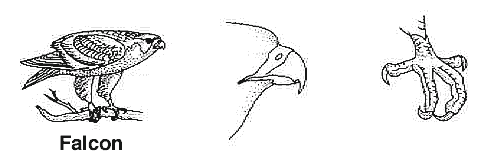
Shredder Birds of prey like hawks and owls have sharp, curved bills for tearing meat.
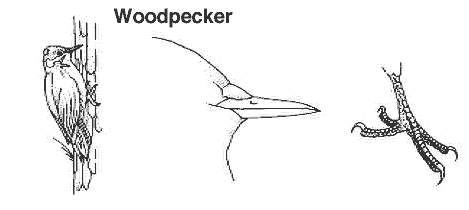
Chisel Woodpeckers have bills that are long and chisel-like for boring into wood to eat insects.
Probe Hummingbird bills are long and slender for probing flowers for nectar.
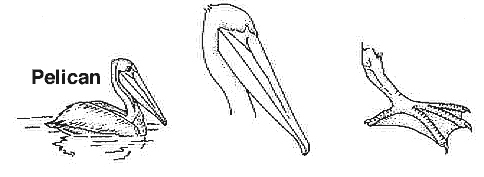
Strainer Some ducks have long, flat bills that strain small plants and animals from the water.
Spear Birds like herons and kingfishers have spear-like bills adapted for fishing.
Tweezer Insect eaters like warblers have thin, pointed bills.
Swiss Army Knife Crows have a multi-purpose bill that allows them to eat fruit, seeds, insects, fish, and other animals.


Another characteristic that can be used to learn more about birds is feet shapes! The shape of the feet reflects the habitat that the bird will be found in and the type of food it might eat. Here are some common feet shapes and the environment they are especially adapted to live in:


SHAPE TYPE ADAPTATION
Grasping Raptors like Osprey use their large curved claws to snatch fish from the water.
Scratching Pheasants and other birds that scratch the soil for food have nail-like toes.
Swimming Ducks and other webbed lined swimming birds use their feet like paddles.
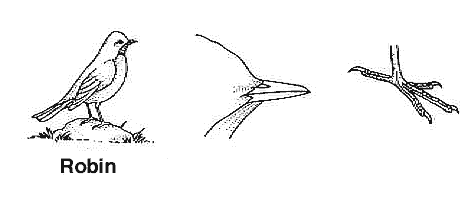
Perching Robins have a long back toe, which lets them grab a perch tightly.
Running Many fast-running birds have three toes rather than four.
Climbing A woodpecker’s hind toes enable it to climb without falling backward.


Objective:

Students will observe adaptations of feet and beaks of birds and relate these to the bird’s method of feeding and to the bird’s environment.

Materials:

Lab paper, pictures of birds, pencil

Procedure:

  1. Look at the pictures of the birds. Examine the beak of each bird and determine the type of each beak based on its shape and function. Some beak types may be used more than once.
  2. Place your choices on the chart in the column marked Beak for: (Some of the same beaks may be found on different birds).
  3. Examine the pictures of each bird and determine the type of feet each bird contains.
  4. Place the name of the bird on the line that best describes their type of feet.
  5. Also place the foot type on the chart in column 3 titled Feet for. (Some foot types may contain more than one bird.)


Bird Images For Bird Lab


Data:

Chart of Characteristics


Name of Bird Habitat Beak for Feet for
Woodpecker
Heron
Falcon
Eagle
Quail
Jacana
Pelican
Hummingbird
Robin
Whippoorwill
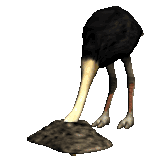
Ostrich
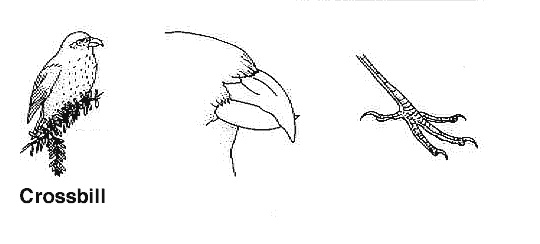
Crossbill

Questions:

  1. Birds living near lakes, pond or the ocean are most likely to eat the following organisms.
  2. If you see birds walking around a lawn in front of your house, what types of things could serve as a food supply for these birds?
  3. Explain why dead or diseased trees can serve as a food source for some birds.
  4. Based on the talons found on an eagle, what type of beak would it contain?
  5. A hawk looks like it has perching feet. What type of claws does it contain based on the hooked beak?
  6. Which bird contain the longest legs? What type of food do you think it eats?
  7. If you found a bird with climbing feet, what type of food would you expect it to eat?
  8. How many of there birds live near water? How can we tell?
BACK


Build a Bug


Build-a-Bug


Introduction:

Most adult insects have the following characteristics:

    1. A body divided into three parts (head, thorax and abdomen)
    2. Three pairs of legs
    3. Usually one pair of antennae and a pair of compound eyes (a few exceptions to these characteristics are found)
    4. Usually two pairs of wings (absent in many insects such as lice, fleas, ants; flies have one pair of wings)

There are approximately 30 orders of insects. Choose one of the insects from these orders.

INSECT ORDERS

Click on the link to learn more about the characteristics of that order. There are links to specific insects on each page.  Visit the Field Guide Index to see a listing of all insects featured in the Field Guide.

Objective:

Students will build biologically correct insects in order to learn insect structure and adaptations.

Materials:

Any non-food item such as cardboard, egg cartons, clay, wire, felt, Styrofoam, pipe cleaners, nylon stockings, pipe cleaners, paint, glue, string, etc.

Guidelines:

  1. Your model must be an INSECT (i.e. no spiders, mites, ticks, centipedes, or millipedes, please). Note: Your insect does not have to live in the United States.
  2. Your model must be between 6-12 inches long, and sturdy.
  3. Be accurate when building your model (appropriate proportions, true color and form, etc.).
  4. The more detail your model has, the better.
  5. A written description must accompany your model and include:
  • The common name of the insect
  • The name of the order to which it belongs
  • A brief description of the insect’s habitat
  • Where the insect is located geographically
  • At least 2 interesting, and unique facts about the insect you have modeled (i.e. “it has 6 legs and 3 body segments” doesn’t count)
  • Your name and address on model description

Examples of Models:


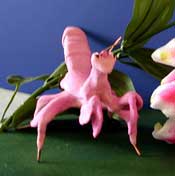
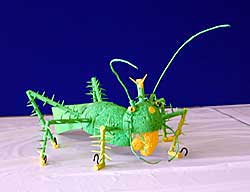
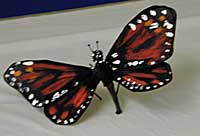
Spiny Katydid Monarch
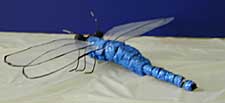
Dragonfly Damselfly Luna Moth
Walking Stick Grasshopper Yellow jacket
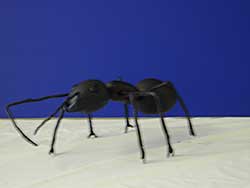
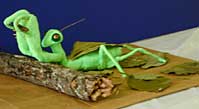
Atlas Moth Carpenter ant Praying Mantid


Bioenergetics Powerpoint Worksheet

Bioenergetics
ppt Questions

Energy

1. What is bioenergetics?


2. All organisms require ____________ to perform their functions.

3. Name the 2 main kinds of energy.

4. What is kinetic energy?


5. Give 2 examples of kinetic energy.


6. What is potential energy?


7. Potential energy is stored in ____________ __________.

Two Types of Energy Reactions

8. What is an endergonic reaction?


9. Give an example of an endergonic reaction.


10. What serves as the energy for photosynthesis?

11. During photosynthesis, the light energy is stored in the chemical bonds of what sugar?

12. What are the two raw materials (reactants) for photosynthesis?

13. What is an exergonic reaction?


14. Give an example of an exergonic reaction.

15. Where does the energy for cellular respiration come from?


16. Energy released during cellular respiration that can be used by cells is called _________.

Metabolic Reactions of Cells

17. Define metabolism of cells.


18. From what compound do animals get their energy (ATP) to do cellular work?

19. Name the 2 types of metabolism.


20. Explain anabolic pathways and give an example.


21. Explain catabolic pathways and give an example.


22. The energy that drives catabolic pathways in organisms comes from breaking _____________ ___________ and producing the energy molecule ___________.

Cellular Energy – ATP

23. Name the 3 components that make up ATP.

     a.

     b.

     c.

24. How many phosphate groups are in ATP?

25. The last two phosphate groups on ATP are bonded with ___________ ___________ bonds.

26. Which phosphate bond contains the MOST energy?

27. Give the formula for a phosphate group.

28. Name the process that breaks the bonds of ATP to release energy.

29. How often does phosphorylation occur in cells?


30. What enzyme weakens the last phosphate bond so it can be broken?

31. Organisms use ___________ to break down energy-rich __________ to release the potential  energy stored in its bonds.

32. Energy released from the chemical bonds of glucose are trapped & stored in ________ until a cell needs energy.

33. What does ATP stand for?

34. How much ATP do cells use?


35. What coupled reactions make ATP and then release its energy.


36. Is hydrolysis exergonic or endergonic?

37. Is energy stored or released during hydrolysis?

38. Is dehydration exergonic or endergonic?

39. Is energy stored or released in dehydration?

40. When ATP is broken down to release energy, what two things form?


41. During hydrolysis of ATP, a molecule of ___________ is added to split the ________ phosphate bond.

42. What happens to the energy released from the hydrolysis of ATP?


43. During dehydration of ATP, a molecule of ___________ is removed to join a free phosphate and __________ making more ATP again.

44. Where is the energy stored in the dehydration process to form ATP?


Review

45. How many high-energy phosphate bonds does ATP have?

46. Is photosynthesis anabolic or catabolic?

47. Is photosynthesis exergonic or endergonic?

48. The breakdown of ATP is due to hydrolysis or dehydration?

49. Water is added or removed in the breakdown of ATP?

50. Which of the following are coupled reactions in organisms:

     a. hydrolysis – dehydration?

     b. Anabolism – Catabolism?

     c. Endergonic – Exergonic?

 

Biochemistry Bi Worksheet


Biochemistry Worksheet


Section 3.1 – Properties of Water  


1. Why is water such an important molecule to living things?


2. Describe the chemical make up and type of bonding found in water molecules.


3. Explain why the hydrogen and oxygen atoms don’t share electrons equally in a water molecule.


4. What is the effect of this uneven sharing of electrons in water?


5. Sketch a molecule of water showing the charges on the molecule.


6. What is the overall charge on a water molecule? Explain why.


7. Define polar compound and give an example.


8. Water’s polarity makes it very effective in _____________ other substances.

9. Name 2 types of compounds that dissolve well in water.

10. What happens when an ionic compound such as sodium chloride (table salt) dissolves in water?


11. Water molecules are ___________ to other water molecules.

12. What type of bonding holds 2 or more water molecules together?

13. Are hydrogen bonds strong or weak bonds? Can they be easily broken?

14. Water molecules attracting other water molecules is called _________________.

15. Cohesion of water molecules produces ________________ tension making water seem like it has a “skin” on it. Surface tension enables some _____________ to walk across the surface of the water.

16. Water molecules attracting other types of molecules is called _________________.

17. Adhesion and cohesion together enable water molecules to move ____________ through narrow tubes against the force of gravity.

18. The above property of water is called _________________.

19. Give an example of an organism using capillarity.


20. What must be true for water to change temperature?

21. What effect does heating water have on the hydrogen bonds holding the water molecules together? What happens to the speed at which the molecules are moving?


22. Give an example of how this water property helps organisms in the environment.


Section 3.2 – Carbon Compounds

23.  What is an organic compound?


24. Besides carbon, name 3 other elements that make up most organic compounds.

25. Carbon dioxide, CO2, is NOT an organic compound. Explain why.


26. How many electrons are in the outermost energy level of carbon? How many does it need to have this energy level filled?

27. How many covalent bonds can carbon form?

28. Name 3 structural shapes that form whenever carbon atoms bond to other carbon atoms.


29. How many electrons are being shared in a single covalent bond? double covalent bond? triple covalent bond? quadruple covalent bond?


30. Draw these 3 molecules and circle a single bond, double bond, and a triple bond in your drawings — benzene, acetylene, and ethanol.


31. Explain what is meant by a functional group, & tell what effect they have on the molecules they are attached to.


32. Write the formula for these functional groups (use your textbook & handout) — hydroxyl, carboxyl, phosphate group, amino group, and methyl group.


33. Hydroxyl groups attached to carbon atoms forms an _____________. Name an alcohol used in humans to assemble molecules needed for life.

34. Large carbon molecules are built from smaller, simpler molecules called ____________.

35. Large carbon molecules made of monomers are called _______________.

36. What are large polymers called?

37. What type of reaction links monomers to make polymers?

38. Sketch a molecule of sucrose (table sugar) formed from condensation. Name the 2 sugars that were combined to form sucrose.


39. Condensation reactions involve the removal of a molecule of ____________.

40. What reaction is used to breakdown polymers? Is water added or removed? How does this compare to condensation?


41. All life processes require a constant supply of ____________. Name the molecule used by cells to get energy. Give its abbreviation.

42. ATP contains what 3 functional groups covalently bonded together? Write the formula for this functional group.

43. Which bonded phosphate group on ATP releases the MOST energy when broken?

Section 3.3 – Macromolecules

44. Name the 4 main classes of macromolecules (organic molecules) & tell what 3 elements all of these contain.


Carbohydrates store energy for organisms!

45. In what ratio are hydrogen & oxygen atoms in carbohydrates?

46. In what 3 forms do carbohydrates exist?

47. What are the monomers of carbohydrates called? What is their common name? Give the ratio of carbons, hydrogens, & oxygens.

48. Name the 3 MOST common monosaccharides.

49. Sketch & label a molecule of each of these monosaccharides. How do they compare? Write the chemical formula for all three.


50. Because all 3 simple sugars have the same chemical, but different structural formulas, they are called _______________.

51. What are double sugars called? Name & describe the process that forms them.


52. Name a disaccharide.

53. What forms a polysaccharide? Name a polysaccharide found in animals. Name 2 found in plants?


54. What chemical reaction formed these large molecule? What reaction would be needed to break these molecules?


Proteins are used to build cells, & they act as enzymes!

55. What are the 4 main elements making up proteins? How many covalent bonds does each of these elements form?


56. Sketch these two amino acids — glycine & alanine.  Circle the center carbon, place a triangle around the amino group, and put a box around the carboxyl group.


57. What are the monomers of proteins called? How many are there? Name the 4 things bonded to the center carbon of this monomer.


58. The main difference among amino acids is their ___________ group. What is the R-group on glycine? on alanine?

59. Differences in R-groups give different proteins different ______________.

60. How does a dipeptide form? Sketch the dipeptide formed from glycine and alanine. What molecule had to be removed to join these 2 amino acids?


61. What do you call the covalent bonds that hold amino acids together? Put a box around these bond in the sketch you did on question 60.

62. Long chains of amino acids are called ___________________ and these join together to make a ________________.

63. Hydrogen bonding among individual amino acids in a chain cause what effect on the protein’s shape?

64, What is the effect of temperature on protein shape? Give an example of this.


65. Most proteins act as catalysts or __________________ inside of cells.

66. The substance an enzyme is acting upon is called the _____________ and it must ______ into a place called the active site on the enzyme.

67. When a substrate joins with an enzyme, what effect does this have on chemical bonding of that substrate? Is the enzyme affected temporarily or permanently? How is it affected?


68. When chemical bonds in a substrate are weakened, what effect does this have on activation energy needed to start the reaction?

69. After the reaction, what happens to the products? Can the enzyme be re-used & why?


70. Besides temperature, what else can effect how an enzyme works by changing the enzyme’s shape? Can the reaction still take place?

Lipids include fats that are used for long-term energy storage!

71. Are lipids polar or nonpolar? What happens to lipids when they are placed in water?

72. Compared to carbohydrates, what is true about the ratio of carbon & hydrogen atoms to oxygen atoms? If a compound has more bonds, what can it store more of in those bonds?


73. Most lipids are made of ______________ acids. Describe their shape. What functional group is found on the head end of the molecule?


74. Sketch these 2 fatty acids — palmitic & linoleic.  Circle the carboxyl group on the “head” of the molecule. Is this end polar or nonpolar? Will this end be attracted to  or repelled by water?


75. Are both ends of a fatty acid polar? Explain.

76. Hydophilic means water ___________. Which end of  a fatty acid is hydrophilic. The nonpolar end of a fatty acid is said to be _______________ or “water fearing”.

77. Which end of a fatty acid chain WOULD dissolve in water? Which WOULDN’T?


78. In what type of fatty acid are there only single bonds in the carbon chain? Name one such fatty acid.

79. What type of bond appears in an unsaturated fatty acid? Give an example of an unsaturated fatty acid. Go back to your fatty acid drawings in question 74 and put a box around the double bond in the unsaturated fatty acid.


80. Name the 3 groups of complex lipids.

81. What makes up a triglyceride? What is the difference between a saturated & unsaturated triglyceride?


82. What type of triglycerides tend to be solids at room temperature & why? Which are liquids & why?


83. What type of triglyceride would this of  substance be — vegetable oil?  butter & shortening?

84. What makes up a phospholipid? How are they different from triglycerides? What main part of a cell is made of phospholipids?


85. What is meant by a lipid bilayer? What makes this such an effective barrier between the inside & the outside of the cell?


86. Wax is another complex lipid. Describe its structure.


87. Waxes are highly _________________. Explain how plants make use of this property? animals?


88. What makes up steroids? To what group of organic compounds do steroids belong? How are they used in animals?


89. Name a steroid made by the body & used by nerve cells.

Nucleic acids  store genetic information for cells!

90. Give the name & abbreviation for 2 nucleic acids found in cells.


91. DNA and RNA are both examples of _____________ made of linked monomers called ________________.  The instructions in these molecules is used to make ____________.

92. Name the 3 parts to a nucleotide then draw and label one.


BACK