Bacteria Culturing Activity


Where are Bacteria Found?  


Introduction:

They’re everywhere. Bacteria are the huddled masses of the microbial world, performing tasks that include everything from causing disease to fixing nitrogen in the soil. The estimated number of bacteria on Earth is five million trillion trillion — that’s a five with 30 zeroes after it.  When people think of bacteria, they likely first consider the nasty ones that cause disease, but the bacteria inside all animals combined — including humans — makes up less than one percent of the total amount. By far the greatest numbers are in the subsurface, soil and oceans.


Objectives:

  1. To take bacterial swabs from various places in the school
  2. To inoculate a petri dish with a bacterial culture
  3. To count bacterial colonies
  4. To determine what kind of environmental conditions influence bacterial growth

Materials: 

Petri dish,  pencil,  incubator, hot water bath, nutrient agar, thermometer

Procedure (Part A): Petri Dish Preparation

  1. Set up a hot water bath at 95oC.
  2. Loosen the caps and place nutrient agar bottle in hot water bath until agar liquefies. (Agar melts above 95oC and remains liquid until cooled to about 45oC.)
  3. Remove agar bottles and allow the agar to cool to about 50-55oC.
  4. Partially lift the cover of the petri dish and pour about 15-20ml of liquid to cover 2/3 of the plate surface.
  5. Lower the lid of the dish and gently swirl the plate to spread the media over all the bottom surface.

  1. Repeat step 5 to fill other petri dishes.
  2. DO NOT MOVE the covered plates until the nutrient agar has solidified.
  3. Once the plates are solidified, turn the plates upside down (presents condensation from getting on the agar surface).
  4. From this moment on, keep the plates upside down (condensation will disappear) in a dark, dust-free place in the room until ready to add bacteria. If plates will not be used for several days, refrigerate them.
  5. Check plates for contamination before proceeding to Part B. Discard contaminated plates.

Materials: 

Petri dish with nutrient agar, sterile cotton swabs, permanent marker, index card with sample location, pencil,  incubator


Procedure (Part B): Collecting Bacteria

  1. Choose an index card to determine your sample location
  2. Turn the petri dish upside down, and using your marker, place your initials, date and sample location along the bottom perimeter of the dish, NOT in the middle
  3. Get your sterile Q-tip, being very careful not to touch the side that will collect your sample. Go to your assigned area and quickly swab and return with your sample! (Sample locations included door handles, water faucets, desk tops, etc.)
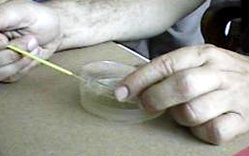
  4. Carefully open your dish just enough to lightly rub your Q-tip in a zigzag pattern across the agar.

  1. Draw what your dish looks like in Figure 1 and record the number of bacterial colonies, if any, present on the agar surface in table 1
  2. Place your petri dish upside down in the incubator to be examined again in a few days.
  3. Recheck the plates after 1 day, 2 days, and 5 days. Count and record the number of bacterial colonies on each plate. If the plate is  completely covered with bacteria, record “lawn” in the data table.
  4.  Ignore “fuzzy” appearing colonies that are actually fungi!

Example of Bacterial Colonies on Plate

Data:

Reminder — Fuzzy Colonies = Fungus not Bacteria

Figure 1 

Day 1                Day 2                Day 5


Table 1:   Number of Colonies on petri dish 

    Location:
Day Number of Colonies


Analysis:  

  1. Compare the number of colonies on your plate on day 5 with the plates collected from other locations. Did any of the areas show a greater number of bacteria? How many clusters of bacteria appear to be growing in each petri dish?
  2. Which petri dish had the most growth? The Least?
  3. Why was the agar sterilized before this investigation?
  4. What kind of environmental conditions seem to influence where bacteria are found?
  5. How can you control the amount of bacteria that you will encounter?
  6. Check the plate that the teacher has had open, exposed to the air for several days. What did you observe and why?

Dispose of the petri dishes carefully!  Place them in a biohazard bag to be autoclaved.

BACK


Bacteria PPT Questions

Bacteria
ppt Q’s

Prokaryote & Eukaryote Evolution

1. What does our current evidence tell us about the evolution of prokaryotes and eukaryotes?


2. About how long ago did eukaryotes evolve from prokaryotes?

3. Name the 2 theories of cellular evolution.


4. Explain the infolding theory.


5. What does endosymbiosis mean?


6. Explain the endosymbiotic theory of cell organelle formation.


7. Name 2 organelles thought to have arisen in this way.


Prokaryotic & Eukaryotic Cells

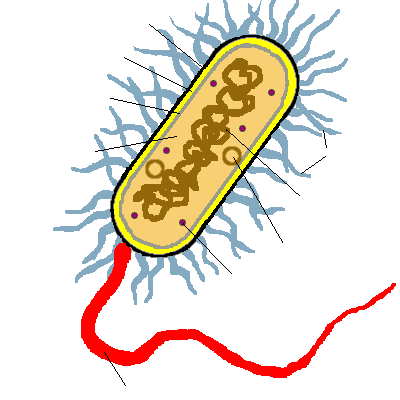
8. Label the parts of this prokaryotic cell.
9. Name several structures that are found in eukaryotic, but NOT prokaryotic cells.


10. What type of cells are the most numerous on Earth?

11. What are the most common type of prokaryotic cells?

12. How old are the earliest prokaryotic fossils?

Classification of Life

13. Name the 3 domains and the organisms found in each.

     a.

     b.

     c.

14. ______________ are found in harsh environments.

15. Give 3 examples of harsh environments in which Archaebacteria can be found.


16. What group is referred to as the true bacteria?

17. What photosynthetic member is in this group?

Characteristics of Bacteria 

18. What must be used to view prokaryotic cells?

19.What cell structures are lacking in prokaryotes?

20. Do bacteria have ribosomes like other types of cells?

21. Describe the genetic material of the bacteria.  be sure to tell where it is found.


22. What surrounds the cytoplasm of bacterial cells?

23.What surrounds the outside of all bacterial cells?

24. Cell walls of true bacteria contain ____________________.

25. Some bacteria have a sticky ____________ around the cell wall to attach to __________ or other bacteria.

26. Besides the circular chromosome, where else can DNA be found inside a bacterial cell?

27. What is the size of most bacterial cells?

28. Compare the size of bacteria to the tip of a pin.


29. ____________ of the bacterial cell membrane are called _______________.

30. What two cellular processes can take place in mesosomes?


31. At what pH do bacteria do best?

32. Most bacteria act as ________________. Why is this so important?


33. How can some bacterial be harmful?  Give an example.


34. name two other important uses for bacteria.


35. What does motile mean?

36. Motile bacteria may have one or more ______________ for movement.

37. Flagella attach to the bacteria by the ___________ ___________.

38. The basal body attaches to the cell through both the cell _________and the cell ___________.

39. What protein makes up bacterial flagella?

40. Tell how these types of bacteria differ from each other:

     a. Monotrichous

     b. Lophotrichous

     c. Amphitrichous

     d. Peritrichous

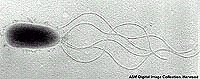
41. What type of bacteria is this?
42. What are bacterial pili?


43. How do pili compare to flagella in size?

44. Give three functions of pili.

     a.

     b.

     c.


Bacterial Shapes

45. Name and describe 5 shapes used to classify bacteria. 

     a.

     b.

     c.

     d.

     e.

46. What does each of these prefixes tell you about the bacteria’s shape:

     a. Diplo-

     b. Strepto-

     c. Staphylo-

47. Sketch the shape of these bacteria:

     a. Coccus

     b. Bacillus

     c. Spirillium

     d. Diplococcus

     e. Streptococcus

     f. Staphylococcus

     g. Diplobacillus

48. E. coli is classified as what shape bacteria?

Bacterial Kingdoms

49. How do the cell walls of Archaebacteria differ from the true bacteria?

50. How do the cell membranes differ?

51. Are the ribosomes the same?

52. Are the gene sequences the same?

53. Do Archaebacteria require oxygen?

54. How is there environment different from true bacteria?


55. What are they commonly called?

56. How many groups make up the ancient bacteria and name them?


57. Methanogens live in _____________ environments. What is lacking in this environment?

58. How do methanogens get their energy?


59. Name 3 environments in which methanogens are found.


60. How do methanogens help cows?


61. How did the methanogens get their name?


62. The __________ ___________ live in very salty environments.

63. How do they get their energy?


64. Name two bodies of water in which halophiles are found.


65. ______________ live in extremely hot environments.

66. Thermophiles that also live in acidic conditions are called _____________________.

67. Name 3 habitats in which thermophiles are found.


Kingdom Eubacteria

68.  Most true bacteria are ____________ and come in ________ basic shapes. Name the shapes.


69. Do eubacteria require oxygen?

70. How are they identified?

71. When was gram staining developed?

72. Describe Gram staining.


73. What colors do bacterial cell walls stain?

74. Describe the cell wall of Gram positive bacteria.


75. What color do they stain?

76. Can Gram positive bacteria be treated with antibiotics?

77.Name 5 Gram positive bacteria and tell how they’re used or what they may cause.

     a.

     b.

     c.

     d.

     e.

78. Describe the cell walls of Gram negative bacteria.


79. Are antibiotics effective against Gram negative bacteria?

80. Some photosynthetic Gram negative bacteria make ___________ instead of oxygen.

81. How do some Gram negative bacteria help plants?

82. Where can Rhizobacteria be found and what is their job?


83. _____________ are parasitic bacteria carried by ticks that may cause ___________ disease or _____________ _______________ _____________ fever.

84. Cyanobacteria are Gram ____________ and carry on ______________ to make food.

85. What is the common name for cyanobacteria?

86. What two main pigments do cyanobacteria contain?

87. What colors are cyanobacteria?


88. _______________ is a cyanobacterium that grows in chains.

89. Name the specialized structures on cyanobacteria that help fix nitrogen.

90. How do cyanobacteria cause eutrophication?


91. Spirochetes are Gram __________ bacteria that move by ___________.

92. Describe the motion of spirochetes.

93. Do all spirochetes need oxygen?

94. Spirochetes may be _______________, _______________, or symbiotic.

95. What are enteric bacteria? Give an example.


96. _______________ is an enteric bacterium that causes food poisoning.

97. How do chemoautotrophic bacteria get their energy?


Nutrition, Respiration, and Reproduction

98. Name and describe 4 modes of nutrition in bacteria.

     a.

     b.

     c.

     d.

99. Explain each of the following methods of respiration in bacteria.

     a. Obligate Aerobes-


     b. Obligate Anaerobes-


     c. Facultative Anaerobes-


100. Anaerobes carry on ______________ to release energy from food, while aerobes carry on ____________ _______________.

101. Bacteria reproduce asexually by what method?

102. Before the cell can divide, what must happen?

103. Is binary fission a slow or fast process?

104. How do the new cells compare with each other after binary fission? What are they called?


105. Bacteria can reproduce sexually by ________________.

106. Describe how conjugation occurs.


107. What is the function of pili in conjugation?

108. How do the new cells compare to each other after conjugation?

109. When can bacteria produce spores and why?


110. What are the spores called?

111. How long can an endospore survive?

112. Why are endospores such a problem in health care facilities and in the canning industry?


113. Bacteria can genetically change by _________________ and ____________________.

114. Disease-causing bacteria may become ______________ _____________ when they genetically change.

115. How do bacteria transform?


116. Describe transduction in bacteria and give an example of a product made by bacteria using this method.


Pathenogenic Bacteria

117. What are pathogens?


118. Pathogens may cause ____________.

119. What are toxins?


120. What is the difference between endotoxins and exotoxins?


121. Name a bacterium that produces each type of toxin.

     a. Endotoxin?

     b. Exotoxin?


AP Unit Cell Cycle Division


OPENERS NOTES POWERPOINTS WORKSHEETS & INTERACTIVES LABS TEST PREP GREAT LINKS


PREVIOUS CHAPTER NEXT CHAPTER


OPENERS:

Right Click on Topic & choose “SAVE AS” to Show any of these 5 minute class openers!

CELL CYCLE & MITOSIS

MEIOSIS

TOP  

NOTES:


TOP  

POWERPOINTS:


TOP  

WORKSHEETS & INTERACTIVES:


TOP  

LABS:


TOP  

TEST PREP:


TOP  

GREAT LINKS:

  • Cell Division: Binary Fission and Mitosis This site, from the University of Arizona, is an illustrated lecture place on mitosis and cell division. It contains many diagrams that may help you understand all the process of cell division.
  • Studying Cells  Introduce yourself to the cell as the fundamental unit of life and the scientific method.
  • The Cell Cycle & Mitosis  Understand the events that occur in the cell cycle and the process of mitosis that divides the duplicated genetic material creating two identical daughter cells.
  • Mitosis Animation Although the diagrams here are somewhat rough, they do a good job of showing the essential features of mitosis. Just remember that the figures show the nucleus, not the entire cell!
  • Meiosis Understand the events that occur in process of meiosis that takes place to produce our gametes.
  • Prokaryotes, Eukaryotes, & Viruses Learn about the cells that make up all living systems, their organelles, and the differences between living cells and viruses.
  • The Cytoskeleton Learn that the cytoskeleton acts both a muscle and a skeleton, and is responsible for cell movement, cytokinesis, and the organization of the organelles within the cell.
  • Online Onion Root Tips Estimate the amount of time cell spent in each mitotic phase in this animated cyber-version of the chapter’s lab investigation. After completing this activity, identifying the phases of mitosis will be a snap.
  • Spindle Microtubules These amazing pictures show microtubule organization at interphase and during several stages of mitosis. (The microtubules are stained green, and the DNA is stained blue.)
  • Cytokinesis Movie This site shows a very nice cytokinesis of a mouse cell growing in a dish.
  • Amphibian Embryology This site provides a good overview of how mitosis takes a fertilized egg and produces an animal from it

TOP  


Ap Biology Notebook

AP Biology Notebooks

Special Instructions:

1.    Use a 2″, 3-ring binder as your notebook.

2.    The cover of your notebook should have your name, subject, & period only!

3.    A master cover sheet with your name & period must be clipped into your notebook as the first sheet.

4.    Dividers with tabs labeled with the name of each section must be included.

5.    All papers must be clipped into the notebook in the correct order by units.

6.    Notebooks must be brought to class each day!

7.    Students will only receive credit for their notebook each nine weeks IF it is kept in order!

Notebook Sections:
SECTION 1 – SYLLABUS

SECTION 2 – HANDOUTS to BE SAVED ALL YEAR

  • Website sheet, class rules, notebook guidelines, safety rules, how to write abstracts and lab reports

SECTION 3 – UNIT WORK

  • Include a cover sheet for each unit with its number & title
  • Unit work should be in the following order — outlines, notes, worksheets, handouts, study guides, etc

SECTION 4 – COMPUTERIZED GRADE REPORTS

  • Printed from computer every 2 – 3 weeks

NOTE: A separate notebook will be kept for labs!
Click here for Lab Notebook instructions


Virus Worksheet


  Viruses Worksheet   

Structure of Viruses

1. Are viruses living or nonliving?

2. How can viruses be useful?


3. What odes a virologist do for a living?


4. Construct a Venn diagram comparing viruses and cells.


5. Explain how viruses were discovered and by whom.


6. Compare the size of viruses, bacteria, and eukaryotic cells.


7. What must be true for viruses to be able to replicate?


8. Name the two main parts of all viruses.


9. Discuss the hereditary material of viruses.


10. Compare & contrast capsids and envelopes of viruses.


11. Name 2 enveloped viruses that cause sexually transmitted disease.

12. What type of virus causes flu?

13. Where are glycoproteins found & what is there purpose?


14. What characteristics are used to group viruses?


15. How are these viruses grouped — retrovirus, adenovirus, and herpes virus?


16. Compare & contrast helical & icosahedral viral shapes & diseases.


17. Explain how RNA viruses replicate.


18. Do viruses contain enzymes? Explain.


19. Compare 7 contrast viroids & prions by constructing a Venn diagram.


Viral Replication

20. Why are viruses considered to be obligate intracellular parasites?


21. What is the best known bacteriophage, and what virus does it attack?


22. Sketch & label a bacteriophage and tell the function of each labeled part.


23. Name the steps of the lytic cycle & tell what happens to the host cell & virus at each stage.


24. What are temperate phages and how do they affect a cell?


25. Name the steps of the lysogenic cycle & tell what happens to the host cell & virus at each stage.


26. How does a prophage form?


27.Name a sexually transmitted virus that uses the lysogenic cycle to attack host cells.

28. Why is the influenza virus so hard to combat?


Viruses & Human Disease

29. Name some of the most common viral disease that attack humans.


30. How are shingles & chickenpox alike? How are they different?


31.What two methods are used to control viral diseases?


32. What is the CDC and what is its job?


33.What eradication program did the World Health Organization undertake in 1967, and what were the results?


34. What virus do we vaccinate our pets against each year?

35. How does AZT work?


36. What drugs prevent viruses from making capsids?

37. Why is rain forest clearing dangerous to humans?


38. Some lysogenic viruses can trigger certain types of _________________.


BACK