PreAP Protozoan Study Guide


Protozoan Review    


1. Protists with animal-like characteristics are called ___________________________.

2. Protozoans are all ______________________ organisms.

3. One convent way to classify protozoans is based on the way they _______________.

4.  _____________________ move by extending their ___________________.  ______________________ propel themselves by ______________________. _____________________ move by hairlike ____________, and _________________________ do ___________ move by themselves at all.

5. Protozoans that move by extending lobes of cytoplasm are called _______________________________.

6. The lobes of cytoplasm that sarcodinians extend are called _____________________ which means “_____________  ________________”.

7. When conditions are unfavorable, many amoebas survive by becoming hard ______________.  The ____________ can withstand drought, heat, or being eaten by other organisms.

8. Not all sarcodinians are soft “Naked”, some have hard shells or  _______________ made of   __________________________________ or _______________________.  They are called ____________________________ and _______________________________.

9. Sarcodinians are protozoans that move by extending lobes of _________________________.

10. ________________________________ are protozoans that move by means of flagella.

11. Some zooflagellates are free-living ________________________ or ____________________ organisms; many can live inside other organisms in _____________________ relationship.  Zooflagellates may have a ________________________ or _________________________________ relationships with other organisms.

12. Which zooflagellate parasite causes African Sleeping Sickness in humans? ____________________________.  The disease is spread by the bite of the __________________  ___________________.

13.  _________________________ are protozoans that have bodies covered with short hairlike projections called _________________.  They beat like ___________ to propel these protists through the water.

14. The ____________________________ is a common freshwater ciliate.

15. Paramecium gathers food with its _____________.  The ____________ sweeps food particles into the ______________  _________________, the Mouth _____________ opens into a ___________________  which pinches off around them to form a ____________________  ______________________.  It ejects wastes through an opening called the ______________________  __________________________.

16. Water is constantly enters the Paramecium cell by _______________________.  They would burst if they did not have a way to get rid of excess water.  ______________________________  _____________________________ collect the excess water and pump it outside.

17. Like all ciliates, Paramecium has ______________ distinct kinds of nuclei, each with a different function.  The ___________________________ controls ongoing functions of the cell and __________________________ reproduction.  Ciliates reproduce _______________________ by cell division.  The _____________________________ is involved in genetic exchange during ___________________________ reproduction.

18. When a Paramecium reproduces sexually, it exchanges genetic information by ________________________________________.

19. The protozoans that have NO structures for movement, and lives by being a parasite in animals are the ______________________________.  They are ____________-__________________ ____________________ protozoans.

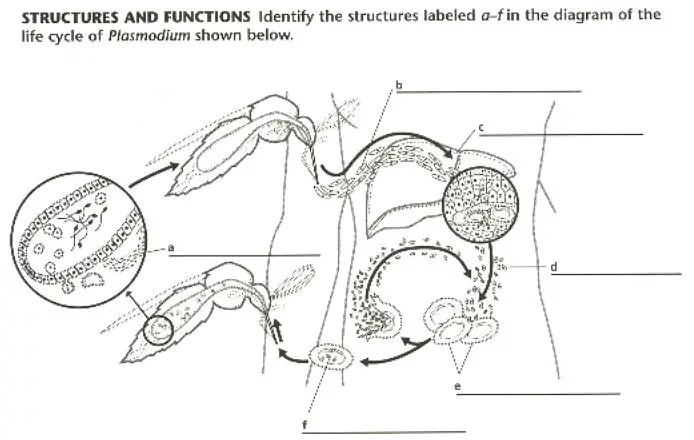
20. The protozoan that causes malaria is named ________________________ and is carried within _________________  ____________________.

21. Protozoans can grow and reproduce only in _____________ environments.

22.   _____________________ is a collection of mostly microscopic organisms that float near the surface of the ocean and lakes.

23. Type of sarcodina that moves by pseudopodia is an _________________________.

24. The sporozoan that causes malaria is _______________________________.

25. The ciliophora that moves by cilia ________________________________.

26. Types of sarcodinians that are covered by a protective test are __________________________ and ______________________________.

27. The insect that transmits malaria to humans is the _____________________.

28. The sporozoan that is found in cats is ________________________  _____________________.

29. The zooflagellate that causes Chaga’s disease is ___________________________  _______________________.

30. The zooflagellate that is known to contaminate stream water in the U.S. is _______________________  __________________________.

31.  ________________________ is a process of sexual reproduction in ciliates.

32. Protozoa are thought to have descended from ________________________ Eukaryotes.

33. Protozoan habitats are characterized by the presence of _______________________.

34. An adaptation to extreme environments is called ________________  _______________________________.

35. Sarcodines use their pseudopodia for ________________________________________, _____________________________________, and ________________________________.

36.  Certain sarcodines affect Earth’s geology by having mineralized shells that form __________________________  _________________ after they die.

37. What do trypanosomiasis, Chaga’s disease, leishmaniasis, and giardiasis have in common?  (Hint) They are all caused by __________________________________.

38. Pseudopodia are extensions of a sarcodine’s ____________________________.

39. In Paramecium, the macronucleus contains _______________________  _______________________ of _____________________.

40. What Two terms best describes members of the Kingdom Protista? (Hint) They are _________________________ – _______________ and ____________________________.

41. Most protists are made up of ______________________________ cell(s).

42. Most protists live in a ________________________________ environment.

43. Some protists undergo sexual reproduction only at times of environmental ________________________________.

44. Some protists have __________________________________ that contain light sensitive pigments.

45. Sleeping sickness is caused by a group of ____________________________ called trypanosomes.

46. _________________________________ has been used since the 1600s to relieve the symptoms of malaria.

47. Disease causing protists are transmitted mainly by insects and contaminated ______________________________.

DIRECTIONS: Answer the questions below as completely and as thoroughly as possible. Answer the question in essay form (not outline form), using complete sentences. You may use diagrams to supplement your answers, but a diagram alone without appropriate discussion is inadequate.

1. What kind of organisms are found in the kingdom Protista? What characteristics do they share?

2. Explain how parasitic zooflagellates infect their hosts. Give two examples.

3. Describe the life cycle of Plasmodium. What features typical of sporozoans does this life cycle exhibit.

4.  Describe the four phyla of protozoa.

5. Would a motile or nonmotile protozoan be more likely to be free-living? Explain your answer.

6. Distinguish between the terms Protist and Protozoan.

7. What is conjugation? How is this process advantageous for ciliates, such as Paramecium?

8. Describe the process of ameboid movement and how it helps with the amoeba’s nutrition.

9. What are pseudopodia? What functions do they serve in sarcodines?

10. Describe Three means of locomotion among protozoa.

11. What is a cyst? Under what conditions might certain protozoa form cysts?

12. Explain how Conjugation in protozoa (Paramecium) differs from conjugation in bacteria?

13. Explain the role of protozoa in aquatic ecosystem food chains?

14. How have sarcodines built geological features of the environment?

15. What adaptive significance does the contractile vacuole have in fresh water sarcodine?

16. What Kinds of diseases can zooflagellates cause in humans?


PreAP Taxonomy Study Guide


Taxonomy Review     


DIRECTIONS: Answer the questions below as completely and as thoroughly as possible. Answer the question in essay form (not outline form), using complete sentences. You may use diagrams to supplement your answers, but a diagram alone without appropriate discussion is inadequate.

1. Describe one way in which embryos of vertebrates and echinoderms are fundamentally different from the embryos of other orders.

2. What are the six kingdoms recognized today? What do plants and fungi have in common with animals?

3. What is Taxonomy?

4. Compare and Contrast Aristotle’s system of classification with that of Linnaeus.

5. The kingdom Protista includes a wide variety of organisms that are more distantly related to each other than plants are to animals. Why are they grouped together in one kingdom?

6. What criterion do modern taxonomists use to classify organisms?

7. What is cladistics and What is it use for?  How do we show these relationships?

8. What is systematic taxonomy, and what kinds of data are used by systematic taxonomist?

9. Why do protests, fungi, plants, and animals share a domain in the six-kingdom system?

10. Explain how embryological evidence helps to define phylogeny.

11. Explain how we name a species and what this process is called. Give or use an example in your answer. Why are species names important is scientific work?

12. List the levels of Classification developed by Linnaeus, from the broadest category to the most specific. What is the difference between a subspecies and a variety?

13. Define the term phylogenic tree. What is a phylogenic tree? What does is show and represent?

14. Compare and Contrast the six-kingdom system with the three-domain system. What evidence prompted the development of the three-domain system? What are the three domains?

Be able to identify organisms using a dichotomous key!


PreAP Virus Study Guide


Viruses Review   


Are viruses made of cells?
Do viruses make their own energy?
Can viruses make their own proteins?
Why are nonliving viruses included in a study of biology?
When is the only time that viruses are active?
What 2 things are found in the core of a virus?
What is the coating around a virus’s core made of?
What is the protective outer coat of a virus called?
Name 3 things that the envelope around some viruses can be made of?
Do viruses contain cell organelles such as cytoplasm, ribosomes, mitochondria, or chloroplasts?
What is the TMV virus & what does it attack?
How does a tobacco mosaic virus compare in size to a bacterium?
Can the TMV be crystallized? How is this helpful?
In nanometers, how large is the biggest known virus?
What viruses use reverse transcriptase to make DNA from RNA?
Viroids contain only what?
Prions are composed of only what substance?
A protein coat & a nucleic acid core makes up a typical what?
When is the only time viruses reproduce?
Sketch a bacteriophage & label the nucleic acid — DNA or RNA.
Do viruses have a nucleus or organelles?
Are viruses cellular?
Animal viruses only attack animal cells because they recognize what on the host cell?
In what viral life cycle does the viral DNA become part of the host cell’s DNA?
___________ don’t work on viruses because viruses don’t perform certain metabolic processes.
Name  several viral diseases of humans.
Name several viruses that have been linked to cancer.
Does Ebola virus cause cancer?
Many new viruses are emerging because of which activity of humans?


Plant Classification Study Guide

PLANT EVOLUTION AND CLASSIFICATION

1. There are more than ________________ different plant species.

2. Plants share Four Characteristics:
A._________________________________________________________________

    B._________________________________________________________________

    C._________________________________________________________________

    D._________________________________________________________________

3. In their characteristics plants are most similar to the ________________________.

4. Plants and Green Algae Have these Characteristics in Common:
A.__________________________________________________________________

    B.__________________________________________________________________

    C.__________________________________________________________________

    D.__________________________________________________________________

5. There are also some important Difference:
A.__________________________________________________________________

    B.__________________________________________________________________

    C.__________________________________________________________________

    D.__________________________________________________________________

6. All plants are photosynthetic, multicellular, __________________________ organisms, and can _________________________  _________________________.

7.  A ____________________ is a ripen ovary that surrounds the seeds of angiosperms.

8. All plants probably evolved from ______________________   __________________.

9. One of the greatest problems that encountered by the first land plants was the need for
___________________________.

10.   How does water aid the fertilization of some organisms? ______________________
____________________________________________________________________

11.   _________________________ of _______________________ means that there are TWO
phases in the life cycle of plants:

    A.  The first phase: ___________________  ______________________ phase that produces ________________________ and _______________________.

    B. The second phase: ___________________  _____________________ phase that produces ________________________.

12.  Sexual reproduction ensures there will be __________________________  ______________________ in plants.

13.  The type of vascular tissue that transports organic compounds is ____________________________.

14.   The _____________________ is a waxy, waterproof layer that coats the parts of a plant
exposed to air.

15.   The earliest plants were probably __________________, and had NO true ___________,
____________________, or ______________________.

16.   __________________ is a hard compound that strengthens cell walls, enabling cells to support additional weight.

17.  The 12 Phyla of plants can be divided into two groups based on the presence of __________________________  ___________________________.

18. One adaptation that help land plants to slow the evaporation of water was a
____________________________.

19. The type of vascular tissue that transports water is _________________________.

20. This type of angiosperm has parallel leaf venation __________________________.

21. The waxy covering on plant surfaces is called _____________________________.

22.  The plant material in peat bogs decomposes very ________________________ because the bogs are ____________________________.

23. How many plant phyla produce seeds? _____________________

24. What type of gymnosperm produces fleshy seeds? ____________________________

25. What is the photosynthetic phase of a moss called? ______________________________

26.  Bryophytes, instead of roots, they have long, thin strands of cells called ____________________ that attach the plant to the soil.

27.   Vascular plants absorb water from the soil through underground structures called
_____________________.  They also provide a plant with ___________________.

28.  Non-woody plants are usually called ___________________________.

29.  _____________________ carries organic compounds in any direction depending on the plant’s needs.

30.   In order to reproduce, a nonvascular plant must have ________________________.

31.   Rhizoids are long, thin strands of cells that resemble ________________________.

32.   The roots of vascular plants absorb water and _________________________  _________________________.

33. What is the non-photosynthetic phase of a moss called ____________________________.

34. Gymnosperms produce “_____________________” seeds, while angiosperms produce _______________________ protected inside a _____________________________.

35. This type of angiosperm has net leaf venation __________________________.

36. The _________________________ allow for the exchange of carbon dioxide and oxygen.

37. Sphagnum is often used to ______________________ soil and help it ____________________  __________________________.

38.   A ___________________ is a protective structure that contains a plant
__________________, and _________________  __________________.

39.   A __________________ is a structure that develops in plants with flowers and contains the
____________________.

40.  Nonvascular plants are distinguished by the absence of ______________________ and ____________________________.

41. All nonvascular plants are collectively called _______________________________.

42.   Vascular plants are classified into one of Two Types: _______________________ or
________________________________ plants.

43.   What are the Four Phyla of Seedless Vascular Plants? ________________________,
________________________, ______________________, ________________________.

44.   What are the Five Phyla of Seed Vascular Plants? _______________________,
_________________________, _________________________,
________________________, and  ______________________________.

45.  Vascular seed plants are subdivided into TWO general categories according to the type of seeds they produce: _________________________________ and
____________________________________.

46. A ____________________________ is a special reproductive structure composed of hard scales, that produces seeds without a fruit.

47.   ____________________ are vascular plants that produce seeds lacking a protective
_______________________.  They are often called _______________  _________.

48.  A seed is a _________________________ embryo inside a __________________________  _____________________.

49.   The _____________________ are vascular plants that produce seeds enclosed and
__________________ by a __________________.

50.   All angiosperms produce _________________ and _________________.

51.   The protective structure that contains the seed or seeds of an angiosperm is the
______________________.

52. One way of distinguishing among the many types of angiosperms is by counting the number of seed leaves or ________________________.

53.  Angiosperms with only ONE cotyledon are called _______________________________  or simply  _____________________.

54.  An angiosperm whose embryo has TWO cotyledons are called __________________________________ or simply _______________________.

56.   Plants that produce seed protected by a fruit are called _______________________________.

57.   A dicot is an angiosperm whose embryo has Two _______________________.

58. Plants remove carbon dioxide from the air by the process of ________________________.

59. Bryophytes are _______________-growing plants that live in _____________________  ________________________________.

60. All vascular plants have __________________________ tissues and _____________________________ of _________________________________.

61. True roots, stems, and leaves are characteristics of all ______________________  _________________________.

62. What are the primary functions of spores and seeds?

63. In what ways do green algae differ from plants?

64. Why do nonvascular plants have to live in moist environments?

65. Name three bryophytes, and identify their common characteristics.

66. Which plant phylum contains the tallest and most massive plants?  Is this a phylum of nonvascular, seedless vascular, or seed plants?

67.  Conifers are often found living at high elevations in locations with cold, dry winters.  What characteristic enables them to retain their leaves in these conditions?


Plant Structure Study Guide

PLANT STRUCTURE AND FUNCTION

1. Cells that support the non-growing parts of plants are called ____________________.

2. Sugars are transported in vascular plants through what tissue?

3. The tissue in a vascular plant that is used to transport water and minerals is __________.
4. Which plant cells are the most abundant and least structurally specialized?
5. Long, narrow cells of xylem with thin separations between them are known as _______.
6. Short, wide cells of xylem with NO end walls function in water transport when the cells are __________.

7. Cells of phloem that help the sieve tube elements to function are called _________________.

8. Growth that makes a plant stem thicker is known as ____________________  ____________.

9. In the meristem regions of plants you would expect to find _____________________ cells.

10. Collenchyma cells would help support which parts of a celery plant?

11. The epidermis on the stems and leaves of young plants prevents ______________________.

12. The vascular cylinder of a root is surrounded by the __________________________.

13.  A plant absorbs water and minerals through  _____________________.

14.  Which type of plant cells function in metabolic activities such as photosynthesis, storage, and healing?

15. Grasses usually have which type of roots?

16. In stems, vascular tissue is arranged to form ________________________.

17. What are the pores in the epidermis of leaves that control water evaporation called?

18.Primary growth in roots results in _________________________ of roots, and secondary growth results in _________________________ of roots.

19. What is the process of the evaporation of water from the leaves of a plant called?

20. The movement of sugars in a plant can be explained by the __________-
_____________  _____________.

21. What causes water molecules to stick together and pull each other up a plant stem?

22. Sugars made in photosynthesis in transported by being pumped into the ___________________________   _______________________________.

23. The function of the endodermis in roots is to _____________________ movement of substances into the ________________________  ___________________ of the root.

24. _______________________________ tissue forms the skin of a plant.

25.  ______________________________ tissue consists of everything that is Not dermal or vascular tissue.

26. The growing regions of plants are called ________________________________________.

27. Meristematic tissue is the only type of plant tissue that produces new cells by _______________.

28. The elongation of stems and roots is called _____________  _______________.

29. Most seed plants have Three basic organs, _________________, ___________________ and
_______________________________.

30. Lateral roots form from the _______________________ inside the root, while lateral stems form from _____________________________ on the surface of stems.

31. Plant cells that are even, thick-walled, rigid cells _____________________________.

32.  The name of the meristem between xylem and phloem  _______________________.

33. The roots that branch off a primary root ________________________  _________________.

34. Plant cells that are irregular, thick-walled cells ______________________________.

35. A root system with an enlarged primary root  _________________________.

36.  Type of meristems found only in monocots  _________________________.

37. Type of root system with many branch roots  _______________________.

38. Type of plants cells that are thin-walled cells that can be cube-shaped or elongated _______________.

39. In Dicots primary growth occurs in _______________________  ________________________ and in monocots it occurs in _______________________ ______________________ and may also occur in _________________________  _________________________.

40. Primary growth results in the ________________________ of plant structures, and secondary growth results in the _____________________ of plant structures.

41. Monocots stems lack ____________________  ____________________ and therefore cannot produce _________________________  growth.

42. Annual rings in woody plants form as a result of the production of _____________________  ___________________, which contain cells of different sizes that were produced during different times of the growing season.

43. Water is transported from the roots to the leaves of a plant by the process of ___________.

Short Answer:
Answer the questions below as completely and as thoroughly as possible. Answer the question in essay
form (not outline form), using complete sentences. You may use diagrams to supplement your answers.

 What are the TWO different types of vascular tissue in plants?  Briefly describe each kind.

2. How are carbohydrates transported throughout a plant? (Explain the pressure-flow hypothesis).

3. Describe tracheids and explain their function.

4. What are the lateral meristems of plants, and what is their function?

5. What is the difference between primary growth and secondary growth?

6. Explain the main functions of stems, roots and leaves.

7. What adaptations of root maximize water and mineral absorption?

8. Identify the structures that a water molecule would move through on its way from the soil into the xylem of a plant root.

9. What is the relationship between stomata and guard cells? Describe how they function and Describe their role in the activities conducted by leaves.

10. What is transpiration?  How is it related to the movement of water in plants?

11. What is the relationship between the Source and the Sink in the transport of sugars?

12. What are the Four types of tissue found in plants?

13. What are the Three basic types of plant cells?  What are the functions of each?

14. Explain the cohesion-tension theory.

15. List five differences and five similarities between the structure of roots and the structure of stems.