
Photosynthesis Cellular and Respiration Study Guide


Photosynthesis & Cellular Respiration Study Guide

* Name 3 life processes that require energy.

* What is the ultimate source of energy on earth?

* The process of plants capturing sunlight & making complex molecules is called?

* Where in chloroplasts are grana found?

* What are biochemical pathways?

* Name 3 things that happens to light that strikes an object.

* Why does chlorophyll look green to your eyes?

* What happens to chlorophyll’s electrons when they absorb energy?

* What pigments are found in flower petals?

* What chain do electrons enter when they are raised to a higher energy level after absorbing energy?

* What replaces the electrons lost by photosystem I?

* What is the source of oxygen during photosynthesis?

* Complex carbohydrates are made during what part of photosynthesis?

* Where is energy temporarily stored when food molecules are broken down?

* What gas made during photosynthesis is used in cellular respiration?

* What is the process of breaking down food molecules to release stored energy called?

* Name 3 things that occur during glycolysis.

* Breaking down organic molecules without oxygen is known as what?

* What acid builds up in muscles during heavy exercise without enough oxygen?

* Name the 2 stages of cellular respiration.
 

Photosynthesis Study Guide BI


Photosynthesis Study Guide


Give several examples of life processes that require energy.
What is the major light absorbing pigment in plants?
What two things are formed by plants when carbon dioxide & water are combined using sunlight as the energy?
Clusters of light absorbing pigments located in the thylakoid membranes of a chloroplast are called what?
Do all organisms require energy?
Are all wavelengths of sunlight absorbed by a plant to make sugar? Explain. 
Only ___________, not heterotrophs, carry on photosynthesis.
When the products of one chemical reaction are used as the reactants for the next reaction, the series of reactions is known as a ___________________ pathway.
Plants cells use light to make what two energy carrying molecules?
What sugar is the final product of photosynthesis?
Electrons are transported from one molecule to another by __________ atoms.
Can the dark reactions of photosynthesis occur during the daytime or only in the dark?
C4 and CAM plants use less water to make sugar than __________ plants.
How do heterotrophs obtain their energy?
What is the original source of energy for all living things on earth?
Stacks of thylakoids called grana are suspended in the fluid inside chloroplasts called __________.
Light travels to plants as tiny packets of radiant energy called _________.
Chlorophyll of plants looks green because green light is ______________ to your eye.
What happens to the electrons of chlorophyll when they are stuck by sunlight?
What gas is put back into our atmosphere by photosynthesis?
Complex carbohydrates are made during what cycle during photosynthesis?
What pigments give flower petals their colors?
Electrons raised to a higher energy level when struck by light enter what chain?
What important energy carrier molecule in photosynthesis picks up hydrogen atoms?
Oxygen made during photosynthesis comes from the splitting of what molecule?
BACK


Preap Nucleic Acid Study Guide

Nucleic Acids, Protein Synthesis, & DNA Technology Study Guide

1. What are purines & pyrimidines and give examples of each?

2. Which scientists determined the structure of DNA?

3. DNA and RNA are named by their __________.

4. What three things make up a nucleotide?

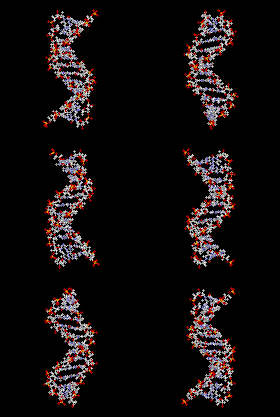
5. Describe the structure of DNA.

6. An organism’s characteristics are coded for by molecules of __________.

7. What are the subunits called that make up DNA?

8. Sketch the basic structure of a nucleotide.

9. What 2 things are found on RNA, but are not found on DNA molecules?

10. What is the primary function of DNA?

11.What did Rosalind Franklin’s x-ray photographs of DNA crystals tell us about this molecule?

12. State Chargaff’s rule.

13. What happens to tRNA anticodons during translation?

14. What is a codon & where are they found?

15. What is the function of rRNA?

16. What bases pair with each other on: a) DNA?   b) RNA?

17. Name the 3 types of RNA & tell the function of each.

18. What is the function of DNA polymerase?

19. If the code on DNA is TTAGCCTGA, what will be the code on the complementary section of DNA when it’s copied during replication?

20. List all the ways that RNA differs from DNA?

21. Where does mRNA go for proteins to be made in a cell?

22. What is transcription?

23. What is translation?

24. Which RNA carries instructions for making proteins?

25. What is the function of DNA helicases?

26. What is the job of restriction enzymes?

27. What are “sticky ends” and how are they helpful?

28. What is the difference between introns & exons?

29. What is an operon and in what type of cell would they be found?

30. What does RFLP stand for?  How is this process used?

31. What is meant by cloning?

32.What is DNA fingerprinting and how can it be used?

33. How is recombinant DNA formed?

NOTES                STUDY GUIDES

Mollusk & Annelid Study Guide B1

Mollusk & Annelid Study Guide

Be able to answer these questions:

  • Name the kingdom for mollusks & annelids.
  • What is the oldest part of a bivalves shell called?
  • What muscles open & close a bivalves shell?
  • What tissue surrounds & protects the soft body of mollusks?
  • What is the larval stage of mollusks called & describe it?
  • What structure enables a squid to move by jet propulsion?
  • What are the external segments of an earthworm’s body called?
  • Name the internal shell of a squid.
  • How do earthworms breathe?
  • Earthworms are hermaphrodites. What does this mean?
  • What type of symmetry do annelids & mollusks have?
  • What are the respiratory organs of aquatic mollusks & annelids called?
  • What are aortic arches & what organism has them?
  • What type of circulatory system do mollusks & annelids have?
  • What is the tongue-like structure called that snails use to scrap algae?
  • What is the “lip” of an earthworm called & how is it used?
  • Name the muscular organ used by mollusks for movement.
  • Name several examples of bivalve mollusks.
  • Give an example of a univalve mollusk.
  • Give an example of a marine, shelled cephalopod mollusk.
  • What is the area of a mollusk’s body called that contains most of the body organs?

Know the class for each of the following mollusks & annelids:

  • clams & scallops
  • snails & slugs
  • clam worms
  • chitons
  • squid & octopus
  • leeches
  • earthworms

Be able to label these internal parts of a clam:

  • heart
  • gills
  • anus
  • adductor muscles
  • incurrent siphon

Be able to recognize pictures of these mollusks & annelids:

  • clam
  • snail
  • lugworm
  • leech
  • earthworm
  • chiton
  • squid
  • octopus

Introduction to Life Study Guide bI

Introduction to Life Study Guide

Study of life is known as?
How are genes used by organisms?
Which characteristic of living things relates to stability?
What does homeostasis mean?
What is ecology?
How do heterotrophs obtain energy?
List distinct properties of living things.
What is the smallest unit that can carry on life called?
What are  all living things made of?
Which of the following are characteristics of ALL living things — growth, development, cellular organization, & movement?
A scientist noticed that bacteria weren’t growing in some test tubes. Is this observation, hypothesis, or experimentation?
The scientist suggests that bacteria aren’t growing in some test tubes because they aren’t getting the nutrients they need. Is this observation, hypothesis, experimentation, or conclusion?
A scientist adds a different nutrient to half of the test tubes in which he is growing bacteria. Is this observation, hypothesis, or experimentation?
Define hypothesis.
What is a theory?
A hypothesis is rejected if it does not explain what?
When scientists are planning experiments,  do they have a good idea of the possible results?
If new evidence emerges, do theories change?
Are theories supported with some scientific knowledge?
Are theories proved scientific ideas?
For scientists to communication with each other about their data, what do they do with their data?
How do scientists organize data?
If a microscope has a 30X objective lens & a 10X ocular (eyepiece) lens, what is its magnification?
What are the base units for each of these SI measurements — length? second? volume? mass? 
BACK
