Grasshopper Internal

Procedure (Internal Anatomy):

With scissors and beginning at the tip of the abdomen, make an incision (lengthwise) in the body covering slightly to the left of the mid-dorsal line and along the entire length of the grasshopper. Make a similar cut ventrally and also up the front of the head. Keep the inner scissors point just inside the body covering to avoid damaging the internal organs. If the specimen is a mature female, the interior spaces may be filled largely with slender eggs in the ovaries. Remove some of these is so directed by the instructor.

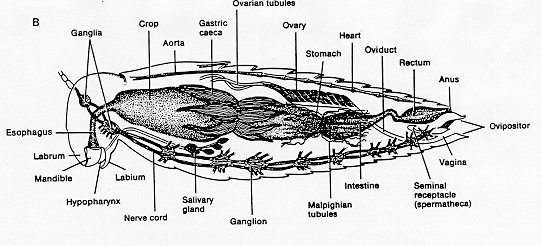
Locate the following organ systems:

1. Integument and exoskeleton
2. Muscular – In studying the other systems, note the many muscles, especially those connecting the wings and the legs.
3. Digestive system – remove some of the lateral muscles and trachea as necessary without injuring other organs. Identify the following structures in the digestive system.
a. *Esophagus
b. *Crop
c. *Gizzard
d. *Gastric caeca
e. *Stomach
f. *Intestine
g. *Rectum
h. *Anus
4. Circulatory system – heart
5. Respiratory system – tracheae
6. Excretory system – Malpighian tubules
7. Nervous system – brain, nerve cord
8. Reproductive system – testes, *ovaries, oviduct


p[

Handase Lab


ENZYME RATE OF REACTION FOR CATALASE


Introduction:

Chemical reactions make life possible. Hundred of chemical reactions are involved in the process of digesting a candy bar. If these reactions proceeded too slowly, not only would the candy bar remain in the stomach for long time, but the ordinary activities of life would come to a halt as well. Since this is not the case, something in the body must be responsible for speeding up the process. Four things that can speed up chemical reactions are: (1) heat; (2) increasing the concentration of reactants; (3) decreasing the concentration of products; and (4) enzymes, which speed up reaction without themselves being used up.

Enzymes are important in regulating chemical pathways, synthesizing materials needed by cells, releasing energy, and transferring information. Enzymes are involved in digestion, respiration, reproduction, vision, movement, thought, and even in the production of other enzymes. With few exceptions, enzymes are proteins. Simple cells may have as many as 2000 different enzymes, each one catalyzing a different reaction. An enzyme may accelerate a reaction by a factor of 1010 making it happen 10,000,000,000 times faster. Thus, a reaction that might take place as long as 1500 years without an enzyme can be completed in just 5 seconds with an enzyme.

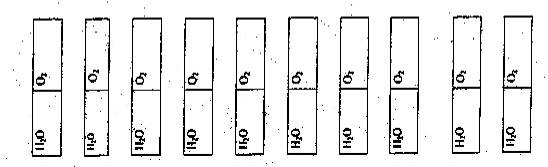
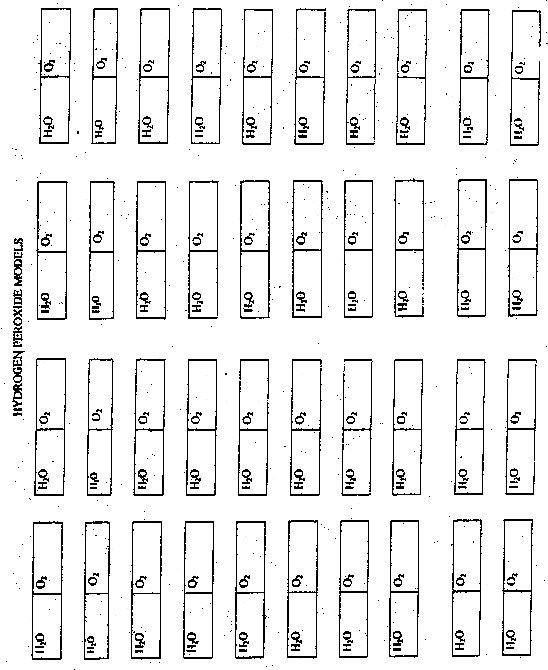
In this lab, your hands are the enzyme Catalase. This enzyme will split H2O2 (a poisonous waste product made by cells) into H20 and O2. You will split the molecule by rippling the paper model down the middle.

Pre Lab Questions:

1. What is an enzyme? What is its functions in living things?


2. What are things that can affect the function of an enzyme?


3 Write the chemical equation for the breakdown of hydrogen peroxide by the enzyme catalase.


4 An enzyme’s efficiency increases with greater substrate concentration, but only up to a point. Why?


Procedure:

1 Cut out 100 hydrogen peroxide molecules from the paper template.

2. Place 100 paper hydrogen peroxide molecules into a paper bag.

3. One member of your group will do the following:

a) When told to, you will grab one hydrogen peroxide molecule and rip it down the middle. Only rip one hydrogen peroxide molecule at a time.

b) Place the pieces back into the paper bag and grab another hydrogen peroxide molecule.

e) Repeat steps a and b, as fast as you can for 10 seconds. A member of group will be timing you for 10 seconds.

d) Empty your container and count the number of ripped hydrogen peroxide molecules.

e) Record the data in the following table.


Time in seconds Ripped Hydrogen Peroxide Molecules Rate of Reaction
0-10 A A
10-30 A A
30-60 A A
60-120 A A
120-180 A A


4. Repeat step a – step e for 30, 60, 120, 180 seconds.

5. Graph the results.

6. Determine the rate of reaction for the following times.

The rate of reaction can be calculated by using the following equation:


Rate = M2-M1
t2t1


a. 0-10 seconds


b. 10-30 seconds


c. 30-60seconds


d. 60-120 seconds


e. 120-180 seconds


7. Record the above rates in a data table.

8. Graph the results.

Graph Title: ______________________________________________


Post Lab Questions:

1. If you were allowed to continue this lab and rip hydrogen peroxide molecules for 240 and 300 seconds. What would happen to the rate of reaction and why will this happen?


2. What can you say about the length of time and the rate of the reaction?


3. What would happen to the rate of reaction if you remove the H2O and O2 molecules as soon as they are produced?


Paper Molecules:.
 

Chapter 54 AP Oby Ecosystems


Chapter 54     Ecosystems
Objectives
Ecosystems, Energy, and Matter
1. Describe the fundamental relationship between autotrophs and heterotrophs in an ecosystem.
2. Explain how the first and second laws of thermodynamics apply to ecosystems.
3. Explain how decomposition connects all trophic levels in an ecosystem.
Primary Production in Ecosystems
4. Explain why the amount of energy used in photosynthesis is so much less than the amount of solar energy that reaches Earth.
5. Define and compare gross primary production and net primary production.
6. Define and compare net primary production and standing crop.
7. Compare primary productivity in specific marine, freshwater, and terrestrial ecosystems.
Secondary Production in Ecosystems
8. Explain why energy is said to flow rather than cycle within ecosystems.
9. Explain what factors may limit production in aquatic ecosystems.
10. Describe an experiment that provided evidence that iron availability limits oceanic primary production in some regions. Explain how iron availability is related to nitrogen availability in these regions.
11. Explain why areas of upwelling in the ocean have exceptionally high levels of primary production.
12. Distinguish between each of the following pairs of terms:
a. primary and secondary production
b. production efficiency and trophic efficiency
13. Explain why the production efficiency of a human is much less than the production efficiency of a mosquito.
14. Distinguish among pyramids of net production, pyramids of biomass, and pyramids of numbers.
15. Explain why aquatic ecosystems may have inverted biomass pyramids.
16. Explain why worldwide agriculture could feed more people if all humans consumed only plant material.
17. Explain the green-world hypothesis. Describe five factors that may act to keep herbivores in check.
The Cycling of Chemical Elements in Ecosystems
18. Describe the four nutrient reservoirs and the processes that transfer the elements between reservoirs.
19. Name the main processes driving the water cycle.
20. Name the major reservoirs of carbon.
21. Describe the nitrogen cycle and explain the importance of nitrogen fixation to all living organisms. Name three other key bacterial processes in the nitrogen cycle.
22. Describe the phosphorus cycle and explain how phosphorus is recycled locally in most ecosystems.
23. Explain how decomposition affects the rate of nutrient cycling in ecosystems.
24. Describe how net primary production and the rate of decomposition vary with actual evapotranspiration.
25. Describe the experiments at Hubbard Brook that revealed the key role that plants play in regulating nutrient cycles.
Human Impact on Ecosystems and the Biosphere
26. Describe how agricultural practices can interfere with nitrogen cycling.
27. Explain how “cultural eutrophication” can alter freshwater ecosystems.
28. Describe the causes and consequences of acid precipitation.
29. Explain why toxic compounds usually have the greatest effect on top-level carnivores.
30. Describe how increased atmospheric concentrations of carbon dioxide could affect Earth.
31. Describe the causes and consequences of ozone depletion.
Back