
Unsegmented Worm

Unsegmented Worms

All Materials © Cmassengale

Phylum Platyhelminthes
Characteristics

  • Called flatworms because bodies are flattened dorso-ventrally

  • Acoelomate – solid bodies without a lined body cavity
  • Have 3 body layers — outer ectoderm, middle mesoderm, & inner endoderm
  • Bilaterally symmetrical
  • Show cephalization (concentration of sensory organs at anterior or head end)
  • Body cells exchange oxygen & carbon dioxide directly with environment by diffusion
  • Single opening into gastrovascular cavity; two-way digestive tract
  • Some are parasites & others are free-living
  • Parasitic worms have thick cell layer called tegument covered with a nonliving cuticle covering their bodies as protection inside hosts
  • Includes 3 classes — Turbellaria (planarians), Trematoda (parasitic flukes), & Cestoda (parasitic tapeworms

Class Turbellaria

  • Most are marine but includes freshwater planarian (Dugesia)
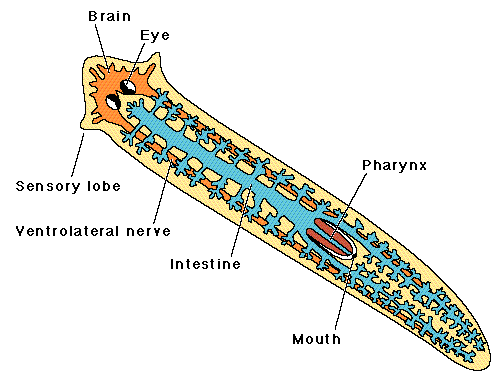
Planarians

  • Spade-shaped at the anterior end & have two, light-sensitive eyespots
  • Can sense light, touch, taste, & small
  • Have 2 clusters of nerve cells or ganglia to form a simple brain
  • Nervous system composed of a nerve net
  • Capable of simple learning
  • Move by tiny hairs or cilia over a mucus layer that they secrete
  • Feed by scavenging or protozoans
  • Have a single opening or mouth located at the end of a muscular tube called the pharynx which can be extended when feeding
  • Flame cells help remove wastes to excretory pores

  • Hermaphrodites that cross-fertilize eggs that are then deposited into a capsule until hatching in 2-3 weeks
  • Reproduce asexually by fragmentation

Class Trematoda

  • Includes parasitic flukes
  • About 1 cm long & oval shaped

  • Require a host to live
  • Have both oral & ventral suckers to cling to host & suck blood, cells, & body fluids
  • Oral sucker around mouth at anterior end sucks blood
  • May be endoparasites (live inside a host) or ectoparasites (live on the outside of host
  • Covered in tough, unciliated tegument
  • Nervous & excretory systems like turbellarians
  • Hermaphrodites
  • Have a long, coiled uterus that stores & releases 10,000+ eggs
  • Eggs released through genital pore & develop into larva
  • Show complex life cycles
  • Life cycle of sheep liver fluke:
    * Adult liver flukes live in sheep liver & gall bladder where they mate & form eggs
    * Eggs enter intestines, pass out with feces, & hatch in water
    * Larva enter snails, asexually multiply, then leave snail & form cysts
    * Cysts (dormant larva with hard, protective covering) clings to grass
    * Sheep ingest cysts when they eat grass
    * Cysts hatch in digestive tract & bore through intestines into bloodstream
    * Mature & reproduce in the liver

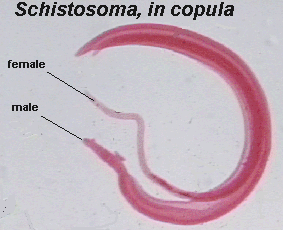
  • Schistosomiasis (disease caused by parasitic blood flukes) infects people in Asia, Africa, & South America causing intestinal bleeding & tissue decay that can result in death
Class Cestoda

  • Includes tapeworms
  • Adapted for parasitic life
  • Tough outer tegument prevents being digested by host
  • Anterior end called scolex contains hooks & suckers for attachment to intestine of host

  • Long, ribbon-like bodies up to 12 m in length
  • Nervous system extends length of body but lacks sense organs
  • Lacks mouth & digestive tract but absorbs digested nutrients from host
  • Grows by making body segments called proglottids
  • Each proglottid produces eggs & sperm that cross-fertilize with other segments & also self-fertilize (hermaphrodites)
  • Oldest, mature proglottids containing eggs at posterior end break off & pass out with feces
  • Life cycle of beef tapeworm:
    * Cattle eat grass with proglottids containing fertilized eggs
    * Eggs hatch into larva & bore through cow’s intestine into bloodstream
    * Larva burrow into cow’s muscle & form cysts
    * Humans eat beef (muscle) & cysts travels to intestines
    * Cyst breaks open & adult beef tapeworm forms


BEEF TAPEWORM LIFE CYCLE

Phylum Nematoda
Characteristics

  • Called roundworms
  • Includes Ascaris, hookworms, Trichinella, & pinworms
  • Pseudocoelomates have fluid-filled body cavity partially lined with mesoderm
  • Pseudocoelom contains the body organs & provides hydrostatic skeletal support for muscles
  • Have long slender bodies that taper at both ends

  • Covered with flexible cuticle
  • Digestive tract with anterior mouth & posterior anus; called one-way digestive tract
  • Separate sexes in most species
  • Most are free living
  • Some are parasites on plants & animals
  • Ascaris is a parasitic roundworm living in the intestines of pigs, horses, & humans
  • Ascaris life cycle:
    * Enter body in contaminated food or water & hatch in intestines
    * Larva bore into bloodstream & carried to lungs & throat
    * Larva coughed up, swallowed, & return to intestines to mature & mate
    * Block the intestine causing death

  • Hookworm eggs hatch in moist soil & larva bore through bare feet of new host 
  • Trichinella are human parasites caused by eating undercooked pork containing the cysts
    * Cause disease called trichinosis
    * Cysts cause muscle pain & stiffness


 CYSTS IN CONTAMINATED PORK

Phylum Rotifera
Characteristics

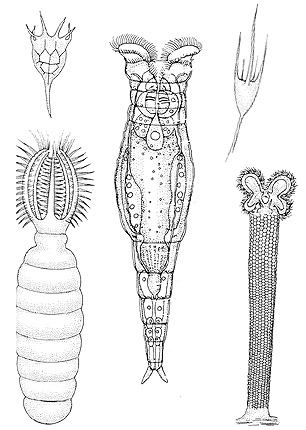
  • Known as rotifers or wheel animals
  • Transparent, free-swimming microscopic animal
  • Freshwater & marine
  • Have a ring of cilia around mouth that rotates like a wheel to bring in food
  • Feed on unicellular algae, bacteria, & protozoa
  • Have a muscular organ called the mastax behind the pharynx to chop food
  • Nervous system composed of anterior ganglia & 2 long nerve cords
  • Show cephalization (head end)
  • Have 2 anterior, light-sensitive eyespots
Back


Scientific Method & Hand Size Lab


Using the Scientific Method


Introduction:

Humans are classified as a separate species because of all the special characteristics that they possess. These characteristics are controlled by strands of DNA located deep inside their cells. This DNA contains the code for every protein that an organism has the ability to produce. These proteins combine with other chemicals, within the body, to produce the cells, tissues, organs, organ systems, and finally the organism itself. The appearance of these organs, such as the shape of ones nose, length of the fingers, or the color of the eyes is called the phenotype.

Even though humans contain hands with five fingers, two ears, or one nose, there are subtle differences that separate these organs from another. There are subtle differences in a person’s genes that allows for these different phenotypes. In this lab, we are going to observe some of these differences in phenotype. All human hands look pretty much alike, but there are genes on your chromosomes that code for the characteristics making up your hand. We are going to examine two of these characteristics (hand width and hand length) and try to determine why these phenotypic differences occurred.

Materials:

  • metric ruler (see end of lab)
  • pencil
  • calculator

Procedures:

Day 1

  1. Choose a partner and have them measure the length of your right hand in centimeters. (Measure from the tip of your middle finger to the beginning of your wrist as shown in figure 1.)  Record your measurements in Table 1.
  2. Now measure and record the length in centimeters of your partners hand.
  3. Have your partner measure the width of your right hand, straight across the palm, and record the data in Table 1. (see figure 1.)
  4. Now measure & record the width of your partner’s hand.

Figure 1.


Table 1


Group Data on Right Hand Width and Length
Student Name Length of Hand (cm) Width of Palm (cm)


  1. After the entire class has completed Table 1, record your group data on the Class Data Table at the front of the room
  2. Record the Class Data Table information on your lab sheet’s Table 2.

Table 2

Class Data on Right hand Width and Length (cm)

Class Period:

Student Gender
(M / F)
Hand Length (cm) Hand Width (cm)
1. M / F
2. M / F
3. M / F
4. M / F
5. M / F
6. M / F
7. M / F
8. M / F
9. M / F
10. M / F
11. M / F
12. M / F
13. M / F
14. M / F
15. M / F
16. M / F
17. M / F
18. M / F
19. M / F
20. M / F
21. M / F
22. M / F
23. M / F
24. M / F

Click for Class Data Table

Day 2

  1. In order to form a more accurate conclusion, the collection of additional data is necessary. Using the Class

. The teacher has the option to include the data from all the classes running this experiment. Below find tables that will allow the tabulation of several classes of data.


Table 3: All Classes Hand Length

Measurement of Hand length in cm. # of Males # of Females Total # ( Male + Female )
1.—————— ——————– ——————- ——————
2.—————— ——————- ——————- ——————-
3.—————— ——————- ——————- ——————-
4.—————— ——————- ——————- ——————-
5.—————— ——————- ——————- ——————-
6.—————— ——————- ——————- ——————-
7.—————— ——————- ——————- ——————-
8.—————— ——————- ——————- ——————-
9.—————— ——————- ——————- ——————-


Table 4: All Classes Hand Width

Measurement of Hand width in cm. # of Males # of Females Total # ( Male + Female )
1.—————— ——————– ——————- ——————
2.—————— ——————- ——————- ——————-
3,—————- ——————- ——————- ——————-
4.—————— ——————- ——————- ——————-
5.—————— ——————- ——————- ——————-
6.—————— ——————- ——————- ——————-
7.—————— ——————- ——————- ——————-
8.—————— ——————- ——————- ——————-
9.—————— ——————- ——————- ——————-


Line Graph the data from Tables 3 and 4. and then answer the questions that follow. Use the measurements of the width and length as your independent variable and the number of times that measurement appeared as your dependent variable.

Graph Tile: ___________________________________________________________


Analysis:

1. Examine the above graph. What is the shape of the line for hand length? _____________

________________________________________________________________________

2. What is the most abundant measurement for hand length? __________________.

3. What is (are) the least abundant measurement(s)? _________________________.

4. If we are to assign letters to represent the various lengths, what value(s) would we assign to the dominant genotype (HH)? ________________; the recessive genotype (hh)? ___________, and he heterozygous genotype (Hh)? _________________.

5. What would be the phenotypic name for the ( HH ) genotype? ___________________.

6. What would be the phenotypic name for the ( Hh ) genotype? ___________________.

7. What would be the phenotypic name for the ( hh ) genotype? ____________________.

8. Examine the above graph. What is the shape of the line for hand width ? ____________

________________________________________________________________________

9. What is the most abundant measurement for hand width? __________________.

10. What is (are) the least abundant measurement(s)? _________________________.

11. If we are to assign letters to represent the various lengths, what value(s) would we assign to the dominant genotype (WW)? ________________; the recessive genotype (ww)? ___________, and he heterozygous genotype (Ww)? _________________.

12. What would be the phenotypic name for the ( WW ) genotype? __________________.

13. What would be the phenotypic name for the ( Ww ) genotype? ___________________.

14. What would be the phenotypic name for the ( ww ) genotype? ___________________.

15. Are there any similarities in the graph of the above two characteristics? ____________.

16. If so, what are they? ____________________________________________________

17. Are there any differences in the graph of the above two characteristics? ____________.

18. If so, what are they? ____________________________________________________

19. Is there a difference in the length and width of the male and female hand? ___________.

20. Does the gender of a person have an effect on the phenotype of a trait? _____________.

Explain _________________________________________________________________

_______________________________________________________________________

________________________________________________________________________


Cut and use:

________________________________________________________________________


Transpiration


Transpiration

Introduction:
The amount of water needed daily by plants for the growth and maintenance of tissues is small in comparison to the amount that is lost through the process of transpiration and guttation. If this water is not replaced, the plant will wilt and may die. The transport up from the roots in the xylem is governed by differences in water potential ( the potential energy of water molecules). These differences account for water movement from cell to cell and over long distances in the plant. Gravity, pressure, and solute concentration all contribute to water potential and water always moves from an area of high water potential to an area of low water potential. The movement itself is facilitated by osmosis, root pressure, and adhesion and cohesion of water molecules.

The overall process: Minerals actively transported into the root accumulate in the xylem, increase solute concentration and decrease water potential. Water moves in by osmosis. As water enters the xylem, it forces fluid up the xylem due to hydrostatic root pressure. But this pressure can only move fluid a short distance. The most significant force moving the water and dissolved minerals in the xylem is upward pull as a result of transpiration, which creates a negative tension. The “pull” on the water from transpiration is increased as a result of cohesion and adhesion of water molecules.

The details: Transpiration begins with evaporation of water through the stomates (stomata), small openings in the leaf surface which open into air spaces that surround the mesophyll cells of the leaf. The moist air in these spaces has a higher water potential than the outside air, and water tends to evaporate from the leaf surface. The moisture in the air spaces is replaced by water from the adjacent mesophyll cells, lowering their water potential. Water will then move into the mesophyll cells by osmosis from surrounding cells with the higher water potentials including the xylem. As each water molecule moves into a mesophyll cell, it exerts a pull on the column of water molecules existing in the xylem all the way from the leaves to the roots. This transpirational pull is caused by (1) the cohesion of water molecules to one another due to hydrogen bond formation, (2) by adhesion of water molecules to the walls of the xylem cells which aids in offsetting the downward pull of gravity. The upward transpirational pull on the fluid in the xylem causes a tension (negative pressure) to form in the xylem, pulling the xylem walls inward. The tension also contributes to the lowering of the water potential in the xylem. This decrease in water potential, transmitted all the way from the leaf to the roots, causes water to move inward from the soil, across the cortex of the root, and into the xylem. Evaporation through the open stomates is a major route of water loss in the plant. However, the stomates must open to allow the entry of CO2 used in photosynthesis. Therefore, a balance must be maintained between the gain of CO2 and the loss of water by regulating the opening and closing of stomates on the leaf surface. Many environmental conditions influence the opening and closing of the stomates and also affect the rate of transpiration. Temperature, light intensity, air currents, and humidity are some of these factors. Different plants also vary in the rate of transpiration and in the regulation of stomatal opening.

Exercise 9A Transpiration

In this lab, you will measure transpiration under various laboratory conditions using a potometer. Four suggested plant species are Coleus, Oleander, Zebrina, and two week old bean seedlings.

Materials:
0.1 mL pipette, plant cutting, ring stand, clamps, clear plastic tubing, petroleum jelly, fan, lamp, spray bottle, and plastic bag.

Procedures:
Each lab group will expose one plant to one treatment.

1. Place the tip of a 0.1 mL pipette into a 16 -inch piece of clear plastic tubing.

2. Submerge the tubing and the pipette in a shallow tray of water. Draw water through the tubing until all the air bubbles are eliminated.

3. Carefully cut your plant stem under water. This step is very important, because no air bubbles must be introduced into the xylem.

4. While your plant and tubing are submerged, insert the freshly cut stem into the open end of the tubing.

5. Bend the tubing upward into a “U” and use the clamp on a ring stand to hold both the pipette and the tubing.

6. If necessary use petroleum jelly to make an airtight seal surrounding the stem after it has been inserted into the tube. Do not put petroleum jelly on the end of the stem.

7. Let the potometer equilibrate for 10 minutes before recording the time zero reading.

8. Expose the plant in the tubing to one of the following treatments( you will be assigned a treatment by your teacher):

a). Room conditions.

b). Floodlight (over head projector light).

c). Fan ( place at least 1 meter from the plant, on low speed, creating a gentle breeze).

d). Mist ( mist leaves with water and cover with a transparent plastic bag; leave the bottom of the bag open).

9. Read the level of water in the pipette at the beginning of your experiment(time zero) and record your finding in Table 9.1.

10. Continue to record the water level in the pipette every 3 minutes for 30 minutes and record the data in Table 9.1.

Table 9.1: Potometer Readings

Time (min) Beginning (0) v3ss fff6ff 9 12 15 18 21 24 27 30
Reading (mL) 4nnnnnnn 4nnnnnn nnnn4

11. At the end of your experiment, cut the leaves off the plant and mass them. Remember to blot off all excess water before massing.

Mass of leaves ______________ grams.

Calculation of Leaf Surface Area
The total surface area of all the leaves can be calculated by using one of the following procedures.

__________________ = Leaf Surface Area (m2)


Leaf Trace Method:
After arranging all the cut-off leaves on the grid below, trace the edge pattern directly on to the grid. Count all of the grids that are completely within the tracing and estimate the number of grids that lie partially within the tracing. The grid has been constructed so that a square of four blocks equals 1 cm2. The total surface area can then be calculated by didvding the total number of blocks covered by 4. Record the value above.

Grid 9.1


Leaf Mass Method:

  • Cut a 1 cm2 section of one leaf.
  • Mass the 1 cm2 section.
  • Multiply the section’s mass by 10,000 to calculate the mass per square meter of the leaf. (g/m2) ____________
  • Divide the total mass of the leaves (step 11) by the mass per square meter (above). This value is the leaf surface area.
  • Record this value above.

12. Water lost per square meter: To calculate the water loss per square meter of leaf surface, divide the water loss at each reading (Table 9.1) by the leaf surface area you calculated.


Table 9.2: Individual Water Loss in mL /m2

Time Intervals ( minutes)
s 0-3 3-6 6-9 9-12 12-15 15-18 18-21 21-24 24-27 27-30
Water Loss (mL)
Water loss per m2

13. Record the averages of the class data for each treatment in Table 9.3.

Table 9.3: Class Average Cumulative Water Loss in mL /m2

Time ( minutes)
Treatment 0 3 6 9 12 15 18 21 24 27 30
Room 0      
Light 0
Fan 0
Mist 0

14. For each treatment, graph the average of the class data for each time interval. You may need to convert data to scientific notation. All numbers must be reported to the same power of ten for graphing purposes.

Graph Title________________________________________


Graph 9.1


Analysis of Results:
1. Calculate the average rate of water loss per minute for each of the treatments:

Room: ______________________________________________________________________

Fan: _______________________________________________________________________

Light: _______________________________________________________________________

Mist: _______________________________________________________________________


2. Explain why each of the conditions causes an increase or decrease in transpiration compared to the control.

Conditions   Effect Reasons
Room
Fan
Light
Mist

3. How did each condition affect the gradient of water potential from stem to leaf in the experimental plant?

_______________________________________________________________________

_______________________________________________________________________

_______________________________________________________________________

_______________________________________________________________________

4. What is the advantage to a plant of closed stomata when water is in short supply? What are the disadvantages?

_______________________________________________________________________

_______________________________________________________________________

_______________________________________________________________________

_______________________________________________________________________

5. Describe several adaptations that enable plants to reduce water loss from their leaves. Include both structural and physiological adaptations.

_______________________________________________________________________

_______________________________________________________________________

_______________________________________________________________________

_______________________________________________________________________

6. Why did you need to calculate leaf surface area in tabulating your results?

________________________________________________________________________

________________________________________________________________________

________________________________________________________________________

________________________________________________________________________

Successful AP Biology Student


The Successful Biology Student:
  1. Realizes this is a fast-paced course so they have excellent attendance.
  2. Is never late.
  3. Always has their textbook, notebook, lab book, pencil, … when they come to class.
  4. Let’s the teacher know ahead of time when they will miss for a doctor’s appointment or school trip.
  5. Makes certain that all assignments, labs, projects, and reports are completed on time.
  6. Schedules tests & labs to be made up after school when they return from an absence.
  7. Does not miss an excessive number of class periods for school trips.
  8. Keeps track of their grade.
  9. Always reads every lab before that lab day.
  10. Reads and recopies lecture notes and keeps them in an organized notebook.
  11. Reads all chapters before lecture.
  12. Reviews all chapters and notes each day.
  13. Asks questions in class.
  14. Utilizes the computer tutorials that supplement each unit of study.
  15. Pays attention in class.
  16. Keeps neat & accurate lab data to be organized in lab reports.
  17. Follows all instructions for projects & collections.
HOME BACK


Study of Biology pptQ


Study of Biology
ppt Questions

What is Biology?

1. Define biology.


2. What are organisms?

3. Name 5 groups of organisms.


4. Living things share common _______________.

5. What is the basic unit of life that makes up all organisms?

6. To survive, populations of organisms must be able to _____________ offspring.

7. All organisms have a _________ code carried in  a molecule called _______.

8. Organisms require ____________ such as food and need __________ for their activities.

9. Living things _________ to their environment.

10. Organisms must maintain what type of internal environments ?

11. What does evolve mean?


12. Do groups or individuals evolve?

Characteristics

13. All ____________ are made of cells.

14. Most cells are so __________, they can’t be seen without a microscope.

15. What is cytoplasm?


16. What surrounds all cells?

17. What is the function of the cell membrane?


18. Cells are complex and highly ___________.

19. What are organelles and give an example?


20. The simplest type of cells are known as ______________.

21. Describe prokaryotic cells.


22. Name one of the most common prokaryotes.

23. More complex cells are called ______________.

24. Eukaryotes have a true _________ and _________________ organelles.

25. Name 3 types of eukaryotic cells.

26. Organisms can be grouped by their __________ of cells.

27. Define unicellular organisms.

28. What are multicellular organisms?


Reproduction

29. When organisms reproduce they pass what on to their offspring?

30. Name 2 types of reproduction.

31. What type of reproduction involves 2 parents?

32. A fertilized egg is called a ___________.

33. Are sexually reproduce organisms genetically identical to their parents?

34. asexual reproduction involves a _____________ parent or _________.

35. In asexual reproduction, a single cell __________ to form two new cells.

36. How do asexually reproduced organisms genetically compare  to their parents?

Genetic Code

37. What carries the genetic code for all organisms?

38.DNA stands for ____________________ ___________.

39. Do all organisms have DNA?

40. What does DNA code for in a cell?

41. Why are proteins so important to cells?


Growth and Development 

42. Name the stages of development in the life of a frog.


43. Name two ways that organisms grow.

44. When organisms change into adults they ___________ and may change.

Requiring Food and Energy

45. What organisms can make their own food?

46. What is a photoautotroph and give an example.


47. What food making process is used by photoautotrophs?

48. What do chemoautotrophs use to get energy?

49. ___________ cannot make their own food.

50. How do heterotrophs meet their food requirements?

51. Name 3 groups of heterotrophs.

52. Explain the difference among herbivores, carnivores, and omnivores.


53. Define metabolism.


54. All metabolic processes require ____________.

55. What is the ultimate energy for all life on earth?

56. What metabolic process uses sunlight for energy?

57. Write the balanced overall equation for the photosynthesis process and label the reactants & products.


58. What metabolic process releases the chemical energy stored in food?

59. Write the balanced overall equation for cellular respiration .


60. Name several environmental factors that organisms respond to.


61. Give an example of an organism responding to their environment to promote survival.


62. Define homeostasis.


63. Give 3 examples of internal conditions in which organisms must maintain stability.


64. Why do populations evolve?


65. What record do we have that populations evolve?

Organization Levels

66. Name 3 nonliving levels into which life is organized.

67. At what level of organization does life begin?

68. Cells organize into ____________.

69. What makes up organs?

70. Organs working together become a ____________, and these working together make the entire _____________.

71. From simplest to most complex, list the levels of life above organism.

72. What is the most inclusive level of life?


BACK