Preap Cell Division Study Guide


Cell Cycle & Cell Division Review  

1. Chromosomes are Rod Shaped structures made of _________ and ___________.

2. State the cell theory.

3. The phases in the life of a cell are called the ______________  _____________.

4. The cell cycle consists of ________, __________, __________, & division.

5. ________________ is a series of ______________ in cell division during which the _____________________ of a cell divides into __________  __________ with ____________   _____________ material.

6. _________________ only occurs  in _________________________  cells.

7. The period of cell growth prior to division is _________________________.

8.   Interphase consist of what three phases and describe each:
a.

b.

c.

9. The period during which DNA is copied ______________________.

10. DNA replication in a cell results in _________________  ____________________.

11. Replication is the process of copying _______________  ____________________.

12. Cell division is the process by which one _________ produces __________ new identical _________  ___________.

13.  Cell division involves 2 Steps called __________________  _____________  ________________________.

The steps are:
a.

b.

14. Step 1 of cell division is called ___________, and step 2 is called ______________.

15. During __________the cytoplasm of the cell divides into _______ new cells called ___________  ___________.

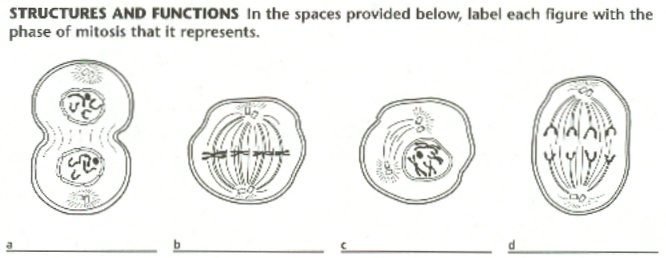
16. The steps or phases of Mitosis are ___________,  ____________,  ____________, and ________________.

17.   _________ is the process by which a nucleus gives rise to ___________ _________  _____________.

18. In anaphase, the sister Chromatids __________________________________.

19. The cell is pinched into two and cytokinesis begins during ____________________.

20. The assembling of microtubules that make up the spindle fibers occurs during _____________.

21. During prophase the _________ and  ________  ____________ disappear.

22. The center of the cell is called the ___________  _______________.

23.   ________________ condenses into chromosomes of two _________________  ____________________, joined together by the _____________________ during __________________________.

24.  The production of offspring from one parent is called ________________________  ________________________.

25.  During mitosis, centrioles are present only in _________________________ cells.

26.  Most organisms are capable of combining ______________________ from two parents to produce ______________________.

27. The phase of mitosis during which chromosomes move to opposite poles is called ____________________________________.

28. When chromosomes of two parents combined to produce offspring, the process is known as _____________________  _____________________.

29. The chromosomes that combine during sexual reproduction are contained in special reproductive cells called _________________________.

30. In most organisms,  ________________ can be either _____________  or _________________.

31. Eggs are _______________ than sperm, but are ______________________.

32. Sperm have ______________________ that help them swim to the ___________.

33. Gametes are formed by _______________________, a type of nuclear division in which _____________________ number is ______________________ and is followed by ________________  ______________________.

34. In humans, specialized reproductive cells with _________  chromosomes, called ____________________ cells, undergo ________________ and ___________ ________________ to give rise to egg or sperm that have only _______ chromosomes,  ___________________ cells.

35. Any cell that contains two complete sets of chromosomes is called a _____________________  ______________.

36. A cell with only one complete set of chromosomes is called a ____________________ ______________.

37. When an egg and sperm join to produce a new individual, the process is called _________________________________.

38. The single cell that results from fertilization is called a ____________________.

39. Matching pairs of chromosomes in a diploid cell are called ___________________ _________________.

40. During ______________________, the cytoplasm of a cell and its organelles separate into two New ______________________  _____________.

41. Cytokinesis proceeds differently in animal and plant cells.  In animal cells, the cytoplasm divides when a _______________ called the ________________ _________________ forms through the middle of the parent cell.  In a plant cell, the material form a  ______________  ____________ and __________________ gather and fuse along the equator or middle of the cell.

42. The term cleavage furrow refers to _______________________________________
________________________________________________.

43. The exchange of genes between pairs of homologous chromosomes is called _____________________ – ___________________________ and Only occurs during __________________________________ of meiosis.

44. What equally divides chromatids between offspring cells _________________  ____________________.

45. The time between cell division is called ________________________________.

46. The division of a prokaryotic cell into two offspring cells is called _______________________  ____________________________.

47. What equally divides an animal cell into two offspring cells (daughter cells) ________________________  _______________________.

48. Each protein in an organisms DNA is coded for an individual __________________.

49. If an organism has 12 chromosomes in each body cell, how many chromosomes would you expect to find in the organism’s gametes? _________________

50. During which phase of meiosis do tetrads form? ___________________________

51. The division of the cytoplasm of a eukaryotic cell is called _________________________________.

52. What event occurs during synapsis? ______________________  __________  ___________________________  _______________________.

53. During mitosis and meiosis, kinetochore fibers are thought to move __________________________________.

54. Histones are proteins that _______________ in the _______________ of __________________ in eukaryotic cells.

55. Spermatogenesis results in _______________  _______________ cells.

56. Each offspring cell produced by binary fission contains an ____________________  __________________ of the original cell’s  __________________________.

57. Crossing-over results in genetic recombination by permitting the ________________________ of genetic material between ____________________ and _______________________ chromosomes.

58. Two of the 46 human chromosomes are called _______________  _________________________, all others (44) are called _________________________.

59. The production of eggs is called ____________________________.

60. What structure not found in animal cells forms along the midline of a dividing plant cell? _________________________  ____________________________.

Answer the Following questions in paragraph form:

1. What is Cytokinesis?  How is it different in plant and animal cells?

2. Explain the difference between Mitosis and Meiosis?

3. What is the Difference (Contrast) between Sex Chromosomes and Autosomes?

4. List 2 ways that meiosis differs from mitosis.

5. Compare the structure of a prokaryotic chromosome with that of eukaryotic chromosomes.

6. What are homologous chromosomes?

7. Explain the difference between a haploid cell and a diploid cell?

8. What is your diploid and haploid Number?

9. What is DNA? What are histones?

10. What is independent assortment, and how does it affect the genetic makeup of offspring cells?

11. What are chromatids and what holds two chromatids together?

12. Describe how you could determine if a dividing cell is a prokaryote or an eukaryote. What structures would you look for?

13. Compare the products of mitosis with those of meiosis II.

14.  Describe the events of binary fission and what kind of organisms would use this.

15. What is the cell cycle?

16. How do the products of spermatogenesis and oogenesis differ?

17.  What is interphase?  What makes up and occurs during each part of interphase?

18.  What is mitosis and in order, What are the four phases of mitosis?

19.  What are kinetochore fibers and polar fibers? What are their functions?

20. Explain crossing-over, What is it? When does it occur? Why is it Important?

21. In what type of cell, Eukaryote, Prokaryote, or Both, does mitosis occur?
__________________________________________.  EXPLAIN WHY?

22. Explain the difference between Mitosis and Cytokinesis.

23. What is the difference between asexual and sexual reproduction?  Which has evolutionary value?  Why?

Preap Biology Study Guides


PreAP Biology Chapter Reviews
All Materials © Cmassengale


Preap Bacteria Notes


Bacteria Review  


1. The most numerous organisms on Earth are ____________________________________.

2. Type of bacteria that peptidoglycan is absent in cell walls _____________________________________________.

3. Type of bacteria that obtain energy from inorganic substances are __________________________________  _________________________________.

4. Type of bacteria that obtain nutrients from dead organisms ____________________________  ______________________________________.

5. Organisms that lack a cell nucleus are called ______________________________.

6.  Most prokaryotes are __________________________________organisms.

7.  Almost all prokaryotes are ____________________ than the smallest Eukaryotes.

8. Prokaryotes have _____________________________ that are different from those of Eukaryotes.

9. The bacteria can be divided into two Kingdoms: ______________________________ and
____________________________________________.

10. The ______________________________________ are a group of bacteria that live in Harsh Environments.

11. The prefix “ARCHEA” means ___________________________________.

12. Archaebacteria can be divided into Three Groups.  LIST AND DESCRIBE EACH GROUP:

A. _____________________  ____________________________________________
__________________________________________________________________

B. _____________________  ____________________________________________
__________________________________________________________________

C. _____________________  ____________________________________________
__________________________________________________________________

13. The Archaebacteria that produce methane are called _______________________________.

14. Archaebacteria that thrive in very salty conditions, such as the Dead Sea, are called
________________________________  ______________________________.

15. Archaebacteria that can live in extremely hot or acidic water are called ______________________________________________________.

16. The prefix “EU” means _________________________.

17. What is the important tool used for classifying Eubacteria  called ________________________  ____________________________.

18. During Gram Staining, depending on structure of their __________  ____________, the
bacteria’s cell walls absorbs either the _______________ or ________________dye.

19.Those bacteria that take on the purple color are called _________________
_________________________  ___________________________

20. Gram-positive Bacteria used to make antibiotics are called __________________________________.

21. Gram-positive bacteria cause many diseases in humans by producing _________________________
which are poisons to our bodies.

22. Bacteria that appear Pink after staining are called  _______________
________________________  ___________________________.

23. Gram-negative bacteria have an extra layer of ________________ on the outside
of the ____________  ____________ and appear ___________ after the Gram staining.

24. The lipid layer _______________ the purple stain from entering the cell wall.

25. Gram-negative bacteria do absorb the ____________ stain during the Gram-staining.

26. The extra layer of lipids also stops many ________________________ from entering the bacteria.

27.  Scientist think that gram-negative bacteria may have evolved from a
____________________________  _____________________________.

28.   ______________________ grow in the root nodules of such plants as soybean, clover, and alfalfa.

29. Rhizobacteria fix ______________________ from the atmosphere into a form that plants
and animals can use (this greatly helps both plants and animals).  They convert the gaseous
nitrogen into compounds such as __________________________  (NH3).

30.  Gram-negative bacteria are distinguished by an extra layer of _________________.

31.   _______________________ are Gram-negative bacteria that perform plant-like
____________________________ and release oxygen as a by-product.
32.   _____________________________ are much _________________ than many other
prokaryotes.

33. Organisms that obtain energy from oxidizing inorganic compound instead of sunlight are called _________________________________.

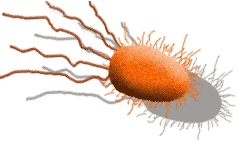
34. Whiplike structures used by bacteria for movements are called ______________________.

35.   Photoautotrophs are bacteria that use ______________________ as an energy source.

36.   Bacteria can be one of three different shapes:

A. _____________________________________________(Rod)

B. _____________________________________________(Sphere)

C. _____________________________________________(Spiral)

37.  Bacteria usually gain part of their ____________________ from their shape.

38. Two major differences between groups of bacteria are their source of ____________________
and weather or not they use ________________ for cellular respiration.

39.   Most bacteria are _______________________; they get their energy by consuming (eating) organic molecules.

40.   Some are __________________ that make their own food from ________________.

41.   ____________________________ obtain their food from inorganic compound instead of sunlight.

42.  _________________________ use sunlight for energy.

43.   Organisms that use oxygen during cellular respiration are called ________________ Organisms
that do not use oxygen are called __________________________.  Typically they get their energy through _________________________________.

44. Bacteria called ______________  __________________ cannot live without oxygen.

45.   Bacteria called ____________  _______________ cannot live in the presence of oxygen.

46.   Bacteria called ________________  __________________ can use oxygen when it is available,
but do not depend on it.

47. Most bacteria reproduce by a process called _________________ __________________.

48. Binary fission is a process in which the __________________________ replicate,
after which the ________________ divides.

49. Binary fission is a type of _____________________ reproduction.

50. Some bacteria contain smaller pieces of circular DNA called  ________________________.

51. Bacteria can exchange genes by one of three special means: _________________________, __________________________, or _____________________________.

52. The process of exchanging genetic material through cell to cell contact is called
___________________________________.

53. Hair like structures on the surface of bacteria are called ______________________.

54. The process by which bacteria cells pick up and incorporate DNA from dead bacteria cells is called _________________________________.

55. Using a virus to transfer DNA from one bacterial cell to another is called _____________________________.

56. When living conditions become _____________________, some bacteria from special
dehydrated cells called ___________________________________.

57. Bacteria that form ___________________ have an advantage for ____________________.

58. Bacteria the feed on and that break down dead organic material are called ______________________________.

59. Type of bacteria that produces many antibiotics__________________________.

60. Type of bacteria that produces endotoxins ___________________________  ___________________________.

61. Bacteria that can only survive in the absence of oxygen are called _______________________  ____________________________.

62. Gram-negative bacteria appear ________________ when they undergo the Gram-stain procedure.

63. Type of  bacteria that performs nitrogen fixation is _________________________.

64. Type of bacteria that peptidoglycan is present in cell walls _________________________________.

65. What bacteria are thought to be responsible for establishing the Earth’s oxygen-rich atmosphere? ____________________________________

66. Bacteria cells typically lack ____________________________________.

67. Bacterial disease of the intestines are usually transmitted by contaminated __________________________  or __________________________.

68. What are the Three Mechanism of action of an antibiotic?

DIRECTIONS: Answer the questions below as completely and as thoroughly as possible. Answer the question in essay form (not outline form), using complete sentences. You may use diagrams to supplement your answers, but a diagram alone without appropriate discussion is inadequate.

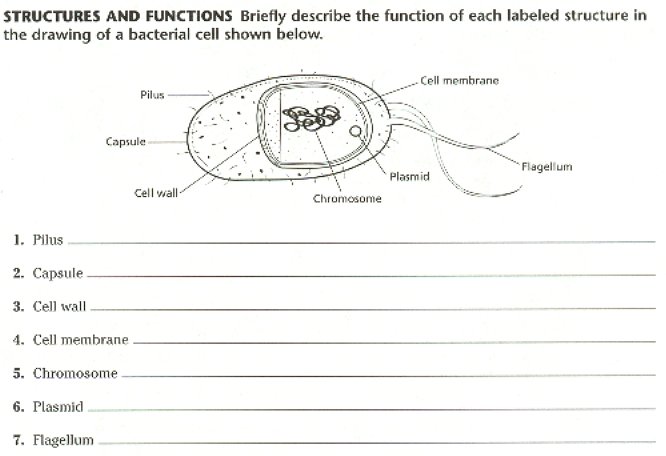
1. Describe the capsule of a bacterium and its function.

2. Identify the most common shapes of Eubacteria and Describe each.

3. Compare and Contrast Archaebacteria with Eubacteria.

4. Identify Three Ways that bacteria are used to produce substances for human use.

5. Describe the significance of cyanobacteria in the formation of the Earth’s atmosphere.

6. List the various structures of the bacterial cell, and Describe their function.

7. Explain the laboratory technique Gram stain and Explain what it is used for.

8. Define the term genetic recombination as it applies to bacteria, and Describe Three ways that genetic
recombination occurs in bacteria.

9. Explain how chemoautotrophs differ from photosynthetic autotrophs.

10. Explain how the terms bacteria, Eubacteria, and Archaebacteria, relate to one another.

11. Describe Three Types of movement among bacteria.

12. List the characteristics that are used to classify bacteria.

13.  Explain how chemoautotrophs harvest energy from the environment.

14.  Describe Two Ways bacteria cause disease.

15.  Explain why antibiotic resistance among bacteria is increasing.

16. List one distinguishing characteristic of each of the three main groups of Archaebacteria.

BACK
 

Preap Assignments Sem2

Updated May 2007

Third Nine Weeks

Week of January 8 assignments:
Read & outline chapter 10 on Nucleic Acids; PowerPoint: Nucleic Acids & protein Synthesis; chapter 10 outline due

Week of January 14 assignments:

Chapter 10 study guide; Lab: Strawberry DNA; Chapter 10 TEST on Nucleic Acids; Read & outline chapters 8 & 12 on genetics


Week of January 21 assignments: 

PowerPoint on genetics; Monohybrid crosses & ratios; Chapter 8 outline due

I have a Dream!  Martin Luther King Holiday

Week of January 28 assignments:
Lab: Karyotyping; Work genetics problems; Notes on genetic disorders; genetics review; TEST on chapters * & 12 genetics; Read chapters 13 & 14 on evolution

Week of February 4 assignments:
Cover section 14.1 and chapter 15 on Charles Darwin & natural selection; Lab: Natural Selection in Peanuts

Week of February 11 assignments:  Interims
study guide on evolution; TEST on chapters13 & 14 Evolution; Read & outline chapter 18 on Taxonomy; PowerPoint notes on taxonomy; Peanut lab write up due

Week of February 18 assignments:
Practice taxonomic keying; Complete taxonomy notes; Chapter 18 TEST on Taxonomy; Read & outline chapters 24 & 25 on bacteria & viruses

Monday Holiday — President’s Day!

Parent-Teacher Conference!

Week of February 25 assignments: 
Notes on Bacteria & Viruses; Assign Virus model to build; Chapter 24 outline due

Week of March 3 assignments:
Notes on Sponges & Cnidarians; Assign Invertebrate drawings; study guide & take online quiz; Continue Koch’s lab

Week of March 10 assignments: 

Complete Virus notes; Virus model due; Chapter 25 outline due; TEST on Bacteria & Viruses; Handout & worksheet on plant unit

Week of March 17 assignments:
Cover nonvascular plants, angiosperms, & gymnosperms

Spring Break March 26 – 30!

End of Third Nine weeks

  Pre -AP Biology        Biology I

Fourth Nine Weeks

Week of March 24 assignments: Monday, Teacher Professional development!

Plant worksheet due; review for plant test; *UNIT TEST on Plants; Assign ecosystem collage; Start answering ecology unit worksheet

Week of March 31 assignments:

Work on and finish ecology unit worksheet; review for ecology test; TEST on Ecology; Read & outline chapter 35 on Sponges & Cnidarians

Good Friday, April 4th!


Week of April 7 assignments:    

Ecosystem Collage due!; Notes on Sponges & Cnidarians; study guide; Test on Chapter 35 Sponges & Cnidarians; read & outline chapter 36 on Round & Flat worms

Week of April 14 assignments:
Notes on worms; Chapter 36 outline due; read & outline chapter 37 on Mollusks & Annelids; notes on mollusks & annelids

Week of April 23 assignments:  Interims 

Biology End-of-Course Exam on Monday, April 16-17th!

Dissect earthworm; *TEST on chapters 36 & 37 Worms & Mollusks; Read & outline chapters 38 & 39 on Arthropods & Insects; Start notes on arthropods

Week of April 30 assignments:
Notes on Insects; review for arthropod test; TEST on chapters 38 & 39 Insects & other Arthropods; read & outline Chapter 40 on Echinoderms

Week of May 7 assignments:
Notes on Echinoderms; Dissect starfish; TEST on Chapter 40 Echinoderms; Read & outline chapters 41 & 42 on fish & amphibians; Assign vertebrate/invertebrate project

Week of May 14 assignments:
Notes on fish & amphibians; fish & amphibian outlines due; read & outline chapter 43 on reptiles

Click frog for jokes

Week of May 9 assignments:   Graduation May 25!
Notes on reptiles, birds, and mammals; Read chapters 44 & 45 on birds  mammals; UNIT TEST on Vertebrates; Vertebrate/Invertebrate Project due!; semester Test review

Final Exams  Start  Next Week-   Don’t Forget to study!!!

Week of May 28 assignments:  

Semester Exams Tuesday, Wednesday, & Thursday; Textbooks due!

Final Exams  Start  –   Don’t Forget to study!!!

End of Fourth Nine weeks

  Pre -AP Biology        Biology I

Enjoy your summer!