Preap Articles


PreAP Biology Articles to Abstract

       An abstract is a summary or synopsis of an article in a journal or magazine.  The purpose of preparing an abstract is to acquaint you with scientific literature and to expose you to current topics in biology.

Special Instructions:

·         Articles to be abstracted must be at least two pages (text) in length.

·         Work cited must be included at the top of the abstract page.

·         Triple space between the citation & the start of your paper

·         Abstracts must be handwritten and at least two and a half pages in length.  (DO NOT WRITE ON THE BACK!)

  • Write your name and period at the top of the abstract.


CLICK HERE FOR PRINTABLE COPY

MLA Style Periodical Citation:

Author. “Title of Article.” Title of Magazine Date: Page(s).

EXAMPLE:

Milton, Katherine. “Diet and Primate Evolution.” Scientific American August 1993: 86-94.


Abstracts DUE 1st  Wednesday of each month August – May.
(Two abstracts due in January – first & 3rd Tuesday.)

Preap Genetics Study Guide

Genetics Review  

The two genes or alleles that combine to determine a trait would be the organism’s _______________.
Type AB blood, having two genes dominant for a trait, is an example of ________.
State Mendel’s law of segregation.
Rr x Rr is an example of what type of cross —– P1, F1, or F2?
If both alleles are the same in a genotype, is the genotype homozygous or heterozygous?
Which cross is a cross between two hybrids —– P1, F1, or F2?
__________ dominance results in the blending of genes in the hybrid. Give an example using flower color.
What is another term for a heterozygous genotype?
The _____________ is the physical feature such as round peas that results from a genotype.
How many traits are involved in a monohybrid cross?
What type of organism was used in the first genetic studies done by Gregor Mendel?
What is a karyotype?
The two genes for a trait represented by capital & lower case letters are called __________.
How many traits are involved in a dihybrid cross?
Which of Mendel’s laws states that the dominant gene in a pair will be expressed?
If both alleles are the same, is the genotype homozygous or heterozygous? Write an example.
Write an example of a hybrid or heterozygous genotype.
The genes for sex-linked traits are only carried on which chromosome?
Who is considered to be the “father of genetics”?
A second filial or F2 cross is also called a ____________ cross.
The failure of chromosomes to separate during meiosis (egg & sperm formation) is known as _________________.
A cross between two pure or homozygous organisms is called what type of cross —– P1, F1, or F2?
What genetic disorder results from a sex-linked trait that affects color vision?
The genetic disorder called _______________ is known as the “free bleeders” disease.
Having three 21st chromosomes causes the genetic disorder known as _________.
A person suffering from the genetic disorder called ______________ can not digest fats.
_____________________ disease is a genetic disorder where red blood cells carry less oxygen.
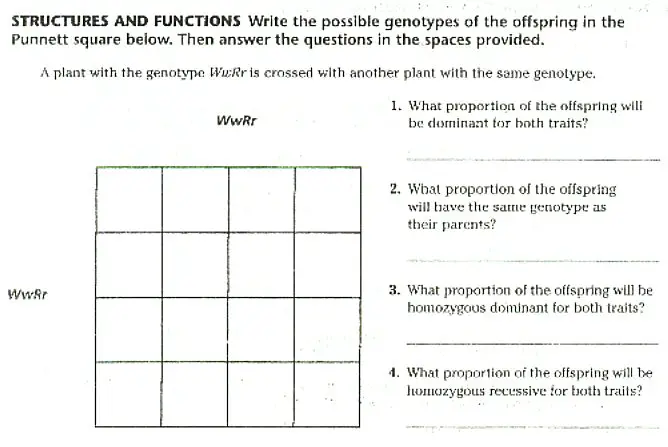
Work a P1 cross for plant height in peas.
Work an F1 cross for plant height in peas.


DIRECTIONS: Answer the questions below as completely and as thoroughly as possible. Answer the question in essay form (not outline form), using complete sentences. You may use diagrams or pictures to supplement your answers, but a diagram or picture alone without appropriate discussion is inadequate.

1. State the two laws of heredity that resulted from Mendel’s work.

2. What happens during meiosis that would allow genes located on the same chromosome to separate independently of one another?

3. List the steps in Mendel’s experiments on pea plants. Include the P generation, F1 generation, and F2 generation.

4. Write the equation for probability.

5. Distinguish between codominance and incomplete dominance. Give an example of each type of inheritance.

6. Define the terms, dominant and recessive.

7. Relate the events of meiosis to the law of segregation.

8. Explain the difference between a monohybrid cross and dihybrid cross. Give an example of each.

9. Explain how you would use a Punnett square to predict the probable outcome of a monohybrid cross. Draw a Punnett square to demonstrate your monohybrid cross.

10. Explain the terms genotype and phenotype.

11. Explain the terms homozygous and heterozygous.


BACK


Preap Biochemistry Study Guide


Biochemistry Review 


1. Molecules with a slightly negative end and a slightly positive end are called ___________________  _____________________________.

2. A monomer of protein is called an __________________  __________________.

3. An attractive force between like particles is called ___________________________.

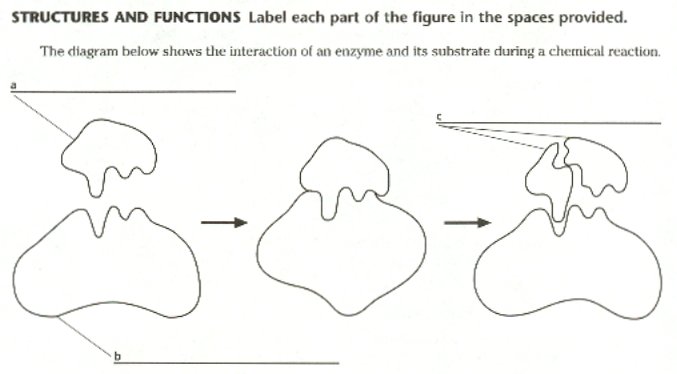
4. Organic molecules that catalyze reactions in living systems are ______________________.

5. The compound found in living things that supplies the energy in one of its chemical bonds directly to cells is ______________________.

6. Enzymes lower activation energy by___________ to the ____________________ and ______________________ bonds within the ________________________.

7. The monomers that make up nucleic acids are called __________________________.

8. The type of attraction that holds two water molecules together is called __________________________  __________________________.

9. The sharing of three pairs of electrons is called a ___________________  _____________.

10.  The structural building block that determines the characteristics of a compound is called the _____________________________  _______________________.

11.  Large carbon compounds are built from smaller molecules called ______________________________.

12.  What is the type of reaction that forms large molecules from smaller ones? _________________________________  _____________________________.

13.  What type of reaction breaks large molecules into smaller ones? _______________________

14.  What is the by product of a condensation reaction? __________________________

15.  The attractive force between unlike particles is called ____________________________.

16.  A compound that is stored as glycogen in animals and as a starch in plants is ____________________________________.

17.  Lipids are good energy storage molecules because they have many _________________-___________________ bonds.

18.  What are the components of many lipids? ________________________  ______________________

19.  What is the monomer of many polysaccharides? ______________________________

20.  What kind of reaction allows amino acids to become linked together? ________________________________  _____________________________.

21.  Nucleic acids function primarily to carry __________________________  ____________________ and direct _____________________  ______________________.

22. Tends not to react with water, “Water Fearing”  ________________________________

23. Attracted to water molecules, “Water Loving” _________________________________

24. Water is called a ___________________________  ___________________________.
DIRECTIONS: Read Chapter 3, Biochemistry, and Answer the questions below as completely and as thoroughly as possible. Answer the question in essay form (not outline form), using complete sentences. You may use diagrams or pictures to supplement your answers, but a diagram or picture alone without appropriate discussion is inadequate.

1. Describe the structure of a water molecule, and explain how the electrical charge is distributed over the molecule.

2. Describe the structure of amino acids and proteins.

3. What are the structural differences between monosaccharides, disaccharides, and polysaccharides?

4. What is capillarity? Include defining Adhesion and Cohesion.

5. How does a condensation reaction differ from a hydrolysis reaction?

6. Give Three reasons why water is an effective solvent.

7. What is an organic compound?

8. What property allows carbon compounds to exist in a number of forms?

9. The presence of four electrons in the outermost energy level of a carbon atom enables
carbon atoms to form what THREE Things.

10. Living things contain many different proteins of vastly different shapes and functions.
What determines the shape and thus the function of a particular protein?

11. How does the structure of a phospholipid, linear molecules with a polar end and a
nonpolar end, relate to their function in the cell membrane?

 

Pre AP Lab Reports


Pre AP Lab Reports

Calorimetry of Food Energy
Sample 1     Sample 2     Sample 3
Scientific Method – All Thumbs!
Sample 1     Sample 2
Osmosis Through an Egg Membrane
Sample 1     Sample 2    Sample 3     Sample 4
Environmental pH
Sample 1     Sample 2
Chromatography of Plant Pigments
Sample 1     Sample 2     Sample 3
Planarian Regeneration
Sheep Heart Dissection Chromatography of Pigments
Metric Measurement Water Properties
 
BACK

Pre AP Grades


Pre AP Biology Grades  

August 20, 2011
Fourth Nine Weeks Grades

1st Period 8th Period
CHERYL MASSENGALE COMPLETE DETAILED RECORD – Quarter 1
1 PREAP BIOLOGY 1 2
Qtr. 1 Aug 18, 2011 100100 QUARTER Method: Weight/Categories
Student H T HOMEWORK LAB QUIZ TEST Qtr. 1
= = > 91100 A- 91% A 100% A 99%
= = > 94 94 A 94% A 94% A 94%
= = > 91 94 A- 91% A 94% A 94%
= = > 88 94 B+ 88% A 94% A- 93%
= = > 91 89 A- 91% B+ 89% B+ 89%
= = > 88 89 B+ 88% B+ 89% B+ 89%
= = > 79 89 C+ 79% B+ 89% B+ 88%
= = > 73 89 C- 73% B+ 89% B+ 87%
= = > 94 83 A 94% B- 83% B 84%
= = > 91 83 A- 91% B- 83% B 84%
= = > 88 83 B+ 88% B- 83% B 84%
= = > 85 83 B 85% B- 83% B- 83%
= = > 83 B- 83% B- 83%
= = > 80 83 B- 80% B- 83% B- 83%
= = > 73 83 C- 73% B- 83% B- 82%
= = > 97 78 A 97% C+ 78% B- 80%
= = > 91 78 A- 91% C+ 78% C+ 79%
= = > 88 78 B+ 88% C+ 78% C+ 79%
= = > 85 78 B 85% C+ 78% C+ 79%
= = > 82 78 B- 82% C+ 78% C+ 79%
= = > 85 72 B 85% C- 72% C 74%
= = > 73 72 C- 73% C- 72% C- 72%
Average = = > 87 85 B+ 87% B 85% B 85%
WT.10% WT.20% WT.70% Weight/PercentagesASSIGNMENTS FOR 1 PREAP BIOLOGY Quarter 1
AUG 17 1 H 100 SAFETY WKSHT AUG 18 2 T 100 SAFETY TEST
CHERYL MASSENGALE COMPLETE DETAILED RECORD – Quarter 1
8 PREAP BIOLOGY 1 2
Qtr. 1 Aug 18, 2011 100100 QTR PTS. QUARTER Method: Cumulative Points
Student H T HOMEWORK LAB QUIZ TEST Qtr. 1
= = > 91 89 180/200 A- 91% B+ 89% A- 90%
= = > 79100 179/200 C+ 79% A 100% B+ 89%
= = > 85 94 179/200 B 85% A 94% B+ 89%
= = > 88 89 177/200 B+ 88% B+ 89% B+ 89%
= = > 82 94 176/200 B- 82% A 94% B+ 88%
= = > 85 89 174/200 B 85% B+ 89% B+ 87%
= = > 79 94 173/200 C+ 79% A 94% B 86%
= = > 88 83 171/200 B+ 88% B- 83% B 86%
= = > 82 89 171/200 B- 82% B+ 89% B 86%
= = > 79 89 168/200 C+ 79% B+ 89% B 84%
= = > 73 94 167/200 C- 73% A 94% B 84%
= = > 82 83 165/200 B- 82% B- 83% B- 83%
= = > 76 89 165/200 C 76% B+ 89% B- 83%
= = > 79 83 162/200 C+ 79% B- 83% B- 81%
= = > 76 78 154/200 C 76% C+ 78% C+ 77%
= = > 55 83 138/200 F 55% B- 83% D+ 69%
= = > NC 94 94/200 F 0% A 94% F 47%
= = > NC 89 89/200 F 0% B+ 89% F 45%
Average = = > 75 89 164/200 C 75% B+ 89% B- 82%
WT. 50% WT. 0% WT. 0% WT. 50% Cumulative PointsASSIGNMENTS FOR 8 PREAP BIOLOGY Quarter 1
AUG 17 1 H 100 SAFETY WKSHT AUG 18 2 T 100 SAFETY TEST

Massengale