Lab 1 Osmosis


Lab 1 Osmosis & Diffusion

osmosis lab

Osmosis Lab Introduction:

Cells have kinetic energy.  This causes the molecules of the cell to move around and bump into each other.  Diffusion is one result of this molecular movement.  Diffusion is the random movement of molecules from an area of higher concentration to areas of lower concentration.  Osmosis is a special kind of diffusion where water moves through a selectively permeable membrane (a membrane that only allows certain molecules to diffuse though).  Diffusion or osmosis occurs until dynamic equilibrium has been reached.  This is the point where the concentrations in both areas are equal and no net movement will occur from one area to another.
If two solutions have the same solute concentration, the solutions are said to be isotonic.  If the solutions differ in concentration, the area with the higher solute concentration is hypertonic and the area with the lower solute concentration is hypotonic.  Since a hypotonic solution contains a higher level of solute, it has a high solute potential and low water potential.  This is because water potential and solute potential are inversely proportional.  A hypotonic solution would have a high water potential and a low solute potential.  An isotonic solution would have equal solute and water potentials.  Water potential (y) is composed of two main things, a physical pressure component, pressure potential (yp), and the effects of solutes, solute potential (ys).  A formula to show this relationship is y = yp + ys.  Water will always move from areas of high water potential to areas of low water potential.
The force of water in a cell against its plasma membrane causes the cell to have turgor pressure, which helps maintain the shape of the cell.  When water moves out of a cell, the cell will loose turgor pressure along with water potential.  Turgor pressure of a plant cell is usually attained while in a hypotonic solution.  The loss of water and turgor pressure while a cell is in a hypertonic solution is called plasmolysis.
Hypothesis:
During these experiments, it will be proven that diffusion and osmosis occur between solutions of different concentrations until dynamic equilibrium is reached, affecting the cell by causing plasmolysis or increased turgor pressure during the process.
Materials:
Lab 1A – To begin Lab 1A, first collect the desired equipment.  The materials needed are dialysis tubing, Iodine Potassium Iodide (IKI) solution, 15% glucose/ 1% starch solution, glucose Testape or Lugol’s solution, distilled water, and a 250-mL beaker.
Lab 1B – For Lab 1B you will need to collect six presoaked dialysis tubing strips, distilled water; 0.2M, 0.4M, 0.6M, 0.8M, and a 1.0M sucrose solution; six 250-mL beakers or cups, and a scale.
Lab 1C – Lab 1C these items are needed: a potato, knife, potato core borers, six different solutions, and a scale.
Lab 1D – During Lab 1D, only paper, pencil, and a calculator will be needed to make the calculations.
Lab 1E – n Lab 1E these items are needed: a microscope slide, cover slip, onion cells, light microscope, and a 15% NaCl solution.
 Procedures:
Lab 1A – After gathering the materials, pour glucose/starch solution into dialysis tubing and close the bag.  Test the solution for presence of glucose.  Test the beaker of distilled water and IKI for presence of glucose.  Put the dialysis bag into the beaker and let stand for 30 minutes.  When time is up test both the bag and the beaker for presence of glucose.  Record all data in table.
Lab 1B – Obtain the six strips of dialysis tubing and fill each with a solution of a different molarity.  Mass each bag.  Put each bag into a beaker of distilled water and let stand for half and hour.  After 30 minutes is up, remove each bag and determine its mass.  Record all data in its appropriate table.
Lab 1C – sing the potato core borer, obtain 24 cylindrical slices of potato, four for each cup.  Determine the mass of the four cylinders.  Immerse four cylinders into each of the six beakers or cups.  Let stand overnight.  After time is up, remove the cores from the sucrose solutions and mass them.  Record all data in its appropriate table.
Lab 1D – Using the paper, pencil, and calculator collected, determine solute potentials of the solutions and answer the questions asked to better understand this particular part of the lab.
Lab 1E – Using the materials gathers, prepare a wet mount slide of the epidermis of an onion.  Draw what you see of the onion cell under the microscope.  Add several drops of the NaCl solution to the slide.  Now draw the appearance of the cell.
Data:
Lab 1A – Table 1.1


Contents  Initial Color Final Color Initial Presence of Glucose  Final Presence of Glucose
  Bag 15% Glucose/ 1% Starch Solution    clear Dark blue       + +
  Beaker  H2O+IKI Orange to brown Orange to brown      _ +


Lab 1A Questions
1)     Glucose is leaving the bag and Iodine-Potassium-Iodide is entering the bag.  The change in color of the contents of the bag and the presence of glucose in the bag prove this.
2)     In the results, the IKI moved from the beaker to the bag, this caused the change in the color of the bag.  The IKI moved into the bag to make the concentrations outside the bag equal to inside the bag.  The glucose solution moved out of the bag making glucose present in the beaker.  The glucose moved to make the solute concentration inside and out of the bag equal.
3)     If the initial and final percent concentration of glucose and IKI for in the bag and the beaker were given, they would show the differences and prove the movement of these substances to reach dynamic equilibrium.
4)     Based on my observations, the smallest substance was the IKI molecule, then the glucose molecules, water molecules, membrane pore, and then the starch molecules being the largest.
5)     If the experiment started with glucose and IKI inside the bag and starch in the beaker, the glucose and IKI would move out of the bag to make the concentrations equal, but the starch could not move into the bag because its molecules are too big to pass through the semipermeable membrane.

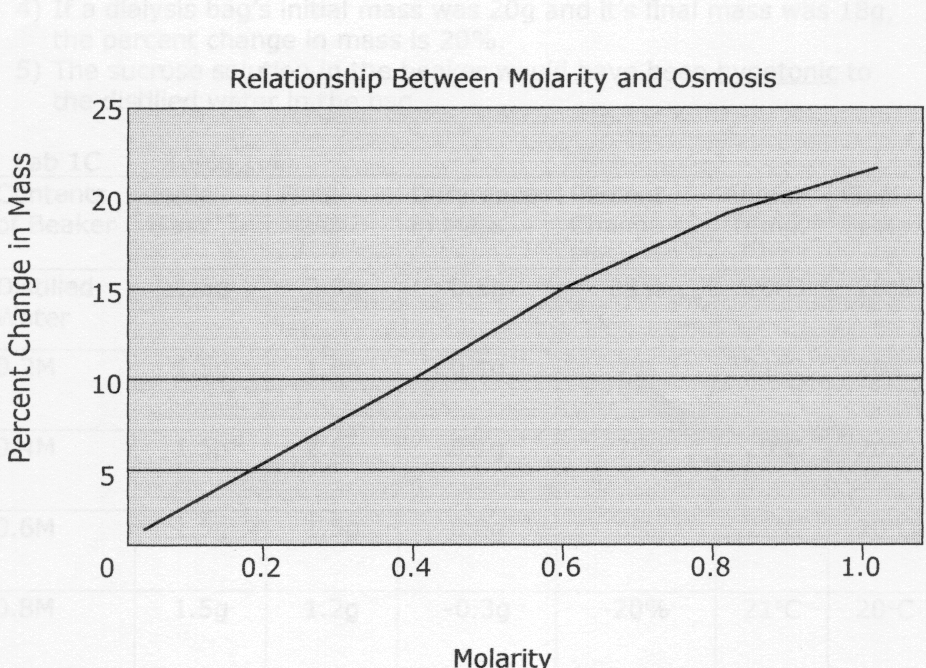
Lab 1B –  Table 1.2   Dialysis Bag Results


Contents in dialysis bag Initial mass Final mass Mass difference Percent change in mass
a) distilled       water 26.5g 26.6g 0.1g 0.4%


b)0.2M 28.1g 29.3g 1.2g 4.3%
c)0.4M 27.3g 30.1g 2.8g 10.3%
d)0.6M 28.3g 32.3g 4.0g 14.1%
e)0.8M 25.9g 30.7g 4.8g 18.5%
f)1.0M 26.7g 32.9g 6.2g 23.2%


Table 1.3     Dialysis Bag Results: Class Data


Group 1

Group 2

Group 3

Group 4 Total Class Average
Distilled Water 0.4% 1.16% 0.79% 1.54% 3.89% 1.0%
0.2M 4.3% 5.99% 6.44% 5.94% 22.67% 5.67%
0.4M 10.3% 10.49% 10.33% 8.45% 39.57% 9.89%
0.6M 14.1% 14.86% 16.04% 15.1% 60.1% 15.03%
0.8M 18.5% 19.80% 17.97% 20.0% 76.27% 19.07%
1.0M 23.2% 18.77% 23.55% 21.9% 87.42% 21.86%


Lab 1B Questions:
1)     The molarity of the sucrose in the bag determines the amount of water that either moves into or out of the bag, which changes the mass.  For example, when the bag contained a 0.2M solution, water entered the bag to make the concentrations inside and outside of the bag more equal.  As this happened, the mass rose 1.2g
2)     If each of the bags were placed into a 0.4M solution instead of distilled water, the masses of the bags would have changed in different ways.  The mass of the bags filled with distilled water and 0.2M sucrose would have gone down because water would have left the bag.  The mass of the 0.4M bag would have stayed the same because the concentrations are now equal.  The masses of the 0.6, 0.8, and 1.0M bags would have increased because water would have moved into the bag to equalize the concentrations.
3)     In the data collected, the percent change in mass was calculated to show how greatly the mass increased or decreased.  The difference in mass is not enough to go by because the initial masses of the dialysis bags were not all the same.
4)     If a dialysis bag’s initial mass was 20g and it’s final mass was 18g, the percent change in mass is 20%.
5)     The sucrose solution in the beaker would have been hypotonic to the distilled water in the bag.
Lab 1C        Table 1.4


Contents of Beaker Initial Mass Final Mass Difference in Mass % Change in Mass Initial Temp. Final Temp.
Distilled Water 1.5g 2.0g 0.5g 33% 20°C 20°C
0.2M 1.5g 1.6g 0.1g 7% 21°C 20°C
0.4M 1.5g 1.6g 0.1g 7% 20°C 20°C
0.6M 1.5g 1.5g 0.0g 0% 21°C 20°C
0.8M 1.5g 1.2g -0.3g -20% 21°C 20°C
1.0M 1.5g 1.4g -0.1g -7% 20°C 20°C


Lab 1C        Table 1.5     Class Results


Percent Change in Mass of Potato Cores
Group 1 Group 2 Group 3 Group 4 Total Class Average
Distilled Water 33% 35.29% 25% 31.25% 124.54% 31.14%
0.2M 7% 29.41% 25% 13.33% 74.74% 18.69%
0.4M 7% 11.11% -12.5% -12.5% -6.89% -1.7%
0.6M 0% -15.79% -18.75% -20% -54.54% -13.64%
0.8M -20% -15.79% -18.75% -25% -79.54% -19.89%
1.0M -7% 0% -18.75% -20% -45.75% -11.44%


Lab 1 D Questions:
1)  The water potential of the potato core after dehydrating will decrease because the water within the potato would evaporate and therefore lower the water potential.
2)     The solute concentration of the plant cell is hypertonic because the solute concentration is higher than the water concentration.  Because of this, water will diffuse into the cell to reach dynamic equilibrium.
3)     The pressure potential of the system is equal to 0.
4)     The water potential is greater in the dialysis bag.
5)     Water will diffuse out of the bag since the water potential is higher in the bag and water moves from areas of higher water potential to areas of lower water potential.
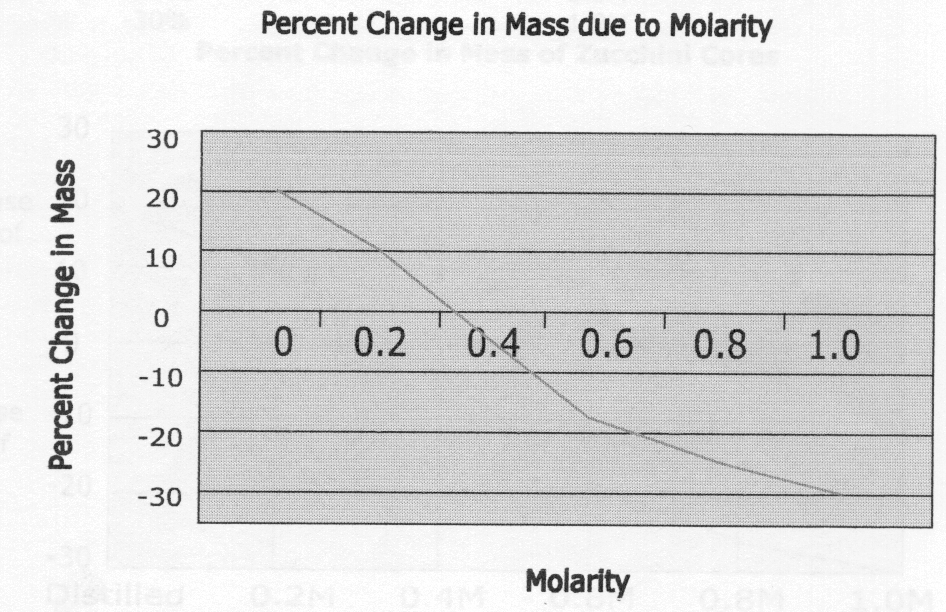
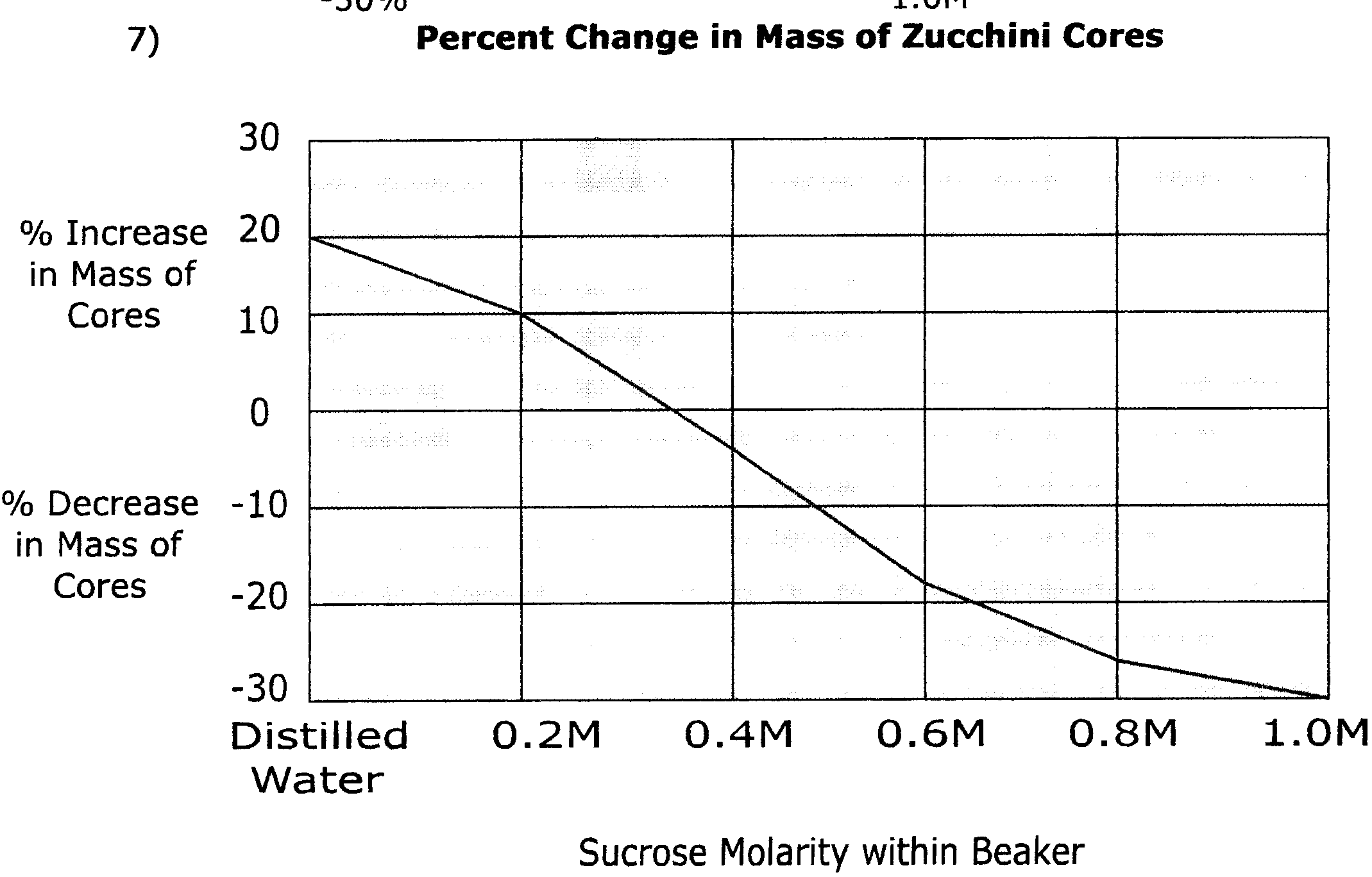
6)     Zucchini cores placed in sucrose solutions at 27°C resulted in the following percent changes after 24 hours:

Percent Change in Mass  Sucrose Molarity
20% Distilled Water
10% 0.2M
  -3% 0.4M
-17%  0.6M
 -25% 0.8M
-30% 1.0M


8)ys=-iCRT
ys=-(1)(0.35)(0.0831)(295)
ys=-8.580075

y=0+ys
y=0+(-8.580075)
y=-8.580075
9) Adding solute to a solution increases solute potential because the solute concentration increases.
10) The distilled water would have a higher concentration of water molecules and would also have a higher water potential.  The red blood cells would increase in size because water is moving from the area of higher water potential (the distilled water) to the area of lower water potential (the red blood cells) until dynamic equilibrium is reached.
Lab 1E Questions
1) After preparing a wet mount slide, I have observed the onion cells under magnification and they appear to be small, empty boxes pushed closely together.
2) By adding two or three drops of NaCl the cells should have shrunk, but no change took place.
3) The cells maintained the same shape.
4)  Plasmolysis is the lose of water and turgor pressure in a cell.
5)  The onion cells should have plasmolyzed because the area surrounding them had a lower water potential and water should have moved out of the cells.
6)  Grasses that live on the sides of roads that have been salted in the winter end to dies because the water is drained from the cells as it moves out of the grass cells into the hypertonic NaCl area around it.

Lab 1D Plasmolysis of Cells – Drawings of onion cells
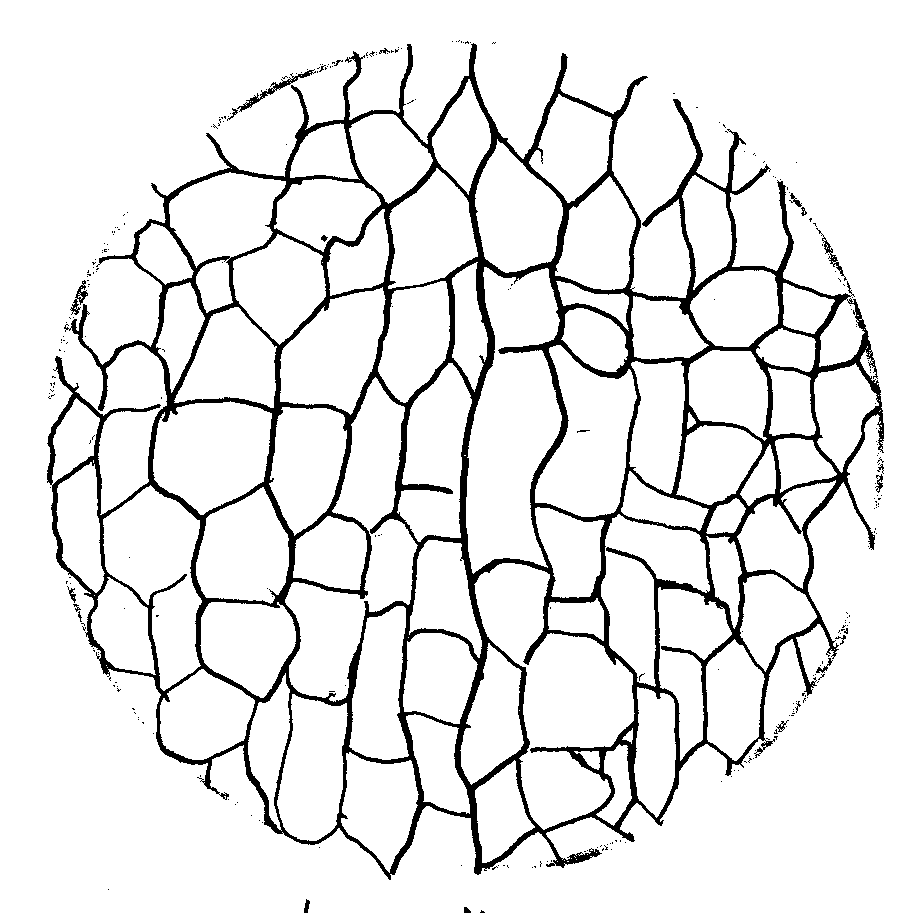
100X
Onion Cells in Distilled Water

*Picture Of onion cells in saline not available.
Error Analysis:
Lab 1A – The data collected in this lab experiment did not seem to contain any inconsistencies, so therefore no human error is detected.
Lab 1B – In this lab experiment, the data seems to be compliant with the data collected by the other lab groups, so no human error was thought to have happened.
Lab 1C – There was some discrepancy in this experiment in the 1.0M solution’s percent change in mass of potato cores.  The data decreases consistently until the 1.0M solution, so human error is thought to be a factor in this.  Some mistakes that could have taken place are miscalculations in initial and final masses or problems with the molarity of the solution itself.
Lab 1D – In this part of the lab, only calculations were made, so no human error probably occurred during this time.
Lab 1E – In part 1E, after adding the NaCl solution to the onion cells, the cells should have reduced in size, but no reaction took place.  This may have occurred in part because the onion itself was already dried out and dehydrated, or while the onion was being looked at through the microscope, the heat from it may have caused the cells to loose water.
Conclusion:
During the experiment conducted in Lab 1A, the results and data collected make it possible to conclude that glucose and Iodine Potassium Iodide can pass through a selectively permeable membrane and will if the concentrations on either side are not equal. In Lab 1B, it can be concluded that sucrose cannot pass over a selectively permeable membrane, but instead water molecules will move across the membrane to the area of lower water potential to reach dynamic equilibrium. Lab 1C provided information that helps to conclude that potatoes do contain sucrose molecules.  This can be stated because the cores took in water while they were emerged in the distilled water.  This means they had a lower water potential and higher solute potential than the distilled water.  The solute potential is equal to about a 0.6M solution of sucrose according to the data collected. During Lab 1D calculations were made and questions were answered to help give a better understanding of water and solute potential. If the onion cell experiment in part 1E of the lab would have produced correct results, conclusions could have been made.  It is thought that the onion cells would have plasmolyzed due to the addition of NaCl to the cells.  This shows how the onion cells had high water potential and moved to the area outside the cell with lower water potential.  Then, after adding water back to the cells, water would have moved back into the cells increasing turgor pressure.
The water potential played an enormous role in each part of this lab.  Since water moves areas of high water potential to areas of low water potential, reactions took place in each part resulting in different conclusions being derived from them.  Water potential was a key element in each part of the experiment. In plant and animal cells, loss or gain of water can have different effects.  In a plant cell, it is ideal to have an isotonic solution.  If the solution is hypertonic, the cell will shrivel from lack of water intake.  Inversely, if the solution is hypotonic the cell could take in too much water and the cell will lyse and break open.  For a plant cell, the ideal solution is a hypotonic solution because the cell takes in water increasing turgor pressure which keeps the cells tightly packed and keep their shape.  If the solution is hypertonic, the cell will plasmolyze and died from lack of water.  In an isotonic solution, the plant cell does not have enough turgor pressure to keep is shape.

BACK

AP Lab 2 Report 2001


Enzyme Catalysis


Introduction
Enzymes are proteins produced by living cells that act as catalysts, which affect the rate of a biochemical reaction. They allow these complex biochemical reactions to occur at a relatively low temperature and with less energy usage.

In enzyme-catalyzed reactions, a substrate, the substance to be acted upon, binds to the active site on an enzyme to form the desired product. Each active site on the enzyme is unique to the substrate it will bind with causing each to have an individual three-dimensional structure. This reaction is reversible and is shown as following:

E + S—-ES—- E + P

Enzymes are recyclable and unchanged during the reaction. The active site is the only part of the enzyme that reacts with the substrate. However, its unique protein structure under certain circumstances can easily be denatured. Some of the factors that affect enzyme reactions are salt concentration, pH, temperature, substrate and product concentration, and activators and inhibitors.

Enzymes require a very specific environment to be affective. Salt concentration must be in an intermediate concentration. If the salt concentration is too low, the enzyme side chains will attract each other and form an inactive precipitate. Likewise, if the salt concentration is too high, the enzyme reaction is blocked by the salt ions. The optimum pH for an enzyme-catalyzed reaction is neutral (7 on the pH scale). If the pH rises and becomes basic, the enzyme begins losing its H+ ions, and if it becomes too acidic, the enzyme gains H+ ions. Both of these conditions denature the enzyme and cause its active site to change shape.

Enzymes also have a temperature optimum, which is obtained when the enzyme is working at its fastest, and if raised any further, the enzyme would denature. For substrate and product concentrations, enzymes follow the law of mass action, which says that the direction of a reaction is directly dependent on the concentration. Activators make active sites better fit a substrate causing the reaction rate to increase. Inhibitors bind with the enzymes’ active site and block the substrate from bonding causing the reaction to subside.

The enzyme in this lab is catalase, which produced by living organisms to prevent the accumulation of toxic hydrogen peroxide. Hydrogen peroxide decomposes to form water and oxygen as in the following equation:

2H2O2 ® 2H2O + O2

This reaction occurs spontaneously without catalase, but the enzyme speeds the reaction considerably. This lab’s purpose is to prove that catalase does speed the decomposition of hydrogen peroxide and to determine the rate of this reaction.


Hypothesis
The enzyme catalase, under optimum conditions, effectively speeds the decomposition of hydrogen peroxide.


Materials
Exercise 2A: Test of Catalase Activity

In Part 1, the materials used were 10mL of 1.5% H2O2, 50-mL glass beaker, 1 mL catalase, and 2 10-mL pipettes and pipette pumps. In Part 2, the materials used were 5 mL of catalase, a boiling water bath, 1 test tube, a test tube rack, 10 mL of 1.5% H2O2, 50-mL beaker, and 2 10-mL pipettes and pipette pumps. In Part 3, the materials used were 10 mL of 1.5% H2O2, 50-mL beaker, liver, and a syringe.

Exercise 2B: The Baseline Assay

This part of the lab required 10 mL of 1.5% H2O2, 1 mL distilled H2O, 10 mL of H2SO4, 2 50-mL beakers, a sheet of white paper, 5 mL KMnO4, 2 5-mL syringes, and 2 10-mL pipettes and pumps.

Exercise 2C: The Uncatalyzed Rate of H2O2 Decomposition

The materials used for this section were 15 mL of 1.5% H2O2, 1 mL distilled H2O, 10 mL H2SO4, 2 50-mL beakers, a sheet of white paper, 5 mL KMnO4, 2 5-mL syringes, and 2 10-mL pipettes and pumps.

Exercise 2D: An Enzyme-Catalyzed Rate of H2O2 Decomposition

The materials required for Exercise 2D were 70 mL of 1.5% H2O2, 70 mL of H2SO4, 6 mL of catalase solution, 13 plastic, labeled cups, 3 100-mL beakers, 1 50-mL beaker, 1 10-mL syringe, 1 5-mL syringe, 1 60-mL syringe, a sheet of white paper, a timer, and 30 mL of KMnO4.


Method
Exercise 2A: Test of Catalase Activity

In Part 1, 10 mL of 1.5% H2O2 were transferred into a 50-mL beaker. Then, 1 mL of fresh catalase solution was added and the reaction was observed and recorded. In Part 2, 5 mL of catalase was placed in a test tube and put in a boiling water bath for five minutes. 10 mL of 1.5% H2O2 were transferred to a 50-mL beaker and 1 mL of the boiled catalase was added. The reaction was observed and recorded. In Part 3, 10mL of 1.5% H2O2 were transferred to a 50 mL beaker. 1 cm3 of liver was added to the beaker and the reaction was observed and recorded.

Exercise 2B: The Baseline Assay

10 mL of 1.5% H2O2 were transferred to a 50-mL beaker. 1 mL of H2O was added instead of catalase, and then, 10 mL of H2SO4 were added. After mixing well, a 5 mL sample was removed and placed over a white sheet of paper. A 5-mL syringe was used to add KMnO4, 1 drop at a time until a persistent brown or pink color was obtained. The solution was swirled after every drop, and the results were observed and recorded. The baseline assay was calculated.

Exercise 2C: The Uncatalyzed Rate of H2O2 Decomposition

A small quantity of H2O2 was placed in a beaker and stored uncovered for approximately 24 hours. To determine the amount of H2O2 remaining, 10 mL of 1.5% H2O2 were transferred to a 50-mL beaker. 1 mL of H2O was added instead of catalase, and then, 10 mL of H2SO4 were added. After mixing well, a 5 mL sample was removed and placed over a white sheet of paper. A 5-mL syringe was used to add KMnO4, 1 drop at a time until a persistent brown or pink color was obtained. The solution was swirled after every drop, and the results were observed and recorded. The percent of the spontaneously decomposed H2O2 was calculated.

Exercise 2D: An Enzyme-Catalyzed Rate of H2O2 Decomposition


The baseline assay was reestablished following the directions of Exercise 2B. Before starting the actual experiment a lot of preparation was required. Six labeled cups were set out according to their times and 10 mL of H2O2 were added to each cup. 6 mL of catalase were placed in a 10-mL syringe, and 60 mL of H2SO4 were placed in a 60-mL syringe. To start the actual lab, 1 mL of catalase was added to each of the cups, while simultaneously, the timer was started. Each of the cups were swirled. At 10 seconds, 10 mL of H2SO4 were added to stop the reaction. The same steps were repeated for the 30, 60, 120, 180, and 360 second cups, respectively.

Afterwards, a five 5 mL sample of each of the larger cups were moved to the corresponding labeled smaller cups. Each sample was assayed separately by placing each over a white sheet of paper. A 5-mL syringe was used to add KMnO4, 1 drop at a time until a persistent brown or pink color was obtained. The solution was swirled after every drop, and the results were observed and recorded.


Results

Table 1
Enzyme Activity


Activity


Observations

Enzyme activity The solution only bubbled slightly and slowly.
Effect of Extreme temperature


The catalase had no reaction with the H2O2; there were no bubbles
Presence of catalase The solution foamed up immediately


Table 2
Establishing a Baseline


Volume


Initial reading


5.0 mL


Final reading


0.8 mL


Baseline ( final volume – initial volume)


4.2 mL


Table 3
Rate of Hydrogen Peroxide Spontaneous Decomposition


Volume


Initial KMnO4


5.0 mL


Final KMnO4


1.2 mL


Amount of KMnO4 used after 24 hours


3.8 mL


Amount of H2O2 spontaneously decomposed
( ml baseline – ml after 24 hours)


0.4 mL


Percent of H2O2 spontaneously decomposed
( ml baseline – ml after 24 hours/ baseline)


9.52%


Table 4
Rate of Hydrogen Peroxide Decomposition by Catalase


Time ( Seconds)
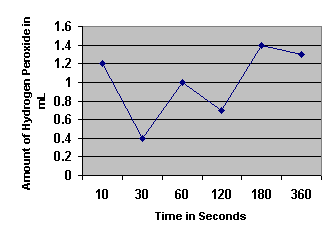
10 30 60 120 180 360
 

Baseline KMnO4


4.0 mL


4.0 mL


4.0 mL


4.0 mL


4.0 mL


4.0 mL


Initial volume KMnO4


5.0 mL


5.0 mL


5.0 mL


5.0 mL


5.0 mL


5.0 mL


Final volume KMnO4


2.2 mL


1.4 mL


2.0 mL


1.7 mL


2.4 mL


2.3 mL


Amount KMnO4 used
(baseline – final)


2.8 mL


3.6 mL


3.0 mL


3.3 mL


2.6 mL


2.7 mL


Amount H2O2 used
(KMnO4 – initial)


1.2 mL


0.4 mL


1.0 mL


0.7 mL


1.4 mL


1.3 mL


Amount of Hydrogen Peroxide Decomposed by Catalase

Exercise 2A: Test of Catalase Activity

1. Observing the reaction of catalase on hydrogen peroxide:

a. What is the enzyme in this reaction?  catalase

b. What is the substrate in this reaction? Hydrogen peroxide

c. What is the product in this reaction? Oxygen & water

d. How could you show that the gas evolved is O2? The gas could be shown to be O2 if the gas were collected in a tube, and a glowing splint was held in the tube. If the splint glowed, it would prove the gas was oxygen.

2. Demonstrating the effect of boiling on enzyme action:

a. How does the reaction compare to the one using the unboiled catalase? Explain the reason for this difference. While the unboiled catalase caused bubbles to form in the solution, the boiled catalase did not react at all because boiling an enzyme causes the protein to unfold and therefore denatures it.

3. Demonstrating the presence of catalase in living tissue:

a. What do you think would happen if the potato or liver was boiled before being added to the H2O2? The catalase in the liver would have been denatured by the boiling and would not have reacted with the H2O2.

Analysis of Results

1. Determine the initial rate of the reaction and the rates between each of the time points.


Time Intervals (Seconds)


Initial 0 to 10


10 to 30


30 to 60


60 to 120


120 to 180


180 to 360


Rates


0.12 mL/sec


-0.04 mL/sec


0.02 mL/sec


-0.005 mL/sec


0.01167 mL/sec


-0.00083

mL/sec


2. When is the rate the highest? Explain why.


The rate is the highest in the initial ten seconds because the concentration of catalase is at its highest. As more of the product is formed, it blocks the reaction between the catalase and the hydrogen peroxide.

3. When is the rate the lowest? For what reasons is the rate low?

The rate is lowest during the 180-360 seconds time period because of the law of mass action. This law says that when there is a high concentration of product as in this period, the enzymes will be blocked by the product (water) from reaching and reacting with the substrate (H2O2).


4. Explain the inhibiting effect of sulfuric acid on the function of catalase. Relate this to enzyme structure and chemistry


Sulfuric acid has an inhibiting effect on catalase function because it causes the pH level in the solution to lower considerably. Acidic solutions cause the protein structure of the enzyme to gain H+ ions causing it to denature.


5. Predict the effect lowering the temperature would have on the rate of enzyme activity. Explain your prediction.


Lowering the temperature of the catalase would slow the rate of reaction until it finally caused the enzyme to denature, and it would no longer react with the substrate. Most enzymes are only affective in a temperature range between 40° – 50° C.

6. Design a controlled experiment to test the effect of varying pH, temperature, or enzyme concentration.

Part 1: Enzyme Activity at Room Temperature

Add 10 mL of 1.5% H2O2 to a 50-mL beaker, and add 1 mL of room temperature catalase. Mix well and add 10 mL of H2SO4. Watch the reaction and record the results.

Part 2: The Effect of Excessive Heat on Enzyme Activity

Put 5 mL of catalase into a test tube and heat thoroughly over a Bunsen burner. Add 1 mL of the heated catalase to 10 mL of 1.5% H2O2 in a 50-mL beaker. Add 10 mL of H2SO4. Watch the reaction and record the results.

Part 3: The Effect of Excessive Cooling on Enzyme Activity

Put 5 mL of catalase in a freezer until completely frozen. Add 1 mL of the frozen catalase to 10 mL of 1.5% H2O2 in a 50-mL beaker. Add 10 mL of H2SO4. Watch the reaction and record the results.


Error Analysis
Any number of factors in this lab could have affected the results of this experiment. To get the desired results all of the measurements had to be precisely accurate and fully planned before hand. In Exercise D especially, the factor of planning became increasingly essential. The first attempt at 2D was unsuccessful due to several reasons. First of all, the measurements, which were taken, could have possibly been inaccurate and the 60-mL syringe containing H2SO4 also dripped into one of the cups early which did not allow the reaction to fully take place. There was also some confusion on the operation of the timer and precise planning in its use. The second attempt at 2D contained errors as well. The measurements were still not as accurate as they should have been, and the solution did not appear entirely uniform. In one cup, for example, the first drop of KMnO4 left a persistent pink color, and then after over a minute, it returned back to being clear. It then took several milliliters more to get it back to a pink color.


Discussion and Conclusion
This lab showed how catalase increased the rate of decomposition of hydrogen peroxide. In 2A, it was shown that catalase causes a visual reaction with H2O2, that when boiled catalase is no longer reactive, and that catalase is present in living tissue. Lab 2C shows that the natural decomposition of H2O2 is much slower than the enzymatic reaction. Lab 2D showed the decomposition of H2O2 over just a period of six minutes, and it had already decomposed more than the uncatalyzed H2O2 had done in 24 hours.

BACK


Lab & Ap Sample 2 Mitosis & Meiosis

Mitosis & Meiosis -AP lab 3

Introduction
Cells come from preexisting cells. New cells are formed during cell division which involves both replication of the cell’s nucleus, karyokinesis, and division of the cytoplasm, cytokinesis. The two kinds of cellular division are mitosis and meiosis. Mitosis usually makes body cells, somatic cells. Making an adult organism from an egg, asexual reproduction, regeneration, and the maintenance and repair of body parts are performed during mitotic cell division. This process called meiosis makes gametes, in animals, and spores, in plants. Gamete or spore cells have half the chromosomes that the parent cell has.

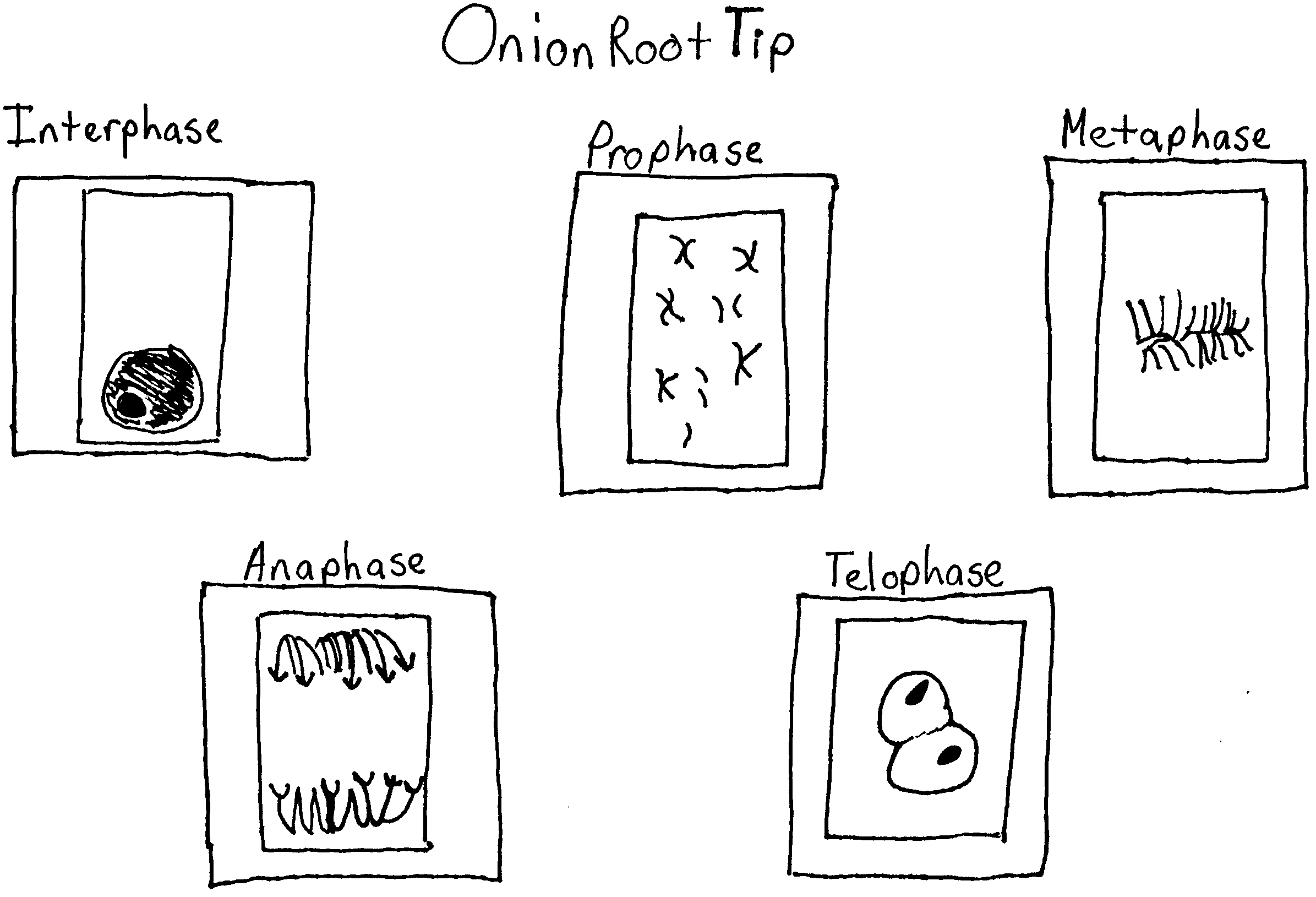
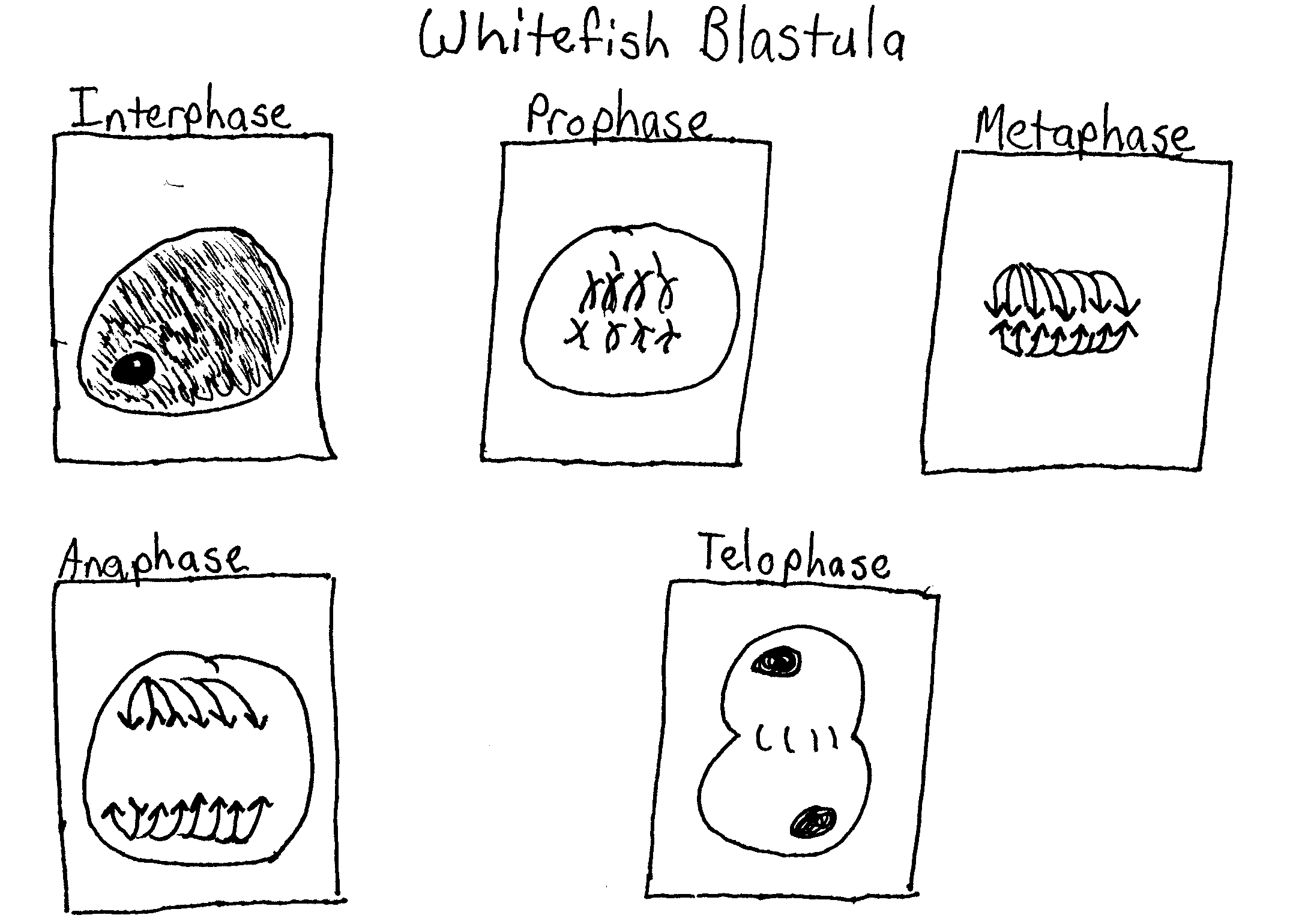
In plants mitosis takes place in the meristems which are normally found at the tips of stems or roots. However, in animal cells cell division takes place every where as new cells are formed and old ones are replaced. Studying mitosis can be accomplished by looking at tissues where there are many cells in a process of meiosis. Two examples are an onion root tip, or developing embryos, in animals such as whitefish blastula. A blastula is formed after an egg is fertilized and the egg begins to divide. There are several phases of the mitotic cell cycle. A precursor to mitosis is interphase. The actual steps of the mitotic cell cycle are prophase, metaphase, anaphase, and telophase. Interphase is a stage in the cell cycle in which the cell is not dividing. The nucleus contains a nucleolus and also contains chromatin. During interphase DNA replication occurs. The first phase of mitotic cell division is prophase. During prophase the chromatin begins to thicken until noticeable chromosomes are formed. Each chromosome has two chromatids that are joined at the centromere. During the later part of prophase, the nuclear envelope and nucleolus disappear. Mitotic spindle fibers, composed of microtubules, also become apparent. Following prophase is metaphase. By the time the cell has reached metaphase the chromosomes have moved to the center of the mitotic spindle. The centromere of the chromosome attaches to the spindle. The centromeres of each chromosome line up on an area called the metaphase plate. Metaphase is followed by anaphase. In the beginning of anaphase, the centromeres of each pair of chromatids separate and moved by the spindle fibers to the opposite ends of the cell. When the daughter chromosomes reach the ends of the cell the form a clump at each spindle pole. The final phase of mitosis is telophase. Telophase is identified by a recognizable condensation of the chromosomes, which is followed by the formation of a new nuclear envelope. The chromosomes slowly uncoil into chromatin once again and the nucleoli and nuclear envelope reform. It is then possible for cytokinesis, the division of the cytoplasm into two cells, to occur. In an animal cells a cleavage furrow forms and the cell pinches off into two new daughter cells.

The process of meiosis involves two nuclear divisions that result in the formation of four haploid cells. Meiosis I, a reduction division, is the first division to reduce the chromosome number from diploid to haploid and separates the homologous pairs. Meiosis II separates the sister chromatids resulting in four haploid gametes. Unlike mitosis meiosis increases genetic variation. In meiosis I each pair of homologous chromosomes come together which is known as a synapse. Chromatids of homologous chromosomes may exchange parts which is called crossing over. The distance between two genes on a chromosome may be estimated by calculating the percentage of crossing over that takes place between them. Meiosis I is preceded by interphase. During interphase DNA synthesis occurs and each chromosome is made of two chromatids joined at the centromeres. The first step of meiosis I is prophase I. During prophase I homologous chromosomes come together and synapse. A tetrad consisting of four chromatids is also formed. Prophase I is followed by metaphase I. In metaphase I the crossed over tetrads line up in the center of the cell. In anaphase I the homologous chromosomes separate and are moved to opposite ends of the cell. The final phase of meiosis I is telophase I. During telophase I centriole duplication is completed. Most of the time cytokinesis and formation of the nuclear envelope occur in order two make to cells. Meiosis II a second mitotic cell division then takes place in order to separate the chromatids in the two daughter cells made in meiosis I. This reduces the amount of DNA to one strand per chromosome. This is the only difference between meiosis I and II. Before meiosis II there is period called interphase or interkenesis. DNA replication does not take place in interphase II. Interphase II is followed by prophase II, No DNA replication occurs in prophase II and replicated centrioles separate and move to opposite sides of the chromosome groups. During metaphase II the chromosomes are centered in the middle of each daughter cell. During anaphase II the centromere regions of the chromatids are separate. The last stage of meiosis II is telophase II. In telophase II the chromosomes are at opposite ends of the cell and a nuclear envelope forms, and sometimes the cytoplasm divides.

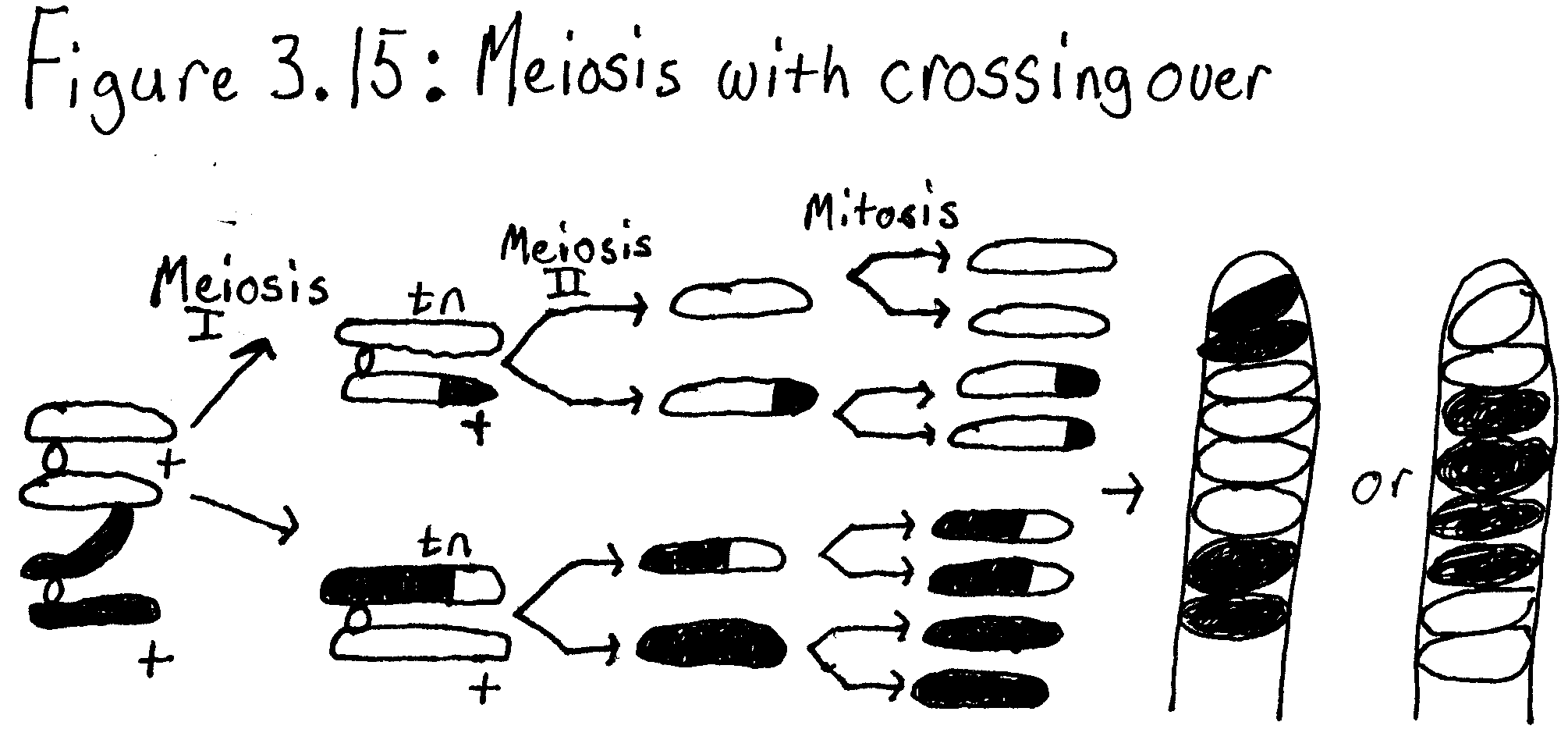
Sordaria fimicola is fungus that may be used to show the results of crossing over during meiosis. Sordaria throughout most of its life is haploid, but becomes diploid after the fusion of two different types of nuclei, which forms a diploid nucleus. In Sordaria meiosis results in the making of eight haploid ascospores found in a sac called an ascus. Most asci are found in a perithecium. The life cycle of Sordaria fimicola is as follows: a spore is discharged through an ascus. The ascospore then undergoes mitosis, which forms a filament. The filament then undergoes mitosis, which forms a mycelium. Mycelial fusion and fertilization then takes place. This forms a diploid zygote. The zygote undergoes mitosis to form four haploid nuclei. The nuclei also undergo mitosis and form eight haploid nuclei, which then form eight ascospores. When mycelia of a mutant strain of Sordaria and a wild type of Sordaria undergo meiosis four black and four tan ascospores form. The arrangement of the ascospores reflects whether crossing over has occurred or not. Gametes, egg and sperm, are made during meiosis. Each egg and sperm cell contains half the total chromosomes a normal cell of that species would have. When the egg and sperm unite during fertilization the total chromosome number is restored.

Exercise 3A.1 –  Hypothesis
While looking at prepared slides of onion root tip cells and whitefish blastula cells under a microscope I will be able to identify and draw the stages of mitosis in these cells.

Materials
The materials used in this experiment were a light microscope and prepared slides of onion root tip cells and whitefish blastula cells.

Methods
Using the microscope examine the slides of onion root tip cells and whitefish blastula cells. Begin by locating the merismatic region of the onion or the blastula using the 10 X objective. Then use the 40 X objective to study individual cells. Identify one cell that clearly represents each phase. Sketch and label the cell on a separate piece of paper.

Exercise 3A.2  –  Hypothesis
When undergoing mitosis most of the cells in an onion root tip will be in interphase. More cells will be in the stage of prophase than metaphase. More cells will be in metaphase than anaphase and more cells will be in anaphase than telophase.

Materials
The materials used in this experiment were a prepared slide of an onion root tip and a light microscope.

Methods
Obtain a prepared slide of an onion root tip and observe every cell in one high power field of view and determine which phase of the cell cycle it is in. Make sure to do this in pairs so one person can observe the cells and the other person can record which phase the cell is in. Make sure to count three full fields of view and at least 200 cells. Then, record your data in table 3.1. Next, calculate the percentage of cells in each phase by using the equation; percentage of cells in stage X 1,440 minutes =_________ minutes of cell cycle spent in stage.

Exercise 3B.1  –  Hypothesis
Using beads it will be possible to show the stages of meiosis I and meiosis II.

Materials
The materials used in this exercise were chromosome simulation kits containing four strands of beads. Two strands will be one color and the other two strands should be another color.

Methods
To show the process of interphase place one strand of each color near the center of your work area. Next, simulate DNA replication by bringing the magnetic centromere region of one strand in contact with the centromere region of the other of the same color. Do the same with its homolog. Next, to show crossing over in prophase I pop the beads apart on one chromatid at the fifth bead. Do the same with the other chromatid. Then reconnect the beads to those of the other color. Proceed through prophase I of meiosis and note how crossing over results in recombination of genetic information. Then to show metaphase I place the chromosomes near the middle of the cell. During anaphase I, the homologous chromosomes separate and are “pulled” to opposite ends of the cell. Next, to show telophase I place each chromosome at opposite sides of the cell.

In prophase II of meiosis II replicated centrioles separate and move to opposite sides of the chromosome groups. Next, to show metaphase II arrange the chromosomes so they are centered in the middle of each daughter cell. Then, separate the chromatids of the chromosomes and pull the daughter chromosomes toward the opposite sides of the daughter cell in order to show anaphase II. Finally in order to show telophase II, place the chromosomes at opposite sides of the dividing cell.

Exercise 3B.2  –  Hypothesis
There will be more asci that maintain a 4:4 relationship of not crossing over than asci that do cross over.

Materials
The materials used in this exercise were a prepared slide of Sordaria fimicola and a light microscope.

Methods
Begin by obtaining a prepared slide that contain asci of Sordaria fimicola. Then, using the 10 X objective, view the slide and locate a group of hybrid asci. Make sure to count at least 50 hybrid asci and enter your data in table 3.3.

Results
Exercise 3A.1


Exercise 3A.2

Table 3.1


Number of Cells

Field 1 Field 2 Field 3 Total
Interphase 42 36 47 125 61.27 14 hours 42 min
Prophase 10 14 18 32 20.10 4 hours 49 min
Metaphase 6 5 4 15 7.35 1 hour 45 min
Anaphase 2 3 2 7 3.43 49 min
Telophase 7 5 4 16 7.84 1 hour 52 min


Exercise 3B.2

Table 3.3


Number of 4:4 Number of Asci showing crossover Total Asci % Asci showing crossover divided by 2 Gene to centromere distance (map units)
60 45 105 21.4 % 21.4 map units


Questions:
Exercise 3A.1

1.Why is it more accurate to call mitosis “nuclear replication” than “cellular division”?

In mitosis two new nuclei are being formed. Also cytokinesis is actually a part of mitosis.

2. Explain why the whitefish blastula and onion root tip are selected for a study of mitosis?

A blastula is a hollow ball of cells that forms when an egg divides quickly; a large amount of mitosis is taking place here. The onion root tip is the place where growth occurs in the onion so a large amount of mitosis is taking place here.

Exercise 3A.1

1. If your observations had not been restricted to the area of the root tip that is actively dividing, how would your results have been different?

The tips are located in the meristem. Cells that are not in the meristem do not divide as quickly but they are elongating and differentiating. None of the phases would have been visible.

2. Based on the data in table 3.1 what can you infer about the relative length of time an onion root-tip cell spends in each stage of cell division?

Prophase is the longest stage and telophase is the shortest.

Exercise 3B.1

1. List three major differences between the events of mitosis and meiosis?

Mitosis has one nuclear division and meiosis has two nuclear divisions. Mitosis makes two identical daughter cells. Meiosis makes four daughter cells that half the number of chromosomes that their parent cells had. Crossing over and the exchange of genes occurs in meiosis but not in mitosis.

2.Compare mitosis and meiosis with respect to the following:


Mitosis Meiosis
Chromosome number of parent cells 2n 2n
Number of DNA replications 1 1
Number of divisions 1 2
Number of daughter cells produced 2 4
Chromosome number of daughter cells 2n n
Purpose Growth and repair Gamete and spore production


3. How are meiosis I and meiosis II different?

Meiosis I starts with a tetrad and separates the homologs. In meiosis the strands separate into 4.

4. How do oogenesis and spermatogenesis differ?

In oogenesis an egg is formed and three cells called polar bodies die. In spermatogenesis sperm are formed.

5. Why is meiosis important for sexual reproduction?

In meiosis the chromosome number is reduced by half. When fertlization occurs chromosome number is restored. Gene exchange causes variation.

6.Using your data in table 3.3 determine the distance between the gene for spore color and the centromere. Record your results in table 3.3.

Table 3.3


Number of 4:4 Number of Asci showing crossover Total Asci % Asci showing crossover divided by 2 Gene to centromere distance (map units)
60 45 105 21.4 % 21.4 map units


7. Draw a pair of chromosomes in MI and MII and show how you would get a 2:4:2 arrangement of ascospres by crossing over.

Error Analysis
In exercise 3A.2 inaccurate results were received. There should have been fewer cells in telophase than any of the other phases and cells should have spent less time in telophase than in any of the other phases. The results received are inaccurate because the number of cells that were in telophase were improperly counted. We received results that more cells were in telophase and spent more time in telophase than anaphase. In exercise 3B.2 improperly identifying some of the asci as crossover or non-crossover might have caused the results that were received to be inaccurate.

Conclusions:

From these experiments one can conclude that it is possible to look at mitotic stages of onion root tip cells and whitefish blastula through a microscope and draw them. Also, from these experiments one can conclude that most of the cell cycle in an onion root tip is spent in interphase. Prophase is after interphase in time spent in each cycle. Metaphase is after prophase. Anaphase is after metaphase. The least amount of time is spent in telophase. Also, a person can simulate the chromosomes in meiosis I and meiosis II using a chromosome simulation kit. Finally, one can conclude form the results of the experiments that more asci do not cross over in Sordaria fimicola than the number of asci that do cross over.

BACK


Lab 7 Sample 3 Fruitflies

Drosophila Genetics

Introduction

Drosophila Melanogaster, the fruit fly, is a great organism for genetic use because it has simple food requirements, occupies little space, is hardy, completes its life cycle in 12 days, makes a large number of offspring, can be knocked out easily, and it has many types of hereditary variations that can be seen with low power microscopes. Drosophila has a small number of chromosomes, four pairs. They are easily located in the large salivary glands. The Drosophila can be obtained from many places. Research of Drosophilae has led to a lot of knowledge about many of its genes.

Many factors combine to affect the length of the Drosophila life cycle. Temperature affects the life cycle the most. At room temperature the average life cycle of the Drosophila is about 12 days. Eggs of the Drosophila are small, oval shaped, and have two filaments at one end. They are usually laid on the surface of the culture medium, and with practice, can be seen with the naked eye. After one day the eggs hatch into the larva.

The larval stage of the Drosophila eats all the time. Larvae tunnel into the culture medium when they eat. The larva will shed its skin as it increases in size. In the last of the three larval stages, the cells of the salivary glands contain giant chromosomes that can be seen under low power in a microscope.

The pupal stage. Before a larva becomes a pupa it climbs the side of the container. The last larval covering then becomes harder and darker, forming the pupal case. Through this case the later stages of metamorphosis to an adult fly can be seen. In particular, the eyes, the wings, and the legs become visible.

The adult stage. When metamorphosis is over, the adult fly emerges form the pupal case. They are fragile and light in color and their wings are not fully expanded. They get darker in about an hour. They live about a month and then die. A female refrains from mating for about 12 days after she emerges from the pupal case. After she mates her receptacles contain large amounts of sperm and she lays her eggs. Make sure that the first flies you use are virgins.

The experiment will take several weeks. You will be assigned Drosophila with well-defined mutant traits by your teacher. You will keep a close record of what happens as each of these flies mate and pass there traits off to their offspring over a few generations.

There are three types of crosses that are studied in this lab. In monohybrid crosses the mode of inheritance is determined when a single contrasting pair of characteristics is involved. In a dihybrid cross the mode of inheritance is determined when the two pairs of contrasting of characteristics are considered simultaneously. In a sex-linked cross the mode of inheritance is determined when the mutant characteristic is associated with the X chromosome.

Hypothesis

In the sex linked cross of Drosophila Melanogaster, a phenotypic ratio of 1:1 will be obtained.

Materials

The materials used in this lab are as follows: a vile of Drosophilia with c designated trait, vials containing a medium, a refrigerator, ice packs, Petri dishes, a light microscope, a vial of wild type flies, an incubator, a pencil and paper.

Methods

Begin by obtaining a vial of wild type flies. Practice immobilizing and sexing these flies. Make sure to examine the flies and determine the characteristics of their eyes, wings, bristles, and antennae. Next, these are the steps for immobilizing the flies. Hold the vial containing the flies at an angle and place it in a refrigerator for several minutes. When the flies are immobilized, place them into a small plastic Petri dish. Then place the Petri dish on top of the icepack in order to maintain the cool temperature necessary to keep flies immobilized. Use the dissecting microscope to view the flies. Make sure to top the petri dish on when viewing the flies.

You can easily distinguish male flies from females by looking for the following characteristics: males are usually smaller than the females, males have dark blunt abdomens and females have lighter pointed abdomens. The males have sex combs, which are black bristles on the uppermost joint of the forelegs. Next, get a vial containing experimental flies. Make sure to write down the number of the vial that you have. The flies you now have are the P1 generation. The females should have laid eggs. The eggs and larvae are the F1 generation. Then after there are eggs present knock out remove the adult flies from the vial. Sex the adult flies and write down any mutations. Place the flies in the morgue that contains alcohol. Make sure to label the vial with the symbols for the mating.

After about another week has passed knock out and record characteristics of the remaining F1 flies and record the results in table 7.1. Then place the six pairs of these flies in a new vial and place the remaining flies in the morgue. Label the new vial F1, and tell the cross, date and your name.

After another week has passed, remove the F1 flies and put them in the morgue. The F2 generation are the eggs and larvae in the vial. Place the vial back into the incubator. Once again, after another week has passed remove the F2 flies and record their sex and characteristics and place the results in Table 7.2. Recording a greater number of F2 flies will make your results more accurate. Try to collect at least 200 flies. In order to analyze your data you will first have to be able to be able to complete Chi-Square Analysis.

Results

Table 7.1 F1 Generation


Phenotype females males
Red eyes 33 0
White eyes 0 31
 

Table 7.2 F2 Generation

Phenotype Male Female
Red eyes 50 52
White eyes 56 67


1. Describe the observed mutations? In the F1 generation the males had white eyes and the females had red eyes. In the F2 generation the males and females could have had either red or white eyes.

2. Write a hypothesis which describes the mode of inheritance of the trait you studied. This is your null hypothesis ( as described in the Statistical Analysis Section). For a sex linked cross there will always be a one to one ratio of the phenotypes. In the F1 generation there will be a one to one ratio of red eyed females to the number of white eyed males. In the F2 generation there will be a one to one ratio of red eyed females to white eyed females. There will also be a one to one ratio of red eyed males to white eyed males.

3. Refer to a textbook and review Punnett squares. In the space below construct two Punnett squares to predict the expected results of both the parental and F1 crosses from your null hypothesis.

Parental cross


Y Xr
Xr YXr Xr Xr
Xr YXr Xr Xr


F1 cross


Y Xr Y XR
XR YXR XR Xr YXR XRXR
XR YXR XR Xr YXr XR Xr
Xr YXr XrXr YXr X RXr
Xr YXr XrXr YXr XRXr


4. Refer to the Punnett squares above. Record the expected ratios for the genotypes and phenotypes of the F1 and F2 in the experiment below.


Expected Genotypic Ratio Expected Phenotypic ratio
F1 1:1 1:1
F2 1:1 1:1


        5. Do the actual results deviate from what was expected? If so, explain how.
No my results do no deviate much from what was expected. However in the F2 generation there were 67 white females and 52 red females.

6. For the results describe your cross? My cross is a sex linked cross.


7. Are the deviations for the phenotypic ratio of the F2 generation within the limits expected by chance?
To answer this question, statistically analyze the data using the Chi-Square-Analysis. Calculate the Chi-Square for the F2 generation in the chart below. Refer to the critical values of the Chi Square distribution table to determine the P value that is associated with your statistic.


Observed Phenotypes (o) Expected (e) (o-e) (o-e)2 (o-e)2

e

67 Xr Xr 56 11 121 2.16
52 XR XR 56 -4 16 .28
50 YXR 56 -6 36 .64
56YXr 56 0 0 0
3.02


(a) Calculate the Chi-Square value for these data.

1. How many degrees of freedom are there? 3 degrees of freedom

2. Chi Square=2.52

3. Referring to the critical values chart what is the probability value for these data? Greater than .05 probabilities that the null hypothesis is right.

(b) According to the probability value, can you accept or reject your null hypothesis? Explain why. I can accept the null hypothesis because my Chi-Square answer is less than the critical value form the table. I have 3 degrees of freedom and my Chi- Square answer was3.0 which is less than 7.82.

        1. Why was it necessary for the females of the parental generation to be virgins? The females store sperm in their receptacles and if they were not virgins we would not be able to tell who the fathers were.

2. Why was it not necessary to isolate virgin females for the F1 cross? The females store sperm in their receptacles and if they were not virgins we would not be able to tell who the fathers were

3. Why the adult flies were removed from the vials at weeks 2 and 4? So, they are not be able to mate with the next generation.

Chi-Square Analysis

Introduction

Statistics can be used to determine if differences among groups are significant, or simply the result of predictable error. The statistical test most frequently used to determine whether data obtained experimentally provide a good fit, or approximation to the expected or theoretical data is the Chi-square test. This test can be used to determine if deviations from the expected values are due to chance alone or to comeother circumstance.

To determine if the observed data fall with in acceptable limits, a Chi-Square analysis is performed to test the validity of a null hypothesis; that there is no statistically significant difference between the observed and expected data. If the Chi-Square analysis indicates that the data vary too much from the expected 3: 1 an alternative hypothesis is accepted.

Methods

The formula for Chi-square is:

X2=E(o-e)2
E

O= observed number of individuals

e= expected number of individuals

E= the sum of the values

The (df) are determined by taking the number of possible phenotypes and subtracting one from it. If the Chi- Square answer is greater than the number from the critical values chart then the null hypothesis is incorrect. The results are said to be significant at .05. This means that only 5 % of the time you would expect to see similar data if the null hypothesis were correct. The probability can also be rejected at .001. This time it means that less than 1 % of the time would you expect to see similar data.

Results

Critical Values Chart


Degrees of Freedom (df)

1 2 3 4 5
.05 3.84 5.99 7.82 9.49 11.1
.01 6.64 9.21 11.3 13.2 15.1
.001 10.8 13.8 16.3 18.5 20.5


Practice Problem

An investigator observes that when pure-breeding long winged Drosophila are mated with pure breeding short wing flies the F1 have an intermediate wing length. When several intermediate wing length flies are allowed to interbreed the following results are obtained. 230 long wings. 510 intermediate length wings. 260 short wings.

a. What is the genotype of the F intermediate wing length flies? The genotype is Ll.

b. Write a hypothesis describing the mode of inheritance of wing length in Drosophila. There will be 333 long winged flies. 666 intermediate winged flies. There will be 33 short wing flies.

c. Complete the table

Table 7.8


Observed Phenotypes Expected (e) (o-e) (o-e)2 (o-e)2/ e
LL 333 -103 10609 31.86
Ll 666 -156 24336 36.54
ll 333 -73 5329 16.00

84.4


1. How many degrees of freedom are there? There are 2 degrees of freedom.

2. Chi-Square= 84.4

3. Referring to the critical values chart, what is the probability value for these data? Less than .001.

4. According to the probability value can you except or reject the null hypothesis? 

I can reject the null hypothesis because the Chi-square answer is greater than the critical value from the table.

Error Analysis

Results from this lab could have been affected by many things. The constant knocking out of flies could have caused some of the larvae to not hatch therefore affecting our numbers. Also, incorrectly identifying the characteristics of the flies could have also greatly affected the results received. Improper calculation of numbers could have also caused inaccurate results. Finally, some flies could have gotten stuck in the medium and could have been identified.

Conclusion

From the results of the experiment I can conclude that I received results that were close to a 1:1 ratio. The Chi- Square worked from my data was accepted at a possibility greater than .05. The null hypothesis in this case can be accepted.

BACK


Invertebrate Notes

Invertebrate Notes
All Materials © Cmassengale

Invertebrate Phyla:


Porifera-sponges

Cnidaria:


sea anemone


hydra


Coral


Jellyfish

Platyhelminthes-flatworms


Fluke

Tapeworm
Nematoda-roundworms

Trichinella

Ascaris

Hookworms

Pinworms
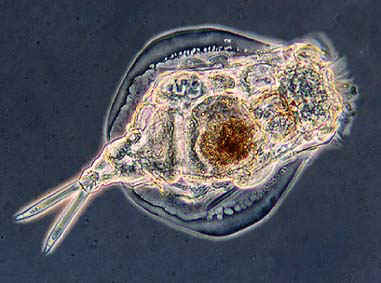
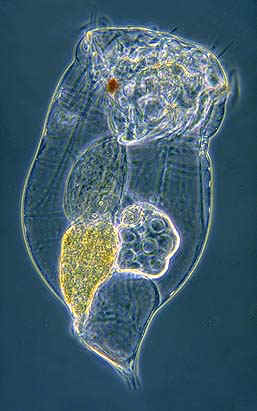
Rotifera–rotifers
Annelida-segmented worms

earthworm

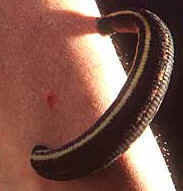
leech
Mollusca

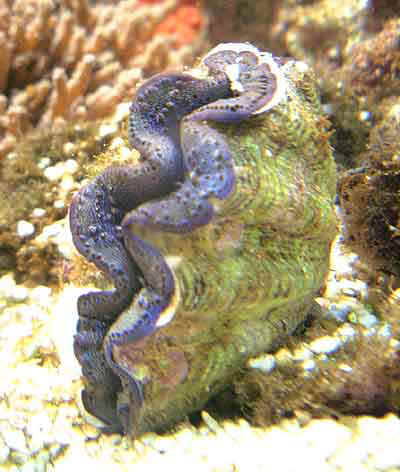
clam

snail

octopus
Arthropoda
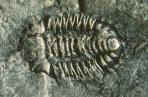
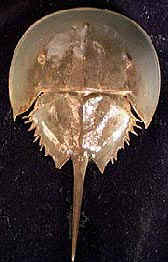
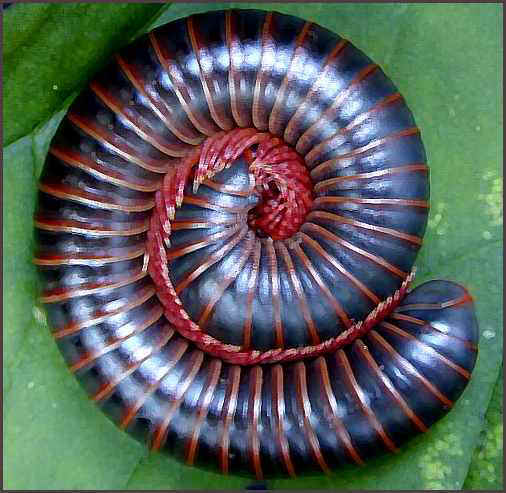
Subphylum: Trilobita–trilobites (extinct) Subphylum: Chelicerata-horseshoe crabs, spiders, scorpions, mites, & ticks Subphylum: Mandibulata–crustaceans, insects, millipedes, centipedes

Trilobite

Horseshoe crab

Millipede
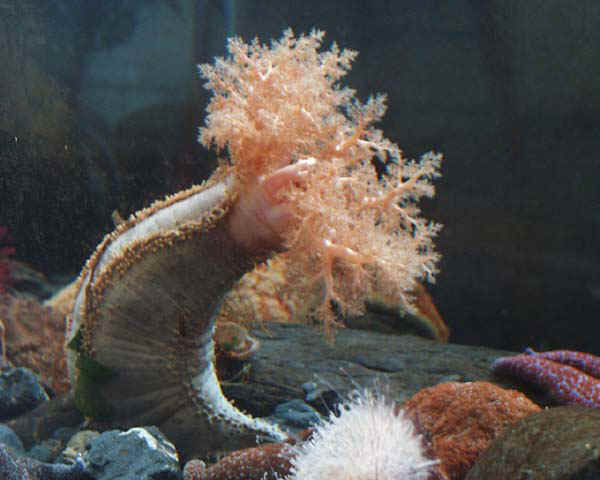
Echinodermata: starfish, sea cucumbers, sea lilies

Starfish

Sea Cucumber

Sea Lily


About 97% of all animals are invertebrates.  Invertebrates are animals which do not have a backbone.  There are nine phyla of  invertebrates:  Porifera, Cnidaria, Platyhelminthes, Nematoda, Rotifera, Mollusca, Annelida, Arthropoda, & Echinodermata.

Sponges