Scientific Method – “I’m All Thumbs”

Introduction:
What makes a “Class Champion” thumb wrestler? Does thumb diameter, length, or wrist diameter have an effect on the overall chances of winning a thumb wrestling match? If you want to find out the answers to these questions then you have to do some scientific study. Scientific study is not only about plants and animals; it is also about how we function. You will have to use the scientific method to answer thesis questions. Scientific method is the principles and empirical processes of discovery and demonstration considered characteristic of or necessary for scientific investigation, generally involving the observation of phenomena, the formulation of a hypothesis concerning the phenomena, experimentation to demonstrate the truth or falseness of the hypothesis, and a conclusion that validates or modifies the hypothesis.
Hypothesis:
The person with the longest thumb will win the thumb war.
Materials:
The materials that were used for this lab was a metric ruler, metric tape measure, scissors, string, and a calculator.
Methods:
First you should choose a partner. Then measure the circumference of your thumb in centimeters at its widest point. Next you measure the length of your thumb, from the tip to the end of its second joint. Then measure the circumference of the wrist over the ulnar knob. Then you copy all of your information on the board onto the table in the results section of the lab.
Results:
| Thumb Circumference | Thumb Circumference (cm) | Thumb Length (cm) | Wrist Circumference (cm) | Number of Wins |
| Cason, Drew | 8.4 | 9 | 21.5 | 4 |
| Dittrich, Chad | 9 | 10 | 24 | 19 |
| Holt, Brad | 8 | 9.5 | 21 | 2 |
| Hooker, Chris | 7.1 | 9.3 | 21 | 2 |
| Jones, Jett | 8.5 | 9.8 | 21 | 6 |
| Lambert, Scott | 9.5 | 8 | 23 | 0 |
| Lewis, Cody | 8 | 9.5 | 20.5 | 1 |
| Lockwood, Blake | 8.3 | 8.5 | 21 | 0 |
| Lorince, Alan | 9.4 | 9.5 | 24 | 1 |
| Moore, Clark | 8.5 | 10 | 20 | 1 |
| Phillips, Jaylon | 9.3 | 10 | 24 | 1 |
| Simpson, Jonathan | 8 | 8.3 | 20 | 0 |
| Smith, Zack | 8.3 | 8.4 | 22.1 | 0 |
| Williams, Paul | 8.4 | 8 | 21 | 0 |
| Yancey, Jey | 9 | 10 | 22.5 | 0 |
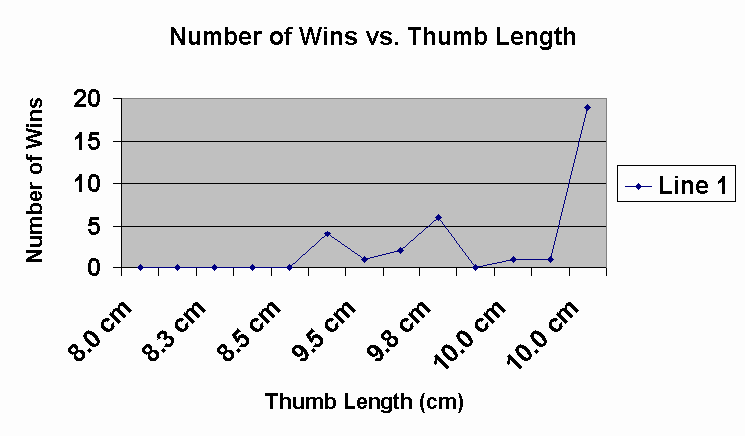
Questions:
1. Restate your hypothesis: The person with the longest thumb will win the thumb war.
2. Which student won? Male: Chad Dittrich Female: Ashley Kersieck
3. What were their measurements: Male: thumb circumference-9cm, thumb length -10cm, and wrist circumference-24 cm.
Female Thumb circumference 7.0, thumb length 8.5, and wrist circumference 20.5
4. What was the mean thumb circumference of the class? 21.0
5. What was the mean wrist circumference of the class? 8.1
6. Did all those with larger measurements win their matches? No
7. Was your hypothesis correct? Yes
8. If not, explain what was different. It was right
9. What is the independent variable? Total of each contestant’s wrist and thumb measurements
10. What is the dependent variable? The number of
11. List the controlled variables in this experiment. Compete only in same sex, and follow all rules.
12. Would this be considered a controlled experiment? No
13. Explain your answer. Their were too many variables
Error Analysis:
The people wrestling might not have followed the rules by picking their arm up when they were wrestling or people just not trying would affect the outcome. Also people might have written their measurements in someone else’s place, which would affect the outcome as well.
Discussion and Conclusion:
The male who won the most thumb wrestling matches, nineteen wins, also had one of the longest thumb lengths, 9.0 centimeters. However, three other males with longer thumb lengths, 10.0 centimeters had fewer wins. Therefore the original hypothesis that the person(s) with the longest thumb length would also have the most wins was incorrect. If the measurements for each person were totaled or averaged together, then the persons with the greatest total measurement or highest average would have had the most wins. The current data would support this hypothesis.