In this brief guide, we are going to answer the question “How much of the MCAT is biochemistry?” We will introduce you to each of the MCAT sections, the main concepts you will need to learn, and some tips for studying biochemistry.
How Much of the MCAT is Biochemistry?
Biochemistry comprises approximately 25% of the MCAT, with 25 to 35 questions covering biochemistry in two of the four sections of the exam.
The Medical College Admission Test (MCAT) is a standardized test administered to individuals who wish to attend medical school in the United States. Almost all American medical schools require MCAT scores from applicants interested in pursuing careers as physicians.
Therefore, the MCAT is an extremely important exam, and both schools and applicants take it seriously. Members of the Association of American Medical Colleges and the American Association of Colleges of Osteopathic Medicine require MCAT scores from their applicants.
The history of the MCAT is quite long. MCAT Test preparation administrations began in the 1920s when standardized intelligence tests became immensely popular in the United States. Medical school administrators were concerned about the high dropout rate among medical students and decided to design a standardized test to assess readiness for medical school.
Dropout rates dropped dramatically after the implementation of this standardized test, and most medical schools adopted it as part of their admissions process.
The MCAT content assesses several areas. The first, of course, is the basic knowledge of the physical sciences and biology. The test also evaluates the applicant’s analytical and critical thinking skills, presenting various passages and arguments that the examinee must analyze during the test.
The MCAT also assesses reading comprehension and communication skills, which are vital for clinicians.
The modern MCAT is a computerized test, although it is not adaptive like the Graduate Record Examination (GRE). This means that examinees can return to a section once they have completed it, as the questions are set and static.
The MCAT takes around five hours to complete, including breaks, and is administered in secure testing centers so applicants have quiet, distraction-free spaces to work.
MCAT Sections
There are four sections on the MCAT. The first tests the applicant’s knowledge of the physical sciences and also challenges the applicant to use their problem-solving skills.
The Verbal Reasoning section, Part Two, provides passages for test-takers to read and analyze, followed by a series of multiple-choice questions that test the applicant’s ability to comprehend and synthesize information. For those looking for additional support, a college paper writing service can help improve writing and analytical skills.
The third section is a writing sample, in which the applicant responds to two short prompts that assess their communication skills and logical thinking. Finally, the life sciences section covers basic topics in biology.
Chemical + Physical Foundations of Biological Systems
The first section of the MCAT focuses on the physical sciences, specifically general chemistry and physics. It covers content in the following proportions:
30% General Chemistry
25% Biochemistry
25% Physics
15% Organic Chemistry
5% Biology
This section lasts 95 minutes and includes 15 standalone questions and 10 passages, each followed by 4 to 7 questions. To prepare for the chemistry portion, examinees need a strong grasp of the periodic table, chemical processes, and molecular bonding. The physics portion requires understanding fundamental physical laws and concepts such as motion, energy, light, and atomic structure.
Critical Analysis + Reasoning Skills
The CARS section is significantly more challenging than SAT-style reading comprehension and the verbal section of the old exams. This section covers:
50% humanities
50% social science
You are not required to have any outside knowledge; everything you need to know to answer the questions will be provided in the passages. You will have a total of 90 minutes to work through nine passages with a total of 53 questions. If you’re struggling with essay writing as part of your test preparation, a paper writing service can help you improve your skills.
In this section, no specific factual knowledge is required. Rather, the questions are designed to test reading comprehension, critical and logical thinking, and analytical skills. In general, test takers prepare for this section of the MCAT primarily by taking practice exams.
Biological + Biochemical Foundations of Living Systems
This section covers:
65% Biology
25% Biochemistry
5% General Chemistry
5% Organic Chemistry
As with the first science section, you’ll have 95 minutes to answer 15 discrete questions and 10 passages with 4 to 7 questions each. The topics in this section vary widely, from enzyme structure to evolution. Test-takers require a thorough understanding of molecular biology, including the structure and function of DNA, as well as microbiology, including the characteristics of viral, bacterial, and eukaryotic cells.
In addition, examinees should be familiar with all major biological systems of larger animals. Finally, organic chemistry topics range from covalent bonds to the characteristics of biological molecules.
MCAT Scores
Each section of the MCAT allows a student to score between a minimum of 118 points and a maximum of 132 points. For the total sum of the four sections, a student can achieve a score ranging from a minimum of 472 to a maximum of 528.
You may have heard scores like 23 or 31 mentioned in the past. However, it’s important to clarify that these scores were used before the MCAT underwent its most recent change in 2015. Currently, all students applying to medical school are doing so with the new scoring system.
What is considered a good GMAT score?
The average for the total MCAT score is 510-511.
The average total MCAT score is 510-511. However, for the most accurate estimate, you should check directly with the programs. Especially for those who must juggle the MCAT alongside other jobs, it helps to know how much effort and time to put into preparing for the exam.
Here are some important questions to consider before beginning your research.
What MCAT Scores Do You Need for Acceptance?
To determine the MCAT score you need, it’s essential to have a target score in mind. Start by contacting the admissions office of the medical schools you’re interested in to request their preferred cutoff score. If the school doesn’t provide a specific cutoff, you can find the average GPA and MCAT scores for accepted students here.
Keep in mind that some schools may use your MCAT scores for course placement or scholarship decisions. In such cases, aiming for a score higher than the minimum requirement may increase your chances of receiving additional benefits.
How can I prepare for the MCAT?
To excel on the MCAT® Biology exam, start by gathering detailed information about the test. This knowledge will help you craft an effective study plan. The MCAT is a standardized exam with primarily multiple-choice questions. Besides biology concepts, it also assesses your understanding of physical sciences, verbal reasoning skills, and writing abilities. There are many MCAT preparation courses available online and in person.
Exploring the Biochemistry Section
For specific details about the MCAT biochemistry section, visit the Association of American Medical Colleges website. The site provides a comprehensive overview of the content covered in the biology and chemistry sections of the MCAT.
Importance of Early Preparation
A high score on the MCAT can significantly enhance your chances of getting accepted into your desired medical school. Therefore, it is beneficial to begin your study preparation early. Many experts recommend starting at least three months before the exam date.
Additionally, if you find yourself struggling with other academic tasks, you might consider using an online paper writing service to help manage your workload. Dedicating substantial study time each day can ensure thorough preparation, allowing you to cover all necessary concepts and avoid last-minute cramming, which is generally ineffective for achieving a high score.
Utilizing Study Guides and Practice Tests
Consider obtaining a copy of the Official MCAT Exam Guide, available on the Association of American Medical Colleges website. This guide contains content and questions similar to those on the actual MCAT, along with answers and detailed explanations. It also offers tips for answering questions correctly and insights into how a strong MCAT score can impact medical school acceptance.
Practice tests are an essential tool for preparing for the MCAT® Biology section. The Association of American Medical Colleges website offers practice tests, and additional tests can be found on other preparatory websites and in study guides. If you opt for an MCAT® Biochemistry Prep course, practice tests, and expert commentary are often included in the package.
Teaching Strategies for Making Connections With Science Concepts
A multidimensional approach to supporting students’ learning related to science vocabulary is shown using graphic organizers, differentiated instruction, and more.
Vocabulary building in science is a difficult task for students and requires a variety of teaching strategies by teachers. A typical science textbook introduces 10 to 30 new vocabulary words every chapter. Students are faced with making sense of these new science words and connecting them to concepts in a relatively short period. Students are also required to connect these new words with information gained from prior knowledge and experiences in science.
Science vocabulary building requires more than rote memorization as one teaching strategy, which only leads to short-term knowledge gain. Since long-term knowledge gain of vocabulary is the goal, students must be exposed to all new science words at least six times in different contexts (“Learning Vocabulary Through Reading,” American Educational Research Journal, Volume 21 Issue 4, 1984).
Examples of exposure to science words in different contexts include:
Reading
KWL Organizers
Venn Diagrams
Videos
Hands-on, Minds-on Explorations
Explaining Using Own Terms
Illustrations
Vocabulary Lists
Graphic Organizers
The following are types of graphic organizers used as teaching strategies to help students learn science words in different contexts for vocabulary building.
Concept Definition Map – using an essential science vocabulary word placed in the center of the graphic that supports a science concept. One example is thermal energy. The descriptive words associated with this vocabulary word are written in boxes surrounding the concept word. For example – heat, energy transformation, etc. This concept definition map technique helps students develop a definition of the vocabulary word and make connections with prior knowledge and experiences, similar to how a PhD research proposal writing service helps scholars define and connect their research ideas.
Vocabulary Concept Cards – in this vocabulary-building technique students select a science word from the vocabulary list and write the word on one side of an index card. Then divide the other side of the index card into quadrants.
The left-hand side quadrants are:
What the word is using own words
What the vocabulary word is not using own words
The right-hand quadrants are:
Examples (next to what the word is) using drawings, words, or sentence
Definition (next to what the word is not) provided by textbook or teacher-provided resource
Other Graphic Organizers – examples of these vocabulary builders include KWLs, Venn Diagrams, Concept Maps, Mind Maps, or Word Maps.
Teaching Strategies
Additional teaching strategies that support students when learning science vocabulary words include a science nature journal, writing in science, and a science newsletter project. These three alternatives involve students writing stories that incorporate science words in a manner that helps them develop a better understanding of the science concepts behind the words.
Differentiated Instruction
Every science classroom has students with a wide range of abilities. This is the challenge all teachers face and the following are teaching strategies to address these concerns.
Differentiate Vocabulary Lists – this vocabulary building technique addresses the needs of all students including gifted and talented or advanced students, struggling students, students with learning disabilities, and all other students. This is accomplished by dividing the vocabulary list into three sections.
These sections are:
Science words all students must know in a chapter
Enrichment vocabulary words for gifted and talented students who need the extra challenge
Essential words struggling students and students with learning disabilities must learn to remain on grade level
Individualized Vocabulary Lists – this vocabulary-building technique allows students to create their list. The list must include essential science words deemed necessary by the teacher and then students select additional vocabulary words from a list of enrichment words. This technique provides students with extra credit for learning enrichment words. This works well in a class with several gifted or advanced students who want the challenge.
Alternative Assessments – differentiated or individualized vocabulary requires alternative assessments. Teachers allow students to draw pictures, write descriptions, or explain definitions based on the ability level of the student. A simple rubric is then used to determine the mastery level of each of the science words.
Making Connections with Vocabulary Building in Science
Traditional science vocabulary building involves rote memorization and recall of vocabulary, which only leads to short-term gains. However, building vocabulary knowledge requires a multi-dimensional approach. Science is a subject best learned through hands-on, minds-on experiences and this lends itself to teaching strategies that use a variety of learning strategies. Because of the way science is typically taught, students have the opportunity to view and learn science vocabulary in many contexts.
Conclusion
Building vocabulary in science is a complex task that requires more than just rote memorization. Effective vocabulary teaching strategies must incorporate diverse methods, including graphic organizers, differentiated instruction, and contextual exposure. Students benefit from experiencing new science terms multiple times in different contexts, which helps them connect these terms with prior knowledge and deeper science concepts.
By using tools like concept definition maps, vocabulary concept cards, and differentiated vocabulary lists, teachers can cater to the varying needs of all students. Additionally, integrating creative projects like science journals and newsletters further solidifies students’ understanding by encouraging them to use new vocabulary in meaningful ways.
Overall, a multidimensional approach to vocabulary building in science not only aids in short-term retention but also fosters long-term comprehension and application of scientific concepts. Vocabulary building in science can be as challenging as understanding complex math concepts, often requiring additional support similar to what students might seek when searching for a math tutor. The right teaching strategies, along with an affordable math tutor price, can significantly enhance students’ ability to grasp both vocabulary and science concepts.
Checklist for Implementing Vocabulary Building Techniques in Science
Expose Students to New Vocabulary in Multiple Contexts
Reading assignments
KWL organizers
Venn diagrams
Educational videos
Hands-on, minds-on explorations
Encouraging explanations using students’ own words
Illustrations
Vocabulary lists
Graphic organizers
Use Graphic Organizers
Concept Definition Maps
Vocabulary Concept Cards
KWLs, Venn Diagrams, Concept Maps, Mind Maps, Word Maps
Incorporate Creative Projects
Science nature journals
Writing in science activities
Science newsletter projects
Implement Differentiated Instruction
Differentiate vocabulary lists for varying student abilities
Individualize vocabulary lists based on student choice and teacher requirements
Use alternative assessments tailored to student ability levels
Encourage Hands-on, Minds-on Learning
Integrate practical activities that relate vocabulary to real-world applications
Provide opportunities for students to experiment and explore scientific concepts
Assess and Adapt
Use rubrics to evaluate students’ mastery of vocabulary
Adjust teaching strategies based on student performance and feedback
By following this checklist, educators can create a rich, supportive environment for vocabulary learning in science, helping students not only remember terms but also understand and apply scientific concepts in various contexts.
For many university students, college-level science courses are very difficult. One key to success is to learn how to properly study all of the course material.
Most universities require that their students take some college-level science courses to be eligible to graduate. Others plan on future careers in nursing, and medical fields, where doing well in these courses is required to get into competitive and selective majors (and into good jobs upon graduation). Regardless, these courses require discipline, good study habits, and perseverance to succeed.
The study skills offered here are designed to help make the best use of one’s time in preparing for exams and retaining information. These tips work for science courses in geology, biology, chemistry, physics, anatomy, and physiology, among other university disciplines.
Using Notecards for Science Course Material
One common error made by university students in science classes is spending too much time making notecards. If all of one’s study time is spent making notecards, there is very little time left to cram notecard material or to go through large packs of index cards. While rewriting notes onto index cards or notecards helps some with recalling information, the likelihood of retaining almost everything rewritten is minimal. If anything, some students may be more focused on getting notecards written rather than watching what is being written. For those struggling to manage their study time effectively, using an essay writing service can be a beneficial alternative, allowing them to focus on learning rather than getting bogged down by excessive note-taking.
Instead, index cards are more effective in preparing for science exams. Prefixes (examples: mono-, poly-) and formulas are tools one can readily memorize and take into a test to help find correct answers among multiple-choice options or problem-solving sets. Likewise, short definitions and vocabulary words can go on cards. The main things to keep in mind are:
keep lots of white space (space with no writing) as too much text distracts the eye and makes it more difficult to recall the information
try writing in color pens, markers
make index cards up as the material is covered in the textbook or class lecture then leave all the index cards to be made the week of an exam
Mnemonics for Science Courses
Another thing a student could use to retain all the course information from a science course is the tool called a mnemonic. Short phrases, acronyms, and sequences of letters can help recall a sequence of words or the ordering/arrangement of a list of words. Examples for the sciences include:
HOMES – the American Great Lakes: H(Huron), O (Ontario), M (Michigan), E (Erie), S(Superior)
My Very Excellent Mother Just Served Us Nine Pizzas (Mercury Venus Earth Mars Jupiter Saturn Uranus Neptune and the former planet, Pluto)
With these previous examples, the words “homes” and the phrase “my very excellent mother just served us nine pizzas” expand outward. In the case of “homes,” the word uses the first letter of each of the five lakes. In the planets’ case, the first letter of each word matches the first letter in the corresponding planet name. What is good with this mnemonic example is the fact that not only does the first letter in each word match the first letter of the corresponding planet, but the entire list is in close order to their proximity to the sun, as Mercury is the closest planet and “my” is the first word in the phrase.
While these examples are more often taught and used in American grade schools rather than in college and university-level science courses, the same principles apply. Mnemonics are particularly useful for human anatomy and physiology courses, where bones or nerves in a particular region of the human body have unique names, sometimes quite close in spelling. Sayings and acronyms make it easier to recall a listing and sometimes the order of the list.
Study Groups for Science Class
In addition to making notecards and mnemonics alone, science students may benefit from studying in pairs or groups with classmates. Before chemistry or biology exams, a group could meet to quiz one another.
Likewise, groups can come in handy for science courses where the professors/course instructors have provided study guides. A group can divvy up a packet so that everyone benefits from a completed study guide, without as much individual investment of time and work.
That way too, if any vocabulary words are unclear or test prep questions that are confusing, the group can collectively work together to find the answer or ask the professor for help. Working together on review packets for science classes more than any other discipline is a good use of time and resources, as the packets tend to be more involved with lots of vocabulary.
Lastly, explaining science concepts, systems or processes (like the Krebs cycle or mitosis) aloud is excellent studying practice, as teaching concepts to others and speaking the stages out loud helps with retention and recall of concepts on test day.
Textbook and Lecture Note Review for Science Class
Along with good group studying sessions, university students enrolled in science courses ought to practice good textbook and lecture note review too. Taking detailed notes in margins, in diagrams and graphics, and with highlighters helps sort out the most important and the most difficult concepts in a clear manner.
One thing that is particularly true with science courses is the importance of reading ahead. Even if the professor does not assign class reading in advance, one should skim-read the next section or chapter so that there is a baseline understanding of a concept before it is covered in class. This way, one can focus more on the dialogue in the lecture and what the instructor has to say rather than trying to cram every little item into notes taken during class.
In closing, strong note-taking, notecard-making, textbook reviewing, and group study habits can help many achieve improvement in college-level science courses, whether the course is in physics, archaeology, or biology for example. The key is to use time efficiently and effectively and find a way to store all the material and recall it come test day.
Autoimmune mechanisms underline many diseases, some organ-specific, others systemic in distribution.
Autoimmune disorders can overlap: an individual may have more than one organspecific disorder;or more than one systemic disease.
Genetic factors such as HLA type are important in autoimmune disease, and it is probable that each disease involves several factors.
Autoimmune mechanisms are pathogenic in experimental and spontaneous animal models associated with the development of autoimmunity.
Human autoantibodies can be directly pathogenic.
Immune complexes are often associated with systemic autoimmune disease.
Autoreactive B and T cells persist in normal subjects but in disease are selected by autoantigen in the production of autoimmune responses.
Microbial cross-reaching antigens and cytokine dysregulation can lead to autoimmunity.
Autoantibody tests are valuable for diagnosis and sometimes for prognosis.
Treatment of organ-specific diseases usually involves metabolic control. Treatment of systemic diseases includes the use of anti-inflammatory and immunosuppressive drugs.
Future treatment will probably focus on manipulation of the pivotal auto reactive T cells by antigens or peptides, by anti CD4 and possibly T cell vaccination.
THE ASSOCIATION OF AUTOIMMUNITY WITH DISEASE
The immune system has tremendous diversity and because the repertoire of specificities express by the B- and T-cell populations is generated randomly, it is bound to include many which are specific for self components. Thus the body must establish self-tolerance mechanisms, to distinguish between self and non-self determinants, so as to avoid auto reactivity (see Chapter 7). However, al mechanism has a risk of breakdown. The self recognition mechanisms are no exception, and a number of disease have been identified in which there is autoimmunity, due to copious production of autoantibodies and auto reactive T cells. One of the earliest examples in which the production of autoantibodies was associated with disease in a given organ is Hashimoto’s thyroiditis. Among the autoimmune diseases, thyroiditis has been particularly well-studied, and many of the aspects discussed in this chapter will draw upon our knowledge of it. It is a disease of the thyroid which is most common in middle-aged women and often lead to formation of a goiter and hypothyroidism.
The gland is infiltrated, sometimes to an extraordinary extent, with inflammatory lymphoid cells.
These are predominantly mononuclear phagocytes, lymphocytes and plasma cells, and secondary lymphoid follicles are common (Figure-1). In Hashimoto’s disease, the gland often shows regenerating thyroid follicles but this is not a feature of the thyroid in the related condition, primary myxoedema, in which comparable immunology features are seen and where the gland undergoes almost complete destruction and shrinks. The serum of patients with Hashimoto’s disease usually contains antibodies to thyroglobulin. These antibodies are demonstrable by agglutination and by precipitin reactions when present in high titre. Most patients also have anti bodies directed against a cytoplasmic or microsome antigen, also present on the apical surface of the follicular epithelial cells (Figure-2), and now known to be thyroid peroxidase, the enzyme which iodinates thyroglobulin.
THE SPECTRUM OF AUTOIMMUNE DISEASES
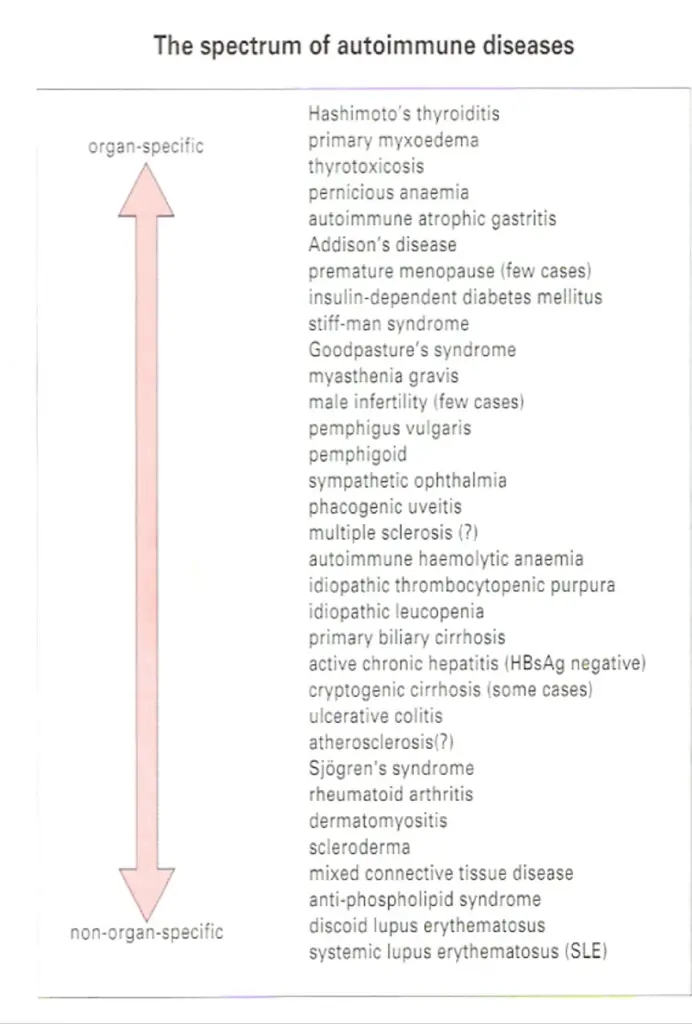
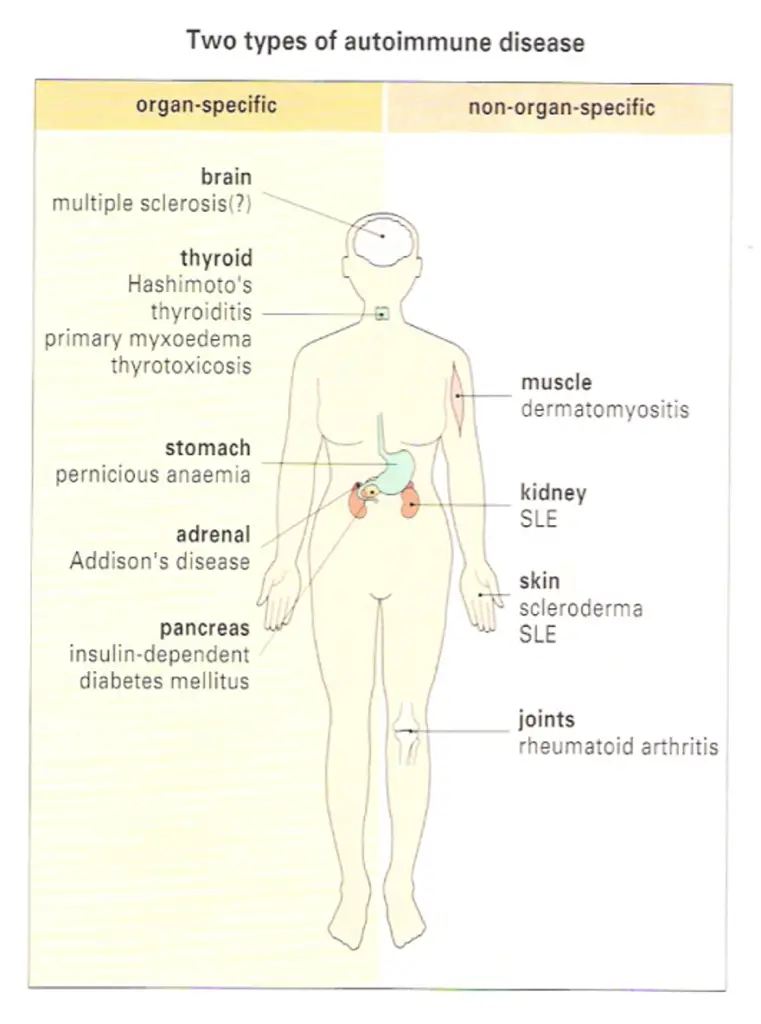
The antibodies associated with Hashimoto’s thyroiditis and primary myxoedema react only with the thyroid, so the resulting lesion is highly localized. By contrast, the serum from patients with diseases such as systemic lupus crythematosus (SLE) reacts with many, if not all, of the tissues I the body. In SLE, one of the dominant antibodies is directed against the cell nucleus (Figure-2). These two diseases represent the extremes of the autoimmune spectrum (Figure-3). The common target organs in organ-specific disease include the thyroid, adrenals, stomach and pancreas. The non-organ-specific diseases, which include the rheumatological disorders, characteristically involve the skin, kidney, joints and muscle (Figure-4).
An individual may have more then one autoimmune disease
Interestingly, there are remarkable overlaps at each end of the spectrum. Thyroid antibodies occur with a high frequency in pernicious anaemia patients who have gastric autoimmunity, and these patients have a higher incidence of thyroid autoimmune disease than the normal population.
Similarly, patients with thyroid autoimmunity have a high incidence of stomach autoantibodies and, to a lesser extent, the clinical disease itself, namely pernicious anaemia. The cluster of hematological disorders at the other end of the spectrum also shows considerable overlap. Features of rheumatoid arthritis, for example, are often associated with the clinical picture of SLE. In these diseases immune complexes are deposited systemically, particularly in the kidney, joints and skin, giving rise to widespread lesions. By contrast, overlap of diseases from the two ends of the spectrum is relatively rare. The mechanisms of immunopathological damage vary depending on where the disease lies in the spectrum. Where the antigen is localized in a particular organ, Type II hypersensitivity and cell-mediated reactions are most important. In non-organ-specific autoimmunity, immune complex deposition leads to inflammation through a variety of mechanisms, including complement activation and phagocyte recruitment.
GENETIC FACTORS
Autoimmune disease can occur in families
There is an undoubted family incidence of autoimmunity. This is largely genetic rather than environmental, as many be seen from studies of identical and non-identical twins, and from the associated of thyroid autoantibodies with abnormalities of the Xchromosome. Within the families of patients with organ-specific autoimmunity, not only is there a general predisposition to develop organ-specific antibodies, it is also clear that other genetically controlled factors tend to select the organ that is mainly affected. Thus, although relatives of Hashimoto patients and families of pernicious anaemia patients both have higher than normal incidence and titer of thyroid autoantibodies, the relatives of pernicious anaemia patients have a far higher frequency of gastric autoantibodies, indicating that there are genetic factors which differentially select the stomach as the target within these families.
Certain HLA Haplotypes Predispose To Autoimmunity
Further evidence for the operation of genetic factors in autoimmune disease comes from their tendency to be associated with particular HLA specificities (Figure-5). Rheumatoid arthritis shows no associations with the HLA-A and-B loci haplotypes, but is associated with a nucleotide sequence (encoding amino acids 70-74 in the DRβ chain) that is common to DR1 and major subtypes of DR4.
This sequence is also present in the dnaJ heat-shock proteins of various bacilli and EBV gp 110 proteins, presenting an interesting possibility for the induction of autoimmunity by a microbial cross-reacting epitope (see below). The plot gets even deeper, though, with the realization that HLA-DR molecules bearing this sequence can bind to another bacterial heat shock protein, dna K, and to the human analogue, namely hsp73, which targets selected proteins to lysosomes for antigen processing. The haplotype B8, DR3 is particularly common in the organ specific diseases, although Hashimoto’s thyroiditis tends to be associated more with DR5. It is notable that for insulin-dependent (type 1) diabetics mellitus, DQ2/8 heterozygotes have a greatly increased risk of developing the disease (Figure-5). Although HLA risk factors tend to dominate-wide searches for mapping the genetic intervals containing genes for predisposition to disease by linkage to micro satellite markers (polymorphic variable numbers of tandem repeats, VNTR) reveal a plethora of genes affecting loss of tolerance, sustained inflammatory responses and end-organ targeting.
Pathogenesis
Autoimmune processes are often pathogenic. When autoantibodies are fond in association with a particular disease there are three possible inferences: • The autoimmunity is responsible for producing the lesions of the disease.
• There is a disease process which, through the production of tissue damage, leads to the development of autoantibodies.
• There is a factor which produces both the lesions and the autoimmunity. Autoantibodies secondary to a lesion (the second possibility) are sometimes found. For example, cardiac autoantibodies may develop after myocardial infarction. However, sustained production of autoantibodies rarely follows the release of autoantigens by simple trauma. In most diseases associated with autoimmunity, the evidence supports the first possibility, that the autoimmune process produces the lesions.
The pathogenic role of autoimmunity can be demonstrated in experimental models
Examples of induced autoimmunity
The most direct test of whether autoimmunity is responsible for the lesions of disease is to induced autoimmunity deliberately in an experimental animal and see if this leads to the production of the lesions. Autoimmunity can be induced in experimental animals by injecting auto antigen (self antigen) together with complete Freund’s adjuvant, and this does indeed produce organ-specific disease in certain organs. For example, thyroglobulin injection can induce an inflammatory disease of the thyroid while myelin basic protein can cause encephalomyelitis. In the case of thyroglobulin-injected animals, not only are thyroid autoantibodies produced, but the gland becomes infiltrated with mononuclear cells and the acinar architecture crumbles, closely resembling the histology of Hashimoto’s thyroiditis. The ability to induce experimental autoimmune disease depends on the strain of animal used.
For example, it is found that the susceptibility of rats and mice to myelin basic protein-induced encephalomyelitis depends on a small number of gene loci, of which the most important are the MHC class II genes. The disease can be induced in susceptible strains by injecting T cells belong to the CD4/TH1 subset and it has been found that induction of disease can be prevented by treating the recipients with antibody to CD4 just before the expected time of disease onset, blocking the interaction of the TH cells’ CD4 with the class II MHC of antigen-presenting target cells. The results indicate the importance of class II restricted auto reactive TH cells I the development of these conditions, and emphasize the prominent role of the MHC.
Examples of spontaneous autoimmunity
It has proved possible to breed strains to animals which are genetically programmed to develop autoimmune diseases closely resembling their human counterparts. One well established example is the Obese strain (OS) chicken (Figure-6) which parallels human autoimmune thyroid disease in terms of the lesion in the gland, the production of antibodies to different components in the thyroid, and the overlap with gastric autoimmunity. So it is of interest that when the immunological status of these animals is altered, quite dramatic effects on the outcome of the disease are seen.
For example, removal of the thymus at birth appears to exacerbate the thyroiditis, suggesting that the thymus exerts a controlling effect on the disease, but if the entire T-cell population is abrogated by combining thymectomy with massive injections of anti-chick T-cell serum, both autoantibody production and the attack on thyroid are completely inhibited. Thus, T cells play a variety of pivotal roles as mediators and regulators of this disease. The non-obese diabetic (NOD) mouse provides an excellent model for human insulin-dependent diabetes mellitus (IDDM; type 1 diabetes) where the insulin producing β cells of the pancreatic islets of Langerhans are under attack from a chronic leukocytic infiltrate of T cells and macrophages (Figure-7). The role of the T cells in mediating this attack is evident from the amelioration and prevention of disease by treatment of the mice with a non-depending anti-CD4 monoclonal antibody, which in the presence of the pancreatic auto-antigens, insulin and glutamic acid decarboxylase (GAD) induces specific T cell anergy. The dependence of yet another spontaneous model, the F1 hybrid of New Zealand Black and White strains (NZB x W/F1), on the operation of immunological processes is aptly revealed by the suppression of the murine SLE which characterizes this strain, by treatment with anti-CD4 (Figure-8).
Human autoantibodies can be directly pathogenic
When investigating human autoimmunity directly, rather than using animal models, it is of course more difficult to carry out experiments. Nevertheless, there is much evidence to suggest that autoantibodies may be important in pathogenesis, and we will discuss the major examples here.
Thyroid autoimmune disease – A number of disease have been recognized in which autoantibodies to hormone receptors may actually mimic the function of the normal hormone concerned and produce disease. Graves’ disease (thyrotoxicosis) was the first disorder in which such anti-receptor antibodies were clearly recognized. The phenomenon of neonatal thyrotoxicosis provides us with a natural ‘passive transfer’ study, because the IgG antibodies from the thyrotoxic mother cross the placenta and react directly with thyroid stimulating hormone (TSH) receptor o the neonatal thyroid.
Many babies born to thyrotoxic mothers and showing thyroid hyperactivity have been reported, but the problem spontaneously resolves as the antibodies derived from the mother are catabolized in the baby over several weeks. Whereas autoantibodies to the TSH receptor may stimulate cell division and/or increase the production of thyroid hormones, others can bring about the opposite effect by inhibiting these functions, a phenomenon frequently observed in the receptor responses to ligands which act as agonists or antagonists. Different combinations of the various manifestations of thyroid autoimmune disease, chronic inflammatory cell destruction and stimulation or inhibition of growth and thyroid hormone synthesis, can give rise to a wide spectrum of clinical thyroid dysfunction (Figure-9).
Myasthenia gravis – A parallel with neonatal hyperthyroidism has been observed with mothers suffering from myasthenia gravis, where antibodies to acetylcholine receptors cross the placenta into the fetus and may cause transient muscle weakness in the newborn baby.
Other receptor diseases – Somewhat rarely, autoantibodies to insulin receptors and to βadrenergic receptors can be found, the latter associated with bronchial asthma. Neuromuscular defects can be elicited in mice injected with serum from patients with the Lambert – Eaton syndrome containing antibodies to presynaptic calcium channels, while sodium channel autoantibodies have been identified in the Guillain – Barre syndrome.
Male infertility – Yet another example of autoimmune disease is seen in rate cases of male infertility were antibodies to spermatozoa lead to clumping of spermatozoa, either by their heads or by their tails, in the semen.
Pernicious anaemia – In this disease an autoantibody interferes with the normal uptake of vitamin B12.Vitamine B12 is not absorbed directly, but must first associated with a protein called intrinsic factor; the vitamin-protein complex is then transported across the intestinal mucosa. Early passive transfer studies demonstrated that serum from a patient with pernicious anaemia, if fed to a healthy individual together with intrinsic factor – B12 complex, inhibited uptake of the vitamin.
Subsequently, the factor in the serum which blocked vitamin uptake was identified as antibody against intrinsic factor. It is now known that plasma cells in the gastric mucosa of patients with pernicious anaemia secrete this antibody into the lumen of the stomach (Figure-10).
Goodpasture’s syndrome – In goodpasture’s syndrome, antibodies to the glomerular capillary basement membrane bind to the kidney in vivo (Figure-3). To demonstrate that the antibodies can have a pathological effect, a passive transfer experiment was performed. The antibodies were eluted from the kidney of a patient who had died with this disease, and injected into primates whose kidney antigens were sufficiently similar for the injected antibodies to localize on the glomerular basement membrane. The injected monkeys subsequently died with glomerulonephritis.
Blood and vascular disorders – Autoimmune haemolytic anaemia and idiopathic thrombocytopenia purpura result from the synthesis of autoantibodies to red cells and platelets, respectively. The primary antiphospholipid syndrome characterized by recurrent thromboembolic phenomena and feta loss is triggered by the reaction of autoantibodies with a complex of β2-glycoprotein turns up again as an abundant component of atherosclerotic plaques and there is increasing attention to the idea that autoimmunity may initiate or exacerbate the process of lipid deposition and plaque formation in this disease, the two lead candidate antigens being heat-shock protein 60 and the low- density lipoprotein, apoprotein B. The necrotizing granulomatous vasculitis which characterizes Wegener’s granulomatosis is associated with antibodies to neutrophil cytoplasmic proteinase III (cANCA) but their role in pathogenesis of the vaculitis is ill defined.
Immune Complexes appear to be pathogenic in systemic autoimmunity
In the case of SLE, it can be shown that complement-fixing complexes of antibody with DNA and other nucleosome components such as histones are deposited in the kidney (Figure-3), skin, joints and choroid plexus of patients, and must be presumed to produce Type III hypersensitivity reactions. Cationic anti-DNA antibodies and histones facilitate the binding to heparin sulphate in the connective tissue structures. Individuals with genetic deficiency of the early classical pathway complement components clear circulating immune complexes very poorly and are unduly susceptible to the development of SLE. Turing to the experimental models, we have already mentioned the (NZB x W) F1 which spontaneously develops murine SLE associated with immune-complex glomerulonephritis and anti-DNA autoantibodies as major features. The fact that measures which suppress the immune response in these animals (e.g. treatment with azathioprine or anit-CD4) also suppress the disease and prolong survival, adds to the evidence for autoimmune reactions causing such disease (Figure-8).
The erosions of cartilage and bone in rheumatoid arthritis are mediated by macrophages and fibroblasts which become stimulated by cytokines from activated T cells and immune complexes generated by a vigorous immunological reaction within the synovial tissue. The complexes can arise through the self-association of IgG rheumatoid factors specific for the Fcy domains, a process facilitated by the striking deficiency of terminal galactose on the biantennary N-linked Fc iligosaccharides (Figure-11). This agalacto glycoform of IgG in complexes can exacerbate inflammatory reactions through reaction with mannosebinding lectin and production of TNE.
Evidence for directly pathogenic T cells in human autoimmune disease is hard to get
Adoptive transfer studies have shown that TH1 cells are responsible for directly initiating the lesions in experimental models of organ-specific autoimmunity. In the human, the production of high affinity, somatically mutated IgG autoantibodies characteristic of Tdependent responses, the isolation of thyroid-specific T-cell clones from the glands of Graves’ disease patients, the beneficial effect of cyclosporine in pre-diabetic individuals and the close association with certain HLA haplotypes, make it abundantly clear that T cells are utterly pivotal for the development of autoimmune disease. However, it is difficult to identify a role for the T cell as a pathogenic agent as distinct from a T-helper function in the organ-specific disorders. Indirect evidence from circumstances showing that antibodies themselves do not cause disease, such as in babies born to mothers with insulin-dependent diabetes (IDDM), may be indicative.
Autoimmunity is antigen driven
Given that auto-reactive B cells exist, the question remains whether they are stimulated to proliferate and produce autoantibodies by interaction with auto-antigens or by some other means, such as non-specific polyclonal activators or idiotypic interactions (Figure-14). Evidence that B cells are selected by antigen comes from the existence of high affinity autoantibodies which arise through somatic mutation, a process which requires both T cells and autoantigen.
Additionally, autoantibodies to epitope clusters occur on the same auto-antigenic molecule. Apart from the presence of auto-antigen itself, it is very difficult to envisage a mechanism that could account for the co-existence of antibody responses to different epitopes on the same molecule. A similar argument applies to the induction, in a single individual, of autoantibodies to organcelles (e.g. nucleosomes and spliceosomes which appear as belbs on the surface of apoptotic cells) or antigens linked within the same organ (e.g. thyroglobulin and thyroid peroxidase).
The most direct evidence for autoimmunity being antigen driven comes from studies of the Obese strain chicken which, as described earlier, spontaneously develops thyroid autoimmunity. If the thyroid gland (the source of antigen) is removed at birth, the chickens mature without developing thyroid autoantibodies (Figure-13). Furthermore, once thyroid autoimmunity has developed, later removal of the thyroid leads to a gross decline of thyroid autoantibodies, usually to undetectable levels. Comparable experiments have been carried out in the non-obese diabetic (NOD) mouse which models human autoimmune diabetes; chemical destruction of the β cells leads to decline in pancreatic autoantibodies. DNase treatment of lupus mice ameliorates the disease, presumably by destroying potentially pathogenic immune complexes.
In organ-specific disorders, there is ample evidence for T cells responding to antigens present in the organs under attack. But in non-organ-specific autoimmunity, identification of the antigens recognized by T cells is often inadequate. True, histone-specific T cells are generated in SLE patients and histone could pay a ‘piggy back’ role in the formation of anti-DNA antibodies by substituting for natural antibody in the mechanism outlined in Figure-14. Another possibility is that the T cells do not see conventional peptide antigen (possibly true of anit-DNA responses) but instead recognize an antibody’s idiotype (an antigenic determinant on the V region of antibody). In this view SLE, for example, might sometimes be initiated as an ‘idiotype disease’, like the model presented in Figure-14 In this scheme, autoantibodies are produced normally at low levels by B cells using germ-line genes. If these then form complexes with the autoantigen, the complexes can be taken up by APCs (including B cells) and components of the complex, including the antibody idiotype, presented to T cells. Idiotype-specific T cells would then help the autoantibody-producing B cells. Evidence for the induction of anti-DNA and glomerulonephritis by immunization of mice with the idiotype of germ-line ‘natural’ antiDNA autoantibody lends credence to this hypothesis.
Controls on the development of autoimmunity can be bypassed in a number of ways
Molecular mimicry by cross-reactive microbial antigens can stimulate autoreactive B and T cells
Normally, naïve autoreactive T cells recognizing cryptic self epitopes are not switched on because the antigen is only presented at low concentrations on ‘professional’ APCs or it may bepresented on ‘non-professional’ APCs such as pancreatic β-islet cells or thyroid epithelial cells, which lack B7 or other co-stimulator molecules. However, infection with a microbe bearing antigens that cross-react with the cryptic self epitopes (i.e. have shared epitopes) will load the professional APCs with levels of processed peptides that are sufficient to activate the naïve autoreactive T cells. Once primed, these T cells are able to recognize and react with the self epitope on the non-professional APCs since they no longer require a co-stimulatory signal and have a higher avidity for the target, due to upregulationof accessory adhesion molecules (Figure-15).
Cross reactive antigens which share B cell epitopes with self molecules can also break tolerance but by a different mechanism. Many autoreactive B cells cannot be activated because the CD4+ helper T cells which they need are unresponsive either because these helper T cells are tolerized at lower concentration of autoantigens than the B cells or because they only recognize cryptic epitopes. However, these ‘helpless’ B cells can be stimulated if the cross-reaching antigen bears a ‘foreign’ carrier epitope to which the T cells have not been tolerized (Figure-16). The autoimmune process may persist after clearance of the foreign antigen if the activated B cells now focus the autoantigen on their surface receptors and present it to normally resting autoreactive T cell which will then proliferate and act as helpers for fresh B-cell stimulation.
A disease in which such molecular mimicry operates is rheumatic fever, in which autoantibodies to heart valve antigen can be detected. These develop in a small proportion of individuals several weeks after a streptococcal infection of the throat. Carbohydrate antigens on the streptococci cross-react with an antigen on heart valves, so the infection may bypass T-cell self tolerance to heart valve antigens. Shared B-cell epitopes between Yersinia enterolytica and the extracellular domain of the TSH receptor have recently been described. There may also be cross reactivity between HLA-B27 and certain strains of Klebsiella in connection with ankylosing spondylitis, and crossreactivity between bacterial heat-shock proteins and DR4 in relationship to rheumatoid arthritis.
In this connection, it has been suggested that because processed MHC molecules may represent a major fraction of the peptide emitopes presented to differentiating T cells within the thymus, a significant proportion of positively selected cell which escape negative selection and enter the periphery will be specific for weakly binding cryptic MHC epitopes. One might therefore expect autoimmune responses to arise not infrequently through activation of these cells by molecular mimicry.
In some cases foreign antigen can directly stimulate auto-reactive cells
Another mechanism to bypass the tolerant autoreactive TH cell is where antigen or another stimulator directly triggers the autoreactive effector cells. For example, lipopolysaccharide or Epstein-Barr virus causes direct B-cell stimulation and some of the clones of activated cells will produce autoantibodies, although in the absence of T-cell help these are normally of low titer and affinity. However, it is conceivable that an activated B cell might pick up and process its cognate autoantigen and present it to a naïve autoreactive T cell.
Cytokine dysregulation, inappropriate MHC expression and failure of suppression may induce autoimmunity
It appears that dysregulation of the cytokine network can also lead to activation of autoreactive T cells. One experimental demonstration of this is the introduction of a transgene for interferon-γ (IFNγ) into pancreatic β-islet cells. If the transgene for IFNγ is fully expressed in the cells, MHC class II genes are upregulated and autoimmune destruction of the islet cell results (Figure-17). This is not simply a result of a nonspecific chaotic IFNγ-induced local inflammatory milieu since normal islets grafted at a separate site are rejected, implying clearly that T-cell autoreactivity to the pancreas has been established.
The surface expression of MHC class II in itself is not sufficient to activate the naïve autoreactive T cells but it may be necessary to allow a cell to act as a target for the primed autoreactive TH cells, and it was therefore most exciting when cells taken from the glands of patients with Graves’ disease were found to be actively synthesizing class II MHC molecules (Figure-18) and so were able to be recognized by CD4+ T cells. In this context it is interesting that isolated cells from several animal strains that are susceptible to autoimmunity are also more readily induced by IFNγ to express MHC class II than are cells from non-susceptible strains.
The argument that imbalanced cytokine production may also contribute to autoimmunity receives further support from the unexpected finding that tumour necrosis factor (introduced by means of a TNF transgene) ameliorates autoimmune disease in NZB x NZW hybrid mice.
Aside from the normal ‘ignorance’ of cryptic self-epitopes, other factors which normally restrain potentially autoreactive cells may include regulatory T cells, hormones (e.g. steroids), cytokines (e.g. TGFβ) and products of macrophages (Figure-19). Deficiencies in any of them may increase susceptibility to autoimmunity. The feedback loop on Thelpersand macrophages through the pituitary – adrental axis is particularly interesting, as defects at different stages in the loop turn up in a variety of autoimmune disorders Figure-20). For example, patients with rheumatoid arthritis have low circulating corticosteroid levels compared with controls, and after surgery, although they produce copious amounts of IL-1
and IL-6, a defect in the hypothalamic paraventricular nucleus prevents the expected increase in ACTH and adrenal steroid output. A subset of CD4 regulatory cell present in young healthy mice of the NOD strain can prevent the transfer of disease by spleen cells of diabetic animals to NOD mice congenic for the severe combined immunodeficiency trait; this regulatory subset is lost in older mice.
Pre-existing defects in the target organ may increase susceptibility to autoimmunity
We have already alluded to the undue sensitivity of target cells to upregulation of MHC class II by IFNγ in animals susceptible to certain autoimmune disease: Other evidence also favours the view that there may be a pre-existing defect in the target organ. In the Obese strain chicken model of spontaneous thyroid autoimmunity, not only is there a low threshold of IFNγ induction of MHC class II expressin by thyrocytes but it has also been shown that, when endogenous TSH is suppressed by thyroxine treatment, the uptake of iodine into the thyroid glands is far higher in the Obese strain than in a variety of normal strains. Furthermore, this is not due to any stimulating animals show even higher uptakes of iodine (Figure-21). Interestingly, the Cornell strain (from which the Obese strain was derived by breeding) shows even higher uptakes of iodine, yet these animals do not develop spontaneous thyroiditis. This could be indicative of a type of abnormal thyroid behavior which in itself is insufficient to induce autoimmune disease but does contribute to susceptibility in the Obese strain. Other situations in which the production of autoantigen is affected are diabetes, in which one of the genetic risk factors is associated with a microsatellite marker lying within a transcription factor controlling the rate of insulin production, and rheumatoid arthritis, in which the agalacto IgG glycoform is abnormally abundant. The intriguing observations that immunization atherosclerotic lesions at classical predilection sites object to major haemodynamic stress and that patients with atherosclerosis produce antibodies to human hsp60 which react with heat or IFNα-stressed endothelial cells, hints strongly at an autoimmune contribution to the pathology of the disease. Particularly relevant to the present discussion is the finding of upregulated hasp60 expression at such critical sites even in a 5-month-old child (Figure22). Again, one must re-emphasize the considerable importance of multiple factors I the establishment of prolonged autoimmunity.
DIAGONOSTIC AND PROGNOSTIC VALUE OF AUTOANTIBODIES
Wherever the relationship of autoantibodies to the disease process, they frequently provide valuable markers for diagnostic purposes. A particularly good example is the test for mitochondrial antibodies, used in diagnosing primary biliary cirrhosis (Figure-23). Exploratory laparotomy was previously needed to obtain this diagnosis, and was often hazardous because of the age and condition of the patients concerned. Autoantibodies often have predictive value. For instance, individuals testing positively for antibodies to both insulin and glutamic acid decarboxylase have a high risk of developing insulin-dependent diabetes.
TREATMENT
Often, in organ-specific autoimmune disorders, the symptoms can be conrolled by administration of thyroxine, and thyrotoxicosis by antithyroid drugs. In pernicious anaemia,
metabolic correction is achieved by injection of vitamin B12, and in myasthenia gravis by administration of cholinesterase inhibitors. If the target organ is not completely destroyed, it may be possible to protect the surviving cells by transfection with FasL or TGFβ genes. Where function is completely lost and cannot be substituted by hormones, as many occur in lupus nephritis or chronic rheumatoid arthritis, tissue grafts or mechanical substitutes may be appropriate. In the case of tissue grafts, protection from the immunological processes which necessitated the transplant may be required.
Conventional immunosuppressive therapy with antimitotic drugs at high doses can be used to dam down the immune response but, because of the dangers involved, tends to be used only in life-threatening disorders such as SLE and dermatomyositis. The potential of cyclosporine and related drugs such as rapamycin has yet to be fully realized, but quite dramatic results have been reported in the treatment of type 1 diabetes mellitus. Anitinflammatory drugs are, of course, prescribed for rheumatoid diseases with the introduction of selective cyclo-oxygenase-2 (COX-2) inhibitors representing a welcome development. Encouraging results are being obtained by treatment of rheumatoid arthritis patients with low steroid doses at an early stage to correct the apparently defective production of these corticosteroids by the adrenal feedback loop, and for those with more established disease, attention is now focused on the striking remissions achieved by synergistic treatment with anti-TNFα monoclonals plus methotrexate.
As we understand more about the precise defects, and learn how to manipulate the immunological status of the patient, some less well-established approaches may become practicable (Figure-24). Several centres are trying out autologous stem-cell transplantation following haemato-immunoablation with cytotoxic drugs in severe cases of SLE, scleroderma and rheumatoid arthritis. Draconian reduction in the T cells in multiple sclerosis by Campath-1H (anti-CD52) and of the B-cell population with antiCD20 in rheumatoid arthritis are both under scrutiny. Treatment with Campath-1H followed by a non-depleting anti-CD4 has produced excellent remissions in patients with Wegener’s granulomatosis who were refractory to normal treatment. In an attempt to establish antigenspecific suppression, considerable clinical improvement has been achieved in exacerbating remitting multiple sclerosis by repeated injection of Cop 1, a random copolymer of alanine, glutamic acid, lysine and tyrosine meant to simulate the postulated ‘guilty’ autoantigen, myelin basic protection. Some experimental autoimmune disease have been treated successfully by feeding antigen to induce oral tolerance, by the inhalation of autoantigenic peptides and their analogues (Figure-25), and by ‘vaccination’ with peptides from heat-shock protein 70 or the antigen-specific receptor or autoreactive T cells. This suggests that stimulating normally suppressive functions, including the idiotype network, could be promising.
CRITICAL THINKING: Autoimmunity and autoimmune disease
Miss Jacob, a 30-year-old Caribbean lady, was seen in a rheumatology clinic with stiff painful joints in her hands, which were worse first thing in the morning. Other symptoms included fatigue, a low-grade fever, a weight loss of 2 kg, and some mild chest pain. Miss Jacob had recently returned to the UK from a holiday in Jamaica and was also noted to be taking the combined oral contraceptive pill. Past medical history of note was a mild autoimmune haemolytic anaemia 2 years previously. On examination Miss Jacob had a non-specific maculopapular rash on her face and chest and patchy alopecia (hair loss) over her scalp. Her mouth was tender and examination revealed an ulcer on the soft palate. She had moderately swollen and tender proximal interphalangeal joints. Her other joints were unaffected, but she had generalized muscle aches. The results of investigations are shown in Figure-26.
Immunodeficiency is the failure of the immune system to protect against disease or malignancy. Primary Immunodeficiency is caused by genetic or developmental defects in the immune system. These defects are present at birth but may show up later on in life. Secondary or acquired immunodeficiency is the loss of immune function as a result of exposure to disease agents, environmental factors, immunosuppression, or aging.
SECONDARY (ACQUIRED) IMMUNODEFICIENCIES
Immunodeficiencies associated with infections
Bacterial, viral, protozoan, helminthic and fungal infections may lead to B cell, T cell, PMN and macrophage deficiencies. Most prominent among these is acquired immunodeficiency syndrome (AIDS). Secondary immunodeficiencies are also seen in malignancies.
Immunologic abnormalities in the AIDS
All acquired immunodeficiencies have been outdone by AIDS that is caused by Human Immunodeficiency Virus (HIV)-1. This virus was first discovered in 1981 and the patients exhibited fungal infections with opportunistic organisms such as Pneumocystis carinii and in other cases, with a skin tumor known as Kaposi’s sarcoma. There are two major types of HIV: HIV-1 and 2, the former being the strain frequently found in North America. HIV is spread through sexual intercourse, infected blood and body fluids as well as from mother to offspring. HIV, which was discovered in 1983, is a retrovirus with RNA that is reverse transcribed to DNA by reverse transciptase (RT) following entry into the cell. The DNA is integrated into the cell genome as a provirus that is replicated along with the cell. HIV-1 does not replicate in most other animals but infects chimpanzees although it does not induce AIDS in them. Severe combined immunodeficient mice (SCID) reconstituted with human lymphocytes can be infected with HIV-1. The HIV-1 virion consists of a viral envelope made up of the outer lipid bilayer of the host cell in which are embedded glycoproteins composed of the transmembrane gp41 along with the associated gp120. The gp120 binds the CD4 expressed on host cells. Within the viral envelope is the viral core or nucleocapsid consisting of a layer of matrix protein composed of p17 and an inner capsid made up of p24. The viral genome consists of two single stranded RNA molecules associated with two RT molecules as well as other enzymes including a protease and an integrase.
Replication cycle and targets of therapy
The virus attaches to the CD4 molecule on Th cells, monocytes and dendritic cells through the gp120 of HIV. For HIV infection, a co-receptor is required. The co-receptor is a chemokine receptor such as CXCR4 or CCR5. CCR5, expressed predominantly on macrophages, and CXCR4 on CD4+ T cells serve as coreceptors for HIV infection. After the fusion of HIV envelope and the host membrane, the nucleocapsid enters the cell. The RT synthesizes viral DNA which is transported to the nucleus where it integrates with the cell DNA in the form of a provirus. The provirus can remain latent till the cell is activated when the provirus also undergoes transcription. Virions, consisting of the transcribed viral RNA and proteins, are produced. These bud out of the host cell membrane from where they acquire the envelope. Thus, therapeutic agents have been developed that target viral entry and fusion, as well as serve as RT, protease and integrates inhibitors. Highly active anti-retroviral therapy is a cocktail of 3 or more such agents.
Immunological Changes
The virus replicates rapidly and within about two weeks the patient may develop fever. The viral load in the blood increases significantly and peaks in two months, after which there is a sudden decline because of the latent virus found in germinal centers of the lymph nodes. CTL develop very early whereas antibodies can be detected between 3 – 8 weeks. The CTL killing of of Th cells around 4 – 8 weeks leads to a decrease in CD4+ T cells. When the CD4+ T cell count decreases below 200 per cubic mm, full blown AIDS develops.
Immunotherapy
There are several barriers to development of an effective HIV vaccine.
Attenuated vaccine may induce the disease CD4+ T cells may be destroyed by the vaccine Antigenic variation of HIV Low immunogenicity of the virus by downregulation of MHC molecules Lack of animal models Lack of in vitro tests
The following reagents have been considered in developing vaccines:
Immunization with deletion mutants to reduce pathogenicity Vaccination with recombinant proteins Gene encoding proteins introduced into virus vectors may be used for vaccination Chemokines that compete for the co-receptors IL-2 to boost the Th cells.
Immunodeficiencies associated with aging
These include a progressive decrease in thymic cortex, hypo-cellularity of and reduction in the size of thymus, a decrease in suppressor cell function and hence an increase in auto-reactivity, a decrease in CD4 cells functions. By contrast B cells functions may be somewhat elevated.
Immunodeficiencies associated with malignancies and other diseases
B cell deficiencies have been noted in multiple myeloma, Waldenstrom’s macroglobulinemia, chronic lymphocytic leukemia and well differentiated lymphomas. Hodgkin’s disease and advanced solid tumors are associated with impaired T-cell functions. Most chemotherapeutic agents used for treatment of malignancies are also immunosuppressive.
Other conditions in which secondary immunodeficiencies occur are sickle cell anemia, diabetes mellitus, protein calorie malnutrition, burns, alcoholic cirrhosis, rheumatoid arthritis, renal malfunction, etc.
PRIMARY IMMUNODEFICIENCIES
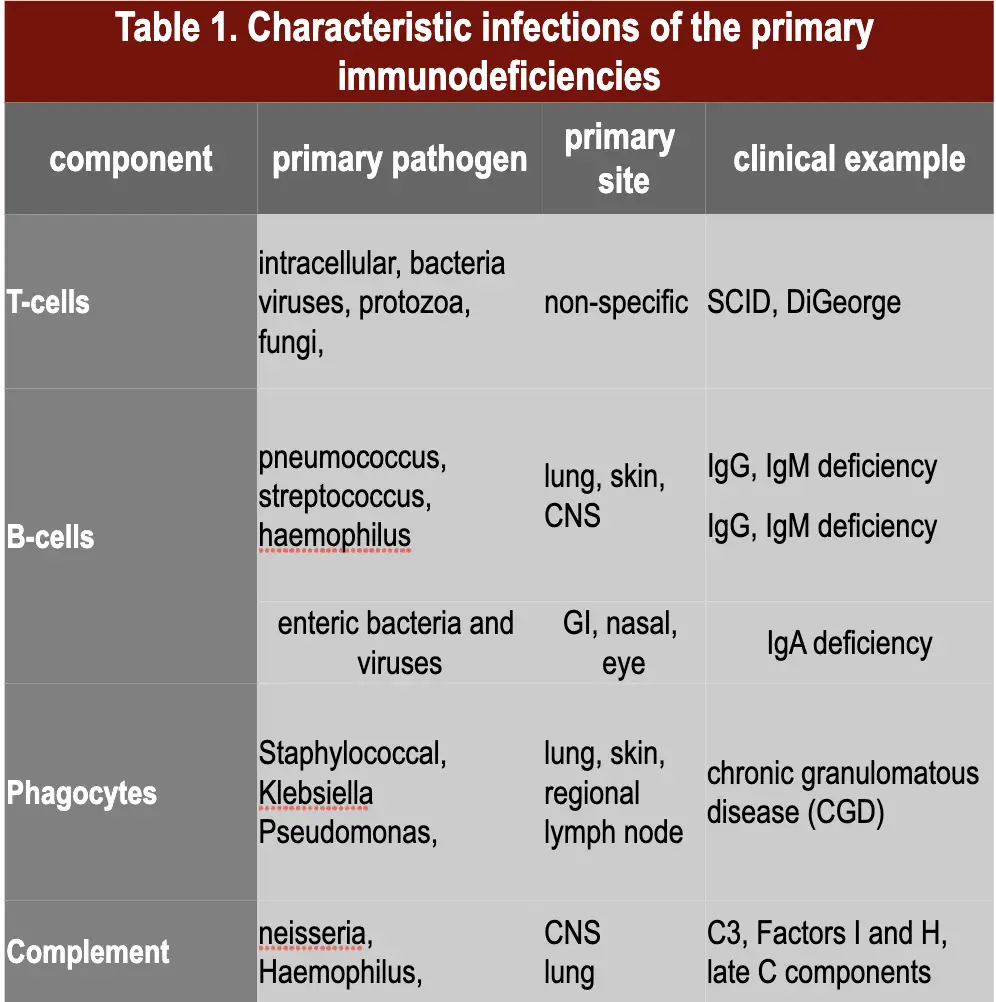
Primary immunodeficiencies are inherited defects of the immune system (figure 1). These defects may be in the specific or non-specific immune mechanisms. They are classified on the basis of the site of lesion in the developmental or differentiation pathway of the immune system. Individuals with immunodeficiencies are susceptible to a variety of infections and the type of infection depends on the nature of immunodeficiency (Table 1).
SPECIFIC IMMUNE SYSTEM
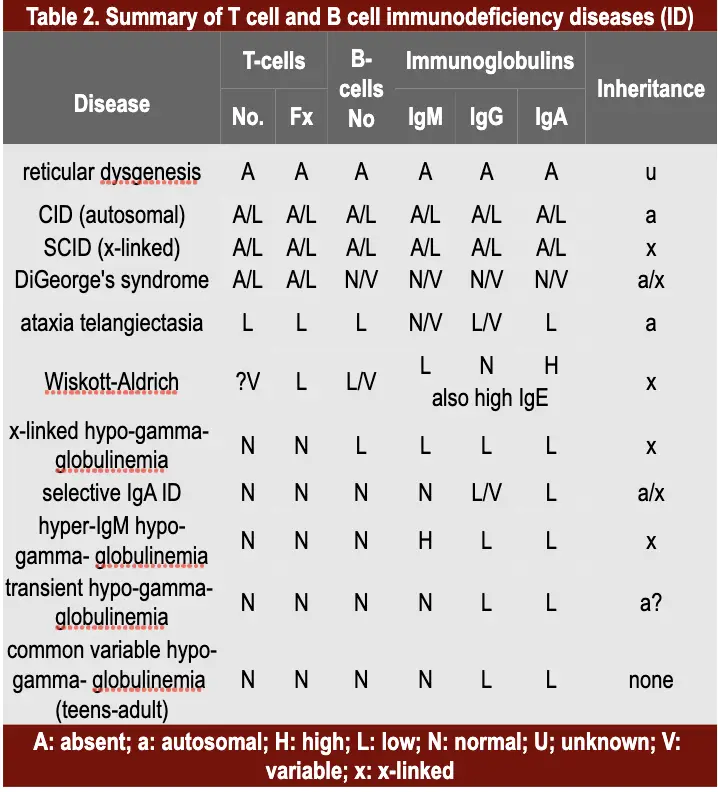
There are a variety of immunodeficiencies which result from defects in stem cell differentiation and may involve T-cells, B-cells, and/or immunoglobulins of different classes and subclasses (Table 2).
A defect in the early hematopoiesis which involves stem cells results in reticular dysgenesis that leads to general immune defects and subsequent susceptibility to infections. This condition is often fatal but very rare.
Lymphoid lineage immunodeficiency
If the lymphoid progenitor cells are defective, then both the T and B cell lineages are affected and result in the severe combined immunodeficiency (SCID). Infants suffer from recurrent infections especially by opportunistic micro-organisms (bacterial, viral, mycotic and protozoan infections).
In about 50% of SCID patients, the immunodeficiency is x-linked whereas in the other half the deficiency is autosomal. Both are characterized by an absence of T cell and B cell immunity and absence (or very low numbers) of circulating T and B lymphocytes. Thymic shadows are absent on X-rays.
The x-linked severe SCID is due to a defect in the gamma-chain of IL-2 also shared by IL-4,-7, -11 and 15, all of which are involved in lymphocyte proliferation and/or differentiation. The autosomal SCIDs arise primarily from defects in adenosine deaminase (ADA) or purine nucleoside phosphorylase (PNP) genes which results is accumulation of dATP or dGTP, respectively, and cause toxicity to lymphoid stem cells. Other genetic defects leading to SCID include those for RAG1, RAG2 and IL-7-alpha. If suspected of SCID, the patient must not receive live vaccine, as it will result in progressing disease.
Diagnosis is based on enumeration of T and B cells and immunoglobulin measurement. Severe combined immunodeficiency can be treated with a bone marrow transplant (see MHC and transplantation). Recently, autosomal SCID patients with ADA deficiency have been treated with a retroviral vector transfected with the gene with some success.
SCID includes several disorders
Patients having both T and B cell deficiency lack recombinase activating genes (RAG1 and 2) that are responsible for the T cell receptor and Ig gene rearrangements. These patients are athymic and are diagnosed by examining the T cell receptor (TCR) gene rearrangement. Defects in B cells are not observed in early infant life because of passive antibodies obtained from the mother. NK cells are normal.
In some SCID patients, T cells may be present but functionally defective because of deficiency in signaling mediated by the CD3 chain that is associated with the TCR.
Interleukin-2 receptor common gamma chain (IL-2Rγc) may be lacking in patients there by preventing signaling by IL-2, 4, 7, 9 and 15. These patients are T and NK cell deficient.
Adenosine deaminase (ADA) is responsible for converting adenosine to inosine. ADA deficiency leads to accumulation of adenosine which interferes with DNA synthesis. The patients have defects in T, B and NK cells.
Disorders of T cells
DiGeorge’s Syndrome (Deletion 22 Syndrome)
This the most clearly defined T-cell immunodeficiency and is also known as congenital thymic aplasia/hypoplasia, or immunodeficiency with hypoparathyroidism. The syndrome is associated with hypoparathyroidism, congenital heart disease, low set notched ears and fish shaped mouth. These defects results from abnormal development of the fetus during the 6th to 10th week of gestation when parathyroid, thymus, lips, ears and aortic arch are being formed. No genetic predisposition is clear and not all DiGeorge syndrome babies have thymic aplasia. A thymic graft taken from an early fetus (13 – 14 weeks of gestation) can be used for treatment. Older grafts may result in GVH reaction. In severely immunodeficient DiGeorge patients, live vaccines may cause progressive infections.
DiGeorge syndrome is autosomal dominant (figure 2) and is caused by a deletion in chromosome 22 (figure 3). The deletions are of variable size but size does not correlate with severity of disease. In about 6% of cases, the chromosome 22 micro-deletion is inherited but most cases result from de novo deletion which may be caused by environmental factors.
T cell deficiencies with variable degrees of B cell deficiency
Ataxia-telangiectasia
Ataxia-telangiectasia is a deficiency of T cells associated with a lack of coordination of movement (ataxis) and dilation of small blood vessels of the facial area (telangiectasis). T- cells and their functions are reduced to various degrees. B cell numbers and IgM concentrations are normal to low. IgG is often reduced and IgA is considerably reduced (in 70% of the cases). There is a high incidence of malignancy, particularly leukemias, in these patients. The defects arise from a breakage in chromosome 14 at the site of TCR and Ig heavy chain genes.
Wiskott-Aldrich syndrome
This syndrome is associated with normal T cell numbers with reduced functions, which get progressively worse. IgM concentrations are reduced but IgG levels are normal. Both IgA and IgE levels are elevated. Boys with this syndrome develop severe eczema, petechia (due to platelet defect and thrombocytopenia). They respond poorly to polysaccharide antigens and are prone to pyogenic infection. Wiskott-Aldrich syndrome is an X-linked disorder (figure 4) due to defect in a cytoskeletal glycoprotein, CD43.
MHC deficiency (Bare leukocyte syndrome)
A number of cases of immunodeficiency have been described in which there is a defect in the MHC class II transactivator (CIITA) protein gene, which results in a lack of class-II MHC molecule on their APC. Since the positive selection of CD4 cells in the thymus depends on the presence of these MHC molecules, these patients have fewer CD4 cells and are infection prone. There are also individuals who have a defect in their transport associated protein (TAP) gene and hence do not express the class-I MHC molecules and consequently are deficient in CD8+ T cells.
Disorders of B lymphocytes
There are a number of diseases in which T cell numbers and functions are normal: B cell numbers may be low or normal but immunoglobulin levels are low. These are briefly summarized below.
X-linked infantile hypogammaglobulinemia
X-linked hypogammaglobulinemia, also referred to as Bruton’s hypoglobulinemia or agammaglobulinemia, is the most severe hypogammaglobulinemia in which B cell numbers and all immunoglobulin levels are very low. The patients have failure of B-cell maturation associated with a defective B cell tyrosine kinase (btk) gene. Diagnosis is based on enumeration of B cells and immunoglobulin measurement.
Transient hypogammaglobulinemia
Children, at birth, have IgG levels comparable to that of the mother. Because the half life of IgG is about 30 days, its level gradually declines, but by three months of age normal infants begin to synthesize their own IgG. In some infants, however, IgG synthesis may not begin until they are 2 to 3 years old. This delay has been attributed to poor T cell help. This results in a transient deficiency of IgG which can be treated with gamma-globulin.
Common variable hypogammaglobulinemia (Late onset hypogammaglobulinemia)
These individuals have acquired deficiencies of IgG and IgA in the 2nd or 3rd decade of their life and are susceptible to a variety of pyogenic bacteria and intestinal protozoa. They should be treated with specially prepared gamma-globulin for intravenous use.
IgA deficiency
IgA deficiency is the commonest of all immunodeficiencies (1/700 of all Caucasians). About 20% of individuals with IgA deficiency also have low IgG. IgA-deficient patients are very susceptible to gastrointestinal, eye and nasopharyngeal infections. Patients with IgA deficiency have a high incidence of autoimmune diseases (particularly immune complex type) and lymphoid malignancies. Anti-IgA antibodies (IgG) are detected in 30 to 40 percent of patients who should not be treated with γ-globulins. Laboratory diagnosis is based on IgA measurement.
Selective IgG deficiency
Deficiencies of different IgG subclasses have been found. These patients are susceptible to pyogenic infections.
Hyper-IgM immunodeficiency
Individuals with this type of immunodeficiency have low IgA and IgG concentrations with abnormally high levels of IgM. These patients cannot make a switch from IgM to other classes which is attributed to a defect in CD40L on their CD4 cells. They are very susceptible to pyogenic infection and should be treated with intravenous gamma-globulins.
NON-SPECIFIC IMMUNE SYSTEM
Primary immunodeficiencies of the non-specific immune system include defects in phagocytic and NK cells and the complement system.
Defects of the phagocytic system
Defects of phagocytic cells (numbers and/or functions) can lead to increased susceptibility to a variety of infections.
Cyclicneutropenia
This is marked by low numbers of circulating neutrophil approximately every three weeks. The neutropenia lasts about a week during which the patients are susceptible to infection. The defect appears to be due to poor regulation of neutrophil production.
Chronic granulomatous disease(CGD)
CGD is characterized by marked lymphadenopathy, hepato- splenomegaly and chronic draining lymph nodes. Leukocytes have poor intracellular killing (figure 5) and low respiratory burst. In majority of these patients, the deficiency is due to a defect in NADPH oxidase (cytochrome b558 : gp91phox, or rarely gp22phox) or other cofactor proteins (gp47phox, gp67phox) that participate in phagocytic respiratory burst. These patients can be diagnosed on the basis or poor Nitroblue tetrazolium (NBT) reduction which is a measure of respiratory burst. Interferon-gamma therapy has been successful.
Leukocyte Adhesion Deficiency
In this disease, leukocytes lack the complement receptor CR3 due to a defect in CD11 or CD18 peptides and consequently they cannot respond to C3b opsonin. Alternatively there may a defect in integrin molecules, LFA-1 or mac-1 arising from defective CD11a or CD11b peptides, respectively. These molecules are involved in diapedesis and hence defective neutrophils cannot respond effectively to chemotactic signals.
Chediak-Higashi syndrome
Chediak-Higashi syndrome is marked by reduced (slower rate) intracellular killing and chemotactic movement accompanied by inability of phagosome and lysosome fusion and proteinase deficiency. Giant lysosomes (intracellular granules) are often seen (figure 6). The respiratory burst is normal. Accompanying NK cell defects and platelet and neurological disorders are noted.
DISORDERS OF COMPLEMENT SYSTEM
Complement abnormalities also lead to increased susceptibility to infections. There are genetic deficiencies of various components of complement system, which lead to increased infections. The most serious among these is the C3 deficiency which may arise from low C3 synthesis or deficiency in factor I or factor H.