Bullfrog Skeletal Reconstruction


Bullfrog Skeleton Reconstruction


Introduction:

The skeleton of the frog consists chiefly of bony and cartilaginous elements.  The functions of a skeleton include providing support for the body,  protection of delicate internal organs and attachment surfaces for muscles.  In vertebrates, the axial skeleton consists of the skull, vertebral column, sternum (breast bone) and ribs (which are not present in amphibians).  The vertebral column of frogs is made up of 10 vertebrae, the first of which (called the atlas) articulates with the base of the skull.  The atlas is the only cervical vertebra in the frog.  The next seven vertebrae are abdominal vertebrae, which is the large sacrum with two strong transverse processes that join with the ileum.  The last vertebra is the long and highly modified urostyle.  Note:  Most vertebrates have a tail supported by caudal vertebrate, but frogs and toads are atypical in that they lack any tail and are therefore called anurans (“tail less amphibians”).


Lab_9b-17a  

1. Skull
2. Axis Cervical vertebrae)
3. Abdominal vertebrae
4. Cervical Vertebrae
5. Urostyle
6. Scapula
7. Ilium
8. Ischium
9. Humerus
10. Radio-ulna
11. Carpals
12. Metacarpals
13. Phalanges
14. Femur


The appendicular skeleton includes the limbs and the pectoral and pelvic girdles that support them.  In most vertebrates the forelimbs consist of three major bones — the humerus, radius and ulna, along with the smaller bones of the hand (carpals, metacarpals and phalanges).  Note that in the frog the radius and ulna have become fused into a single bone, the radio-ulna.  Likewise, the hindlimbs consist of three major bones — the femur, tibia and fibula, along with the smaller bones that make up the feet (tarsals, metatarsals and phalanges). Once again, in frogs and toads the tibia and fibula have become fused into a single bone, the tibio-fibula.  The pectoral girdle consists of four pairs of bones (the suprascapula, scapula, coracoid, and clavicle).  The last three pairs are connected to the sternum.  In frogs, the pelvic girdle, which supports the hindlimbs, is formed by the fusion of the ilium, ischium and non-ossified pubis.  Each femur fits into a socket on the pelvic girdle called an acetabulum.  Note that the pelvic girdle and limb structure are well adapted for giving a powerful, synchronous thrust of both hind limbs in swimming and jumping

Objective:

By reassembling an amphibian skeleton, students will learn the bones and modifications of a vertebrate.

Materials:

Dermestid beetles, small aquarium with air-vented lid,  dermestid bedding, food, & water supply, freeze-dried bullfrogs, tweezers, small container with lid for bones, 20% H2O2, thin piece of wood, paints, and glue.

Procedure:

  1. Place the freeze dried frog into a small aquarium of dermestid beetles.
  2. Leave the frog skeleton in the aquarium for several days to several weeks until all flesh has been stripped from the skeleton.
  3. Carefully remove all bones from the aquarium and use forceps to carefully pull away any flesh that remains..
  4. Rinse the bones in running water thoroughly.
  5. Bleach the bone in 20% hydrogen peroxide solution until the bones appear white.
  6. Dry the bones and articulate them. (use the above diagram to help in the arrangement of the bones.)
  7. Bones should be mounted on a thin piece of wood.
  8. You may be creative and place your frog in a scene of your choosing — playing football or basketball, swimming in a pond, practicing ballet, etc.

Examples:


Biology Second Semester

Biology I Second Semester

Updated May 2007

Week of January 8 assignments:
Read & outline chapter 10 on Nucleic Acids; PowerPoint: Nucleic Acids & protein Synthesis; chapter 10 outline due

Week of January 14 assignments:

Chapter 10 study guide; Lab: Strawberry DNA; Chapter 10 TEST on Nucleic Acids; Read & outline chapters 8 & 12 on genetics

Week of January 21 assignments: 

PowerPoint on genetics; Monohybrid crosses & ratios; Chapter 8 outline due

I have a Dream!  Martin Luther King Holiday

Week of January 28 assignments:
Lab: Karyotyping; Work genetics problems; Notes on genetic disorders; genetics review; TEST on chapters * & 12 genetics; Read chapters 13 & 14 on evolution

Week of February 3 assignments:
Cover section 14.1 and chapter 15 on Charles Darwin & natural selection; Lab: Natural Selection in Peanuts

Week of February 11 assignments:  Interims
study guide on evolution; TEST on chapters13 & 14 Evolution; Read & outline chapter 18 on Taxonomy; PowerPoint notes on taxonomy; Peanut lab write up due

Week of February 18 assignments:
Practice taxonomic keying; Complete taxonomy notes; Chapter 18 TEST on Taxonomy; Read & outline chapters 24 & 25 on bacteria & viruses

Monday Holiday — President’s Day!

Parent-Teacher Conference!

Week of February 25 assignments:
Notes on Sponges & Cnidarians; Assign Invertebrate drawings; study guide & take online quiz; Continue Koch’s lab

Week of March 3 assignments: 

Complete Virus notes; Virus model due; Chapter 25 outline due; TEST on Bacteria & Viruses; Handout & worksheet on plant unit

Week of March 10 assignments: 

Cover nonvascular plants, angiosperms, & gymnosperms

End of Third Nine weeks

   Biology I

Spring Break March 17 – 21!

Week of March 24 assignments:

Plant worksheet due; review for plant test; *UNIT TEST on Plants; Assign ecosystem collage; Start answering ecology unit worksheet


Week of March 31 assignments:

Work on and finish ecology unit worksheet; review for ecology test; TEST on Ecology; Read & outline chapter 35 on Sponges & Cnidarians

Good Friday, April 4th!


Week of April 7 assignments:    

Ecosystem Collage due!; Notes on Sponges & Cnidarians; study guide; Test on Chapter 35 Sponges & Cnidarians; read & outline chapter 36 on Round & Flat worms

Week of April 14 assignments:  Interims
Notes on worms; Chapter 36 outline due; read & outline chapter 37 on Mollusks & Annelids; notes on mollusks & annelids

Biology End-of-Course Exam on Wednesday April 16th and Thursday April 17th!

Week of April 21 assignments:
study guide & take online echinoderm test; Lab: Starfish Dissection; read & outline chapters 41 &42 on fish & amphibians; notes on fish; Scientist/Career Report due!

Week of April 28 assignments: 

Dissect earthworm; *TEST on chapters 36 & 37 Worms & Mollusks; Read & outline chapters 38 & 39 on Arthropods & Insects; Start notes on arthropods

Week of May 5 assignments:
Notes on Insects; review for arthropod test; TEST on chapters 38 & 39 Insects & other Arthropods; read & outline Chapter 40 on Echinoderms

Click frog for jokes

Week of May 12 assignments:
Notes on Echinoderms; Dissect starfish; TEST on Chapter 40 Echinoderms; Read & outline chapters 41 & 42 on fish & amphibians; Assign vertebrate/invertebrate project

Week of May 19 assignments:   Graduation May 23!
Notes on reptiles, birds, and mammals; Read chapters 44 & 45 on birds  mammals; UNIT TEST on Vertebrates; Vertebrate/Invertebrate Project due!; semester Test review

Final Exams  Start  Next Week-   Don’t Forget to study!!!

Week of May 26 assignments:  

Semester Exams Tuesday, Wednesday, & Thursday; Textbooks due!

Final Exams  Start  –   Don’t Forget to study!!!

End of Fourth Nine weeks

    Biology I

Enjoy your summer!  

Bacteria Study Guide Bi


Bacteria Study Guide


1. What are rod-shaped bacteria are called?

2. Bacteria are the only organisms characterized as____________________.

3. The earliest known group of living organisms on Earth was__________________.

4. Bacteria can be classified according to what three things?
A.
B.
C.

5. What does the  prefix “archea” mean?

6. Archaebacteria can be divided into 3 Groups.  Name and describe each group.
A.

B.

C.


7. The most numerous organisms on Earth are ________________.

8. Name the type of bacteria that does not have peptidoglycan  in its cell walls.

9. Name the type of bacteria that obtain energy from inorganic substances.

10. Name the type of bacteria that obtain nutrients from dead organisms.

11. Organisms that lack a cell nucleus and membrane-bound organelles are called ______________.

12. Most prokaryotes are ________________organisms.

13. Escherichia coli is an example of a bacterium that has short, thin, hairlike projections called __________. What is their function?


14. Bacteria lack true nucleus and membrane-bound organelles so they are classified as __________.

15. What is the procedure called that is used to distinguish between two types of bacterial cell wall structures ?

16. _______________ are protective structures that some bacteria may form under harsh conditions.

17. Spiral- shaped bacteria are known as what?

18. Almost all prokaryotes are ____________________ than the smallest Eukaryotes.

19. Prokaryotes have ___________________ that are different from those of Eukaryotes.

20. What are the 2 kingdoms of bacteria and briefly describe each?


21. ________________ is the process by which bacteria cells pick up and incorporate DNA from dead bacteria cells.

22. _____________ is the process of using a virus to transfer DNA from one bacterial cell to another.

23. When living conditions become ______________, some bacteria from special
dehydrated cells called__________________.

24. Bacteria that form ___________________ have an advantage for ____________________.

25. Bacteria the feed on and that break down dead organic material are called ___________.

26. _______________ is a type of bacteria that produces many antibiotics.

27. ________________ is a type of bacteria that produces endotoxins.

28. The ____________________ are a group of bacteria that live in harsh environments.

29. Bacteria that take on the purple color when stained are called what?

30. Gram-positive Bacteria used to make antibiotics are called _________________.

31. Gram-positive bacteria cause many diseases in humans by producing ____________ which are poisons to our bodies.

32. Bacteria that appear pink after staining are called  what?

33. Gram-negative bacteria have an extra layer of ________________ on the outside
of the ____________  ____________ and appear ___________ after the gram staining.

44. The lipid layer _______________ the purple stain from entering the cell wall.

35. The Archaebacteria that produce methane are called ____________________.

36. Archaebacteria that thrive in very salty conditions, such as the Dead Sea, are called what?

37. The prefix “eu” means __________________.

38. What is the important tool used for classifying Eubacteria  called?


39. During Gram staining, depending on structure of their __________  ____________, the
bacteria’s cell walls absorbs either the _______________ or ________________dye.

40. Gram-negative bacteria are distinguished by an extra layer of _________________.

41.  ______________ are Gram-negative bacteria that perform plant-like ___________________ and release oxygen as a by-product.

42.  ________________ are much __________ than many other prokaryotes.

43. Organisms that obtain energy from oxidizing inorganic compound instead of sunlight are called what?

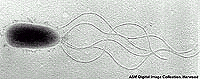
44. Whiplike structures used by bacteria for movements are called __________________.

45. Photoautotrophs are bacteria that use ______________________ as an energy source.

46. Bacteria can be one of three different shapes:
A. _____________________________________________(Rod)
B. _____________________________________________(Sphere)
C. _____________________________________________(Spiral)

47. Gram-negative bacteria do absorb the ____________ stain during the Gram-staining process.

48. The extra layer of lipids also stops many _________________ from entering the bacteria.

49. Scientist think that gram-negative bacteria may have evolved from a_____________  ________________.

50.  ______________________ grow in the root nodules of such plants as soybean, clover, and alfalfa.

51. Rhizobacteria fix ______________________ from the atmosphere into a form that plants
and animals can use (this greatly helps both plants and animals).  They convert gaseous
nitrogen into compounds such as __________________________  (NH3).

52. Organisms that use oxygen during cellular respiration are called ________________. Organisms
that do not use oxygen are called __________________________.  Typically they get their energy through ________________________.

53. Bacteria called ______________  __________________ cannot live without oxygen.

54. Most bacteria reproduce by a process called ____________   _______________.

55. Binary fission is a process in which the __________________________ replicate,
after which the ________________ divides.

56. Binary fission is a type of ____________________ reproduction.

57. Some bacteria contain smaller pieces of circular DNA called  _________________.

58. Bacteria can exchange genes by one of three special means. Name these means.

A.

B.

C.

59. The process of exchanging genetic material through cell to cell contact is called
_______________.

60. Where are pili found? Do all bacteria have them?


61. Bacteria usually gain part of their ____________________ from their shape.

62. Two major differences between groups of bacteria are their source of ________________
and whether or not they use ________________ for cellular respiration.

63. Most bacteria act as  _______________________ getting their energy by consuming (eating) organic molecules.

64. Some are __________________ that make their own food from ________________.

65. ___________________ obtain their food from inorganic compound instead of sunlight.

66.  _________________________ use sunlight for energy.

67. Bacteria that can only survive in the absence of oxygen are called what?

68. Gram-negative bacteria appear ________________ when they undergo the Gram-stain procedure.

69. A type of  bacteria that performs nitrogen fixation is _________________________.

70. Bacteria called ____________  _______________ cannot live in the presence of oxygen.

71. Type of bacteria that peptidoglycan is present in cell walls __________________.

72. What bacteria are thought to be responsible for establishing the Earth’s oxygen-rich atmosphere?

73. Bacteria cells typically lack _________________________.

74. Bacterial disease of the intestines are usually transmitted by contaminated ____________  or ______________.

75. What are the 3 mechanism of action of an antibiotic?


76. The cell walls of Gram-negative Eubacteria are composed of a combination of polysaccharide and polypeptide called what?

77. Bacteria that obtain their energy by removing electrons from inorganic molecules, rather than obtaining energy from the sun, are called _____________________ bacteria.

78. In general, organisms that obtain their energy from sunlight are called _________________.

79. Bacteria that are heterotrophic and feed on dead organic matter are called _____________.

80. A(n) _________________ is a substance that can be obtained from bacteria or fungi and  can be used as a drug to fight pathogenic bacteria.

81. Many bacteria are ________________ and play an important role in recycling carbon, nitrogen, and other elements,  while other bacteria are ___________________ and assemble organic compounds from carbon dioxide, nitrogen, and other elements.

82. A pathogen is an agent that is ________________________.

83. Bacteria cells such as E. coli transfer pieces of genetic material in a process called ____________________.

84. Archaebacteria that can live in extremely hot or acidic water are called _____________.

85. Spherical bacteria are called ________________.

86. Bacteria called ________________  __________________ can use oxygen when it is available,
but do not depend on it.

87. Nitrogen-fixing bacteria convert atmospheric _________________ into _________________.

88. Structurally, bacteria have one of two types of _______________  _______________.

89. Certain cyanobacteria, such as Anabaena, can fix nitrogen by using enzymes contained in specialized structures called what?

90. The oxidation of ammonia to nitrates that can be used by plants is called what?

TRUE OR FALSE

_____91. Bacterial cells have membrane-bound organelles and chromosomes.

_____92. Certain antibiotics have become ineffective against certain strains of bacteria. These bacteria have developed a resistance, which may be passed on from one generation of bacteria to the next.

_____93. Bacteria that can survive only in the absence of oxygen are called obligated aerobes.

_____94. The photoautotrophic bacteria are the only bacteria that are indirectly beneficial to humans.

_____95. Bacterial cells are usually much larger than eukaryotic cells.

_____96. Gram-negative bacteria have a thick layer of peptidoglycan that stains purple.

_____97. Ancient bacteria known as Archaebacteria are now extinct.

_____98. Although there are some bacteria that are heterotrophic, the vast majority are autotrophic.

_____99. Bacteria lack nuclei and therefore also lack genetic material.

_____100. Photosynthetic bacteria are present in leguminous plants and convert atmospheric nitrogen into a form that is usable by the plant.

_____101. Gram-negative bacteria appear purple when they undergo the Gram-stain procedure.

_____102. Bacteria are incapable of movement themselves; they an only get to new locations by growing toward them or by forming endospores and being carried in air or water.

_____103. The bacterial cell wall prevents the passage of antibiotics and is only means by which bacteria can resists antibiotics.

_____104. Some bacteria cannot survive in the presence of oxygen.

_____105. The terms Eubacteria and Archaebacteria refer to members of a single kingdom.

_____106. When bacteria undergo nonreproductive genetic recombination, their bacterial chromosome is altered.

DIRECTIONS: Answer the questions below as completely and as thoroughly as possible. Answer the question in essay form (not outline form), using complete sentences. You may use diagrams or pictures to supplement your answers, but a diagram or picture alone without appropriate discussion is inadequate.

107. Describe the capsule of a bacterium and its function.


108. Identify the most common shapes of Eubacteria and describe each.


109. Compare and contrast Archaebacteria with Eubacteria.


110. Identify 3 ways that bacteria are used to produce substances for human use.


111. Describe the significance of cyanobacteria in the formation of the Earth’s atmosphere.


112. List the various structures of the bacterial cell, and describe their function.


113. Explain the laboratory technique Gram stain and explain why it is used.


114. Define the term genetic recombination as it applies to bacteria, and describe 3 ways that genetic recombination occurs in bacteria.


115. Explain how chemoautotrophs differ from photosynthetic autotrophs.


116. Explain how the terms bacteria, Eubacteria, and Archaebacteria, relate to one another.


117. Describe 3 types of movement among bacteria.


118. List the characteristics that are used to classify bacteria.


119.  Explain how chemoautotrophs harvest energy from the environment.


120.  Describe 2 ways bacteria cause disease.


121.  Explain why antibiotic resistance among bacteria is increasing.


122. List one distinguishing characteristic of each of the three main groups of Archaebacteria.


Bacteria

KINGDOMS ARCHAEBACTERIA & EUBACTERIA


All Materials © Cmassengale

Bacterial Evolution & Classification 

  • Most numerous organisms on earth
  • Earliest life forms (fossils date 2.5 billion years old)
  • Microscopic prokaryotes (no nucleus nor membrane-bound organelles)
  • Contain ribosomes
  • Infoldings of the cell membrane carry on photosynthesis & respiration
  • Surrounded by protective cell wall containing peptidoglycan (protein-carbohydrate)
  • Many are surrounded by a sticky, protective coating of sugars called the capsule or glycocalyx (can attach to other bacteria or host)
  • Have only one circular chromosome
  • Have small rings of DNA called plasmids
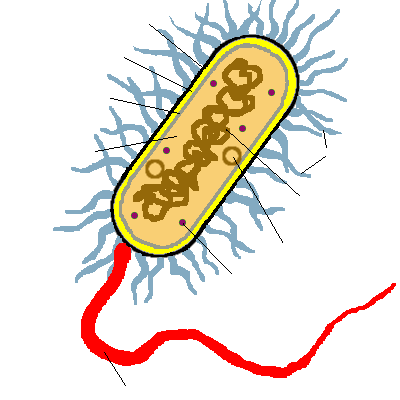
  • May have short, hairlike projections called pili on cell wall to attach to host or another bacteria when transferring genetic material
  • Most are unicellular

  • Found in most habitats
  • Most bacteria grow best at a pH of 6.5 to 7.0
  • Main decomposers of dead organisms so recycle nutrients
  • Some bacteria breakdown chemical & oil spills
  • Some cause disease 
  • Move by flagella, gliding over slime they secrete ( e.g. Myxobacteria)
  • Some can form protective endospores around the DNA when conditions become unfavorable; may stay inactive several years & then re-activate when conditions favorable
  • Classified by their structure, motility (ability to move), molecular composition, & reaction to stains (Gram stain)
  • Grouped into 2 kingdoms — Eubacteria (true bacteria) & Archaebacteria (ancient bacteria)
  • Once grouped together in the kingdom Monera


STRUCTURE FUNCTION
Cell Wall protects the cell and gives shape
Outer Membrane protects the cell against some antibiotics (only present in Gram negative cells)
Cell Membrane regulates movement of materials into and out of the cell; contains enzymes important to cellular respiration
Cytoplasm contains DNA, ribosomes, and organic compounds required to carry out life processes
Chromosome carries genetic information inherited from past generations
Plasmid contains some genes obtain through genetic recombination
Capsule, and slime layer protects the cell and assist in attaching the cell to other surfaces
Endospore protects the cell against harsh environmental conditions, such as heat or drought
Pilus (Pili) assist the cell in attaching to other surfaces, which is important for genetic recombination
Flagellum moves the cell


Kingdom Archaebacteria

  •   Found in harsh environments (undersea volcanic vents, acidic hot springs, salty water)
  • Cell walls without peptidoglycan
  • Subdivided into 3 groups based on their habitat — methanogens, thermoacidophiles, & extreme halophiles

Methanogens

  • Live in anaerobic environments (no oxygen)
  • Obtain energy by changing H2 and CO2 gas into methane gas
  • Found in swamps, marshes, sewage treatment plants, digestive tracts of animals
  • Break down cellulose for herbivores (cows)
  • Produce marsh gas or intestinal gas (methane)

Extreme Halophiles

  •   Live in very salty water
  •   Found in the Dead Sea, Great Salt Lake, etc.
  • Use salt to help generate ATP (energy)

Thermoacidophiles (Thermophiles)

  • Live in extremely hot  (1100C) and acidic (pH 2) water
  • Found in hot springs in Yellowstone National Park, in volcanic vents on land, & in cracks on the ocean floor that leak scalding acidic water

Kingdom Eubacteria (true bacteria)

  • Most bacteria in this kingdom
  • Come in 3 basic shapes — cocci (spheres), bacilli (rod shaped), spirilla (corkscrew shape)

  • Bacteria can occur in pairs ( diplo– bacilli or cocci)
  •   Bacteria occurring in chains are called strepto- bacilli or cocci
  • Bacteria in grapelike clusters are called staphylococci
  • Most are heterotrophic (can’t make their own food)
  • Can be aerobic (require oxygen) or anaerobic (don’t need oxygen)
  • Subdivided into 4 phyla — Cyanobacteria (blue-green bacteria), Spirochetes, Gram-positive, & Proteobacteria
  • Can be identified by Gram staining (gram positive or gram negative)  

Gram Staining

  • Developed in 1884 by Danish microbiologist, Hans Gram
  •   Bacteria are stained purple with Crystal Violet & iodine; rinsed with alcohol to decolorize; then restained with Safranin (red dye)

  • Bacterial cell walls either stain purple or reddish-pink

Gram-positive bacteria (Gram +)

  • Thick layer of peptidoglycan (protein-sugar) complex in cell walls & single layer of lipids
  • Stain purple

  • Lactobacilli are used to make yogurt, buttermilk ….
  • Actinomycetes make antibiotics like tetracycline & streptomycin
  • Disease-causing gram + bacteria produce poisons called toxins
  • Clostridium causes tetanus or lockjaw
  • Streptococcus cause infections such as “strep” throat

  • Staphylococci cause “staph” infections

  • Also cause toxic shock, bacterial pneumonia, botulism (food poisoning), & scarlet fever
  • Can be treated with penicillin (antibiotics) & sulfa drugs

Gram-negative bacteria (Gram -)

  • Cell walls have a thin layer of peptidoglycan & an extra layer of lipids on the outside
  • Stain pink or reddish 

  • Lipid layer prevents the purple stain & antibiotics from entering (antibiotic resistant)
  • Some are photosynthetic but make sulfur, not oxygen
  • Rhizobacteria grow in root nodules of legumes (soybeans, peanuts…) & fix nitrogen form the air for plants
  • Rickettsiae are parasitic bacteria carried by ticks that cause Rocky Mountain spotted fever
  • Spirochetes can cause syphilis & Lyme disease

Phylum Cyanobacteria

  • Gram negative
  •   Carry on photosynthesis & make oxygen
  • Called blue-green bacteria
  • Contain pigments called phycocyanin (red & blue) & chlorophyll a (green)
  •    May be red, yellow, green, brown, black, or blue-green
  • Some grow in chains (e.g. Oscillatoria)  & have specialized cells called heterocysts that fix nitrogen


OSCILLATORIA

  •  First bacteria to re-enter devastated areas
  • Anabaena that live on nitrates & phosphates in water can overpopulate & cause “population blooms” or eutrophication
  •   After eutrophication, the cyanobacteria die, decompose, & use up all the oxygen for fish

Phylum Spirochetes

  •   Gram positive
  • Have flagella at each end so move in a corkscrew motion
  •   Some are aerobic (require oxygen); others are anaerobic
  • May be free-living, parasitic, or live symbiotically with another organism  

Phylum Gram Positive bacteria

  • Most are Gram +, but some are Gram –
  • Lactobacilli grow in milk & make lactic acid (forms yogurt, cottage cheese, buttermilk) & also found on teeth & cause tooth decay
  • Actinomycetes grow in the soil & make antibiotics
  • Gram + members are found in the oral & intestinal cavities & slow the growth of disease-causing bacteria

Phylum Proteobacteria

  • Largest & most diverse bacterial group
  • Subdivided into Enteric bacteria, Chemoautotrophic bacteria, & Nitrogen-fixing bacteria  

Enteric bacteria

  • Gram negative heterotrophs
  • Can live in aerobic & anaerobic environments
  • Includes E. coli that lives in the intestinal tract making vitamin K & helping break down food
  • Salmonella causes food poisoning

Chemoautotrophs

  • Gram negative bacteria that obtain energy from minerals  
  • Iron-oxidizing bacteria found in freshwater ponds use iron salts for energy

Nitrogen-Fixing bacteria

  • Rhizobium are Gram negative & live in legume root nodules

  • 80% of atmosphere is N2, but plants can’t use nitrogen gas
  • Nitrogen-fixing bacteria change N2 into usable ammonia (NH3)
  • Important part of the Earth’s nitrogen cycle

Methods of Nutrition

  •  Saprobes feed on dead organic matter
  •  Parasites feed on a host cell
  •  Photoautotrophs use sunlight for energy, but get carbon from organic compounds (not CO2) to make their own food  
  • Chemoautotrophs obtain food by oxidizing inorganic substances like sulfur, instead of using sunlight

Methods of Respiration

  •   Obligate aerobic bacteria can’t live without oxygen; (tuberculosis bacteria)
  •  Obligate anaerobes die if oxygen is present; (tetanus bacteria that causes lockjaw)
  • Facultative anaerobes do not need oxygen, but don’t die if oxygen is present; (E. coli)
  • Anaerobes carry on fermentation, while aerobes carry on cellular respiration 

Bacterial Reproduction & Genetic Recombination

  • Most bacteria reproduce asexually by binary fission (chromosome replicates & then the cell divides)  
  •   Bacteria replicate (double in number) every 20 minutes under ideal conditions  
  • Bacteria contain much less DNA than eukaryotes
  • Bacterial plasmids are used in genetic engineering to carry new genes into other organisms  
  • Bacteria recombine genetic material in 3 ways — transformation, conjugation, & transduction

Conjugation

  • Sexual reproductive method
  • Two bacteria form a conjugation bridge or tube between them

  •   Pili hold the bacteria together
  •   DNA is transferred from one bacteria to the other       

Transformation

  • Bacteria pick up pieces of DNA from other dead bacterial cells
  • New bacterium is genetically different from original

Transduction

  • A bacteriophages (virus) carries a piece of DNA from one bacteria to another

  • Human insulin is produced in the lab by this method

Pathogenic bacteria

  •   Known as germs or pathogens
  • Cause disease
  • Can produce poisonous toxins
  • Endotoxins are made of lipids & carbohydrates by Gram – bacteria & released after the bacteria die (cause high fever, circulatory vessel damage…)
  • E. coli  produce endotoxins
  • Exotoxins are made of protein by Gram + bacteria 
  • Clostridium tetani produce exotoxins
  • Antibiotics interfere with cellular functions (Penicillin interferes with synthesis of the cell wall; tetracycline interferes with protein synthesis)
  • Some antibiotics are made by bacteria or fungi
  • Broad-spectrum antibiotics affect a wide variety of organisms
  • Bacteria can mutate and become antibiotic resistant (often results from overuse of antibiotics)
BACK


AR Wildflowers

Arkansas Wildflowers


Carolina Larkspur (Delphinum carolinium) – 4′ tall.
Blooms May – July.  These spurred flowers may be deep blue, reddish – blue, or white.  Native perennial.  OZ, OU, CP.


Mexican Hat  (Ratibida columnifera) ― 2 – 3′ tall.
Blooms June – October.  A widely planted form of a native perennial.  Statewide.


Queen Ann’s Lace (Daucus carota)  ― 1 – 4′ tall

Blooms May – frost.  This is the ancestor of the cultivated carrot.  Introduced biennial. Statewide.


Black-eyed Susan  (Rudbeckia hirta) ― 2 – 3′ tall with one 2″ flower head on each hairy stem.

Blooms May – October.  Native Biennial or short-lived perennial.  Statewide.


Showy Evening Primrose  (Oenothera speciosa) ― 1 – 2′ tall.

Blooms April – July.  White or pink flowers.  Native perennial.  Statewide.


Pale Purple Coneflower (Echinacea pallida) – 3′ tall.

Blooms May – July.  Native perennial.  OZ, OU, CP.


Lance-leaved Coreopsis (Coreopsis lanceolata) – 3′ tall.

Blooms April – June.  Native perennial.  Statewide.


Chicory  (Coreopsis intybus) – 4′ tall.

Blooms May – October.

This European native’s roots are sometimes used as a coffee substitute or additive.  Perennial.  OZ, OU.


Rough Blazing Star  (Liatrus aspera)  ― 3 – 4′ tall.
Blooms July – October.  The unopened flower buds resemble small cabbages.  Native perennial.  Statewide.


Cardinal Flower (Lobelia cardinalis) – 3′ tall.
Blooms August – October. This flower attracts hummingbirds.  Native perennial. Statewide.


Arkansas Beard Tongue (Penstemon arkansanus) – Less than 2′ tall.
Blooms April – June.  The 3/4″ whitish flowers have lavender streaking.  Native perennial. OZ, OU.


Purple Coneflower  (Echinacea purpurea) – Up to 4′ tall.
Blooms from June – October.
The ray flowers are more purple than those of pale purple coneflower. Native perennial. OZ, OU.
Downy Phlox (Phlox pilosa) – 2′ tall.

Blooms April – July.

Flowers can be pink, pale pink, or sometimes white with purple centers.  Native perennial.  OZ, OU, CP.


Spider Lily (Hymenocallis caroliniana) – 3′ tall.

Blooms May – August.  These large white flowers have a distinctive spider-like shape. Native perennial. OU, GP, AP.


Rose Vervain (Glandularia canadensis) – Plants less than 2′ tall.

Blooms March – September.  The source of many garden hybrids.  Native perennial.  OZ, OU, CP, AP.


Indian Paintbrush (Castilleja coccinea) ― 1 – 2′ tall.  The bracts that surround the small flowers displays brilliant colors.

Blooms April – June.  Native annual.  Found on prairies in the OZ, CP, AP.


Wild (Monarda fistulosa) ― 2 – 4′ tall.
Blooms June – September.  Also called Bee Balm.  Flowers pinkish, lavender, or lilac.  Statewide.


Goldenrod (Solidago canadensis) ― 4 – 6′ tall.

Blooms July – September.  Native perennial.  Statewide.


Ohio Spiderwort (Tradescantia ohiensis) – Stems 3′ tall.
Blooms May – July.
So named because the internal jellylike substance resembles a spider’s web.  Native perennial.  OZ, OU, CP.
Plains Coreopsis (Coreopsis tinctoria) – 3′ tall.

Blooms June – September.  Native annual.  Statewide.

Bird’s Foot Violet (Viola pedata) – 6″ tall.

Blooms April – May.  This violet occurs in several different colors:  light violet, dark violet, or dark violet with 2 dark purple petals. Native perennial.  OZ, OU, CP.


Butterfly Weed (Asclepias tuberosa) ― 1 – 2′ tall.

Blooms May – September.  Flower’s nectar attractive to butterflies.  Native perennial.  Statewide.


Ox-eyed Daisy (Chrysanthemum leucanthemum) – 2″ flower heads.

Blooms May – July.  Introduced perennial.  OZ, OU, CP.


Tickseed (Bidens aristosa) ― 1 – 6′ tall.

Blooms August – November.  This late bloomer is often found in large stands.  Native perennial.  Statewide.