Cell PowerPoint Questions


Cell Structure and Function
PowerPoint Questions

CELLS

1. What is the smallest basic unit of life?

2. What is needed to see most cells?

3. ___________ are made of one cell, while _______ are composed of more than one cell.

4. What are prokaryotic cells?

5. Give an example of a prokaryote.

6.What are eukaryotes?

7. Are plant and animal cells prokaryotes or eukaryotes?

8. Where is DNA found inside prokaryotic cells?

9. What 2 structures surround prokaryotic cells?

10. What organelle, not surrounded by a membrane, is found in prokaryotes & eukarotes?

11. Name the 3 basic cell structures in eukaryotes.

     a.
b.
c.

12. __________ are small structures in the cytoplasm that perform specific functions.

13. Give the function of these organelles:

      a. endoplasmic reticulum

      b. Golgi bodies

      c. Nucleolus

      d. Lysosomes

      e. Ribosomes

14.Describe the structure of Golgi bodies.


15. Golgi receive and modify _________ made by the ER.

16. what structures pinch off the ends of the “shipping” side of Golgi to carry cell products to their destination?

17. Lysosomes contain __________ enzymes to break down _______ and worn out ________ parts.

18. Explain how lysosomes are programmed for cell daeth.


19. Where is the nucleolus located?

20. Cells may have _______ to ______ nucleoli.

21. Nucleoli make _____________ that make __________ for the cell.

22. How does smooth ER differ from rough ER?


23. Proteins used in the cell are made by __________ Er, while proteins to be exported are made by _____________ ER.

24. What organelle serves as the powerhouse of the cell?

25. What important process takes place in the mitochondria?

26. Which type of cells would have more mitochondria & why?

27. ___________ like glucose are burned in the mitochondria to release cellular energy known as __________.

28. What surrounds the outside of all cells?

29. In plant cells, a cell __________ surrounds the cell membrane for extra support.

30. What 2 things make up all cell membranes?

31.Cell membranes only allow certain materials into & out of the cell so they are said to be ________________  _____________.

32. The cell ______________ is a living layer around cells, while the cell ________ in plants is nonliving.

33. Jelly-like material inside the cell membrane is called _______________ and is where most ____________________ of the cell take place.

34. Organelles are found inside the cell’s _________________.

35. The ______________ controls the activities of the cell and contains the cell’s _____________.

36. the ______________________ surrounds the nucleus.

37. Chromosomes inside the nucleus contain _____________ that control the cell’s characteristics.

38. Plant cell walls are made of _____________ fibers and are freely ______________.

39. Cell walls resist the loss of _________ from a cell and give _________ & support to the cell.

40. What large organelle takes up most of the space in a plant cell?

41. What is the membrane called that surrounds the central vacuole in plants?

42. Cell __________ is found inside the central vacuole & may contain ____________, proteins, _____________, wastes, and ______________.

43. Give 3 examples of different kinds of plant cells.

44. Name 2 structures found in plant, but NOT animal cells.

45. Animal cells store their carbohydrate energy as ________________ in their cytoplasm.

46. What paired organelle involved with cell division is found in animal but NOT plant cells?

47. Name 6 types of animal cells.


48. List 3 similarities between plant and animal cells.

     a.

     b.

     c.

49. How do plant and animal cells compare in size?

50. How do plant and animal cells compare in shape to each other?

51. Do animal cells have cell walls?

52. Animal cells sore food energy as _____________, while plants store food energy as ____________.

53. Where is the nucleus in:

     a. animal cells?

     b. plant cells?

54. Do animal cells have vacuoles like plant cells? Explain.


MICROSCOPES

55. Light microscopes are also called ____________ microsopes.

56. Light microscopes can magnify objects up to ____________ times.

57. Label the parts of the microscope:

  LEVELS OF ORGANIZATION

58. Cells of _____________ organisms are specialized to do different jobs.

59. Give 2 examples of specialized cells & their jobs.

     a.

     b.

60. Similar cells grouped together to do a job are called ____________.

61. ____________ and _________ are 2 types of tissues in animals, while ___________- and ____________ are types of plant tissues.

62. Tissues working together to do a job are known as __________.

63. Give an example of organs found in:

     a. Animals?

     b. Plants?

 64. Several organs & tissues working together to carry out a set of functions is known as a ______________.

65. Name & give the function for 4 animal systems.

     a.

     b.

     c.

     d.


66. Systems working together make an _______________.
 

Cell Size

THE SURFACE AREA TO VOLUME RATIO OF A CELL
INTRODUCTION:

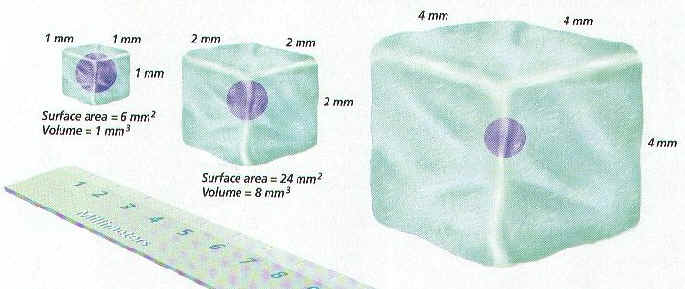
Cells are limited in how large they can be. This is because the surface area and volume ratio does not stay the same as their size increases. Because of this, it is harder for a large cell to pass materials in and out of the membrane, and to move materials through the cell.
In this lab, you will make cube shaped models to represent cells. The dimension along one side will be doubled with each model. You will then calculate the surface area, volume, and the ratio between the two.

MATERIALS:

Scissors
Construction paper
Tape
Metric ruler

PROCEDURE:

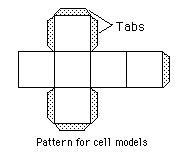
1. Construct three cell models like the pattern shown. The dimensions of a side will double each time, with the sides being 2 cm, 4 cm, and 8 cm. Fold and tape into cubes with the tabs to the inside. Record the dimensions in the DATA TABLE (the first one is done for you in the table).


DATA TABLE: Cell Size Comparison

Cell Dimensions
(cm)
Surface Area
(cm2)
Volume
(cm3)
Ratio
Surface area to Volume
1 2 X 2 X 2
2
3


CALCULATIONS:

2. Calculate the total surface area for each cell model by the following formula:

surface area = (Length X Width) X 6 sides


Record the surface areas in the DATA TABLE.

3. Calculate the volumes for each cell model by the following formula:

volume = length X width X height


Record the volumes in the DATA TABLE.

4. Calculate the surface area-to-volume ratio for each cell model by the following formula:

ratio = surface area
volume


Record the ratio values in the DATA TABLE.
These ratios show how many times larger the surface area is as compared to the volume. Notice that it becomes less than one very quickly.

QUESTIONS:

1. Which model has the largest surface area?

2. Which model has the largest volume?

3. Which model has the largest ratio?

4. To maintain life, and carry-out cellular functions, materials must be able to move into and out of the cell. Also, material needs to be able to move within the cell. What might be the advantage of having a large surface area?


5. What might be the disadvantage of having a large volume?


Cell Structure and Function Assi


Cell Structure and Function Assignment


Project Due – Tuesday, June 28

Instructions:

  1. Draw and color EACH CELL or CELL ORGANELLE on a separate sheet of unlined paper. BE SURE TO CENTER YOUR DRAWING ON THE PAGE!
  2. At the top of each page, CENTER and WRITE THE NAME of the cell or organelle that you are drawing.
  3. LABEL all parts of the cell and/or organelle.
  4. WRITE the function of EACH LABELED PART (FUNCTION MUST BE WRITTEN NEXT TO THE LABEL).
DRAWINGS:

  1. Prokaryote diagram
  2. Animal Cell Diagram
  3. Plant Cell Diagram
  4. Nucleus & Nucleolus Diagram
  5. Rough and Smooth Endoplasmic Reticulum Diagram
  6. Golgi Diagram
  7. Chloroplast Diagram
  8. Mitochondria Diagram
  9. Lysosome Diagram
  10. Cell Membrane Diagram

Cell Worksheet Ch4 BI


Cells


Section 4-1 Introduction to the Cell

1. What is a cell?

2. Who was the first person to use a simple microscope and view microscopic organisms?

3.. What English scientist was first to view dead plant cells?

4. State the 3 parts to the cell theory.

5. Tell how each of these scientists contributed to the cell theory — Matthias Schleiden, Theodor Schwann, and Rudolf Virchow.

6. Give 3 ways that cells are not alike.

7. What is one of the longest animal cells?

8. Explain why cells are limited in how large they can grow.

9. The shape of a cell reflects its ______________________. Give an example of this.

10. Define organelle & tell what they do for a cell.

11. What surrounds the outside of all cells?

12. Where is the nucleus of a cell & what does it do?

13. What two characteristics do all eukaryotes share?

14. What type of cell is a bacterium?

15. Where is the genetic information (chromosome) of a bacterium found?

16. What are prokaryotes & are they in the same kingdom as eukaryotes?

Section 4-2 Parts of the Eukaryotic Cell

17. Why can cells not survive if they are totally isolated from their environment?

18. What controls what enters or leaves a cell?

19. Define selectively permeable.

20. Describe the phospholipid make up of cell membranes.

21. Cells are bathed in an aqueous environment. What does this mean?

22. Sketch the lipid bilayer of a cell showing the inside & outside of the cell. Be sure to label all parts of the membrane.

23. What is the difference between peripheral & integral proteins in the cell membrane?

24. What is the purpose of the carbohydrate tails attached to some integral proteins?

25. Do all integral proteins look alike? Explain.

26. Explain the fluid mosaic model of the cell membrane.

27. Name 12 organelles found in cells. (See table 4-2)

28. In what part of a cell are organelles found?

29. What is cytosol & what does it contain?

30. Name 3 organelles found in plant, but not animal cells. (See bottom of table 4-2)

31. What is the function of mitochondria? What energy molecule is made there?

32. Why do liver & muscle cells have more mitochondria than other types of cells?

33. Describe the outer covering of the mitochondria.

34. What are cristae & what is their purpose?

35. Mitochondria are able to reproduce inside cells because they have their own ___________.

36. What organelles are the most numerous inside cells?

37. What two things make up ribosomes & are ribosomes surrounded by membrane like other organelles?

38. Ribosomes are made inside the _______________ of a cell.

39. Ribosomes may remain unattached or __________ in cytosol or attach to what other organelle’s surface?

40. What organic compounds to ribosomes synthesize or make?

41. What does ER stand for & what is the ER in a cell?

42. What is the ER’s function?

43. Name the two types of ER inside cells.

44. What is on the surface of rough ER?

45. Rough ER synthesizes large amounts of _________________ for cells.

46. Give 3 functions of smooth ER.

47. What is the Golgi apparatus?

48. Golgi is a system of ________________ or flattened _____________.

49. How does the Golgi work with the endoplasmic reticulum of a cell?

50. What are lysosomes & what do they do?

51. Name 8 things that the enzymes inside lysosomes digest?

52. In what type of cells are lysosomes common? In what type of cell are they rare?

53. Where is the cytoskeleton & what is its function?

54. What are the two major components of the cytoskeleton?

55. How do microfilaments & microtubules differ from each other?

56. What are spindle fibers & what are they made of?

57. What protein makes up microfilaments?

58. Compare cilia & flagella.

59. What is the purpose of the nuclear matrix?

60. What double membrane surrounds the nucleus?

61. Where is chromatin found & what 2 things is it made of?

62. When a cell is ready to divide, chromatin condenses & coils into _____________________.

63. What is the purpose of DNA inside the nucleus?

64. How do nuclear pores help RNA?

65. Where is the nucleolus found and what is made there?

66. Where is the cell wall in plants found, what is its function, and what is it made of?

67. What are the 2 types of cell walls in plants?

68. What is the difference between the primary & secondary cell walls?

69. What is found inside plant vacuoles?

70. What takes up much of the volume of plant cells? What happens to the other organelles?

71. How are plastids similar to mitochondria?

72. What is found inside of plastids?

73. Name the most familiar plastid & tell its function.

74. What are thylakoids?

Section 4-3 Multicellular Organization

75. Cells are organized into ______________________. Give an example.

76. What is an organ & give an example?

77. What forms organ systems?

78. The digestive system is an organ system. Name the organs that make up this system.

79. All the systems working together make up an ______________________ such as a plant or animal.

BACK


Cell Membrane PPT Qs BI


Transport Across Membranes
PowerPoint Questions

Membrane Structure

1. Cell membranes of unicellular organisms are ____________ so the organism can move.

2. What is meant by homeostasis?

3. Homeostasis is also called __________________.

4. How does the plasma membrane help maintain homeostasis?


5. Give 7 functions of the plasma membrane.

    a.

    b.

    c.

    d.

    e.

    f.

    g.

6. What is meant by the term selectively permeable?

7. What are cell junctions?

8. Fluid inside the cell is called _________________.

9. Label the plasma membrane (phospholipids, cholesterol, peripheral proteins, integral proteins, cytoskeleton, glcocalyx…)

10. A ________________ bilayer makes up most of the cell membrane.

11. Are phospholipids heads polar or nonpolar? the tails?

12. How many fatty acid chains are in a phospholipid?

13. Describe the heads of a phospholipid.

14. The __________ _____________ ___________ describes the appearance of the cell membrane.

15. Why is the cell membrane said to act like a fluid?


16. What causes the mosaic pattern of the cell membrane when viewed from above?

17. The phospholipid ____________ of the cell membrane allows ____________ molecules to pass through easily, but _________________ do NOT.

18. Materials soluble in __________ can pass easily through the cell membrane.

19. Because the cell membrane is ___________________, only ___________ molecules and larger _______________ molecules can move through easily.

20. List 3 substances that pass easily through the cell membrane.

21. _________, _____________ molecules larger than water, and large __________ molecules do NOT move easily through the phospholipids of the cell membrane.

Types of Membrane Transport

22. Simple ____________ requires NO energy to move things across the cell membrane.

23. With simple diffusion, molecules move from an area of ________ concentration to an area of ______ concentration.

24.Why is diffusion considered a passive process?

25. With diffusion, molecules move by their own natural __________ energy or energy of motion.

26.  Explain what happens to a drop of food coloring put into a beaker of water.


27. When solutes diffuse through a membrane, they move from __________ to _________ concentration.

28. __________ is the diffusion of _________ across a cell membrane.

29. If water potential is HIGH, solute concentration is __________.

30. If water potential is LOW, solute concentration is ___________.

31. Water moves from _________ water potential to ________ water potential.

32. Water diffuses through the pores called _____________ of the cell membrane.

33. Sketch a picture of a cell in an isotonic environment & show the direction of water movement?


34. What is meant by NO NET movement?

35. Sketch a picture of a cell in an Hypotonic environment & show the direction of water movement?


36. Sketch a picture of a cell in an hypertonic environment & show the direction of water movement?


37. Complete the following table:


Direction of Osmosis
Environmental Condition Net Movement of water What happens to cell
Hypotonic
Hypertonic
Isotonic


38. _____________ occurs whenever water moves out of a cell & the cell shrinks in size.

39. _____________ occurs whenever water moves into the cells causing them to swell and burst.

40. Explain what happens to a red blood cell placed in:

     a. distilled water

     b. a concentrated salt solution

41. Complete the following drawings.

42. Plants prefer ________________ environments, while animal cells do best in _____________ environments.

43. Describe these 3 types of movement across cell membranes.

     a. simple diffusion


     b. facilitated diffusion


    c. active transport


44. Passive transport does _______ require additional energy & moves materials from ________ to _________ concentration.

45. Give 2 examples of passive transport in cells.


46. ___________ diffusion is a type of __________ transport because energy is NOT required.

47. Facilitated diffusion uses _____________ proteins to help move materials from _________ to __________ concentrations.

48. Name 2 materials that move into or out of cells by facilitated diffusion.

49. name 2 types of transport proteins found in cell membranes.

50. Describe channel proteins.

51. How do carrier proteins help move materials across a cell membrane?

52. Channel proteins have an opening or ___________ through which molecules can passively move by _____________ diffusion.

53. Do all carrier proteins extend across the cell membrane?

54. Explain how these carrier proteins move materials across the membrane.


55. Some carrier proteins can change ________ to move materials across the cell membrane.

56. __________ transport requires additional energy to move materials.

57. Active transport uses cellular energy known as _________.

58. Active transport moves materials AGAINST the concentration gradient or from _________ to ___________ concentration.

59. The _______________ pump is an example of active transport.

60. The sodium-potassium pump moves _______ sodium ions out for every ______ potassium ions moved into the cell creating voltage across the cell called the ____________ potential.

61. Moving very large particles out of the cell is called _____________.

62. In exocytosis, wastes are moved out of the cell in ___________ that fuse with the cell membrane.

63. __________ involves moving large particles into the cell.

64. taking in large liquid droplets is called ____________ or “cell drinking”.

65. __________ ____________ endocytosis involves protein ____________ recognizing hormones to help move them into the cell.

66. How does cholesterol get into a cell?

67. “Cell eating” is known as ______________.

68. White blood cells engulfing bacteria is an example of _____________.

69. _____________ is the opposite of exocytosis.