Evolution Answers


Evolution Answers
    1. In biological terms, what is a species? a group of organisms that are similar in form and structure
      a group of organisms that can interbreed
      a group of organisms that share common features
      a group of organisms that have live in the same habitat
    2. What is the Scala Naturae? an idea proposed by Darwin that suggests that all organisms share a common ancestor
      an idea proposed by Plato that suggests organisms are all evolving toward an ideal form
      an idea proposed by Aristotle that suggests that all organisms fit into an orderly scheme
      an idea proposed by Wallace that suggests that organisms change over time
    3. Creationism is not accepted as a valid scientific theory because: it violates the scientific principle of natural causality
      it doesn’t offer a model to explain the diversity of life on earth
      it cannot be disproven
      all of these

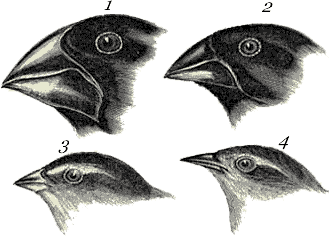
birds

    1. The picture of the finches is used to illustrate: phylogeny of finches
      change over time
      specialization of beaks for different diets
      natural selection
    2. Which of the following was not an observation made by Darwin on his voyages: penguins use wings to paddle instead of fly
      snakes have rudimentary hind limbs
      the earth is very old
      islands had species that did not exist on the mainland

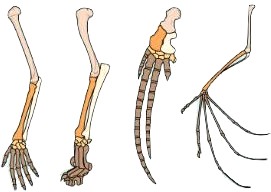
bones

    1. The image illustrates: vestigial structures
      homologous structures
      the fossil record
      natural selection
    2. Which of the following is an example of artificial selection: a panda’s thumb
      the breeding of dogs
      the galapagos finches
      a giraffe’s neck
    3. According to the theory of evolution by natural selection, which of the following is true: random mating is necessary for evolution to occur
      variation does not exist between members of the same species
      populations will change to better fit their environment
      individuals will adapt to their environment
    4. Which of the following are assumptions made with regards to the Theory of Evolution by Natural selection organisms compete with each other to survive
      variations exist among organisms
      not all organisms that are born survive to reproduce
      all of these

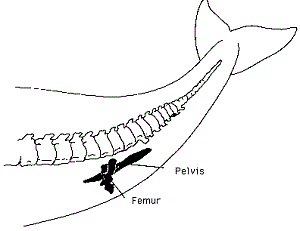
whale

    1. The image illustrates which of the following: artificial selection
      acquired characteristics
      homologous structures
      vestigial structures
    2. A panda’s thumb is considered an evolutionary contrivance because: it is assembled from wrist bones, and imperfect
      it is perfectly structured to grab leaves
      it is an structure that has no use
      none of these
    3. Which of the following outcomes would you predict for a population of bacteria exposed to a new antibiotic. over many generations, the bacteria would become resistant to the antibiotic
      over a few generations, the bacteria would evolve into Archaebacteria
      over a few generations, the bacteria would become extinct
      over many generations, the bacteria would become more susceptible to the antibiotic
    4. Which of the following is an example of convergent evolution: whales and sharks have similar body designs
      bees and hummingbirds have similar body designs
      bats and birds have similar body designs
      all of these
    5. Why is evolution called the “unifying theory of biology” because it explains the diversity of life on the planet
      because it serves as a model to predict how organisms will change
      it serves as a model to interpret relationships between organisms on the planet
      all of these

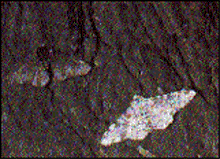
moths

  1. The image illustrates how peppered moths are related to other moths
    how peppered moths adapted to a changing environment
    how peppered moths became extinct
    how peppered moths became two species

Evolution BI Worksheet


EVOLUTION


Section 14-1     Biogenesis

1. Define biogenesis.


2. What is spontaneous generation & give an example. Can spontaneous generation occur?


3. Describe Redi’s experiment and its results.


4. Describe Spallanzani’s experiment and its results.


5. Did Redi & Spallanzani’s experiments disprove spontaneous generation? Explain.


6. Describe Pasteur’s experiment and its results. Did it prove or disprove spontaneous generation?


Section 14-2     Earth’s History

7. What is the estimated age of the earth?

8. a. What is radioactive dating, and how is it used to tell the age of materials?


b. Use a science dictionary to look up and explain relative dating of fossils.


9. What is meant by half-life?

10. Name 3 radioactive isotopes and give their half-life.


11. a. What 2 scientists set up an experiment that simulated the atmosphere of early earth?


b. What molecules were made during this experiment?


Section 14-3     The First Life Forms

12. Why was there no oxygen in the early atmosphere?


13. Were the 1st cells probably aerobic or anaerobic? Why?


14. What gases did the early atmosphere contain primarily?


15. What bacteria live in harsh environments containing methane gas?


16. Oxygen didn’t become part of our atmosphere until what process started taking place?


Section 15-1     Fossil Record

17. What is a fossil?

18. In what type of rock are fossils usually found?

19. What is sedimentary rock?

20. From what part or parts of organisms do sedimentary fossils usually form?


21. How do sedimentary fossils form?

22. How do casts form?


23. What do you call imprint fossils?

24. Complete insect fossils can be found inside of a clear, golden material called  ________________.
25. Who was one of the first scientists to study fossils?

26. In which rock layer or strata would the oldest fossils be found? The newest fossils?

27. Name the 4 eras of earth’s history in order beginning with the oldest & going to present day.


28. Which organisms appeared first in earth’s history?

29. Name the period in which each of these events occurred:
a. Humans appeared?
b. Mass extinction of dinosaurs?
c. Land plants appeared?
d. Birds appeared?
e. Fish appeared?
f. Reptiles appeared?
g. Modern mammals appeared?

30. What is true about fossils in the same rock layer or strata?

31. a. What is meant by mass extinction and give an example?


b. Has there been more than one mass extinction in earth’s history? Explain.


32. Radioactive isotopes are used to determine the ___________________ age of fossils.

Section 15-2     Theories of Evolution

33. What was Lamarck’s hypothesis about how species change?


34. What is meant by acquired trait?

35. What did Lamarck think had caused the webbed feet of water birds?


36. How did Lamarck think the offspring of these web-footed birds got their web-feet?


37. Can traits be passed in this way? Explain why or why not.


38. Was Lamarck’s idea of acquired traits proven or rejected?

39. Charles Darwin’s idea of how species change over time is called what?

40. Explain natural selection.


41. What other scientist came up with this same idea about evolution?

42. What was the name of the book that Darwin published with his ideas about evolution?

43. Explain how Darwin obtained all of his records & supporting evidence that led him to his theory of natural selection.


44. Describe the voyage of the H.M.S. Beagle.


45. What book did Darwin read that influenced his ideas when he sailed on the Beagle? Who was the author?

46. What unusual information did Darwin collect about the Galapagos finches on his voyage?


47. What forced Darwin to move ahead and publish his ideas?


48. State the 2 theories that sum up Darwin’s ideas about evolution & natural selection.


49. State Darwin’s Descent with Modification theory.


50. Darwin’s theory stated that all the Galapagos finches had descended from what?

51. State Darwin’s Modification by Natural Selection theory.


52. What idea, published in a book by Thomas Malthus, did Charles Darwin use?


53. According to Darwin, what limits the growth of populations?

54. How do populations of organisms adapt to their environment?


55. What is meant by the fitness of an organism?


Section 15-3     Evolution in Process

56. What are homologous structures and give an example?


57. What are analogous structures & give an example?


58. Which structures, homologous or analogous, show that organisms are more closely related?

59. What are vestigial structures & give an example?


60. Vestigial structures show __________________________ ancestry.

61. In the early stages, how do all vertebrate embryos compare with each other? What does this indicate?


62. Organisms with homologous (similar) _________________ & __________________ acids are probably more closely related.
63. What is co-evolution & give 2 examples of organisms that co-evolve?


64. Are a shark and a porpoise closely related? Explain your answer.


65. When does convergent evolution occur?


66. What is divergent evolution?


67. Divergent evolution usually results in new ________________________.

68. What is adaptive radiation & give an example?


69. How can adaptive radiation be sped up & give an example?


Section 16-1     Genetic Equilibrium

70. Do populations change quickly or slowly?

71. What is the study of evolution using genetics called?

72. Do individuals evolve?

73. Do populations evolve?

74. Variations in traits may be due to ___________________ factors or __________________.
75. Name the 3 ways variations in genotypes arise.


76. What is meant by the gene pool?

77. How many alleles exist for each trait in a gene pool?

78. How is allele frequency determined?


79. Determine the frequency of each allele in the following genotypes:
a. AA?
b. Aa?
c. aa?

80. How is phenotypic ratio determined?

81. What is the phenotypic frequency of white, pink, & red four-o-clocks in these crosses?
a. RR x rr ?
b. Rr x Rr ?
c. Rr x rr ?

82. The frequency of alleles or phenotypes in a cross must always add up to ______________.

83. What does the Hardy-Weinberg theory state about allele frequencies in a population?


84. List the 5 conditions that must hold true in the ideal population for Hardy-Weinberg to be correct.


85. Would the Hardy-Weinberg law apply to real populations?

Section 16-2    Disruption of Genetic Equilibrium
86. What effect does evolution have on a population’s genetic material?

87. Does evolution affect allele frequencies?
88. Any violations of the 5 conditions necessary for Hardy-Weinberg can result in _____________.

89. A change in genetic material is known as a _______________________.

90. Mutations occur constantly at _______________ rates unless an organism is exposed to ___________.

91. Most mutations are __________________, but some may be _____________________ & help the population evolve & survive.
92. Compare & contrast population immigration & emigration.


93. What is gene flow & give an example?


94. Does the Hardy-Weinberg law apply to small and medium sized populations?

95. What is genetic drift?


96. In what size populations does genetic drift apply & explain why?


97. Do all populations mate randomly? Explain.


98. What is the effect of matings of related individuals?


99. What is the most significant factor that affects genetic equilibrium?


100. Name the 4 types of natural selection & explain each.

a.

b.

c,

d.


101. Give an example of stabilizing selection using body size of lizards.


102. Give an example of directional selection using tongue length of anteaters.


103. Give an example of disruptive selection using limpets.


104. Explain the following — “genes of successful reproducers, rather than those of successful survivors, are amplified through natural selection.”


Section 16-3    Formation of Species

105. Do new species ever form? Do old species ever disappear? Explain your answer.


106. Define speciation.


107. Are all new species similar to their ancestral species? Explain.


108. What did scientists use for many years to help classify organisms?

109. What is morphology?

110. What are some limitations of using only morphology to identify organisms?


111. What is the biological species concept?


112. Does this concept help identify extinct species & why?


113. Members of a species are _________________similar & can __________________ to produce _____________________ offspring.
114. What does speciation begin with & does it affect mating?


115. Name 2 important types of isolation.

a.


b.


116. Define geographic isolation.


117. Give an example of how this type of isolation could occur.


118. What happens to the 2 subgroups after being geographically isolated from each other?


119. Define reproductive isolation.


120. Name & describe the 2 types of reproductive isolations.

a.


b.


121. Not recognizing mating calls or having different breeding times are examples of what type of isolation?

122. An infertile mule produced when a donkey and a horse mate is an example of ______________________ isolation.
123. Speciation often requires ______________________ of years.
124. Can some species form more quickly than others? Explain.


125. Does fossil record support a slow, gradual or more “instant” change in species?

126. A more “instant” formation or change occurs in ___________________, not millions of years.
127. What is this type of quicker species formation called?


128. What does punctuated equilibrium mean?



BACK


Evolution Myths


Myths About Evolution


Myth
Debunked
1. Charles Darwin developed the theory of evolution The theory of evolution existed before Darwin, it was Darwin’s Theory of Evolution by Natural Selection that became widely accepted.
2. Living things adapt to their environment As a whole, living things are adapted to their environment. Individuals are unchanging, they either live or die based on the traits they are born with.
3. Biologists “believe” in evolution. Science is not based on belief. The theory of evolution provides a model for scientists to understand the relationships between organisms on the planet.
4. Monkeys will eventually become human. There are many species of primates and all are adapted to their environment. A chimpanzee would not turn into a human over time anymore than a cheetah would turn into a lion (or vice versa)
5. Evolution is JUST a theory. Saying that it is “just” a theory implies that it is a guess, or that its not well supported. There is much evidence to support the theory of evolution, as well as direct observation of species change.
6. Only atheists accept the Theory of Evolution. Scientists of many religions across the world accept evolution, and do not find it incompatible with their faith.
7. If evolution is disproven, creationism must be true. A problem with logic (disconfirming evidence). Even if you disproved evolution, you would have to develop and support another model of organism diversity. Disproving one, doesn’t prove the other.
8. No one has ever seen evolution happen. In organisms that reproduce quickly (like bacteria) changes in species can be directly observed, such as resistances to antibiotics.
9. Order cannot come from disorder, so evolution is false. Many instances in nature show molecules and substance organizing, such requires energy. The sun provides the energy that ultimately fuels all of life’s processes.
10. There is evidence that dinosaurs lived with humans There is no evidence that suggests humans and dinosaurs lived at the same time.
11. Scientists regularly debate that evolution occurs. Scientists debate elements of evolution, relationships between organisms, and fossils. The only place the evolution debate really happens is in the social settings.
12. Creationism is a valid scientific theory and should be presented with evolution. Creationism violates the scientific principle of natural causality.
13. There are no transition fossils. Museums are filled with fossils that show intermediate species.
14. Carbon dating is not accurate, therefore the age of the earth cannot be determined. Carbon dating is one of many methods used to date the earth. Taken as a whole, the evidence is overwhelming that the earth is very old.


DNA Model


Structure of DNA Lab


Introduction:

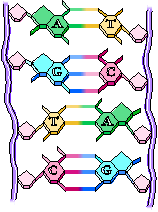
Deoxyribonucleic acid (DNA) is one of the two types of nucleic acids found in organisms and viruses. The structure of DNA determines which proteins particular cells will make. The general structure of DNA was determined in 1953 by James Watson and Francis Crick. The model of DNA that they constructed was made of two chains now referred to as the double helix. Each chain consists of linked deoxyribose sugars and phosphates units. The chains are complementary to each other. One of four nitrogen-containing bases connects the chains together like the rungs of a ladder. The bases are cytosine, guanine, thymine, and adenine. The DNA molecule looks like a spiral staircase. The structure of DNA is illustrated by a right handed double helix, with about 10 nucleotide pairs per helical turn.

DNA is a polymer. The monomer units of DNA are nucleotides. Each nucleotide consists of a 5-carbon sugar (deoxyribose), a nitrogen containing base attached to the sugar, and a phosphate group. (See Table 1.) There are four different types of nucleotides found in DNA, differing only in the nitrogenous base. Adenine and guanine are purines. Purines are the larger of the two types of bases found in DNA. They have two rings of carbons & nitrogens. Cytosine and thymine are pyrimidines and have a single carbon-nitrogen ring. (See Table 2.) The sequence of these bases encodes hereditary instructions for making proteins—which are long chains of amino acids. These proteins help build an organism, act as enzymes, and do much of the work inside cells.

Table 1


DNA Nucleotide
(Sugar + Phosphate + Base)


 Table 2


Pyrimidine
(single ring of C & N)
Purine
(double ring of C & N)


Materials:

Colored paper (any 5 different colors to run templates), scissors, transparent tape, coat hanger, hole punch, string or fishing line

Procedure:

  1. Use the section of DNA you have been assigned (Human hemoglobin or Chicken Hemoglobin), and figure out the sequence of bases present on the complementary strand of this molecule Table 1.


Human Hemoglobin Chicken Hemoglobin
Left Strand Complementary Strand Left Strand Complementary Strand
TAA GTT
TGT TGT
CGA CCG
CCG CCG
CTG CGA
GTC GTC
CAA TAT
GTC CGA
CTT TTG
TGA AGG


  1. Count the number of bases (A, T, C, and G) you will need for both strands of the DNA model your group has been assigned, and cut out these bases. (60 total)
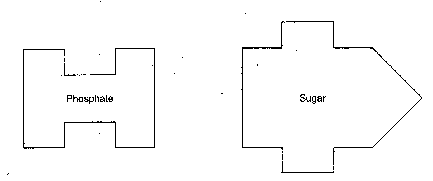
  2. Cut out a sugar and a phosphate for each of your DNA bases. (120 of each)
  3. Construct a nucleotide for each base that you have cut (sugar + phosphate + base) by taping these together. (20 total nucleotides)
  4. Using your assigned DNA sequence from Table 1, line up the nucleotides in the right order forming he left strand of your DNA molecule. (30 nucleotides)
  5. Add the other complementary nucleotides to form the right strand by taping the bases together (A bonds with T; C bonds with G).
  6. Once the strand is complete, secure it by adding more transparent tape or ask your teacher to laminate your model.
  7. Punch two holes at the top of your model, and attach the DNA model to a coat hanger with string.
  8. Carefully twist your model into a double helix (5 base pairs in a 1/2 turn and 10 in a complete turn).
  9. Attach thin fishing line to the sides of the nucleotides to hold the turns in place.
  10. Hang your model from the ceiling using the top of your coat hanger.

TEMPLATES:

Questions & Observations:

1. What 2 molecules make up the sides of the DNA molecule?

2. What nitrogen bases form the rungs of the DNA double helix?

3. What is meant by the complementary strand of DNA?


4. What sugar makes up DNA nucleotides?

5. How are nucleotides named?


6. DNA is the instructions for building what molecule in our cells?

7. What would happen if one or more bases on the DNA strand were changed?