
AP Lecture Guide 14 – Mendel and The Gene Idea

AP Biology: CHAPTER 14

 MENDEL AND THE GENE IDEA

1. How does the “blending hypothesis” differ from the “particulate hypothesis” for the

transmission of traits?

__________________________________________________________________________

__________________________________________________________________________

2. List a few of the advantages of Mendel’s choice of the garden pea as a model organism.

__________________________________________________________________________

__________________________________________________________________________

__________________________________________________________________________

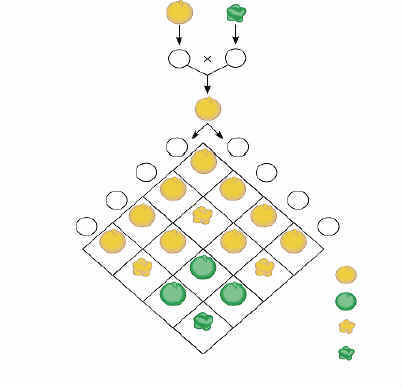
3. Use the diagram to label the generations: P, F1, F2, pure, hybrid, and make notes of Mendel’s observations.

5. Using the diagram in Question 3, describe how the Law of Segregation applies to the F1 and to the F2 generations.

__________________________________________________________________________

__________________________________________________________________________

6. When does the segregation of alleles occur? _____________________________________

7. What is the difference between an allele and a gene?

a. allele __________________________________________________________________

__________________________________________________________________________

b. gene __________________________________________________________________

__________________________________________________________________________

8. Briefly define the following terms:

a. homozygous ____________________________________________________________

b. heterozygous ___________________________________________________________

c. phenotype ______________________________________________________________

d. genotype _______________________________________________________________

9. What is the purpose of a test cross? ____________________________________________

__________________________________________________________________________

__________________________________________________________________________

10. When two traits are on different (non-homologous) chromosomes, how are they inherited?

__________________________________________________________________________

__________________________________________________________________________

a. Indicate the phenotypic ratios that result in the F2 from the F1 cross (dihybrid cross)
11. Use the rules of probability to determine the expected ratio of offspring showing two recessive traits in the trihybrid cross (PpYyRr X Ppyyrr).


12. Describe and give an example of incomplete dominance. ___________________________

__________________________________________________________________________

__________________________________________________________________________

13. How does codominance compare to incomplete dominance? ________________________

__________________________________________________________________________

__________________________________________________________________________

14. How is blood type an example of multiple alleles? _________________________________

__________________________________________________________________________

__________________________________________________________________________

15. Define and give an example of pleiotropy. _______________________________________

__________________________________________________________________________

16. Define and give an example of epistasis. ________________________________________

__________________________________________________________________________

17. What is observed when traits are polygenic? _____________________________________

__________________________________________________________________________

18. The expression of phenotypes is often a result of both… ____________________________

__________________________________________________________________________

19. Briefly describe each of the following genetic disorders:

a. Cystic fibrosis ___________________________________________________________

__________________________________________________________________________

b. Tay-Sachs _____________________________________________________________

__________________________________________________________________________

c. Sickle cell anemia _______________________________________________________

__________________________________________________________________________

d. Achondroplasia __________________________________________________________

__________________________________________________________________________

e. Huntington’s disease _____________________________________________________

__________________________________________________________________________

20. How can a parent learn the risks of having a child with a genetic disorder?

__________________________________________________________________________

AP Lecture Guide 20 – DNA Technology

AP Biology: Chapter 20

DNA TECHNOLOGY

1. Define biotechnology.

__________________________________________________________________________
__________________________________________________________________________
2. What is meant by “recombinant DNA technology?”

__________________________________________________________________________

__________________________________________________________________________

3. List some of the organisms we have been modifying for many hundreds of years.

__________________________________________________________________________

__________________________________________________________________________

4. Why are bacteria ideal workhorses for biotechnology?

__________________________________________________________________________

__________________________________________________________________________

5. What are other organisms used in biotechnology?

__________________________________________________________________________

__________________________________________________________________________

6. How does gene cloning differ from human cloning?

__________________________________________________________________________

__________________________________________________________________________

__________________________________________________________________________

7. Why is DNA cloning considered an important technology?

__________________________________________________________________________

__________________________________________________________________________

8. What are plasmids?

__________________________________________________________________________

__________________________________________________________________________

9. What is the function of restriction enzymes in bacteria?

__________________________________________________________________________

__________________________________________________________________________

10. How do bacteria protect their DNA from the effects of the restriction enzymes?

__________________________________________________________________________

__________________________________________________________________________

11. How do biologists make use of restriction enzymes?

__________________________________________________________________________

__________________________________________________________________________

12. What is a genomic library?

__________________________________________________________________________

__________________________________________________________________________

13. How is cDNA different from typical eukaryote DNA?

__________________________________________________________________________

__________________________________________________________________________

14. Describe the steps involved in cloning a gene.


15. How can transformed bacteria that carry genes of interest be identified and isolated from the majority of non-transformed bacteria?

__________________________________________________________________________

__________________________________________________________________________

__________________________________________________________________________

16. What can be accomplished with Nucleic Acid Hybridization?

__________________________________________________________________________

__________________________________________________________________________

__________________________________________________________________________

17. What is the purpose of the Polymerase Chain Reaction?

__________________________________________________________________________

__________________________________________________________________________

18. List some advantages & uses of the PCR technique.

__________________________________________________________________________

__________________________________________________________________________

__________________________________________________________________________

19. How are DNA fragments of different sizes separated?

__________________________________________________________________________

__________________________________________________________________________

20. What is a RFLP? How are they made?

__________________________________________________________________________

__________________________________________________________________________

__________________________________________________________________________

__________________________________________________________________________

21. What does the technique of Southern Blotting accomplish?

__________________________________________________________________________

__________________________________________________________________________

22. What are some other techniques that build on the Southern Blotting technique?

__________________________________________________________________________

__________________________________________________________________________

23. What was the goal of the Human Genome Project?

__________________________________________________________________________

__________________________________________________________________________

__________________________________________________________________________

24. List some of the most important things we learned by completing the Human Genome Project.

__________________________________________________________________________

__________________________________________________________________________

25. What is the Sanger Sequencing Method used for?

__________________________________________________________________________

__________________________________________________________________________

26. How does the shot-gun approach differ from the whole-genome sequencing?

__________________________________________________________________________

__________________________________________________________________________

__________________________________________________________________________

27. In the future, DNA chips may be used for regular diagnostics. What do the florescent spots indicate when the chip is read?

__________________________________________________________________________

__________________________________________________________________________

28. How can DNA technology be used to diagnose a carrier of a genetic disorder?

__________________________________________________________________________

__________________________________________________________________________

29. What is the goal of gene therapy?

__________________________________________________________________________

__________________________________________________________________________

30. How has forensics made use of DNA technology? Give a specific example.

__________________________________________________________________________

__________________________________________________________________________

__________________________________________________________________________

31. What is currently used by the FBI to do a DNA fingerprint in a criminal investigation?

__________________________________________________________________________

__________________________________________________________________________

__________________________________________________________________________

32. What technique has been used to modify agricultural plants?

__________________________________________________________________________

__________________________________________________________________________

33. List a few of the traits that have been engineered into agricultural plants? Could any of these

pose an environmental threat?

__________________________________________________________________________

__________________________________________________________________________

__________________________________________________________________________

AP Lecture Guide 22 – Descent with Modification


AP Biology: CHAPTER 22- DESCENT WITH MODIFICATION


1. Identify the three significant historical themes that set the stage for Darwinian evolutionary

theory.

__________________________________________________________________________

__________________________________________________________________________

2. What were the two major points made in The Origin of Species?

__________________________________________________________________________

__________________________________________________________________________

3. What were the conventional paradigms in the 1800’s when Darwin developed his theories?

__________________________________________________________________________

__________________________________________________________________________

4. What was the contribution of Carolus Linnaeus to the evolutionary theories?

__________________________________________________________________________

__________________________________________________________________________

5. How did the study of fossils help Darwin shape his theories?

__________________________________________________________________________

__________________________________________________________________________

6. How did geological gradualism and uniformitarianism influence Darwin?

__________________________________________________________________________

__________________________________________________________________________

7. Identify the two principles of Lamarck’s theory of evolution.

__________________________________________________________________________

__________________________________________________________________________

8. How did the observations during his voyage on the Beagle influence Darwin’s theories?

__________________________________________________________________________

__________________________________________________________________________

9. Why were the Galápagos Islands so important to Darwin’s observations?

__________________________________________________________________________

__________________________________________________________________________

10. What are the elements for the formation of new species?

__________________________________________________________________________

__________________________________________________________________________

11. What is the driving force behind the evolution of the 14 species of finches on the

Galapagos?

__________________________________________________________________________

__________________________________________________________________________

12. What was Wallace’s role in the Theory of Natural Selection?

__________________________________________________________________________

__________________________________________________________________________

13. What were the main points of The Origin of Species?

__________________________________________________________________________

__________________________________________________________________________

14. Define Descent with Modification.

__________________________________________________________________________

__________________________________________________________________________

15. How does the “tree analogy” represent the evolutionary relationships of creatures?

__________________________________________________________________________

__________________________________________________________________________

16. Summarize the observations and inferences recognized as the backbone of evolution by

natural selection.

__________________________________________________________________________

__________________________________________________________________________

__________________________________________________________________________

17. Observations:

a. ______________________________________________________________________

b. ______________________________________________________________________

c. ______________________________________________________________________

d. ______________________________________________________________________

e. ______________________________________________________________________

18. Inferences:

a. ______________________________________________________________________

b. ______________________________________________________________________

c. ______________________________________________________________________

19. How did Darwin’s experience with artificial selection influence his theories of evolution?

__________________________________________________________________________

__________________________________________________________________________

20. For each of the following, indicate how it is used as evidence of evolution by natural

selection.

a. Paleontology ____________________________________________________________

__________________________________________________________________________

b. Biogeography ___________________________________________________________

__________________________________________________________________________

c. Resistance to insecticides _________________________________________________

__________________________________________________________________________

d. Drug Resistance _________________________________________________________

__________________________________________________________________________

e. Homology ______________________________________________________________

__________________________________________________________________________

f. Homologous structures ___________________________________________________

__________________________________________________________________________

g. Vestigial organs _________________________________________________________

__________________________________________________________________________

h. Embryology ____________________________________________________________

__________________________________________________________________________

i. Biochemical similarity _____________________________________________________

__________________________________________________________________________


AP Genetics Problems


Genetics Problems

1. A rooster with gray feathers is mated with a hen of the same phenotype. Among their offspring, 15 chicks are gray, 6 are black, and 8 are white.

  • What is the simplest explanation for the inheritance of these colors in chickens?
  • What offspring would you predict from the mating of a gray rooster and a black hen?

2. In some plants, a true-breeding, red-flowered strain gives all pink flowers when crossed with a white-flowered strain: RR (red) x rr (white) —> Rr (pink). If flower position (axial or terminal) is inherited as it is in peas what will be the ratios of genotypes and phenotypes of the generation resulting from the following cross: axial-red (true-breeding) x terminal-white? What will be the ratios in the F2 generation?

3. Flower position, stem length, and seed shape were three characters that Mendel studied. Each is controlled by an independently assorting gene and has dominant and recessive expression as follows:


Character Dominant Recessive
Flower position Axial (A ) Terminal (a )
Stem length Tall (T ) Dwarf (t )
Seed shape Round (R ) Wrinkled (r)


If a plant that is heterozygous for all three characters were allowed to self-fertilize, what proportion of the offspring would be expected to be as follows: (Note – use the rules of probability (and show your work) instead of huge Punnett squares)

  1. homozygous for the three dominant traits
  2. homozygous for the three recessive traits
  3. heterozygous
  4. homozygous for axial and tall, heterozygous for seed shape

4. A black guinea pig crossed with an albino guinea pig produced 12 black offspring. When the albino was crossed with a second one, 7 blacks and 5 albinos were obtained.

  • What is the best explanation for this genetic situation?
  • Write genotypes for the parents, gametes, and offspring.

5. In sesame plants, the one-pod condition (P ) is dominant to the three-pod condition (p ), and normal leaf (L ) is dominant to wrinkled leaf (l) . Pod type and leaf type are inherited independently. Determine the genotypes for the two parents for all possible matings producing the following offspring:

  1. 318 one-pod normal, 98 one-pod wrinkled
  2. 323 three-pod normal, 106 three-pod wrinkled
  3. 401 one-pod normal
  4. 150 one-pod normal, 147 one-pod wrinkled, 51 three-pod normal, 48 three-pod wrinkled
  5. 223 one-pod normal, 72 one-pod wrinkled, 76 three-pod normal, 27 three-pod wrinkled

6. A man with group A blood marries a woman with group B blood. Their child has group O blood.

  • What are the genotypes of these individuals?
  • What other genotypes and in what frequencies, would you expect in offspring from this marriage?

7. Color pattern in a species of duck is determined by one gene with three alleles. Alleles H and I are codominant, and allele i is recessive to both. How many phenotypes are possible in a flock of ducks that contains all the possible combinations of these three alleles?

8. Phenylketonuria (PKU) is an inherited disease caused by a recessive allele. If a woman and her husband are both carriers, what is the probability of each of the following?

  1. all three of their children will be of normal phenotype
  2. one or more of the three children will have the disease
  3. all three children will have the disease
  4. at least one child out of three will be phenotypically normal

(Note: Remember that the probabilities of all possible outcomes always add up to 1)

9. The genotype of F1 individuals in a tetrahybrid cross is AaBbCcDd. Assuming independent assortment of these four genes, what are the probabilities that F2 offspring would have the following genotypes?

  1. aabbccdd
  2. AaBbCcDd
  3. AABBCCDD
  4. AaBBccDd
  5. AaBBCCdd

10. In 1981, a stray black cat with unusual rounded curled-back ears was adopted by a family in California. Hundreds of descendants of the cat have since been born, and cat fanciers hope to develop the “curl” cat into a show breed. Suppose you owned the first curl cat and wanted to develop a true breeding variety.

  • How would you determine whether the curl allele is dominant or recessive?
  • How would you select for true-breeding cats?
  • How would you know they are true-breeding?

11. What is the probability that each of the following pairs of parents will produce the indicated offspring (assume independent assortment of all gene pairs?

  1. AABbCc x aabbcc —-> AaBbCc
  2. AABbCc x AaBbCc —–> AAbbCC
  3. AaBbCc x AaBbCc —–> AaBbCc
  4. aaBbCC x AABbcc —-> AaBbCc

12. Karen and Steve each have a sibling with sickle-cell disease. Neither Karen, Steve, nor any of their parents has the disease, and none of them has been tested to reveal sickle-cell trait. Based on this incomplete information, calculate the probability that if this couple should have another child, the child will have sickle-cell anemia.

13. Imagine that a newly discovered, recessively inherited disease is expressed only in individuals with type O blood, although the disease and blood group are independently inherited. A normal man with type A blood and a normal woman with type B blood have already had one child with the disease. The woman is now pregnant for a second time. What is the probability that the second child will also have the disease? Assume both parents are heterozygous for the “disease” gene.

14. In tigers, a recessive allele causes an absence of fur pigmentation (a “white tiger”) and a cross-eyed condition. If two phenotypically normal tigers that are heterozygous at this locus are mated, what percentage of their offspring will be cross-eyed? What percentage will be white?

15. In corn plants, a dominant allele I inhibits kernel color, while the recessive allele i permits color when homozygous. At a different locus, the dominant gene P causes purple kernel color, while the homozygous recessive genotype pp causes red kernels. If plants heterozygous at both loci are crossed, what will be the phenotypic ratio of the F1 generation?

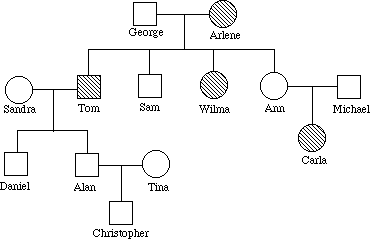
16. The pedigree below traces the inheritance of alkaptonuria, a biochemical disorder. Affected individuals, indicated here by the filled-in circles and squares, are unable to break down a substance called alkapton, which colors the urine and stains body tissues. Does alkaptonuria appear to be caused by a dominant or recessive allele? Fill in the genotypes of the individuals whose genotypes you know. What genotypes are possible for each of the other individuals?

 
17. A man has six fingers on each hand and six toes on each foot. His wife and their daughter have the normal number of digits (5). Extra digits is a dominant trait. What fraction of this couple’s children would be expected to have extra digits?

18. Imagine you are a genetic counselor, and a couple planning to start a family came to you for information. Charles was married once before, and he and his first wife had a child who has cystic fibrosis. The brother of his current wife Elaine died of cystic fibrosis. What is the probability that Charles and Elaine will have a baby with cystic fibrosis? (Neither Charles nor Elaine has the disease)

19. In mice, black color (B ) is dominant to white (b ). At a different locus, a dominant allele (A ) produces a band of yellow just below the tip of each hair in mice with black fur. This gives a frosted appearance known as agouti. Expression of the recessive allele (a ) results in a solid coat color. If mice that are heterozygous at both loci are crossed, what will be the expected phenotypic ratio of their offspring?

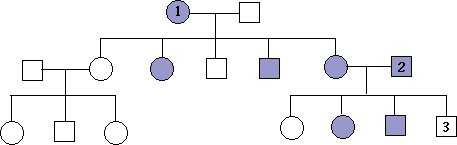
20. The pedigree below traces the inheritance of a vary rare biochemical disorder in humans. Affected individuals are indicated by filled-in circles and squares. Is the allele for this disorder dominant or recessive? What genotypes are possible for the individuals marked 1, 2, and 3.


Solutions

Genetic Problems Solutions Campbell Ch14


Genetics Problems Campbell
1. A man with hemophilia (a recessive , sex-linked condition has a daughter of normal phenotype. She marries a man who is normal for the trait. What is the probability that a daughter of this mating will be a hemophiliac? A son? If the couple has four sons, what is the probability that all four will be born with hemophilia?

Solution


2. Pseudohypertropic muscular dystrophy is a disorder that causes gradual deterioration of the muscles. It is seen only in boys born to apparently normal parents and usually results in death in the early teens. (a) Is pseudohypertrophic muscular dystrophy caused by a dominant or recessive allele? (b) Is its inheritance sex-linked or autosomal? (c) How do you know? Explain why this disorder is always seen in boys and never girls.

Solution

3. Red-green color blindness is caused by a sex-linked recessive allele. A color-blind man marries a woman with normal vision whose father was color-blind. (a) What is the probability that they will have a color-blind daughter? (b) What is the probability that their first son will be color-blind? (Note: the two questions are worded a bit differently.)

Solution

4. A wild-type fruit fly (heterozygous for gray body color and normal wings was mated with a black fly with vestigial wings. The offspring had the following phenotypic distribution: wild type, 778; black-vestigial, 785; black-normal, 158; gray-vestigial, 162. What is the recombination frequency between these genes for body color and wing type.

Solution

5. In another cross, a wild-type fruit fly (heterozygous for gray body color and red eyes) was mated with a black fruit fly with purple eyes. The offspring were as follows: wild-type, 721; black-purple, 751; gray-purple, 49; black-red, 45. (a) What is the recombination frequency between these genes for body color and eye color? (b) Following up on this problem and problem 4, what fruit flies (genotypes and phenotypes) would you mate to determine the sequence of the body color, wing shape, and eye color genes on the chromosomes?

Solution

6. A space probe discovers a planet inhabited by creatures who reproduce with the same hereditary patterns as those in humans. Three phenotypic characters are height (T = tall, t = dwarf), hearing appendages (A = antennae, a = no antennae), and nose morphology (S = upturned snout, s = downturned snout). Since the creatures were not “intelligent” Earth scientists were able to do some controlled breeding experiments, using various heterozygotes in testcrosses. For a tall heterozygote with antennae, the offspring were tall-antennae, 46; dwarf-antennae 7; dwarf-no antennae 42; tall-no antennae 5. For a heterozygote with antennae and an upturned snout, the offspring were antennae-upturned snout 47; antennae-downturned snout, 2; no antennae-downturned snout, 48: no antennae-upturned snout 3. Calculate the recombination frequencies for both experiments.

Solution

7. Using the information from problem 6, a further testcross was done using a heterozygote for height and nose morphology. The offspring were tall-upturned nose, 40; dwarf-upturned nose, 9; dwarf-downturned nose, 42; tall-downturned nose, 9. Calculate the recombination frequency from these data; then use your answer from problem 6 to determine the correct sequence of the three linked genes.

Solution

8. Imagine that a geneticist has identified two disorders that appear to be caused by the same chromosomal defect and are affected by genomic imprinting: blindness and numbness of the limbs. A blind woman (whose mother suffered from numbness) has four children, two of whom, a son and daughter, have inherited the chromosomal defect. If this defect works like Prader-Willi and Angelman syndromes, what disorders do this son and daughter display? What disorders would be seen in their sons and daughters?

Solution

9. What pattern of inheritance would lead a geneticist to suspect that an inherited disorder of cell metabolism is due to a defective mitochondrial gene?

Solution

10. An aneuploid person is obviously female, but her cells have two Barr bodies. what is the probable complement of sex chromosomes in this individual?

Solution

11. Determine the sequence of genes along a chromosome based on the following recombination frequencies: A-B, 8 map units; A-C, 28 map units; A-D, 25 map units; B-C , 20 map units; B-D, 33 map units.

Solution

12. About 5% of individuals with Downs syndrome are the result of chromosomal translocation. In most of these cases, one copy of chromosome 21 becomes attached to chromosome 14. How does this translocation lead to children with Down syndrome?

Solution

13. Assume genes A and B are linked and are 50 map units apart. An individual heterozygous at both loci is crossed with an individual who is homozygous recessive at both loci. (a) What percentage of the offspring will show phenotypes resulting from crossovers? (b) If you did not know genes A and B were linked, how would you interpret the results of this cross?

Solution

14. In Drosophila, the gene for white eyes and the gene that produces “hairy” wings have both been mapped to the same chromosome and have a crossover frequency of 1.5%. A geneticist doing some crosses involving these two mutant characteristics noticed that in a particular stock of flies, these two genes assorted independently; that is they behaved as though they were on different chromosomes. What explanation can you offer for this observation?

Solution


BACK