Genetics Problems ppt Questions

Genetics Problems
ppt Questions


Independent Assortment

1. How many different kinds of gametes could the following individuals produce? Remember the formula 2n where n equals the number of heterozygotes.

     a. aaBb

     b. CCDdee

     c. AABbCcDD

     d. MmNnOoPpQq

     e. UUVVWWXXYYZz


P1, F1, and F2 Monohybrid Crosses

2. In dogs, wire-haired is due to a dominant gene (W), smooth-haired is due to its recessive allele (w). Show the results of crossing a homozygous wire-haired dog with a smooth-haired dog.


3. What kind of cross is this?

4. What was the genotype of all of the puppies? the phenotype?


5. The puppies belong to the _________ generation.

6. How would you write the F1 cross for this trait?

7. Show the results of working the F1 cross for this trait.


6. What phenotypic ratio did you get from this F1 cross?

7. What genotypic ratio did you get from this F1 cross?

8. Two wire-haired dogs are mated. Among the offspring of their first litter is a smooth-haired pup. If these two dogs mate again, what are the chances of them having another smooth-haired pup?


9. What are the chances that the pup will be wire-haired?


10. A Wire-haired male is mated with a smooth-haired female. The mother of the wire-haired male was smooth-haired. What are the phenotypes and genotypes of the pups they could produce? Show how you got your results.


Incomplete Dominance 

11. In snapdragons, red flower color (R) is incompletely dominant over white flower color (r). The hybrids or heterozygous plants (Rr) are pink in color. Show the genotype for a white flower and for a red flower.


12. If a red-flowered plant is crossed with a white-flowered plant, what are the genotypes and phenotypes of the F1 generation plants? Show your work.


13. What is the phenotype of the flowers? what is their genotype?


14. What genotypes and phenotypes will be produced in the F2 generation? Show your work.


15. How did the genotypic and phenotypic ratio compare to each other in this incomplete dominance cross?

16. What would the phenotypic ratio have been if this had been complete dominance?

17. What kind of offspring can be produced if a red-flowered plant is crossed with a pink-flowered plant? Show your work.


18. What kind of offspring is/are produced if a pink-flowered plant is crossed with a white-flowered plant? Show your work.


Sex-linked Traits

19. What is the genotype for female?  for male?

20. In humans, colorblindness (Xc) is a recessive sex-linked trait. Two people with normal color vision (XC) have a colorblind son. What are the genotypes of the parents?


21. What are the genotypes and phenotypes possible among their other children? Show your work.


22. A couple has a colorblind daughter. What are the possible genotypes and phenotypes of the parents and the daughter?


Dihybrid Crosses

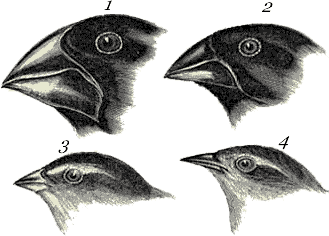
23. In humans, the presence of freckles is due to a dominant gene (F) and the non-freckled condition is due to its recessive allele (f). Dimpled cheeks (D) are dominant to non-dimpled cheeks (d). Two persons with freckles and dimpled cheeks have two children. One child has freckles but no dimples. The other child has dimples but no freckles. What is the genotypes of the parents? the children?


24. What are the possible phenotypes and genotypes of the children that they could produce? Show all your work.


25. What phenotypic ratio did you get?

26. What genotypic ratio did you get?

27. What are the chances that they would have a child whom lacks both freckles and dimples?  What would be the child’s genotype?


28. A person with freckles and dimples whose mother lacked both freckles and dimples marries a person with freckles but no dimples whose father did not have freckles or dimples. What are the chances that they would have a child whom lacks both freckles and dimples? Show the genotypes of the parents and all the offspring.


29. In dogs, the inheritance of hair color involves a gene (B) for black hair and a gene (b) for brown hair. A dominant (C) is also involved. It must be present for the color to be synthesized (made). If this gene is NOT present, a blond condition results. Complete the following table:


Genotype Phenotype Color Deposition gene
BB or Bb CC or Cc
bb CC or Cc
BB or Bb cc
bb cc


30. A brown-haired male, whose father was a blond, is mated with a black-haired female ,whose mother was brown-haired and her father was blond. What is the genotype of the man and woman? Show the genotypes and phenotypes of all of their offspring.


Population Genetics or Hardy-Weinberg Law

Sixteen percent (16%) of the human population is known to be able to wiggle their ears. This trait is determined to be a recessive gene. Use the following equations to answer this population genetics problem:

1 = p2 + 2pq + q2                                      then use 1 = p + q

p2 – frequency of homozygous dominants

2pq – frequency of heterozygotes

q2 – frequency of homozygous recessives

p – frequency of dominant allele

q – frequency of recessive allele

31. What percent of the population is homozygous dominant for this trait? Show your work.


32. What percent of the population is heterozygous for this trait? Show your work.


Multiple Alleles – ABO Blood Type 

33. Henry Anonymous, a film star, was involved in a paternity case. The woman bringing the suit had two children. One child had blood type A and the other child had blood type B. Her blood type was O, the same as Henry’s. The judge in the case awarded damages to the woman, saying that Henry had to be the father of at least one of her children. was the judge correct in his decision? Show how you got your answer.




Genetics Study Guide

Genetics Study Guide 

The two genes or alleles that combine to determine a trait would be the organism’s _______________.
Type AB blood, having two genes dominant for a trait, is an example of ________.
State Mendel’s law of segregation.
Rr x Rr is an example of what type of cross —– P1, F1, or F2?
If both alleles are the same in a genotype, is the genotype homozygous or heterozygous?
Which cross is a cross between two hybrids —– P1, F1, or F2?
__________ dominance results in the blending of genes in the hybrid. Give an example using flower color.
What is another term for a heterozygous genotype?
The _____________ is the physical feature such as round peas that results from a genotype.
How many traits are involved in a monohybrid cross?
What type of organism was used in the first genetic studies done by Gregor Mendel?
What is a karyotype?
The two genes for a trait represented by capital & lower case letters are called __________.
How many traits are involved in a dihybrid cross?
Which of Mendel’s laws states that the dominant gene in a pair will be expressed?
If both alleles are the same, is the genotype homozygous or heterozygous? Write an example.
Write an example of a hybrid or heterozygous genotype.
The genes for sex-linked traits are only carried on which chromosome?
Who is considered to be the “father of genetics”?
A second filial or F2 cross is also called a ____________ cross.
The failure of chromosomes to separate during meiosis (egg & sperm formation) is known as _________________.
A cross between two pure or homozygous organisms is called what type of cross —– P1, F1, or F2?
What genetic disorder results from a sex-linked trait that affects color vision?
The genetic disorder called _______________ is known as the “free bleeders” disease.
Having three 21st chromosomes causes the genetic disorder known as _________.
A person suffering from the genetic disorder called ______________ can not digest fats.
_____________________ disease is a genetic disorder where red blood cells carry less oxygen.
Work a P1 cross for plant height in peas.
Work an F1 cross for plant height in peas.
BACK


Hardy-Weinberg Problems


POPULATION GENETICS AND THE HARDY-WEINBERG LAW


The Hardy-Weinberg formulas allow scientists to determine whether evolution has occurred. Any changes in the gene frequencies in the population over time can be detected. The law essentially states that if no evolution is occurring, then an equilibrium of allele frequencies will remain in effect in each succeeding generation of sexually reproducing individuals. In order for equilibrium to remain in effect (i.e. that no evolution is occurring) then the following five conditions must be met:

  1. No mutations must occur so that new alleles do not enter the population.
  2. No gene flow can occur (i.e. no migration of individuals into, or out of, the population).
  3. Random mating must occur (i.e. individuals must pair by chance)
  4. The population must be large so that no genetic drift (random chance) can cause the allele frequencies to change.
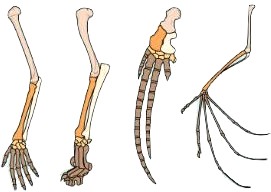
  5. No selection can occur so that certain alleles are not selected for, or against.

Obviously, the Hardy-Weinberg equilibrium cannot exist in real life. Some or all of these types of forces all act on living populations at various times and evolution at some level occurs in all living organisms. The Hardy-Weinberg formulas allow us to detect some allele frequencies that change from generation to generation, thus allowing a simplified method of determining that evolution is occurring. There are two formulas that must be memorized:


p2 + 2pq + q2 = 1 and p + q = 1


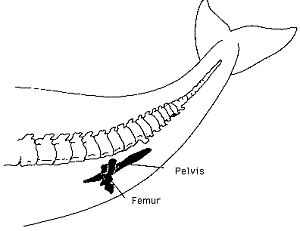
p = frequency of the dominant allele in the population
q = frequency of the recessive allele in the population
p2 = percentage of homozygous dominant individuals
q2 = percentage of homozygous recessive individuals
2pq = percentage of heterozygous individuals

Individuals that have aptitude for math find that working with the above formulas is ridiculously easy. However, for individuals who are unfamiliar with algebra, it takes some practice working problems before you get the hang of it. Below I have provided a series of practice problems that you may wish to try out. Note that I have rounded off some of the numbers in some problems to the second decimal place.

PROBLEM #1    You have sampled a population in which you know that the percentage of the homozygous recessive genotype (aa) is 36%. Using that 36%, calculate the following:

  1. The frequency of the “aa” genotype.
  2. The frequency of the “a” allele.
  3. The frequency of the “A” allele.
  4. The frequencies of the genotypes “AA” and “Aa.”
  5. The frequencies of the two possible phenotypes if “A” is completely dominant over “a.”

PROBLEM #2.    Sickle-cell anemia is an interesting genetic disease. Normal homozygous individuals (SS) have normal blood cells that are easily infected with the malarial parasite. Thus, many of these individuals become very ill from the parasite and many die. Individuals homozygous for the sickle-cell trait (ss) have red blood cells that readily collapse when deoxygenated. Although malaria cannot grow in these red blood cells, individuals often die because of the genetic defect. However, individuals with the heterozygous condition (Ss) have some sickling of red blood cells, but generally not enough to cause mortality. In addition, malaria cannot survive well within these “partially defective” red blood cells. Thus, heterozygotes tend to survive better than either of the homozygous conditions. If 9% of an African population is born with a severe form of sickle-cell anemia (ss), what percentage of the population will be more resistant to malaria because they are heterozygous (Ss) for the sickle-cell gene?

PROBLEM #3.    There are 100 students in a class. Ninety-six did well in the course whereas four blew it totally and received a grade of F. Sorry. In the highly unlikely event that these traits are genetic rather than environmental, if these traits involve dominant and recessive alleles, and if the four (4%) represent the frequency of the homozygous recessive condition, please calculate the following:

  1. The frequency of the recessive allele.
  2. The frequency of the dominant allele.
  3. The frequency of heterozygous individuals.

PROBLEM #4.    Within a population of butterflies, the color brown (B) is dominant over the color white (b). And, 40% of all butterflies are white. Given this simple information, which is something that is very likely to be on an exam, calculate the following:

  1. The percentage of butterflies in the population that are heterozygous.
  2. The frequency of homozygous dominant individuals.

PROBLEM #5.     A rather large population of Biology instructors have 396 red-sided individuals and 557 tan-sided individuals. Assume that red is totally recessive. Please calculate the following:

  1. The allele frequencies of each allele.
  2. The expected genotype frequencies.
  3. The number of heterozygous individuals that you would predict to be in this population.
  4. The expected phenotype frequencies.
  5. Conditions happen to be really good this year for breeding and next year there are 1,245 young “potential” Biology instructors. Assuming that all of the Hardy-Weinberg conditions are met, how many of these would you expect to be red-sided and how many tan-sided?

PROBLEM #6.    A very large population of randomly-mating laboratory mice contains 35% white mice. White coloring is caused by the double recessive genotype, “aa”. Calculate allelic and genotypic frequencies for this population.

PROBLEM #7.    After graduation, you and 19 of your closest friends (lets say 10 males and 10 females) charter a plane to go on a round-the-world tour. Unfortunately, you all crash land (safely) on a deserted island. No one finds you and you start a new population totally isolated from the rest of the world. Two of your friends carry (i.e. are heterozygous for) the recessive cystic fibrosis allele (c). Assuming that the frequency of this allele does not change as the population grows, what will be the incidence of cystic fibrosis on your island?

PROBLEM #8.    You sample 1,000 individuals from a large population for the MN blood group, which can easily be measured since co-dominance is involved (i.e., you can detect the heterozygotes). They are typed accordingly:


BLOOD TYPE GENOTYPE NUMBER OF INDIVIDUALS RESULTING FREQUENCY
M MM 490 0.49
MN MN 420 0.42
N NN 90 0.09


Using the data provide above, calculate the following:

  1. The frequency of each allele in the population.
  2. Supposing the matings are random, the frequencies of the matings.
  3. The probability of each genotype resulting from each potential cross.

PROBLEM #9.    Cystic fibrosis is a recessive condition that affects about 1 in 2,500 babies in the Caucasian population of the United States. Please calculate the following:

  1. The frequency of the recessive allele in the population.
  2. The frequency of the dominant allele in the population.
  3. The percentage of heterozygous individuals (carriers) in the population.

PROBLEM #10.    In a given population, only the “A” and “B” alleles are present in the ABO system; there are no individuals with type “O” blood or with O alleles in this particular population. If 200 people have type A blood, 75 have type AB blood, and 25 have type B blood, what are the allelic frequencies of this population (i.e., what are p and q)?

PROBLEM #11.    The ability to taste PTC is due to a single dominate allele “T”. You sampled 215 individuals in biology, and determined that 150 could detect the bitter taste of PTC and 65 could not. Calculate all of the potential frequencies.

ANSWERS

Evolution PPT Questions


Evolution
ppt Questions

History of Evolutionary Thought

1. What were Aristotle’s early ideas about life on Earth?


2. How long did these ideas last?

3. What was Linnaeus first to do?


4. What language is used for scientific naming?

5. What are the two words called in a scientific name?

6. This naming system is known as ____________ ______________.

7. Name the contribution that each of these men made to Darwin’s ideas on evolution:

     a. Charles Lyell

     b. George Cuvier

     c. Thomas Malthus

     d. James Hutton

     e. Lamarck

     f. Wallace

8. Which was published first – the Origin 0f Species by Darwin or Gregor Mendel’s papers on inheritance?

9. What was the name of George Cuvier’s theory on evolution?

10. What did Cuvier study in Paris and what did he find?


11. What did Cuvier decide was responsible for the disappearance of some species?


12. James ___________ was a Scottish _________ who studied fossils of _____________ in the Paris Museum.

13. Hutton’s ideas were known as _____________.

14. Briefly state Hutton’s idea on geological change.


15. Lyell proposed the theory of _________________.

16. Describe uniformitarianism.


17. How old did Lyell propose that the Earth was? How old did most people at this time believe the Earth was?

18. How did reading Lyell’s book help darwin on his voyage on the Beagle?


19. Lamarck was one of the first scientists to understand that change occurs over ___________.

20. Lamarck believed that changes were adaptations to the ____________ that organisms _____________ in their lifetime and that he thought could be passed on to _______________.

21. Explain Lamarck’s idea of the Law of Use and Disuse.


22. Lamarck’s theory of acquiring or losing traits by using or not using them led to his theory of evolution called the _____________ of ______________ _____________.

23. According to this theory new ___________ could arise over time.

24. According to Lamarck, if a blacksmith built up his muscles then he would have what type of sons?


25. According to Lamarck, if a giraffe stretched its neck reaching for leaves, what would its offspring look like?


26. What did Lamarck NOT know that made his theory incorrect?


27. Are genes changed by life activities?

Darwin the Naturalist

28. In what year and at what age did Darwin become the naturalist for the ship the HMS Beagle?


29. How long was the Beagle voyage around the world?

30. As Darwin sailed around the coast of __________ __________, he collected many different types of plants and animals on the mainland and on the islands.

31. Where are the Galapagos Islands and how were they formed?


32. What did Darwin discover about the animals on each type of island


33. How did the island species of finches and tortoises compare with those on the islands?


34. How did the necks of the tortoises compare with each other?

35. The island finches resembled a finch on the ___________.

36. Was the available food and habitat the same on all the islands? Explain.


37. What was different about the finches and why?


Darwin’s Observations & Conclusions

38. List three observations Darwin made on his travels that led him to propose his revolutionary idea about the way life changes over time.

     a.

     b.

     c.

39. Give an example of the uneven distribution of species noted by darwin.


40. Darwin collected both ___________ organisms and ____________ of organisms.

41. Give 2 examples of fossils collected by Darwin in which the species were no longer in existence.


42. Give a definition for evolution.


43. Left unchecked, what did Darwin predict would happen to the number od individuals in a population?


44. In nature, what tends to happen to the size of populations over time?

45. Competition among members of a population occur due to a limited number of ____________ _______________.

46. Only a ___________ of the offspring produced survive to the next generation.

47. The struggle for environmental resources is commonly called _____________ of the ____________.

48. How do individuals in population compare with each other?

49. Variation in a population is ______________.

50. Which organisms in a population are most likely to live offspring to pass on their traits?

51. This process is known as _____________ ___________ and was proposed by Charles ___________.

52. State Darwin’s theory of natural selection.


53. New ____________ evolve according to natural selection.

Ideas that Shaped Darwin’s Thinking

54. _____________ was an economist in 1798 that influenced Darwin’s thinking.

55. Malthus observed what about the birth rate of babies?

56. Malthus knew population size was limited by what?

57. According to Malthus, a high birth rate and limited resources caused what to happen?


58. List several things that organisms struggle for in the environment.


59. What did Malthus say would happen if the population size continued to groww unchecked?


60. The __________ rate should increase to balance the __________ of a population and the limited _____________ in the environment.

61. Did Darwin see this occurring in nature?

62. Most organisms produce ____________ offspring than can survive causing many to ________.

Darwin’s Theory of Evolution

63. Darwin proposed that organisms descended from what?

64. Over time, according to Darwin organisms __________ their form causing evolution of new ____________.

65. ___________ __________ is the driving force for evolution.

66. During the struggle for survival, which organisms survive to pass on their traits?

Origin of Species

67.How long after he returned to England did Darwin publish his book about evolution?

68. Why did Darwin wait so long to publish his ideas?


69. Darwin’s theory of evolution challenged both the ____________ and _____________ ideas at that time.

70. What made Darwin publish his book?


71. _______________ independently developed the same theory as Darwin.

72. Both Darwin and Wallace believed that __________ changed over time due to a _____________ for existence.

73. Both Darwin’s and Wallace’s papers were presented to the ____________ ______________ in July of __________.

74. How long after this did it take Darwin to finish writing his book?

75. Before Darwin, it was thought that species were perfectly made and _______________.

76. What group of people had been observing and using variations in organisms for a long time?

77. How were farmers using variation?

78. This process is called _____________ ______________ instead of natural selection that occurs in nature.

79. Artificial selection involves ____________ desired traits in stock or crops and __________ them to pass on the trait.

Controversy

80. Define these terms:

     a. struggle for existence

     b. survival of the fittest

     c. descent with modification

     d. Fitness

     e. adaptation

81.What are the two types of adaptations?

82. Give some examples of physical adaptations.


83. Give some examples of behavioral adaptations.


84. What happens to organisms with LOW fitness?


85. How did changes in the Galapagos finches make them more FIT to survive?


86. Natural selection takes place over a _________ period of time.

87. Natural selection can be observed as changes in _______ structure, ecological _________, and ____________.

88. Do species today look them same as their ancestors?

89. Living species descended with changes from other __________ over periods of time.

90. What was a major problem in Darwin’s Theory?


91. The work of what scientists solved the problem of how variations were passed to offspring?

92. What is the complete title of Darwin’s book?


Theory of Evolution Today

93. List three main things used today to show how organisms are related.

     a.

     b.

     c.

94. Give two examples of evolution that has occurred today in a much shorter period of time.

     a. 

     b.

95. Define macroevolution.


96. Define microevolution.


97. Darwin argued that Earth was ____________ of years old instead of thousands of years old.

98. One of the main pieces of evidence to support this ancient age of the Earth came from ___________ collected by Darwin.

99. Fossils are found in what type of rock layers?

100. Animals on different continents living in similar habitats show similar _______________.

101.  All ____________ have similar bon structures known as ______________ structures.

102. Homologous structures have the same structure but different ______________.

103. Give 3 examples of homologous structures in vertebrates.


104. __________ structures seem to have no important function.

105. Give an example of a vestigial structure in humans.

106. What is an embryo?


107. How does the embryonic development of different vertebrates compare to each other?


Evolution & Phylogeny AP Study Guide


Unit 6  Evolution & Phylogeny Study Guide
  • Be able to give an example of an idea that Charles Darwin borrowed from Thomas Malthus
  • Know some anatomical structures that would be homologous to the wing of a bat
  • Know what important information was unavailable to Darwin in the mid-nineteenth century when he formulated his theory of evolution
  • Know the name of Darwin’s 1859 publication
  • Be able to explain all parts of the Darwin-Wallace theory of natural selection
  • Be able to explain how phylogenetic relationships are determined for closely related species
  • Be able to differentiate between analogous & homolgous structures
  • Know the requirements for the maintenance of  Hardy-Weinberg equilibrium
  • Be able to use the Hardy-Weinberg equation to determine allele frequencies and genotypic frequencies
  • Be able to describe and give an example of a cline
  • Be able to explain the bottleneck effect
  • Know what process creates new alleles and serves to balance natural selection
  • Be able to explain & give an example of genetic drift
  • Know what is meant by the “gene pool”
  • Know the major divisions of geologic time
  • Be able to give several examples of fossil types
  • Be able to explain binomial nomenclature
  • Be able to list in order the major taxonomic categories
  • Know what individuals in a population would most often carry copies of harmful recessive alleles
  • Be able to explain & give an example of hybrid sterility
  • Be able to explain & give an example of ecological isolation of species
  • Know what polyploidy is & how it can cause rapid speciation
  • Know the effect of mitosis & meiosis on allelic frequencies in nature
  • Be able to explain the effect on alleles when new members move into a population
  • Know the difference in prezygotic & postzygotic barriers
  • Be able to name & and give examples of prezygotic and postzygotic barriers
  • Be able to explain & give examples of mechanical and behavioral isolation
  • Know the difference between sympatric isolation and allopatric isolation
  • Be able to explain why such a great diversity of life exists on the Hawaiian & Galapagos Islands
  • Be able to tell the difference between anagenesis & cladogenesis
  • Know what taxonomic level can exist as a discrete unit in nature
  • Know what taxonomic unit would show the most genetic variation
  • Be able to explain & give an example of adaptive radiation
  • Be able to determine the age of a fossil using the half-life of carbon-14
  • Know what major evolutionary episode occurred closely with the formation of Pangaea
  • Be able to explain phylogeny
  • Know the significance of the asteroid hypothesis
  • Be able to explain & give examples of divergent & convergent evolution