Effect of Solutions on Cells

 Effect of  Solutions on Cells

What happens when cells are place in different kinds of solutions

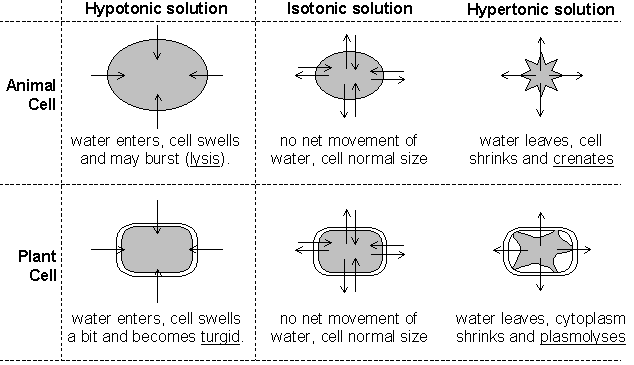
Plant cells placed in a hypertonic solution will undergo plasmolysis, a condition where the plasma membrane pulls away from the cell wall as the cell shrinks. The cell wall is rigid and does not shrink. 

   The Elodea cells  have been placed in a 10% NaCl solution. The contents of the cells have been reduced to the spherical structures shown.  


   Normal Elodea cells


Animal cells placed in a hypertonic solution will undergo crenation, a condition where the cell shrivels up as it loses water. Red blood cells in a hypotonic solution will swell and burst or lyse.


BACK

Egg Osmosis Sample 1 Lab

Osmosis through the Cell Membrane of an Egg

Introduction:
The cell or plasma membrane is made up of phospholipids and different types of proteins that move laterally. These include peripheral proteins, which are attached to the interior and exterior surface of the cell membrane. Integral proteins are embedded in the lipid bilayer. Attached to these integral proteins are carbohydrate chains. These carbohydrates may hold adjoining cells together, or act as sites where viruses or chemical messengers such as hormones can attach. Cell membranes are selectively permeable. They allow some substances to pass through, but not others. Small molecules that are usually nonpolar, such as oxygen, water, and carbon dioxide, easily move through the lipid bilayer. Larger molecules, such as glucose, the food for all living things, must seek aid from the carrier proteins in a process called facilitated diffusion. Facilitated diffusion is a process used for molecules that cannot diffuse rapidly through cell membranes. Integral proteins are used by calcium, potassium, and sodium ions to move through the cell membrane. The muscles and nerves use these ions.
Diffusion is the movement of molecules from an area of higher concentration to an area of lower concentration. This difference in the concentration of molecules across a space is called a concentration gradient. Diffusion is a type of passive transport, meaning it does not require energy input by the cell. This type of transport and osmosis are the two processes used in this lab. Osmosis is the process by which water molecules diffuse across a cell membrane from an area of higher concentration to an area of lower concentration. When the concentration of the solute is higher outside of the cell, it is known as a hypertonic solution. When the concentration of the solute is lower outside of the cell, it is known as a hypotonic solution.

Hypothesis:
The substance, syrup, which has a higher solute concentration than the interior of the eggs, will cause water to leave the eggs’ membrane; the other substance, distilled water, which has a lower solute concentration than the eggs’ interior, will cause liquid to enter the eggs’ membrane.

Materials:
The materials necessary for this lab are: two fresh eggs in their shells, a felt tip marker, 200mL graduated cylinder, five jars, clear Saran wrap, white vinegar, clear sugar syrup (Karo), distilled water, tap water, pencil, paper, eraser, computer, electronic scale, and a plastic tray.

Methods:
Day One: On day one, label the five jars, with the felt tip marker: one labeled vinegar, two labeled syrup, and two labeled distilled water. Also put the group number on each jar. Find the mass of each egg and record this information in the data table. Place the two eggs in the jar labeled vinegar. Add vinegar until both eggs are submerged by it. Cover the jar with the clear Saran wrap. Place the jar on the plastic tray and allow to set for 24 hours.

Day Two: On day two, observe what has happened to your eggs. Record this in a data table. Now that the eggs’ shells are dissolved, gently remove the eggs from the vinegar. Rinse each egg with tap water. Pat the eggs dry with paper towels and mass them separately on the electronic balance. Record this in the data table. Place the eggs in the jars labeled syrup. Add syrup to each jar (labeled egg 1 or egg 2) until the eggs are submerged in syrup. Loosely cover each jar with Saran wrap. Place the jars on the tray and allow them to soak for 24 hours.

Day Three: On day three, observe what has happened to the eggs and record this information in the data table. Carefully remove the eggs from the syrup and rinse them with tap water. Pat dry with paper towels. Using the electronic balance, find the mass of each egg separately and record these masses in the data table. Place the eggs in the jars labeled distilled water (labeled egg 1 and egg 2). Add distilled water to each jar until the eggs are covered. Cover the jars with the Saran wrap and allow them to sit on the tray for 24 hours.

Day Four: On day four, remove the eggs from the jars and record the eggs’ appearance. Mass each egg on the electronic balance. Record this in the data table. Dispose of the eggs in the container provided by the teacher.

Results:

Egg 1 Data Table


Substance egg submerged in Egg’s mass before placed in substance Egg’s mass after removed from substance Observations of egg before placed in solution Observations of egg after removed from substance
Vinegar 59.2 g 86.0 g The egg’s shell is intact and is included in the first mass. The egg’s shell dissolved and wasn’t included in the 2nd mass.
Syrup 86.0 g 53.2 g The egg is swollen and soft, yet firm to touch. The liquid inside the egg diffused into the syrup.
Distilled Water 53.2 g 86.5 g The egg has lost some of its firmness. The water diffused into the egg, increasing the egg’s mass.


Egg 2 Data Table


Substance egg submerged in Egg’s mass before place in substance Egg’s mass after removed from substance Observations of egg before placed in solution Observations of egg after removed from substance
Vinegar 58.8 g 85.6 g The egg’s shell is intact and is included in the first mass. The egg’s shell is mostly dissolved and so wasn’t included in 2nd mass.
Syrup 85.6 g 52.2 g The egg is rough to touch and feels rather sturdy. The liquid inside the egg diffused into the syrup.
Distilled Water 52.2 g 88.9 g The egg feels more fragile and lighter in weight. The water diffused into the egg increasing the egg’s mass.


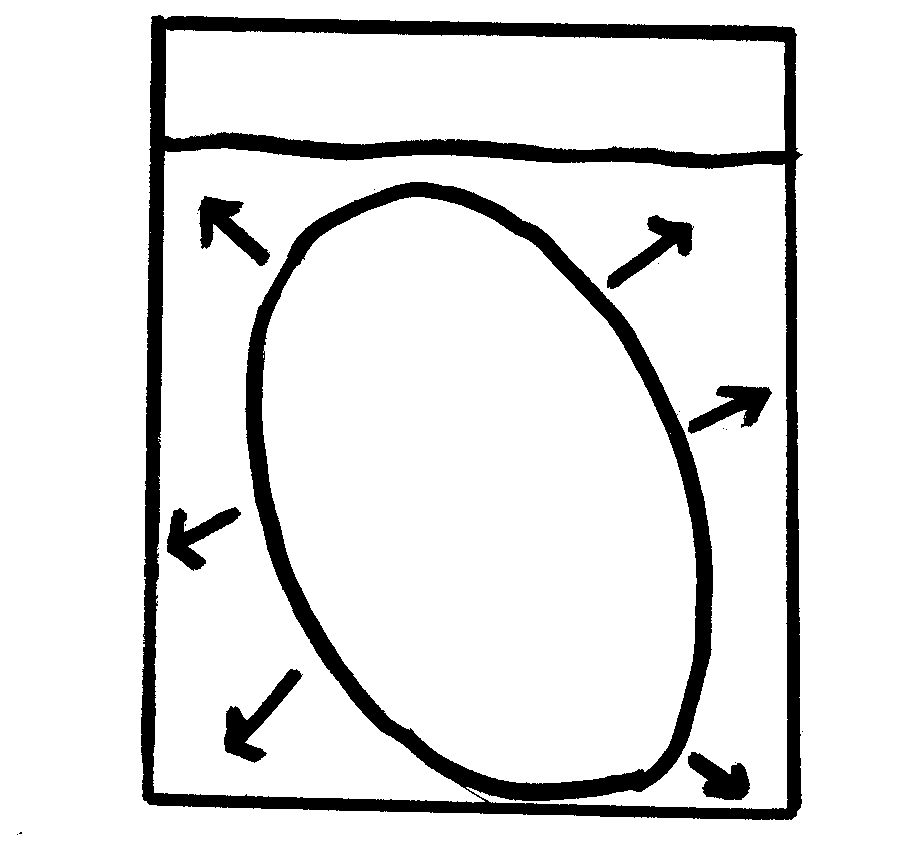
Egg in Hypotonic Solution of Vinegar & Plasmolyzed Egg in Distilled Water Egg in Hypertonic Solution of Syrup


1. When the egg was place in the water, in which direction did the water molecules move? The water moved into the eggs from the surrounding environment.

2. On what evidence do you base this? The eggs’ masses had increased from the time they were placed in the water to when the eggs were removed.

3. How do you explain the volume of liquid remaining when the egg was removed from the syrup? The volume of the liquid remaining when the egg was removed from the syrup must have increased because the eggs’ masses had decreased. The liquid within the eggs left the eggs and diffused into the surrounding syrup.

4. When the egg was place in the water after being removed from the syrup, in which direction did the water move? The water moved into the eggs.

Error Analysis:
Several errors may have occurred during this lab. When finding the eggs’ masses, on each occasion, an error may have occurred. Mistakes may have been made when recording these masses on the data table. Some of the eggs’ shell may have been left on the eggs’ membranes and changed the outcome of this lab. When the eggs were rinsed, after being placed in the vinegar and syrup, a small amount of water could have entered through the membranes of the eggs, effecting their masses. These are just a few of the errors that may have taken place throughout the lab.

Discussion and Conclusion:
The hypothesis was correct. When the eggs were placed in the syrup, their masses decreased greatly. This shows that the interior of the eggs must have had a lower solute concentration than their surrounding environment of syrup. The water within the eggs left through the membrane and diffused into the syrup, decreasing its solute concentration. When the eggs were placed in the distilled water, their masses greatly increased. This shows that the interior of the eggs must have had a higher solute concentration than their surrounding environment of distilled water. The distilled water diffused into the eggs’ membrane, decreasing the interior of the eggs’ solute concentration.

Back

Egg Osmosis Sample 2 lab


Osmosis through the Cell Membrane of an Egg


Introduction:
Transport can be either passive or active. Passive transport is the movement of substances across the membrane without any input of energy by the cell. Active transport is the movement of materials where a cell is required to expend energy. In the case of this lab the discussion will be centered on passive transport.
The simplest type of passive transport is diffusion. Diffusion is the movement of molecules from an area of higher to an area of lower concentration without any energy input. Diffusion is driven by the kinetic energy found in the molecules. Diffusion will eventually cause the concentration of molecules to be the same throughout the space the molecules occupy, causing a state of equilibrium to exist.
Another type of passive transport is that of osmosis. Osmosis is the movement of water across a semi-permeable membrane. The process by which osmosis occurs is when water molecules diffuse across a cell membrane from an area of higher concentration to an area of lower concentration. The direction of osmosis depends on the relative concentration of the solutes on the two sides. In osmosis, water can travel in three different ways.
If the molecules outside the cell are lower than the concentration in the cytosol, the solution is said to be hypotonic to the cytosol, in this process, water diffuses into the cell until equilibrium is established. If the molecules outside the cell are higher than the concentration in the cytosol, the solution is said to be hypertonic to the cytosol, in this process, water diffuses out of the cell until equilibrium exists. If the molecules outside and inside the cell are equal, the solution is said to be isotonic to the cytosol, in this process, water diffuses into and out of the cell at equal rates, causing no net movement of water.
In osmosis the cell is selectively permeable, meaning that it only allows certain substances to be transferred into and out of the cell. In osmosis, the proteins only on the surface are called peripheral proteins, which form carbohydrate chains whose purpose is used like antennae for communication. Embedded in the peripheral proteins are integral proteins that can either be solid or have a pore called channel proteins. Channel proteins allow glucose, or food that all living things need to live, pass through.


Hypothesis:
In the syrup solution, there will be a net movement of molecules out of the egg, and in the water solution, the molecules will diffuse in and out of the cell at equal rates.


Materials:
The materials used in this lab were 2 fresh eggs in the shell, an overhead marker, 400 ml of water, graduated cylinder, 1 large beaker, 2 medium beakers, 1 small beaker, white vinegar, Karo syrup, distilled water, pencil, paper, lab apron, lab goggles, saran wrap, masking tape, plastic tray, tongs, electronic balance, osmosis lab sheet, and computer.


Methods:
On day 1, measure the masses of both the eggs with the shell. Label 1 beaker vinegar, and then use the graduated cylinder to measure 400 mL of vinegar to put in the labeled beaker. Place both eggs in the solution (place a small beaker on top of the eggs, if necessary) then cover. Let the eggs stand for 24 hours or more to remove the shell.


On day 2, record the observations of what happened to the eggs in the vinegar solution. Carefully, remove the eggs from the vinegar, gently rinsing the eggs off in water. Clean the beakers used for the vinegar solution preparing them for the syrup solution, and then label the 2 medium beakers syrup. Before the eggs are placed in the syrup solution record the mass of both eggs then put it on the datasheet. After that has been done, place the eggs in the beaker, pouring enough syrup to cover the eggs, cover them loosely and let them stand for 24 hours.

On day 3, record the observations of the egg from the syrup solution. Carefully, remove the eggs from the beakers, gently rinsing the syrup off of the eggs. Pour the remaining syrup in the container provided by the teacher. Clean the two beakers used in the syrup solution, preparing them for the water solution. Before the eggs are placed in the water solution record the mass of both eggs then put it on the datasheet. After that has been done, using a graduated cylinder, measure out 200 mL of water for each beaker. Place the eggs in the water solution, cover and let stand 24 hours.

On day 4, record the observations of the egg from the water solution. Carefully remove the eggs from the beakers, gently rinsing them off. Mass both of the eggs. After the teacher has came and looked at the eggs, discard in the proper place.


Results:


Isotonic Solution Hypotonic (Vinegar is acid in Water)
Hypertonic


Table 1- Egg 1 Data


Egg mass before added into the solution (g)


Egg mass after added into the solution (g)


Observations


Vinegar

70.8 g (with shell) 98.0 g (without shell) Before the egg was added into the vinegar, it was large, but the after effect was that the egg increased in size and had become hard. After two days, the shell was completely removed.
 

Syrup

98.0 g 65.0 g When the egg was removed from the syrup, it had shrunk and it was softer than before it was added into the solution
 

Water

65.0 g 105.3 g When the egg was removed out of the water, the color looked of a pale yellow. The water had diffused into the egg, because the egg was larger in size before it was added into the water.


Table 2- Egg 2 Data


Egg mass before added into the solution (g)


Egg mass after added into the solution (g)


Observations


Vinegar

71.6 g (with shell) 99.1 g (without shell) Egg 2s’ mass was greater than egg 1s’ mass before and after it was added into the vinegar solution. The mass had increased some 20 grams with the shell off.
 

Syrup

99.1 g 64.0 g The mass of the egg had decreased some 30 grams after it the egg was removed from the syrup solution. The mass of the egg 2 was smaller than the mass of egg1.
 

Water

64.0 g 105.2 g The mass of egg 2 had increased some 50 grams after being added into the water solution. The mass of egg 1, though, was larger than the mass of 2 by 1 gram. If the egg would have remained in the water a little while longer, the egg would have probably went through cytolysis.


1. When the egg was placed in the water in which direction did the water molecules move?     The water molecules moved in the egg.

2. On what evidence do you base this? The molecules moved in, because the size of the egg increased

3. How do you explain the volume of liquid remaining when the egg was removed from the syrup? Since, the cell is selectively permeable, it only allowed a certain amount of the syrup to be present in the cell, just enough to shrink it and also equilibrium was reached..

4. When the egg was placed in the water after being removed from the syrup in which direction did the water move? The water moved in.

5. Why did the water molecules travel better inside the cell than the syrup molecules? The water molecules traveled better into the cell because smaller molecules travel better than other larger molecules.

6. What was the purpose of placing the egg in vinegar? The  vinegar solution was only used to remove the shell off the egg.

Error Analysis:
A possible error in this lab occurred by having to leave the egg in vinegar for two days instead of one to remove the shell. This caused the egg to initially take in more water.


Discussion and Conclusion:
Based on the data collected and the results of the experiment, the hypothesis was  correct. The egg appeared shriveled after removing it from the syrup because of the movement of water out of the egg. The syrup solution was hypertonic so water moved out of the egg from an area where water was more concentrated to the outside of the egg where water was less concentrated due to the high amount of sugar or solute. The acetic acid in vinegar did remove the shell from the egg, because the egg required two days to completely remove the shell, some water did move into the egg causing its initial mass without the shell to be higher than the egg’s mass with its shell. Whenever the egg was transferred from the syrup to the distilled water, the concentration of water outside the shriveled egg was greater than the water concentration inside the egg; therefore, water moved into the egg until equilibrium was reached. At that point, movement into and out of the egg continued with no net movement of water molecules.
Additional research  to see if the egg would have went through cytolysis in another 24 or more hours in the water solution would have been interesting.

BACK

DNA Model


Structure of DNA Lab


Introduction:

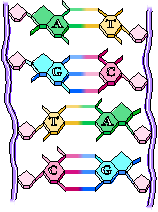
Deoxyribonucleic acid (DNA) is one of the two types of nucleic acids found in organisms and viruses. The structure of DNA determines which proteins particular cells will make. The general structure of DNA was determined in 1953 by James Watson and Francis Crick. The model of DNA that they constructed was made of two chains now referred to as the double helix. Each chain consists of linked deoxyribose sugars and phosphates units. The chains are complementary to each other. One of four nitrogen-containing bases connects the chains together like the rungs of a ladder. The bases are cytosine, guanine, thymine, and adenine. The DNA molecule looks like a spiral staircase. The structure of DNA is illustrated by a right handed double helix, with about 10 nucleotide pairs per helical turn.

DNA is a polymer. The monomer units of DNA are nucleotides. Each nucleotide consists of a 5-carbon sugar (deoxyribose), a nitrogen containing base attached to the sugar, and a phosphate group. (See Table 1.) There are four different types of nucleotides found in DNA, differing only in the nitrogenous base. Adenine and guanine are purines. Purines are the larger of the two types of bases found in DNA. They have two rings of carbons & nitrogens. Cytosine and thymine are pyrimidines and have a single carbon-nitrogen ring. (See Table 2.) The sequence of these bases encodes hereditary instructions for making proteins—which are long chains of amino acids. These proteins help build an organism, act as enzymes, and do much of the work inside cells.

Table 1


DNA Nucleotide
(Sugar + Phosphate + Base)


 Table 2


Pyrimidine
(single ring of C & N)
Purine
(double ring of C & N)


Materials:

Colored paper (any 5 different colors to run templates), scissors, transparent tape, coat hanger, hole punch, string or fishing line

Procedure:

  1. Use the section of DNA you have been assigned (Human hemoglobin or Chicken Hemoglobin), and figure out the sequence of bases present on the complementary strand of this molecule Table 1.


Human Hemoglobin Chicken Hemoglobin
Left Strand Complementary Strand Left Strand Complementary Strand
TAA GTT
TGT TGT
CGA CCG
CCG CCG
CTG CGA
GTC GTC
CAA TAT
GTC CGA
CTT TTG
TGA AGG


  1. Count the number of bases (A, T, C, and G) you will need for both strands of the DNA model your group has been assigned, and cut out these bases. (60 total)
  2. Cut out a sugar and a phosphate for each of your DNA bases. (120 of each)
  3. Construct a nucleotide for each base that you have cut (sugar + phosphate + base) by taping these together. (20 total nucleotides)
  4. Using your assigned DNA sequence from Table 1, line up the nucleotides in the right order forming he left strand of your DNA molecule. (30 nucleotides)
  5. Add the other complementary nucleotides to form the right strand by taping the bases together (A bonds with T; C bonds with G).
  6. Once the strand is complete, secure it by adding more transparent tape or ask your teacher to laminate your model.
  7. Punch two holes at the top of your model, and attach the DNA model to a coat hanger with string.
  8. Carefully twist your model into a double helix (5 base pairs in a 1/2 turn and 10 in a complete turn).
  9. Attach thin fishing line to the sides of the nucleotides to hold the turns in place.
  10. Hang your model from the ceiling using the top of your coat hanger.

TEMPLATES:

Questions & Observations:

1. What 2 molecules make up the sides of the DNA molecule?

2. What nitrogen bases form the rungs of the DNA double helix?

3. What is meant by the complementary strand of DNA?


4. What sugar makes up DNA nucleotides?

5. How are nucleotides named?


6. DNA is the instructions for building what molecule in our cells?

7. What would happen if one or more bases on the DNA strand were changed?


Ecology

Ecology

All Materials © Cmassengale 

Ecology is the study of interactions between organisms (biotic part) and their nonliving environment (abiotic factors)

Biotic factors includes plants, animals, fungi, & microorganisms. They may be producers, consumers, or decomposers.

Abiotic factors include climate, soil, temperature, water, air, sunlight, humidity, pH, and atmospheric gases.

Habitat is the place a plant or animal lives, while its niche is its total way of life.

Life is organized into levels:

Organism (any single living thing)

¯

            Population (members of the same species living in one place)

 ¯

                    Community (all the populations living in an area)

 ¯

        Ecosystem (community living in a similar habitat such as a forest)

 ¯

Biomes (ecosystems covering wide areas & with similar climates & organisms)

¯

Biosphere ( all the living & nonliving things on earth)

Producers:

Make their own food through photosynthesis or chemosynthesis
Includes plants, algal protists, & some bacteria

Consumers:

Can’t make their own food
May be herbivores (feed only on plants), carnivores (feed only on animals), or omnivores (feed on plants & animals)

Decomposers:

Break down dead plants & animals (detritus)
Recycle nutrients
Called detritivores
Include fungi & bacteria

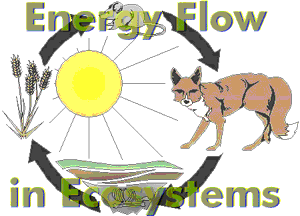
Sunlight is the ultimate energy for all life on earth, but only producers can get their energy directly from the sun.

Energyflowinecosystemimage

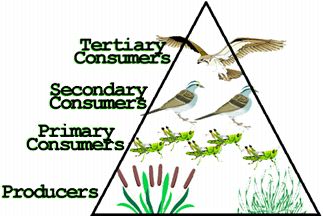
Trophic levels are feeding levels of producers & consumers in an ecosystem:

1st Trophic Level is producers that use sunlight directly
2nd Trophic Level includes herbivores that feed directly on plants
Higher Trophic Levels are carnivores feeding on each other

energypyramid

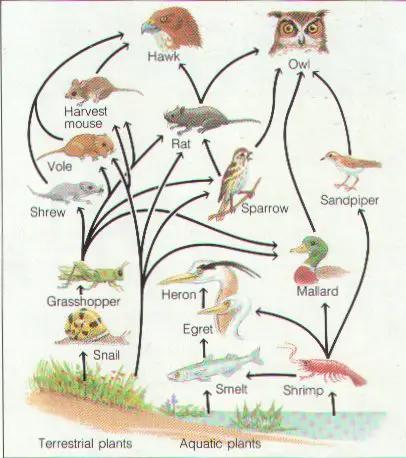
Food chains & food webs:

Chains show who eats whom in an ecosystem.
Webs are made up of several food chains.
Always begin with producers absorbing sunlight.
Producers store energy in the chemical bonds of the food they make.
Stored energy is passed to consumers when they eat producers or other consumers.
Some energy is lost at each trophic level as heat when consumers “burn” food during cellular respiration.
Both energy & nutrients must move through an ecosystem.

Three main elements that must move through an ecosystem:

Water
Carbon
Nitrogen

Water or Hydrologic Cycle:

Cells are 70 – 90% water
Water is needed for metabolic processes
Water is most important for terrestrial organisms because of desiccation (drying out)

Steps in the water Cycle:

Evaporation                                         Transpiration
(water loss from lakes, rivers, oceans…)          (water loss from plant leaves)

     ¯                                ¯

Condensation
(water vapor forms clouds)

¯

Precipitation
(water returns to earth as sleet, rain, snow…)

¯

Surface Runoff
(returns water to bodies of water or to groundwater)

Carbon Cycle:

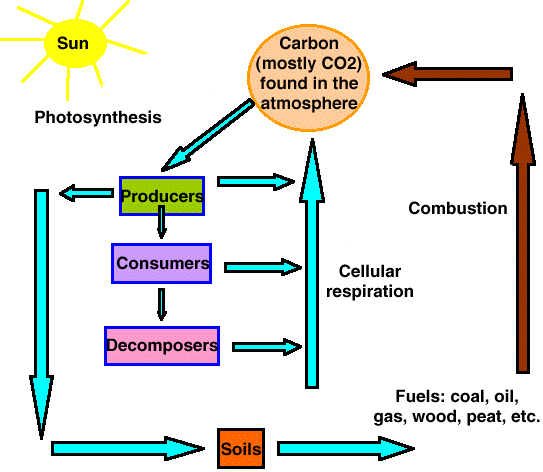
Consists of photosynthesis, cellular respiration, & decomposition
Begins with producers taking carbon dioxide from the air during photosynthesis
Carbon dioxide used in cellular respiration
Decomposing plants and animals return Carbon to the soil

Carbon Cycle Steps:

Plant leaves take carbon dioxide from air

¯

Plants store carbon in carbohydrates or starches
(photosynthesis)

¯

Plants & animals release carbon dioxide back into the air
(cellular respiration)

¯

Decomposers return carbon to environment
(decomposition)

Nitrogen:

Needed by all organisms
Used to make proteins & nucleic acids (DNA & RNA)
Air made up of 80% nitrogen
Only Cyanobacteria & Rhizobium bacteria can use nitrogen directly from the air (nitrogen fixation)
Bacteria found in the soil & on the roots of legumes (beans, peas …)

Steps in the Nitrogen Cycle:

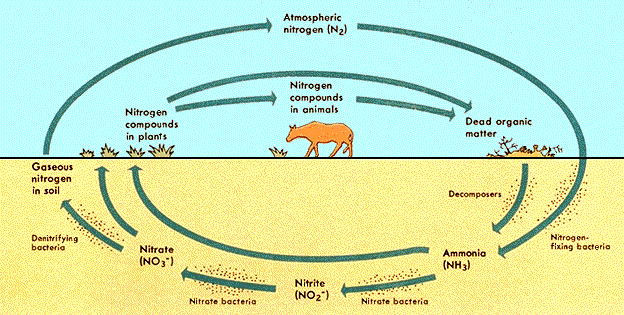
Cyanobacteria & Rhizobium take nitrogen from air
(nitrogen fixation)

¯

Convert nitrogen gas into ammonia

¯

Nitrifying bacteria in soil change ammonia into nitrates

¯

Plants can absorb & use nitrates to make proteins

¯

Consumers eat plants & get proteins containing nitrogen

¯

Decomposers break down dead organisms & return nitrogen to air
(called ammonification)

¯

Anaerobic bacteria in soil release nitrogen from nitrates into air
(called denitrification)

Three main types of ecosystems:

Terrestrial (land)
Freshwater (rivers, ponds, lakes …)
Marine (oceans & seas)

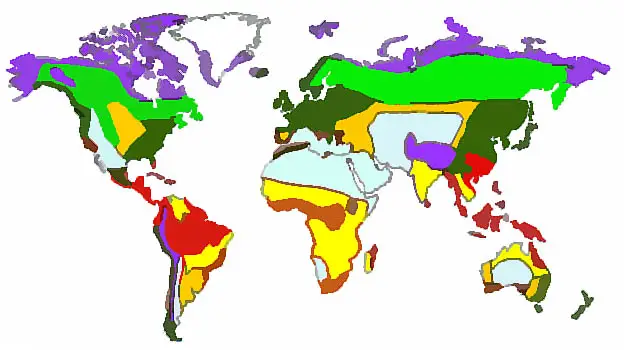
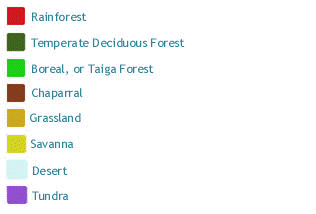
Terrestrial ecosystems are divided into 7 biomes with similar climates & organisms

Seven Terrestrial Biomes:

Tropical Rain Forest (jungle)
Savanna (tropical grasslands)
Deserts
Grasslands
Deciduous Forest
Taiga (coniferous forest)
Tundra

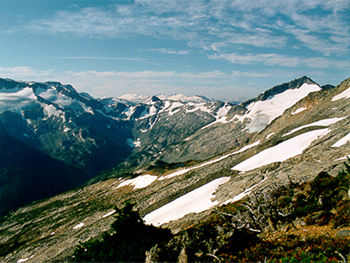
Tundra:

Cold & dark most of the year
Includes the arctic
Permafrost is the top layer of soil that thaws & in which plants grow
No trees, but sedges & grass, mosses, & lichens
Many migratory animals
Lemmings & ptarmigans are year round residents
Approximately 20 cm annual rainfall

Tundra

Taiga:

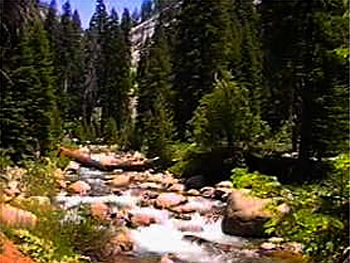
  • Coniferous forest
  • Extends across northern Eurasia & North America
  • Contains conifers or evergreens (spruce, cedar, fir, pine …)
  • Needle like leaves withstand weight of snow
  • Bear, deer, moose, wolves, mountain lions …
  • Sequoia or redwood (largest conifer) grows here
  • Bristle cone pine oldest living conifer found here

Coniferous Forest

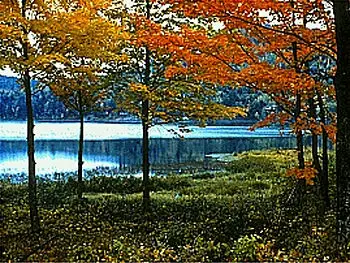
Temperate Deciduous Forest:

  • South of taiga in North America, eastern Asia, & Europe
  • High annual rainfall (75-150 cm)
  • Moderate temperatures
  • Well-defined seasons of about equal length
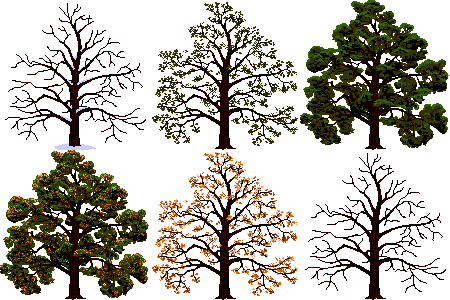
  • Trees loose leaves in winter (deciduous)
  • Show stratification (plant layers):
    1. Canopy – broad leaf deciduous trees forming uppermost layer
    2. Under story – shrubs
    3. Forest Floor – herbaceous plants
  • Songbirds, deer, rabbits, foxes, squirrels, frogs 7 toads, lizards …

Temperate Deciduous Forest

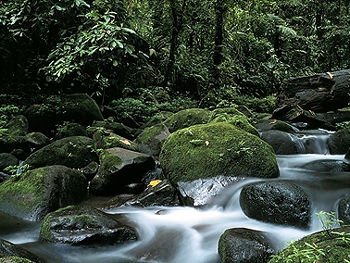
Tropical Rain forest:

  • Near equator
  • Warm climate (20 -25 degrees C)
  • Plentiful rainfall (190 cm/year)
  • Contains the greatest diversity of plants & animals
  • Insects, monkeys & apes, snakes, tropical birds, leopards…
  • Animals & plants brightly colored
  • Poor soil for agriculture

Rainforest

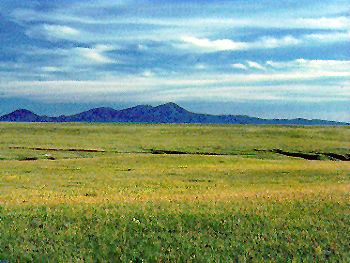
Grasslands:

  • Mostly grasses with a few trees due to less rainfall
  • Moderate climates
  • Good for agricultural crops
  • Grazing & burrowing animals dominate
  • Also called prairies

Grassland

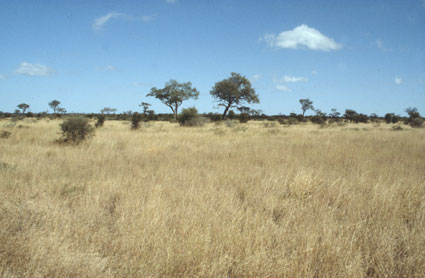
Savanna:

  • Tropical grasslands
  • Warm climate & rainy season
  • Antelope, zebra, lions, wildebeests, hyenas, elephants…
  • Suffer from floods & drought

(26KB)

Deserts:

  • Low annual rainfall
  • Subject to strong winds
  • Days usually hot & nights cold
  • Sahara desert is without vegetation
  • Succulents such as cacti & other water storing plants
  • Most animals nocturnal
  • Lizards, snakes, roadrunners, insects, tarantula, hawks, rodents, coyotes…

Desert

Aquatic Biomes:

  • May be freshwater or saltwater
  • Wetlands near oceans have brackish water (mixture of fresh & salt waters)
  • Part of the part water or hydrologic cycle
  • Often polluted by man’s activities

Lakes & Rivers:

  • Freshwater
  • Oligotrophic lakes are nutrient poor (catfish, carp…)
  • Eutrophic lake are nutrient rich (trout, bass…)
  • Deep lakes have layers or strata where different plants & animals live
  • Phototropic organisms in upper layers for light
  • Estuary at mouth of river contains brackish water

Ocean Zones:

  • Intertidal zone
    1. Along shoreline
    2. Wave action
    3. Lots of light so many producers
    4. Starfish, sand dollars…
  • Neritic Zone
    1. Ocean water above continental shelf
    2. Coral reef found here
    3. Surrounds continents & receives light in upper layers
  • Oceanic Zone
    1. Beyond continental shelf
    2. Deepest area (up to 7 miles)
    3. Bottom doesn’t receive light so animals adapted to darkness (many produce their own light, feed on other animals…)
    4. Deepest area called abyss
    5. Upper area gets light & called the photic zone (lots of seaweed here)
    6. Floaters called plankton (microscopic organisms)
    7. Swimmers such as fish called nekton
    8. Bottom dwellers called benthos
BACK